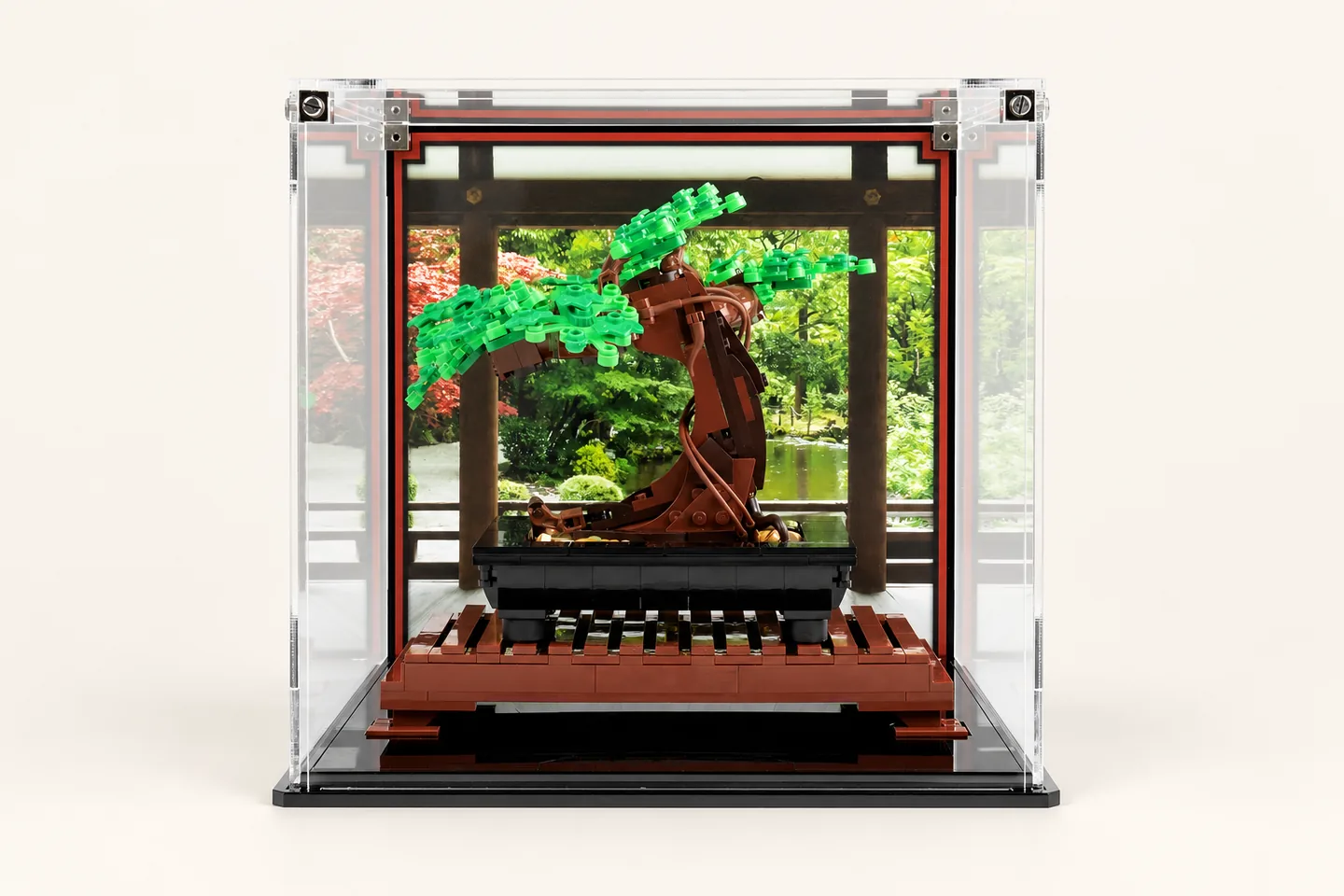
Cover image: CubeBuff · used with permission · AI-assisted composition and tonal edits; reference illustration, not a product test.
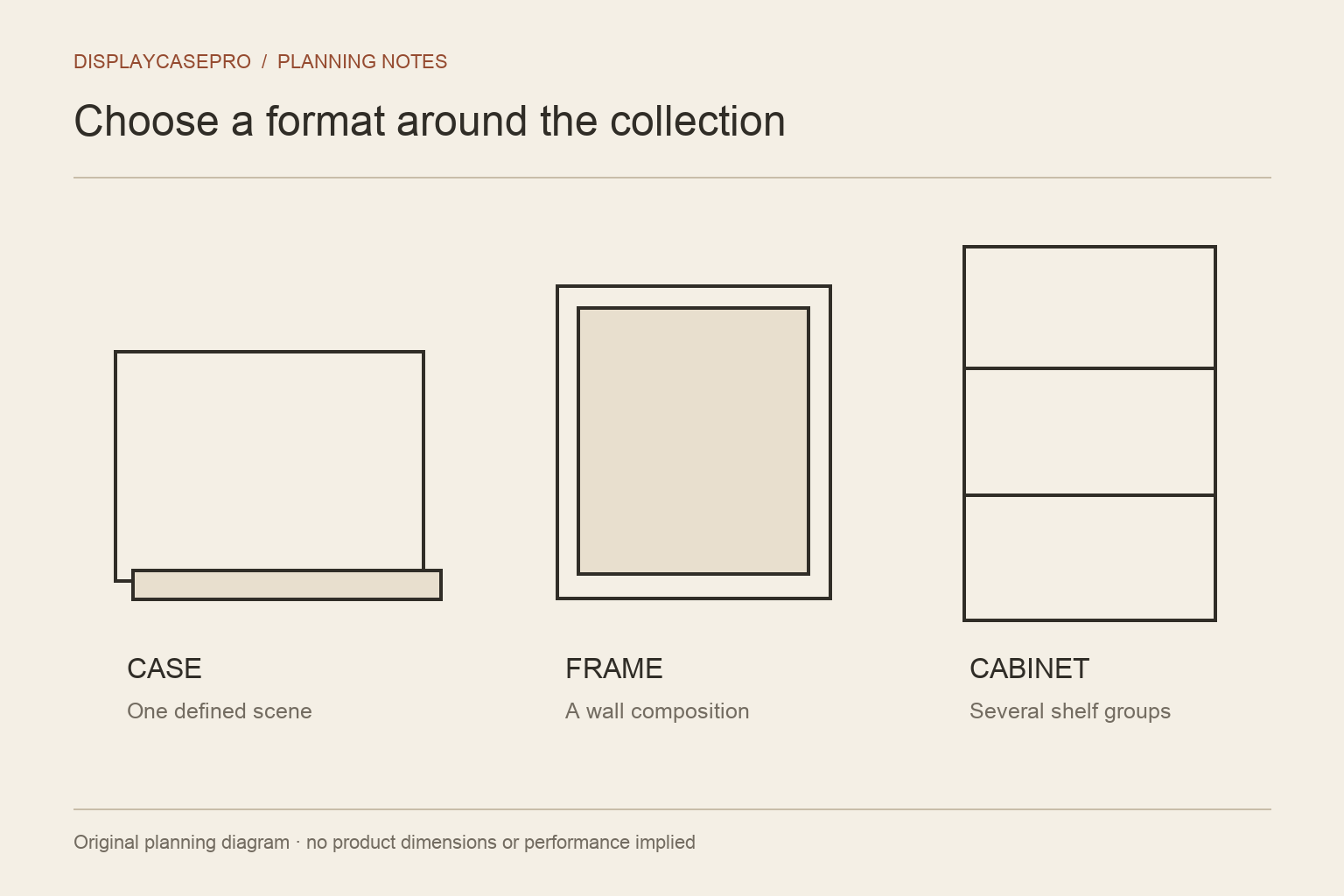
Choose a display case when one model or a small group needs its own enclosure. Choose a frame when the collection works as a wall arrangement and the objects can be supported at the required depth. Choose a cabinet when you need several shelves, room for different sizes and access to a growing collection. The right choice starts with what you own, how you handle it and the space you can actually use.
There is no universal winner. A large cabinet can be inconvenient for a single model, while a beautiful frame can fail the practical test if an accessory touches its front. Work through the following decisions before comparing individual products.
Start with the complete arrangement
Put the objects in the orientation you want to see. Include stands, bases, labels and anything you intend to display beside them. A model car with an open door occupies a different envelope from the same car with its doors closed. A figure with a raised accessory may need more depth as well as more height.
Then record three separate things: the space occupied by the arrangement, the usable space inside the display, and the room around it. These are different measurements. Our display measurement guide explains how to keep them separate and check the opening as well as the final fit.
Compare the three formats
| Your main need | Format to investigate | Detail that can change the decision |
|---|---|---|
| A defined place for one model or a small scene | Individual display case | Whether the cover can be removed where the case will sit |
| A wall composition of smaller objects | Display frame or shadow box | Usable depth, object support and mounting requirements |
| Several shelves for a mixed or growing collection | Display cabinet | Shelf clearance, access, load limits and installation requirements |
| Frequent rearranging or handling | Any format with convenient access | How many other objects must move before you can reach one piece |
Use the table to choose a format to investigate, rather than treating the name as proof that a particular product will work.
When an individual display case makes sense
A case can give a finished model a clear boundary on a desk, shelf or sideboard. It also lets you treat a small scene as one arrangement instead of reorganizing an entire cabinet. If you use several cases, compare their external footprints before assuming they will form a neat row.
Check whether the quoted dimensions describe the clear interior, the base or the outside of the cover. Find out how the case opens. A lift-off cover needs somewhere to move; a front opening needs a clear route for your hands and the model. For a LEGO build, follow the shelf and case planning guide and identify the exact set before relying on a compatibility claim.
When a frame makes sense
A frame puts a collection into a wall composition. That can be useful for small models, figures, pins or other objects whose arrangement matters as much as the individual pieces. Before ordering, lay out the real objects and their supports at full size.
The main question is not simply how many items a frame advertises. Ask what each support holds, how it contacts the object, and how far the assembled object projects. Our model-car frame guide focuses on these fit and support questions. Use the collection wall planner when the challenge is arranging several frames around furniture and future additions.
When a cabinet makes sense
A cabinet gives several groups a shared place in a room. Measure the usable shelf areas and the door opening, not just the overall furniture dimensions. Check how adjustable shelves, hinges, lights and supporting hardware change the space available to each group.
Read the installation instructions for the exact cabinet. The US Consumer Product Safety Commission's Anchor It guidance explains the importance of securing furniture against tip-over. Follow the furniture maker's instructions for the particular unit and wall rather than selecting fixings from a photograph.
Treat protection claims as separate questions
An enclosure is not automatically dust-tight, UV-filtering or suitable for long-term preservation. Ask what a specific product claims and what information supports that claim. The material name alone does not settle the question.
Lighting and location also matter. Canadian Conservation Institute guidance explains that light exposure can damage sensitive collection materials. An attractive clear cover does not make a sunny windowsill an appropriate location for every object. For unusual, fragile or valuable materials, seek advice appropriate to that object.
Make a decision you can check
Write a short purchase brief with the intended objects, their arrangement, the measured envelope, the available room, the access method you need and the specifications still unanswered. Compare shortlisted products against that same brief.
If a product only works after you remove a stand, hide an accessory or block a door, record that compromise before buying. A display that fits your collection and your routine is more useful than a format chosen on appearance alone.
A short brief for comparing actual displays
Choose the format first, then ask each seller the same practical questions. Keep unanswered specifications visible instead of letting an attractive photograph decide the result.
| Format | Bring to the comparison | Request from the maker |
|---|---|---|
| Individual case | The complete object pose and available surface | Usable dimensions and the cover-removal route |
| Frame | The mounted arrangement and its forward projection | Clear depth from the finished backing to the front |
| Cabinet | Collection groups and the items you reach for often | Usable shelf areas, door access and specified installation |
After choosing a format, investigate the specific limitation. Use the shadow-box usable-depth guide for frame depth and the cabinet dust inspection guide for an existing cabinet’s dust-entry questions. These tasks supplement this format comparison rather than replacing it.
Comments
Share a display tip or ask a question.