
Cover image: Gregory.sacre · CC BY 4.0 · AI-assisted composition and tonal edits; reference illustration, not a product test.

Compare the actual acrylic and glass products, not just the material names. Usable space, opening method, cleaning instructions, glazing treatment and the complete assembled weight can matter more to your decision than a generic material comparison.
This is a source-based buying checklist. It does not report impact tests, scratch tests or measured UV performance, and it does not name a universally better material. Use the questions below to turn product descriptions into a shortlist you can verify.
Check what the product is made from
Ask for the material description for each part. A case may combine an acrylic cover, a separate base and different supporting hardware. A cabinet or frame may use a particular glazing product within a larger structure. Record any coating or treatment separately from the base material.
Avoid carrying a claim from one product into another. A specification for a named manufacturer's sheet or glazing does not prove that an unidentified case uses the same material, thickness, coating or construction.
Separate UV protection from appearance
A clear view, reduced reflections and UV filtering describe different things. Ask which property the exact product claims, how the maker describes it and whether the claim applies to the complete item you are buying.
Tru Vue's glazing FAQ discusses different glass and acrylic products and their properties. It is useful for understanding why the product name and specification matter; its claims should not be applied to every acrylic or glass case.
Also assess where the display will sit. The Canadian Conservation Institute identifies light and UV damage as risks for plastic objects. A glazing claim should not become a promise that a collectible will never fade or change.
Read the cleaning instructions before choosing
Check how the exact surface should be cleaned, including any restrictions relating to coatings. A routine that works for another household surface may not be suitable here.
For example, ACRYLITE's cleaning guidance for its own acrylic sheet recommends suitable soft cleaning materials and warns about incompatible cleaners and surface damage. Treat that as guidance for the specified material, then follow the actual case maker's instructions. This guide does not recommend a chemical recipe for an unidentified display product.
Ask whether the base, joints or printed areas need different care. Check whether the surface is coated before attempting to polish or remove a mark. Cleaning instructions are part of the practical cost of ownership, not an afterthought.
Compare complete weight and handling
Use the assembled product weight from the supplier, together with the collection and any supports, when checking shelf or mounting suitability. Do not infer the total from a generic comparison between sheets of material.
Consider how the display will be moved and opened. Can one person handle the cover as instructed? Is there a clear place to put it? If breakage behaviour or impact performance matters in your room, ask for the relevant specification for that product and its construction. Do not turn an unverified adjective into a safety rating.
Inspect the construction questions
The material comparison cannot establish how a cover meets its base, whether a door closes evenly, or how much dust enters through gaps. Request clear photographs or drawings of the opening, joints and supporting parts.
Likewise, a thicker-looking panel in a photograph is not a confirmed thickness measurement. If panel thickness affects your shortlist, obtain the stated value and confirm which component it describes. Record missing information as an unanswered supplier question.
Use the same comparison sheet for both products
| Check | Acrylic candidate | Glass candidate |
|---|---|---|
| Exact product and material description | Record the specification | Record the specification |
| Clear usable interior and opening | Check the complete arrangement | Check the complete arrangement |
| UV or reflection claim | Identify the named treatment | Identify the named treatment |
| Care instructions | Check permitted cleaning methods | Check glazing and coating instructions |
| Assembled weight and support | Confirm for the complete display | Confirm for the complete display |
| Unanswered details | Keep visible on the shortlist | Keep visible on the shortlist |
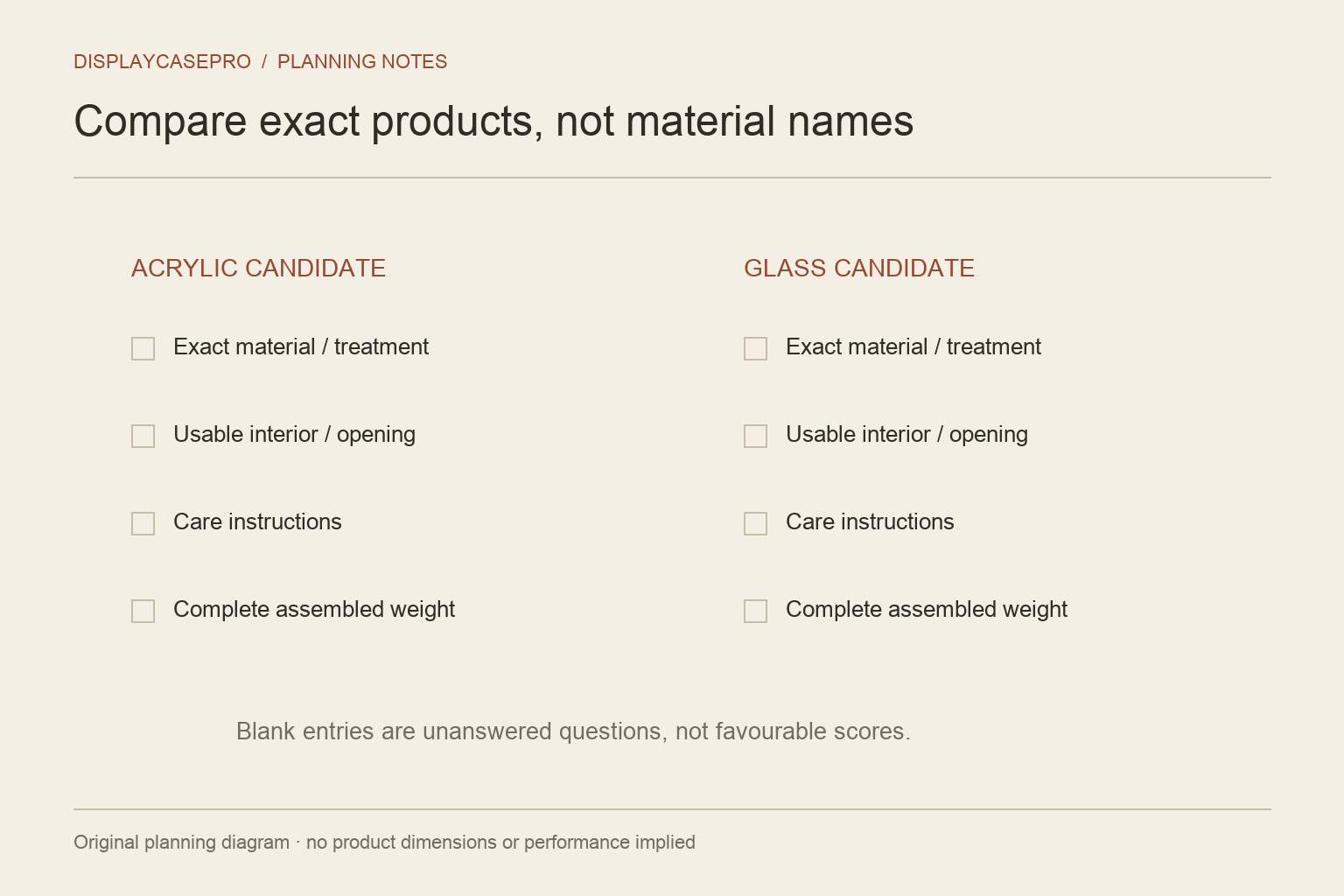
This table is a worksheet, not a test result. A blank entry means the information has not been established; it should not silently become a favourable score.
Decide around your collection
If both products meet the fit, access and support requirements, compare the remaining differences that matter to your room and routine. If one product lacks a key specification, resolve that before choosing a winner.
Use the measurement guide to check fit independently of the material comparison. For a shelf-based LEGO scene, see the case planning checklist. For reflections caused by room or cabinet lighting, work through the lighting plan before assuming a different clear material will solve the whole problem.
Compare the complete enclosure, not only its clear panel
Use the same questions for each shortlisted case. A material label is a starting point; an unanswered product claim should remain an unanswered claim.
| Comparison item | Evidence to request |
|---|---|
| Panel identity | Exact material, relevant grade and any coating |
| Clear space | The definition and endpoints of internal measurements |
| Care | Directions covering the panel and the assembled base, frame and joints |
| Protection statement | The specific claim, configuration and supporting information |
| Replacement and access | How the enclosure opens and how an identified component can be replaced |
The practical consequence is that a preferred material can still be unsuitable in a particular assembly. Use the acrylic case cleaning checklist for the cleaning task after you identify an acrylic case. For cabinet gaps and closure questions, follow the cabinet dust inspection guide. Neither guide establishes a product’s UV or airtightness rating.
Comments
Share a display tip or ask a question.