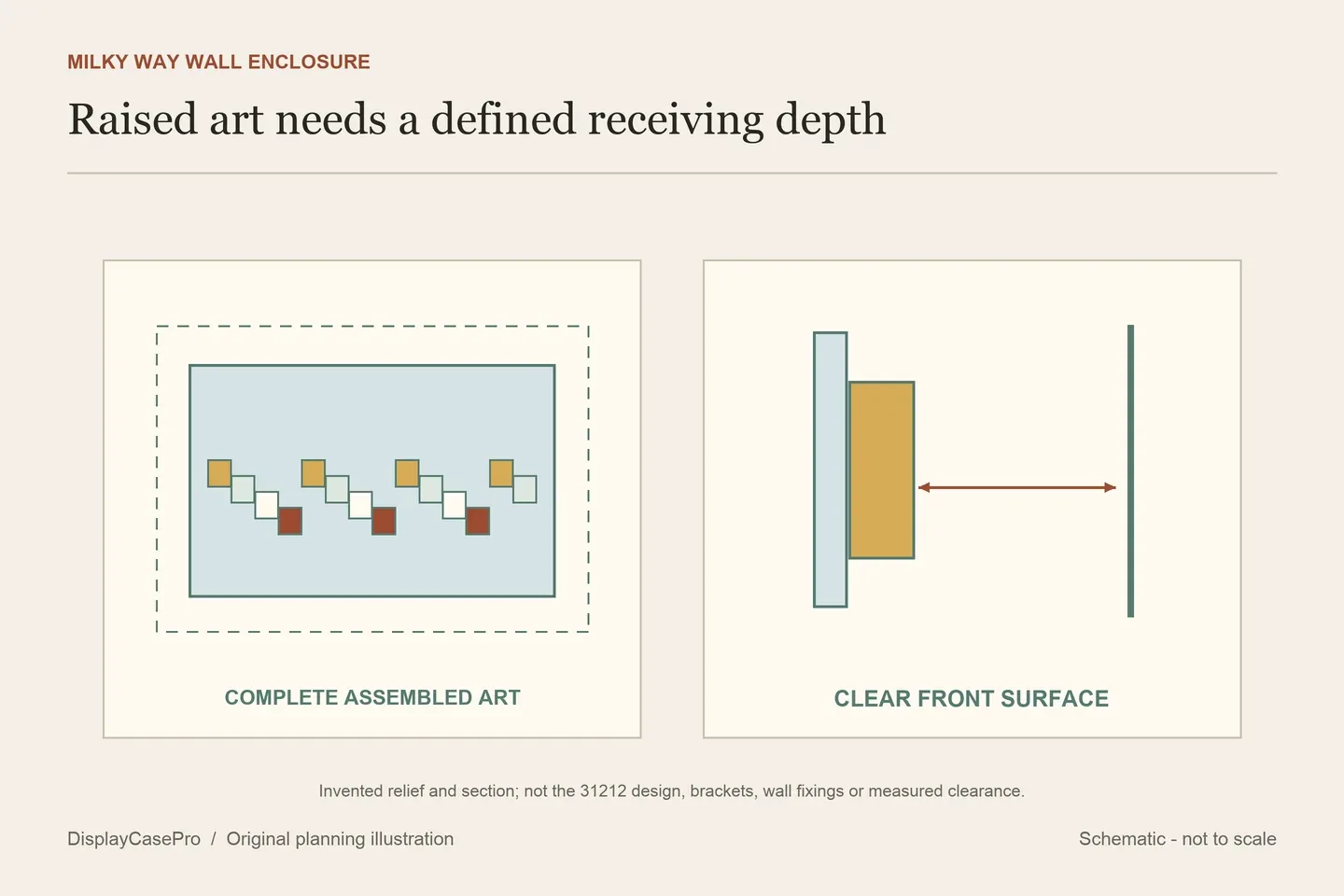
A LEGO Milky Way display case has to receive the layered 31212 artwork and support it in a wall enclosure. Compare usable front-to-back space, model brackets and the removable front before choosing the finished frame. The model’s own hanger and the enclosure’s wall attachment are separate parts of that decision.
Measure the assembled relief, not a flat picture opening
LEGO’s official 31212 specification describes layered bricks creating depth and texture, built on five panels and displayed using a hanger element. Its complete model reference is over H40 × W65 × D5 cm.
Record the five panels as the intended assembled artwork. Their separate instruction booklets do not establish five independently supported wall pictures or interchangeable enclosure positions. Keep the actual completed frame, rear attachment and furthest forward detail in the receiving enquiry.
The quoted depth is a model reference, not a universal five-centimetre frame requirement. The enclosure’s model supports, back panel, front retaining details and measurement endpoints still matter. Ask where its clear depth begins and ends rather than subtracting a guessed backing thickness.
Four case products use different size definitions
The sampled results included four enclosure listings and LEGO’s official model page. The latter supplies the artwork reference; it is not a fifth aftermarket case. The following enclosure descriptions were read on 18 October 2026, without physical fit or installation testing.
| Source | Published figures | Resolve before ordering |
|---|---|---|
| Wicked Brick | W752 × D65 × H492 mm. | Inside/outside boundary and actual model retention. |
| Flying Box | L27.5 × W2.9 × H17.5 in. | Inside/outside boundary and front opening. |
| iDisplayit | Inside L68 × W06 × H43 cm; external numeric fields blank. | Source prints 06 for W; confirm endpoints and whole exterior. |
| shopPOPdisplays 21152-RTA | External H16.5 × W27 × D3.25 in, paired with H42 × W68.5 × D9 cm. | Actual depth unit line and usable cavity. |
iDisplayit’s size block explicitly separates its interior from an exterior row, but leaves the exterior numbers empty. Do not turn the 68 × 6 × 43 cm interior into an assumed outside size by adding acrylic thickness. Fittings, backing and the complete perimeter need their own dimensions.
shopPOPdisplays gives external dimensions in two unit systems. Its 3.25-inch depth converts to 8.255 cm, while the paired metric depth says 9 cm. Preserve both lines and ask which current dimension applies. Neither exterior line establishes the clear space in front of the artwork.
Wicked Brick names width, depth and height but does not label the boundary in the main size line. Flying Box uses L × W × H for a wall product. Map the axes to the intended wall view explicitly instead of treating every supplier’s W as the same direction.
The artwork-to-case and case-to-wall connections differ
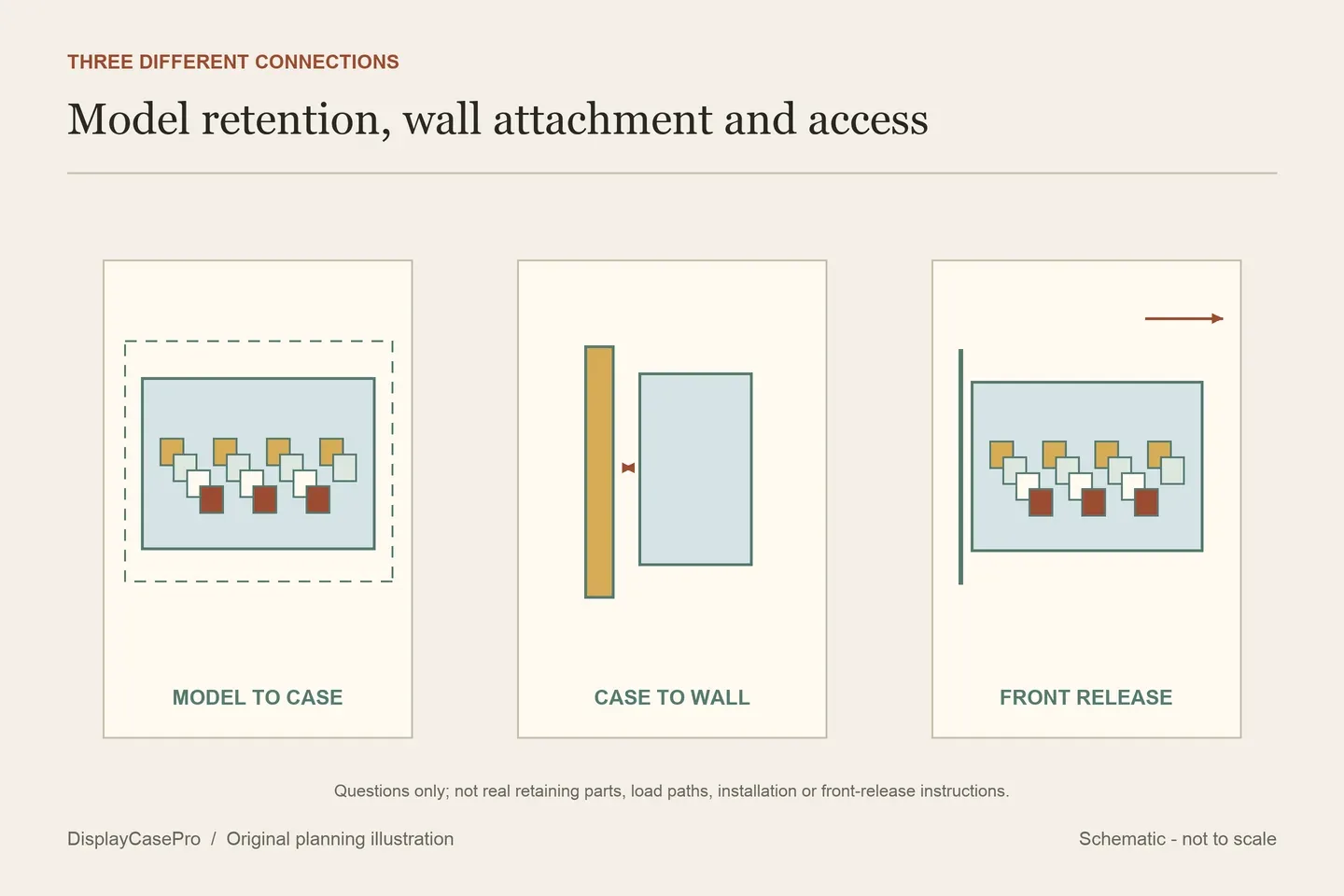
First establish how the enclosure receives the complete LEGO artwork. Then establish how the assembled enclosure attaches to the wall. A model supplied with its own hanger has not thereby supplied every component needed by an aftermarket enclosure.
shopPOPdisplays describes two brackets on its back panel for the model, plus two wall anchors and two wall screws. That identifies separate retention and installation components. Obtain the actual instructions for the selected wall and complete assembly; included anchors are not a suitability statement for every wall construction.
| Record | Ask the maker to identify | Keep distinct |
|---|---|---|
| Artwork retention | Actual brackets or receiving points for the completed 31212 model. | The model’s original hanger and the case’s supports. |
| Enclosure attachment | Wall-facing parts, complete assembly and applicable installation instructions. | The frame footprint and the wall’s actual requirements. |
| Front access | Which front part moves and its intended release route. | Closed fit and the space needed to open it again. |
Keep the full case outline in the wall plan. A shallow-looking front elevation does not show how far it projects into the room, and the artwork width alone does not identify the enclosure’s outside border.
Identify the rear panel before adding lighting
iDisplayit describes a February 2026 rear-panel update adding a discreet central opening for lighting cables or a small battery pack. Confirm that the product being quoted has that version and ask how the selected cable or pack is intended to sit.
The opening does not establish that an LED kit, power supply or a particular battery pack is included. It also does not turn an earlier rear panel into the updated version. Obtain the current package and instructions rather than modifying a panel to match a photograph.
LEGO’s QR-code soundtrack is a different feature from electric display lighting. A soundtrack reference in the model description is not evidence of LEDs in the artwork or case. Keep the lighting kit, cable route and power arrangement as separate selected components.
Reserve the front’s actual release route
iDisplayit says its front panel can be removed using a disguised hook design. Ask which movement releases it, how it is supported during removal and where it rests. A neighbouring frame or shelf can obstruct that route even when the closed case fits on the wall.
For the other products, request their own routine opening method. The presence of assembly screws does not identify the part intended for repeated cleaning or model access. Check the view of raised details from your normal position after the physical arrangement is settled.
Use the Milky Way wall-case worksheet to keep the rear version, retention, dimensions and front route together. The usable depth guide explains measurement endpoints; the collection wall planner helps position complete enclosures, and the display lighting guide covers the view and reflections.
Common questions
Does the official five-centimetre depth specify the case I need?
It describes the model. Confirm the enclosure’s usable depth, supports, opening and actual completed artwork.
Does the cable opening mean lighting is included?
Confirm the exact package. The cited update provides a rear-panel feature, not a complete lighting system.
Comments
Share a display tip or ask a question.