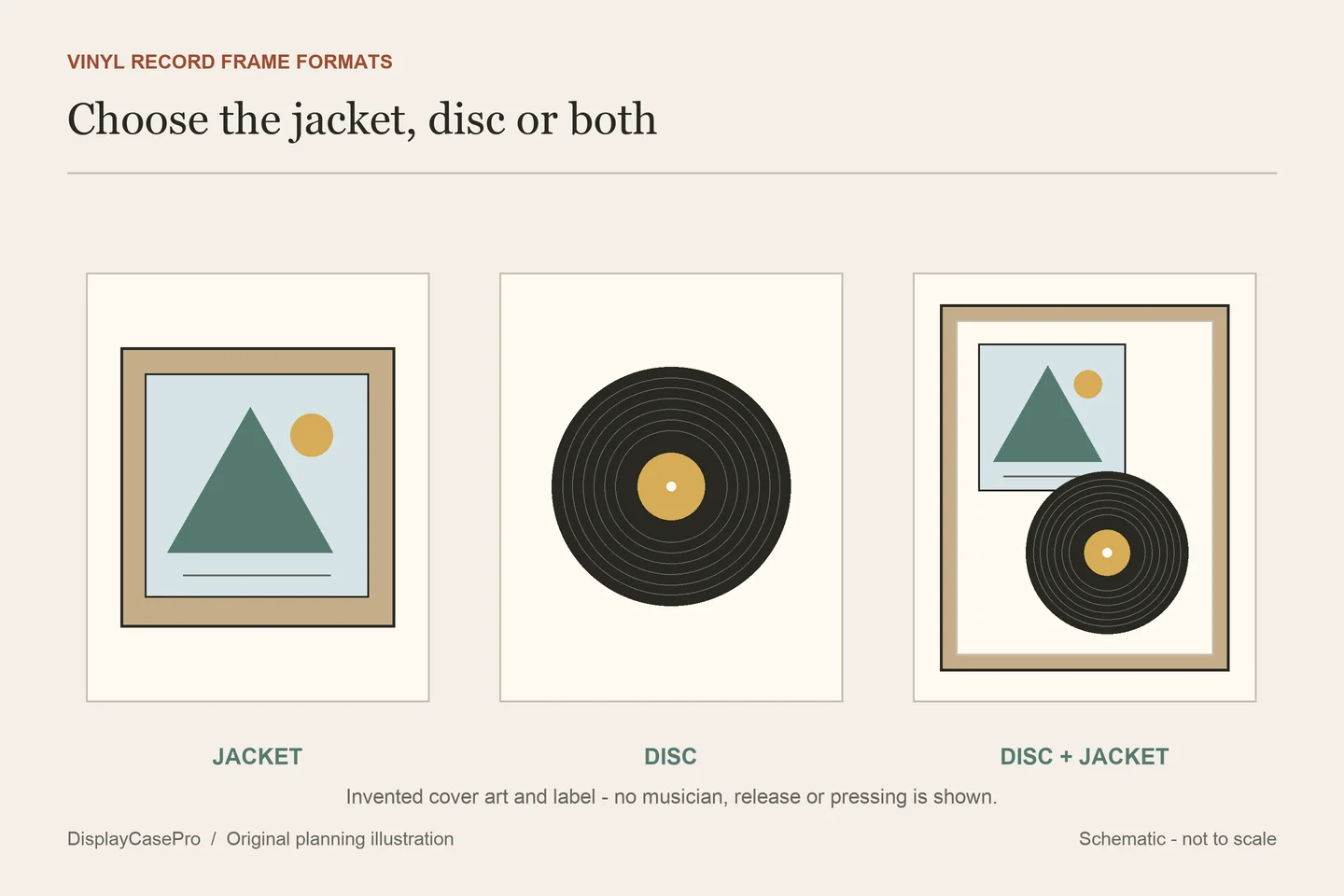
Choose a vinyl record display frame by deciding what belongs on the wall: the jacket, the disc or both. Then decide how often you want to play the record. A frame that suits a permanent disc-and-cover composition may be inconvenient for an album you remove every weekend.
Choose what the frame will display
“Record frame” can describe several different products. A jacket-only frame presents album artwork. A disc frame shows the label or a picture disc. A combined frame gives the record and jacket separate positions. An openable jacket display can also keep a playable record within reach. Pick the task before comparing nominal frame sizes.
| Composition | Useful when | What to specify |
|---|---|---|
| Jacket or cover | The artwork, printing or a signed jacket is the main subject. | The actual jacket width, height, thickness and visible area; where the disc will be kept. |
| Disc or picture disc | The physical recording or its visual design is the subject. | A mount intended for that disc format, its contact locations and the release method. |
| Disc and jacket separately | You want to show the relationship between the two in one composition. | Separate receiving spaces, complete outside footprint and access to each component. |
A closed gatefold jacket and an opened gatefold are different display states. Record the chosen state in the frame brief. A product that accepts a thick closed sleeve has not thereby promised enough width or support for the unfolded artwork.
Use the actual release and packaging. A nominal 12-inch record category does not define the size of an outer protective sleeve, a special jacket or a box set. Keep those layers in the measurement if they will remain in the display.
Compare how you will reach the playable record
A front-opening frame for regular changes
A front-opening design can suit a changing album selection. For example, Show and Listen describes a top release catch that lets its frame open while mounted. That is an opening concept for the named product; confirm the chosen version’s accepted package and installation instructions.
Check which part moves and how you support the jacket during access. If the record remains inside, confirm that it can leave its sleeve through the intended opening. Decide where the jacket and disc will rest while you use the turntable, rather than balancing them on the open frame.
A rear-access frame for a less frequently changed composition
A traditional frame may require removal from the wall and opening at the back. Ask for its prescribed loading and unloading sequence. A rear-mounted disc-and-jacket arrangement may suit a display that changes infrequently, but count the complete access task when choosing it.
Do not assume that a frame’s quick self-mounting description means frequent disc retrieval is intended. Ask how the mounting components are released and reused, and whether the disc can be removed without disturbing the jacket.
A multi-jacket system for a changing wall
A fabric-pocket or open jacket system is a different category from an individually glazed frame. Andover Audio’s Record Roots listing describes a fabric frame measuring 29.5 × 54.5 in overall, also stated as 75 × 138 cm. Those are the system’s outside dimensions, not the usable size of one pocket.
For this route, check the actual jacket/pocket relationship, removal direction and location of the disc during playback. A large wall footprint does not establish that a particular thick package is accepted.
Read jacket thickness separately from overall frame size
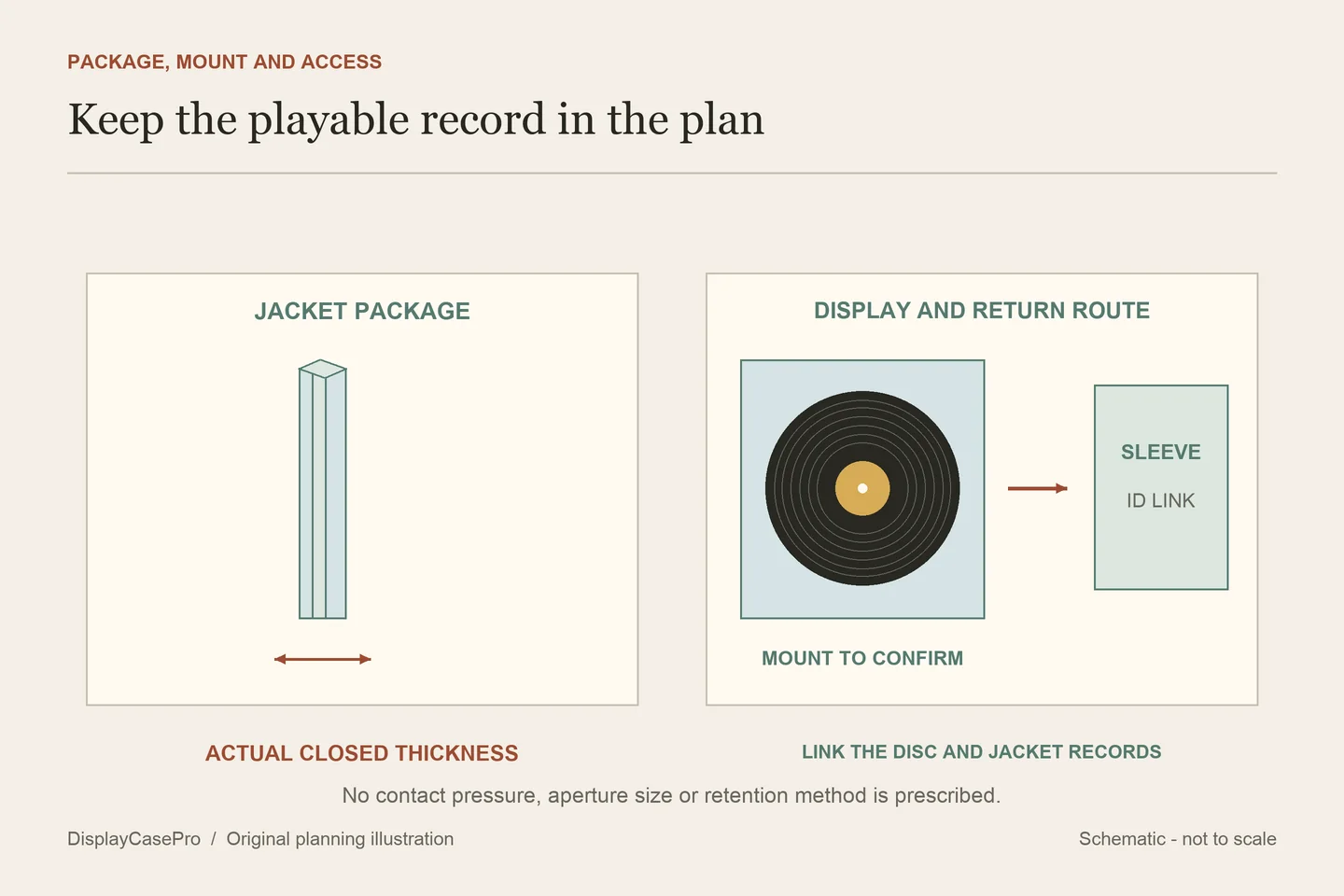
An exact product example shows why a headline size is insufficient. Frame My Collection’s 12-inch LP Record Album Frame with Sleeve places the vinyl and sleeve separately and lists an 18 × 31 in overall frame. Its product details distinguish the following sleeve-mount limits:
| Mount configuration | Published sleeve thickness | Condition to retain |
|---|---|---|
| Standard mount | Up to 1/8 in | The actual jacket package must meet the stated limit. |
| Requested thicker mount, black/silver/gold/white moulding | Maximum 3/8 in | The thicker mount must be requested for the relevant configuration. |
| Requested thicker mount, walnut moulding | Maximum 1/4 in | The walnut limit differs from the other listed mouldings. |
These are published product-specific limits, not measurements by DisplayCasePro or a standard for every gatefold. The outside dimensions do not tell you the sleeve opening, and a thicker-mount option should not be assumed to arrive automatically. Confirm which layers the maker expects in the receiving mount.
When comparing another frame, record its opening, accepted thickness and loading instructions in their own fields. A clear specification is more useful than matching the words “LP frame” across two product titles. The usable-space guide explains why finished internal faces matter when a deeper frame is involved.
Resolve how the mount contacts the disc
The Library of Congress guidance for audio-visual materials says to handle grooved discs by their edge and label areas and avoid touching the playing surfaces. Its storage and environment guidance also keeps direct or intense light and heat sources out of the plan. Apply those distinctions when assessing how a framed record will be loaded, held and removed; they do not certify a particular commercial mount.
Ask the frame maker where each retaining component contacts the record and how it is released. Confirm the intended record format and the instructions for that exact mount. A feature described for an optical disc, or a central hole that looks similar, is not a substitute for a grooved-record mounting specification.
Keep modifications outside the framing task. Choose a suitable format rather than drilling, heating or permanently attaching a collected disc to make it fit. For a recording or jacket with a particular condition concern, resolve that concern before adopting a display system. A clearly identified display copy can serve an artwork-focused arrangement when the original is kept separately.
Keep the record, jacket and playback location connected
Give the recording and its associated packaging linked identifiers. Record whether the display contains the original jacket, an empty jacket, a disc or a copy. When the disc is housed elsewhere, note that location. This keeps a wall of covers from becoming a search through unrelated storage sleeves.
For a changing display, add a position code and a return location. A simple entry might state the record ID, displayed jacket ID, frame position and current disc sleeve location, leaving the actual values for your collection. Do not infer a pressing, edition or association from matching artwork alone.
Use the blank record-frame worksheet to capture the package, moulding/mount option and opening task. Once the individual frames are specified, the collection wall layout guide can help arrange their complete footprints.
Common record-frame questions
Does a 12-inch frame fit every LP jacket?
Check the actual receiving dimensions, package thickness and chosen display state. The nominal record format does not define all of its packaging.
Can the record remain inside the displayed jacket?
Only where the selected frame is intended for that complete package and provides a suitable access route. Other frames place the disc and jacket in separate mounts. Record which configuration you are ordering.
Which format is best for a record I still play?
Compare the actual removal sequence and frequency of use. A front-opening or accessible jacket system may suit that task; a permanent-looking combined composition may involve more steps. Confirm the chosen product’s instructions.
About this guide: This is a format and specification comparison using attributed maker information and bounded record-care guidance. No frame, disc mount or long-term preservation performance was tested for this article.
Comments
Share a display tip or ask a question.