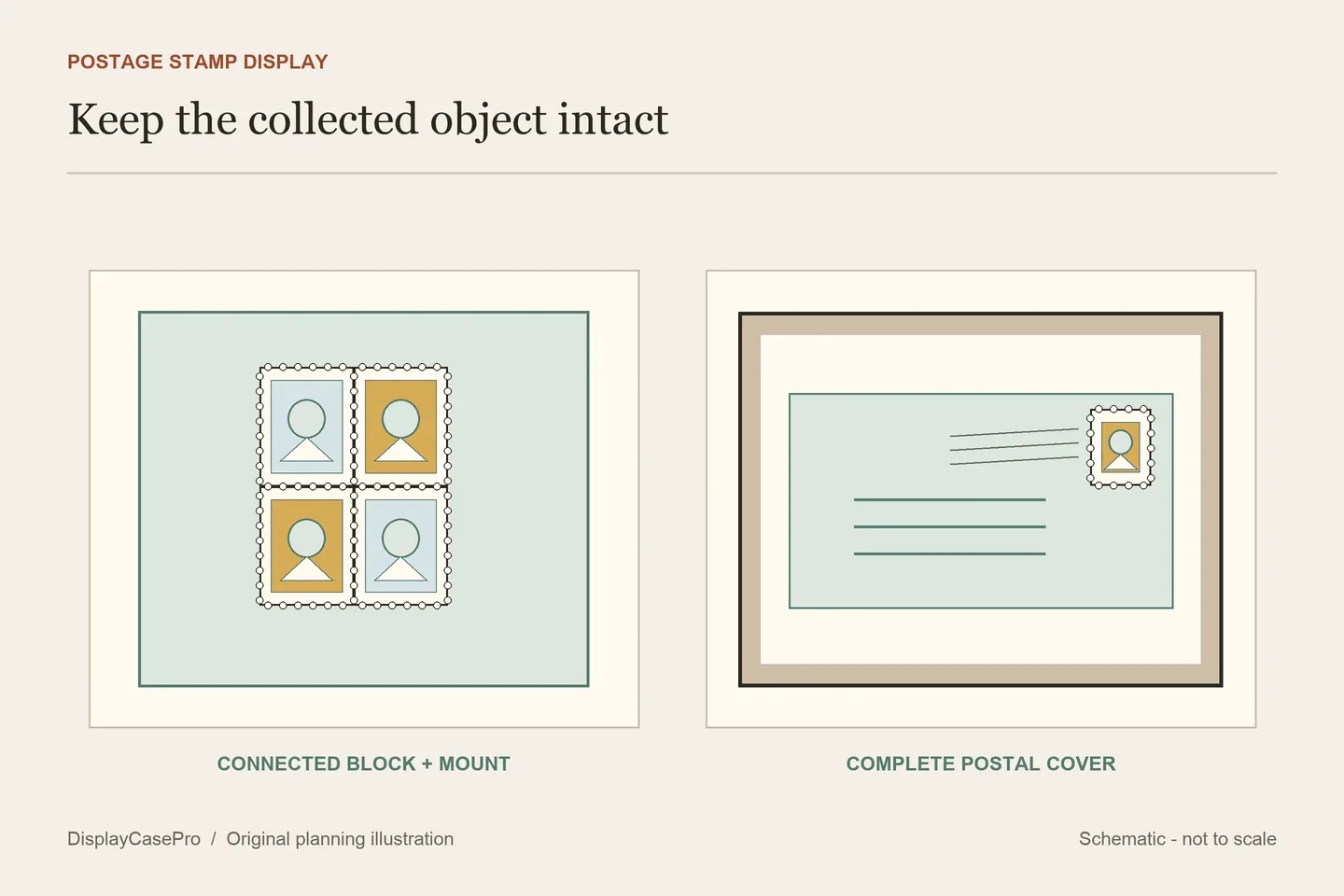
Choose a postage stamp display case around the object you want to keep intact: a single stamp, connected block, sheet or complete envelope. Plan its protective mount and visible window before the outer frame. A retail stamp pocket, collector mount and decorative shadow box perform different jobs.
Start with the stamp, block, sheet or cover
A stamp collection is not necessarily a collection of separate rectangles. Joined stamps, sheet margins and the envelope on which a stamp traveled can be part of what you collect. Keep those relationships in the display plan instead of separating the objects to fit matching openings.
| Object | Include in its outline | Decide before framing |
|---|---|---|
| Single stamp | The complete perforated or imperforate edge, not only the printed image. | What supports the stamp, and whether the full edge should show. |
| Connected block | Every joined stamp and any attached margin. | How the intact block is housed without a divider crossing its perforations. |
| Sheet or sheet fragment | Surviving selvage, inscriptions and irregular edges. | Which marginal details explain the item and need to remain visible. |
| Cover or first-day cover | The complete postal envelope and relevant marks. | Whether the address, cancellation or reverse carries part of the story. |
Record whether an item is mint, used or uncertain using your existing documentation. A neat appearance does not establish its gum condition or value. For an important or fragile item, settle the housing with a philatelic specialist before choosing a wall treatment.
Make a layout using paper outlines or reference images while the originals remain housed. Give each item an ID. This lets you rearrange a sequence without repeatedly moving tiny stamps and keeps the proposed opening connected to the correct object.
A stamp mount is different from a hinge
The American Philatelic Society's mounting guidance distinguishes gummed hinges from clear sleeve mounts. It explains that removing a hinge can remove some gum from a mint stamp. A sleeve mount receives the stamp; the mount is attached to the page. Those are different forms of contact.
For a framed original, identify the actual mount and how it is supported within the frame. A mat is a presentation component, not a substitute for resolving that attachment. Do not apply ordinary tape or glue to the stamp to keep it centered, or assume a frame maker's decorative tutorial is suitable for its present condition.
Keep the protected object and its outer mount dimensions together in your notes. A sleeve can extend beyond the stamp, and that extra area belongs in the layout. Confirm whether the intended presentation shows the mount border, conceals part of it behind a mat or uses another professionally agreed arrangement.
Plan three outlines, then the frame package
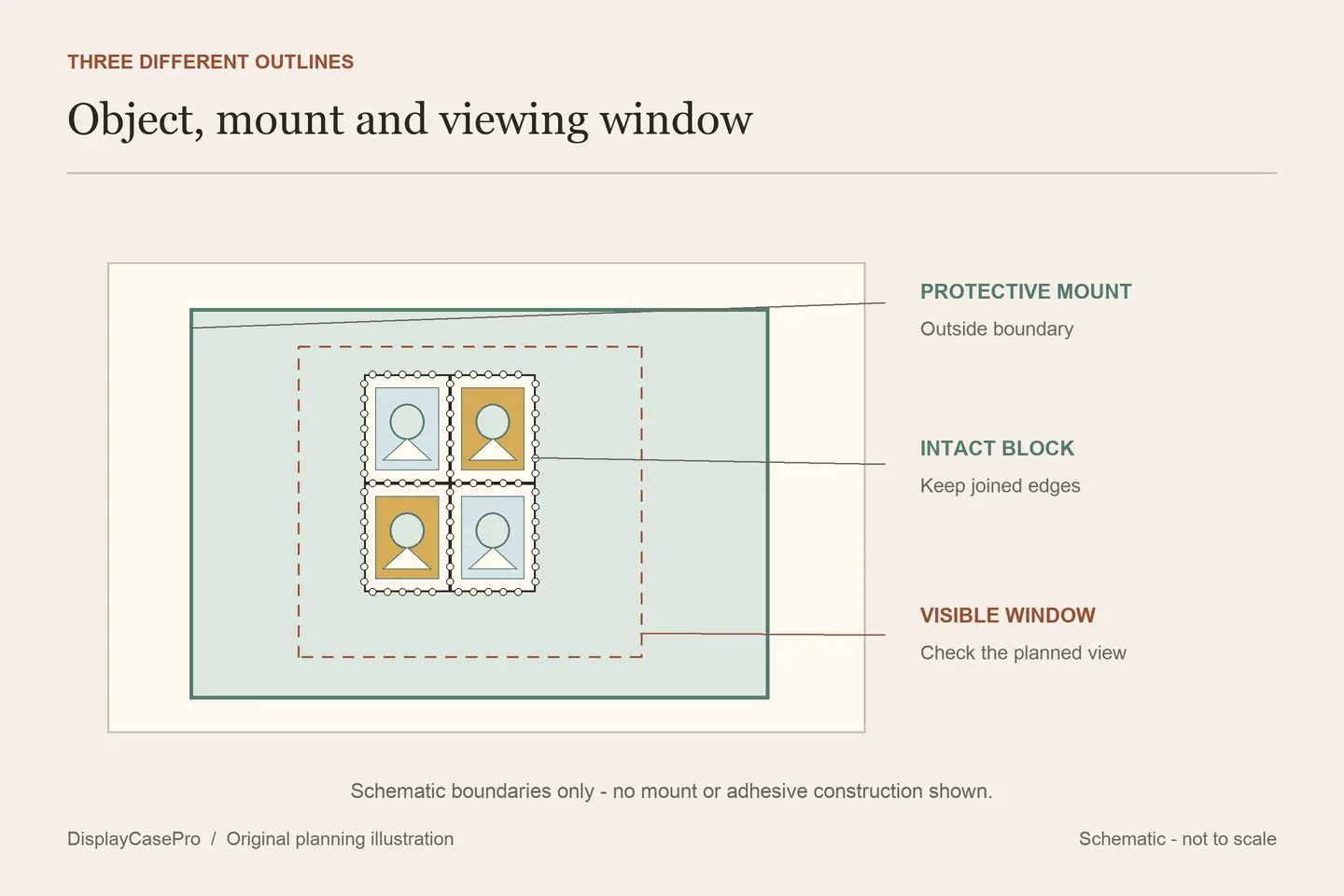
Draw the intact object's outline first. Add the protective mount's outside outline. Finally, draw the visible mat opening over a reference image. These outlines need not coincide: a window can expose a stamp while hiding a mount border, but it should not accidentally hide perforations, a plate number or part of a cancellation that matters to the display.
Ask the framer what is held behind the window and what prevents the original from contacting the glazing. Confirm the complete support, mount, mat and backing arrangement. A nominal picture size supplies neither the full package depth nor the remaining space in front of the mounted item.
For several stamps, plan each opening individually before aligning the group. A connected block can share one window while single stamps occupy separate positions. Consistency can come from captions and spacing rather than forcing every item into the same small opening.
Read what a display product actually supplies
Retail binder pages
Postal Products N1024968 is a replacement page for a Retail Stamp Binder. The listing gives twenty 2 × 2-inch pockets per page and fifty replacement pages per box. It also suggests back-to-back retail presentation. Those numbers describe pocket layout and order quantity, not fifty positions in one page.
The description does not establish the pocket material or its suitability for your collected originals. Do not treat the retail display suggestion as a recommendation to place two mint stamps together. If you are seeking collector housing, ask specifically about the material, object contact and intended philatelic use.
Frames with custom windows
Custom Picture Frames' stamp category includes single items, blocks, first-day covers and multi-opening layouts. Its copy contains different minimum-window statements for different contexts. Request the actual proposed opening dimensions and layout rather than treating one minimum as a universal stamp format.
A useful enquiry includes the intact object, mount outside size, details to reveal and the complete package depth. If a supplier asks only for the stamp's printed image size, clarify that the perforated edge and mount still need accommodation.
Nominal shadow-box sizes
The Poster Palooza white-on-dark-gray stamp shadowbox lists 16 × 18, 17 × 21 and 20 × 32 size options. Its description identifies a wood frame, acrylic and backing. It does not provide a stamp-window plan or a clear backing-to-glazing depth in the text read.
Confirm what the selected size measures and whether the required stamp mounts and mat are included. A photograph of an attractive arrangement does not answer those questions. The usable shadow box depth guide explains which reference surfaces to request for a complete assembly.
Choose how often and how much to show
A framed selection and a working collection can coexist. Display a small documented theme while retaining the rest in suitable housing. Decide how you will access and return that selection; opening the whole frame every time you want to study a reverse can make the chosen format inconvenient.
The National Postal Museum's 2012 account of preparing pullout frames describes double-sided panels for stamps and covers, with reduced light exposure when they are not being viewed. It is an institutional example of planning access and exposure together, not evidence that a home shadow box reproduces museum conditions.
A clearly identified display reproduction can provide a lasting wall composition while the original is independently housed. Record copy status in the caption. UV-related glazing descriptions do not establish a harmless display duration for every stamp or ink.
Use the blank stamp display worksheet to record the object, mount, visible details and exposure/access plan. For several separate frames, finish those individual packages before using the collection wall layout guide to arrange their outer footprints.
Common questions
Can I frame a connected block as separate stamps?
Keep the collected block intact and plan one suitable mount and window around it. Separate openings should not require breaking the perforated connections.
Is an archival backing enough?
It identifies only one component. The stamp's mount, contact materials, glazing separation and future access still need an appropriate plan.
Should every perforation show?
Choose that viewing goal deliberately, then check it against the mount and visible window. A frame that accepts the package can still conceal the edges in its finished view.
About this guide: This is a source-led display-planning guide. It does not authenticate stamps, assess gum or value, prescribe removal or mounting treatments, or report hands-on tests of the named products.
Comments
Share a display tip or ask a question.