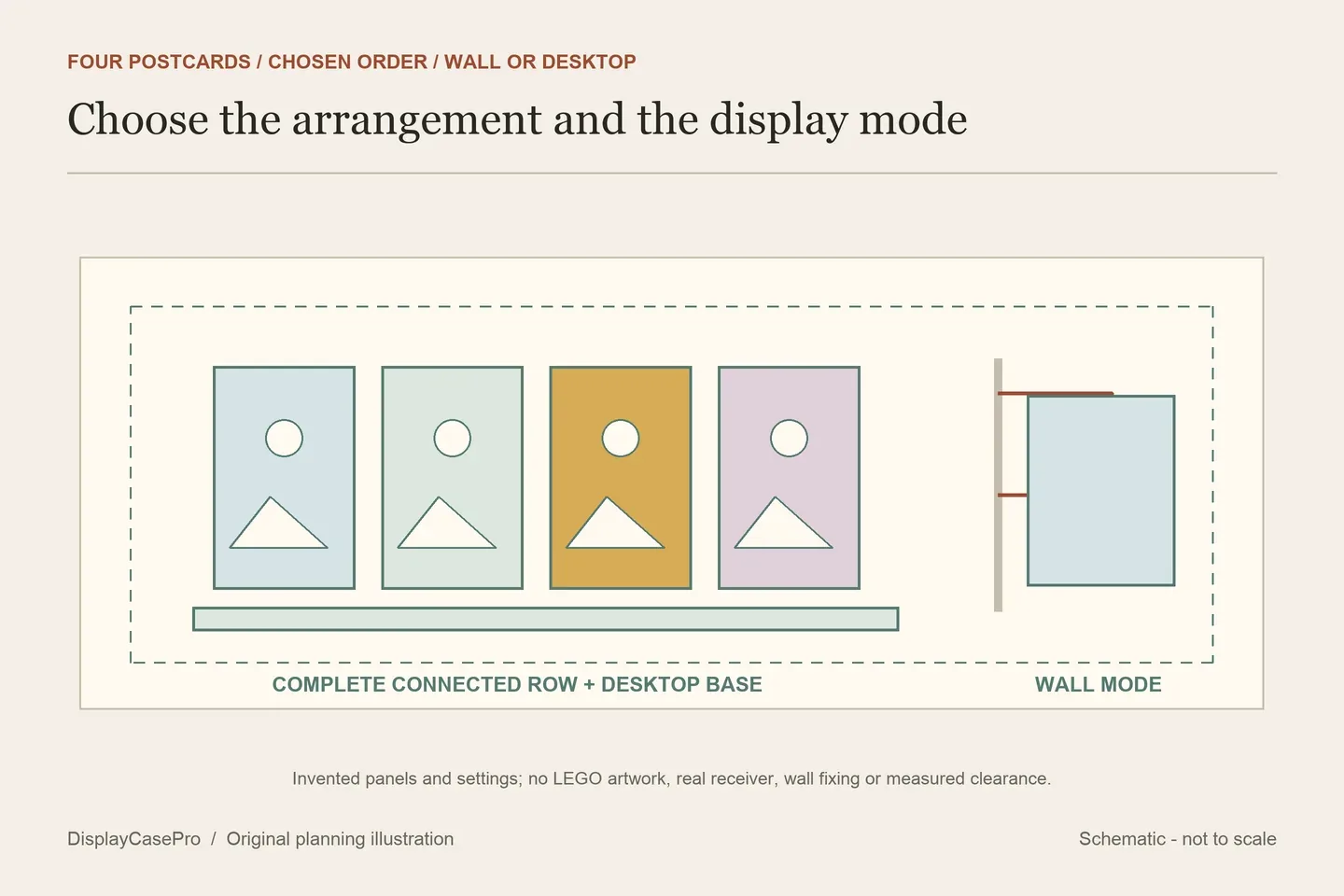
Choose a LEGO Tales of the Space Age display case for the four postcards in set 21340 and the way you want to arrange them. A joined desktop row, four separate model positions and a complete wall enclosure have different receiving requirements. The model’s own hangers do not specify the attachment of an aftermarket case.
Four postcards can be individual models or one connected row
LEGO’s official 21340 specification describes four connectable brick-built 3D postcards. They can be connected in any order, stand on a flat surface or hang individually using their rear hangers. The pink/purple postcard’s star elements can also be rearranged into named constellations.
The descriptive size reference is over H14 × W9 × D3 cm for each postcard. It is not the complete joined row. Multiplying the rounded width by four does not establish the exact receiving length, connection details or spacing of your arrangement.
Choose all four connected, a selected subset or separate positions before requesting a case. Record the actual arrangement, its complete rear-to-front profile and any added gaps. An enclosure advertised for the whole set need not provide separate supports for a different grid or spaced composition.
The case’s desktop base and wall attachment are different packages
Wicked Brick’s 21340 listing describes wall display using pin holes in the back panel and a desktop arrangement with an additional base. It gives one W46 × D8.6 × H17.5 cm size line, without an explicit inside/outside boundary or separate size block for each mode.
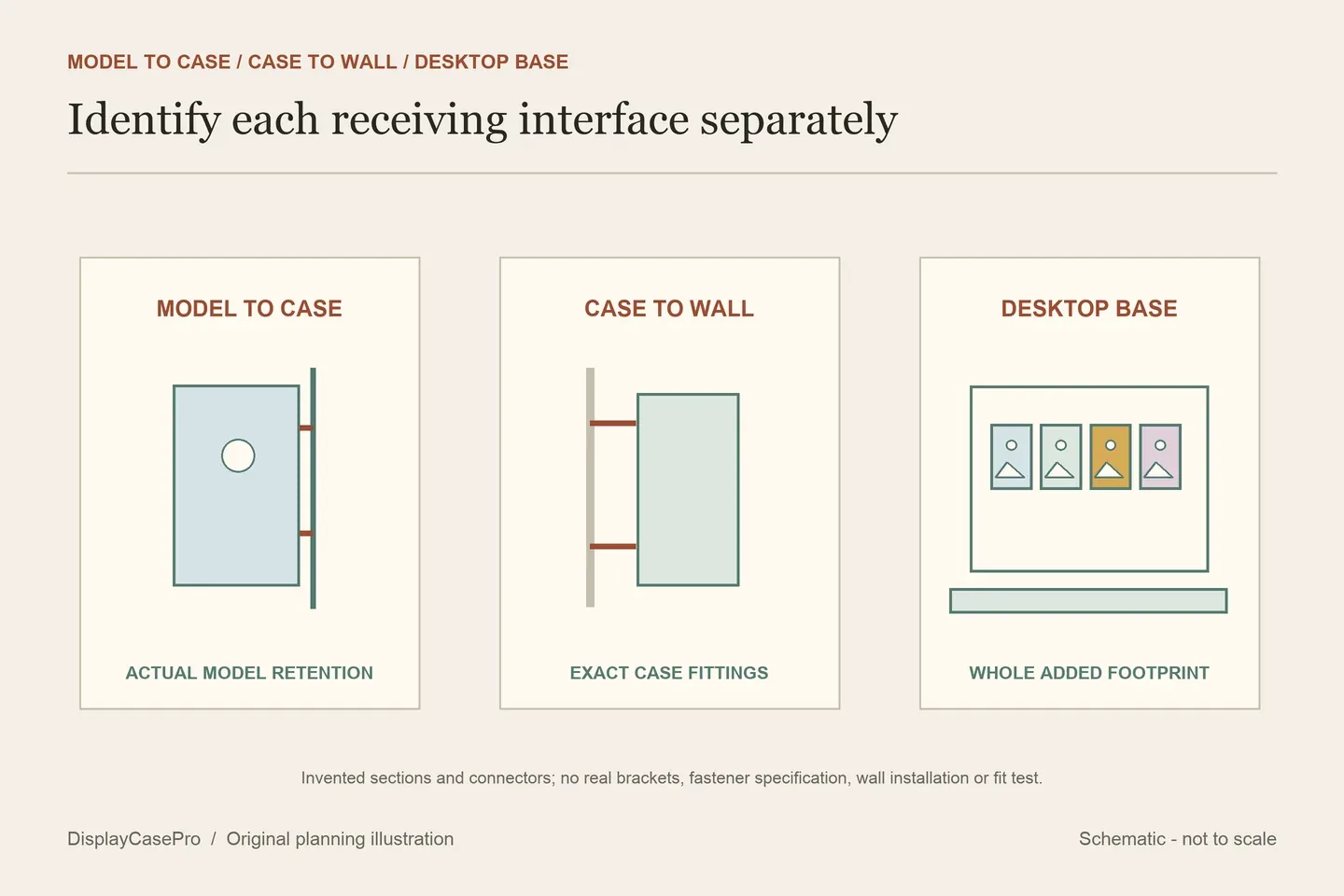
Ask which dimensions include the desktop base and which apply to the wall configuration. Keep the model’s individual rear hangers separate from those case attachment points. The fact that the postcards can hang on their own does not establish that a complete enclosure uses the same wall fittings.
Keep the clear interior, assembled size and box label distinct
These five supplier descriptions were read on 19 October 2026. They are not five measured fit tests. Two label separate interior and exterior dimensions; the others require a receiving drawing before their size lines can be compared on the same basis.
| Source | Published figures | Definition to retain |
|---|---|---|
| Wicked Brick | W46 × D8.6 × H17.5 cm. | Inside/outside and selected-mode boundary unlabelled. |
| iDisplayit | Inside L39 × W05 × H16 cm; outside L41 × W07 × H17 cm. | Labelled rows; source literally prints 05 and 07 for W. |
| Brickcessories LDC075.01 | Assembled 410 × 60 × 170 mm. | Tuple axes and clear interior not labelled. |
| Kingdom Brick Supply | Approximate inside L45.6 × W7.2 × H16.8 cm; outside L47.1 × W8.7 × H17.7 cm. | Separate receiving cavity and whole exterior. |
| Scoparius, Italian listing | Box size 40 × 10 × 15 cm. | Axes, inside/outside and exact-version applicability unlabelled. |
Map each axis to the intended front view. An L/W/H sequence for a shallow display should not silently acquire another maker’s width/depth names. A 60 mm assembled dimension cannot be treated as the same usable gap as iDisplayit’s labelled W05 cm.
Brickcessories describes aluminum corner brackets, screws and 4.5 mm and 3 mm acrylic. Kingdom Brick Supply lists 3 mm acrylic, ten screws and a 56 × 8-stud area. These construction and base-area descriptions do not establish a wall-mounting package or a new cavity calculated by subtracting selected thicknesses.
The suppliers’ rounded sizes do not determine a permitted gap between the postcards. If you want a different order, added labels or a wider separation, provide the complete actual layout. Set-number compatibility should remain attached to the maker’s intended receiving arrangement.
Identify which interface holds which part of the display
| Interface | Ask the maker to identify | Keep separate |
|---|---|---|
| Postcards to case | Actual receiving points and the supported connected or separate layout. | The postcards’ own rear hangers. |
| Case to wall | Case fittings, supplied parts and applicable installation instructions. | Model-to-case retention and the complete wall footprint. |
| Desktop case to furniture | The complete added base and intended resting surface. | The smaller postcard row and any wall-only dimensions. |
Do not treat a flat-pack screw count as an attachment design. Follow the selected product’s actual instructions for the wall construction and full assembly. A support pictured behind one postcard also does not establish independently positioned receivers for all four.
Wood-grain finish, solid wood and a sliding door are separate choices
The observed Italian Scoparius page redirects to its mirror-case product and describes several configurations. Its wood-grain base uses PVC, while the named solid-wood ring-light version describes natural wood. Similar finish language should not collapse those into one material specification.
A USB ring light and sliding door are described for named ring-light configurations. Confirm their inclusion and the matching size block for the exact order. Do not transfer the door to a plain-base selection or infer the clear height by subtracting the raised base from an unlabelled box size.
A printed background and mirror floor also change the composition around the original postcards. Check the intended view of all four scenes. UV printing is a printing process, not proof of a particular clear-panel filtering performance.
Leave a route for the front or cover to come away
Ask how the selected enclosure opens for a postcard rearrangement or constellation change. The source descriptions do not establish one common release sequence across all five products. An assembly link is not automatically the routine opening procedure for your chosen version.
Use the complete wall outline or desktop base in the location plan, then reserve the actual opening route and a resting place for the removed part. Keep that movement separate from handling the individual postcards according to the model instructions.
The 21340 arrangement and display-mode worksheet keeps these choices together. Use the collection wall guide for complete enclosure placement, and the usable depth guide for the distinction between a border, a backing and clear receiving space.
Comments
Share a display tip or ask a question.