
Choose a jigsaw puzzle display case by deciding whether the finished puzzle will become wall art, stay accessible for replay or remain a three-dimensional model. Those goals need different products. For a flat completed puzzle, start with its actual outline and the way the assembled pieces will be supported, then choose the frame or cover.
Decide whether the puzzle is becoming art or returning to the box
A favorite completed image can become a lasting display. Another puzzle may be kept intact for a few days before the pieces are separated and used again. Make that choice before applying a permanent treatment or buying a product that expects a bonded assembly.
Record the puzzle’s identity, orientation and completed dimensions. The number of pieces helps identify it but does not give its finished width or height. A panoramic design, an irregular edge and a conventional rectangle also present different outlines even when their piece counts match.
If preserving the original pieces and their unbonded condition matters, ask specifically for a supported, removable arrangement. A transparent front alone does not tell you how the pieces are held or what happens when the frame is opened. Keep those questions separate from the appearance of the border.
A board, a frame and a retail rack answer different needs
The products below were read on 18 October 2026. They illustrate the different tasks described under puzzle-display and accessory names. They are not a ranked comparison or products physically tested by DisplayCasePro.
| Source or format | What the described product does | Check for your finished puzzle |
|---|---|---|
| Puzzle Warehouse frame category | Offers snap, wooden and acrylic frame products with different named sizes. | The exact frame’s receiving area, support and opening method. |
| Bits and Pieces accessory category | Mixes boards, tables, trays, easels, storage and framing supplies. | Whether the selected item displays a finished assembly or supports puzzling in progress. |
| Robotime kit accessories | Lists covers for named miniature-house and 3D-puzzle families. | The exact kit and three-dimensional outline received. |
| Woodshop Diaries DIY board | A rotating assembly board with four drawers. | Its supported work area and complete furniture footprint. |
| Heritage Puzzle spinning rack | Wholesale rack with sixteen facings holding three boxed puzzles each. | Retail puzzle boxes, rather than 48 assembled puzzle pictures. |
Bits and Pieces shows why “puzzle accessories” is too broad a purchase specification. A sorting tray receives loose pieces, a board supports the working assembly and a frame presents an image. Decide which of those tasks you need before comparing their capacity labels.
Robotime’s accessory collection contains named kit covers. A clear cover intended for a miniature house should not be treated as a general flat-jigsaw frame. Likewise, Heritage Puzzle’s rack holds 48 boxed retail puzzles; that count says nothing about completed-puzzle dimensions or wall-art capacity.
Keep the completed outline, receiving area and visible window separate
Measure the puzzle after completing it in the intended orientation. Record the furthest edges without bending or trimming pieces to meet a nominal frame size. For an irregular shape, keep a reference image or outline showing the empty areas as well as the extreme width and height.
| Measurement | Include | Why it matters |
|---|---|---|
| Completed puzzle outline | Actual assembled width, height, orientation and unusual edges. | A piece count or box illustration is not the receiving outline. |
| Receiving area | The frame or support area intended to accept the whole assembly. | It must agree with the specified puzzle and backing arrangement. |
| Visible window | The area visible after the front, border or mat is installed. | An accepted puzzle can still have important edge details hidden. |
| Complete package depth | Puzzle, intended backing/support and front components as assembled. | A flat outside size does not establish usable depth or retention. |
A specific listing makes the distinction useful: Puzzle Warehouse’s Eurographics Black Aluminum Snap Frame labels 19.25 × 26.75 in as “Accessory Dimensions.” That label does not define the clear opening, total exterior and supported package separately. Ask which surface the figures refer to and whether the actual puzzle and its required support are received.
For a work-in-progress alternative, Shara’s Woodshop Diaries board describes a puzzle area up to 21½ × 28½ in and an overall board about D23 × W30 × H1¾ in before the lazy Susan is added. These are different boundaries. The optional turning hardware changes the complete height, and the drawer design is an assembly surface rather than a transparent enclosure. Use the author’s actual plans if building it; this guide does not reproduce the cut list or construction instructions.
Resolve the support and transfer method before adding glue
Puzzle Warehouse’s category guidance discusses gluing before framing. The specific Snap Frame description above instead advertises insertion and removal without tools or adhesives. Keep the product-specific question open: what assembly, backing and retention does the exact frame require for your puzzle? Do not turn either description into a universal rule.
A glued puzzle and an unbonded assembly also need different removal expectations. Ask whether the selected method is intended to keep the pieces together permanently, and what reopening involves. If replay is the goal, make that explicit before accepting a mounting or bonding treatment.
Plan the move from the existing assembly surface to the receiving support. The useful answer names the supported surfaces, the loading sequence and the frame’s intended retention. A photograph of a completed display does not demonstrate how loose interlocking pieces are transferred. Follow the puzzle and frame makers’ instructions rather than lifting an unsupported assembly to see whether it holds.
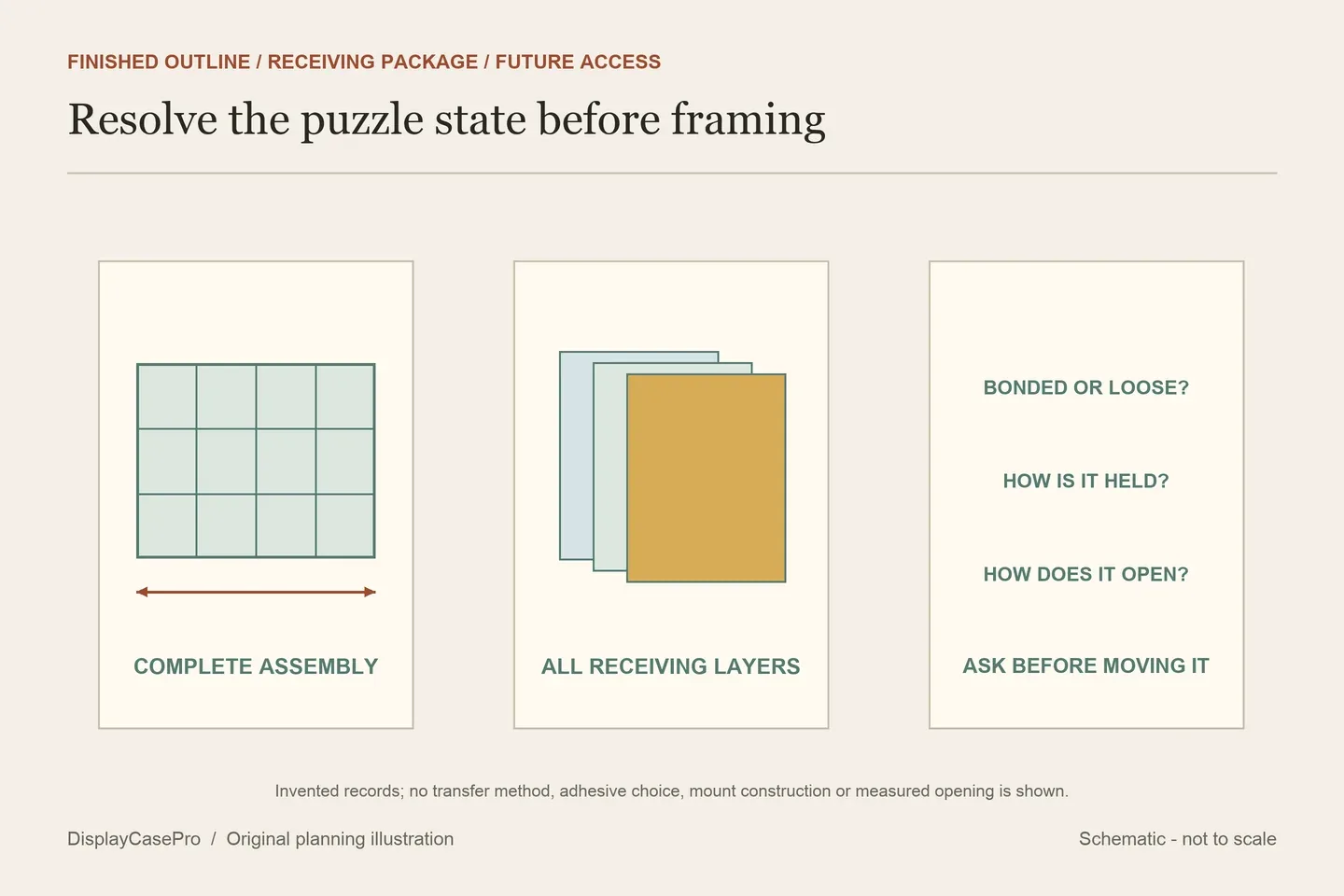
Review the image, complete frame and future access together
Make a paper layout of the proposed visible window. Check whether the border hides a signature, a caption or part of the picture you want to see. For several puzzles, use each actual outline; a common outside frame size need not imply identical internal openings.
Obtain the complete exterior and intended hanging or standing arrangement for the selected product. A board designed to sit on a table does not become wall-mounted because it fits behind another clear panel. Use that product’s own fittings and instructions rather than transferring a hanging method from a photograph.
The jigsaw display and frame-package worksheet keeps puzzle state, receiving dimensions, support and transfer questions together. The usable-depth guide explains depth boundaries; the collection wall guide helps arrange the completed frames after their individual packages are resolved.
Common questions
Will a 1000-piece frame fit any 1000-piece puzzle?
Check the actual completed puzzle and the frame’s receiving and visible dimensions. The piece count alone does not establish either size.
Do all puzzles need glue before framing?
The read descriptions differ by product. Ask for the exact frame’s support, retention and removal instructions, particularly if the pieces must remain reusable.
Cover photograph: Profpcde, via Wikimedia Commons, CC0 1.0. Whole image retained and compressed to WebP. It shows loose pieces, not a completed puzzle or a tested frame.

Comments
Share a display tip or ask a question.