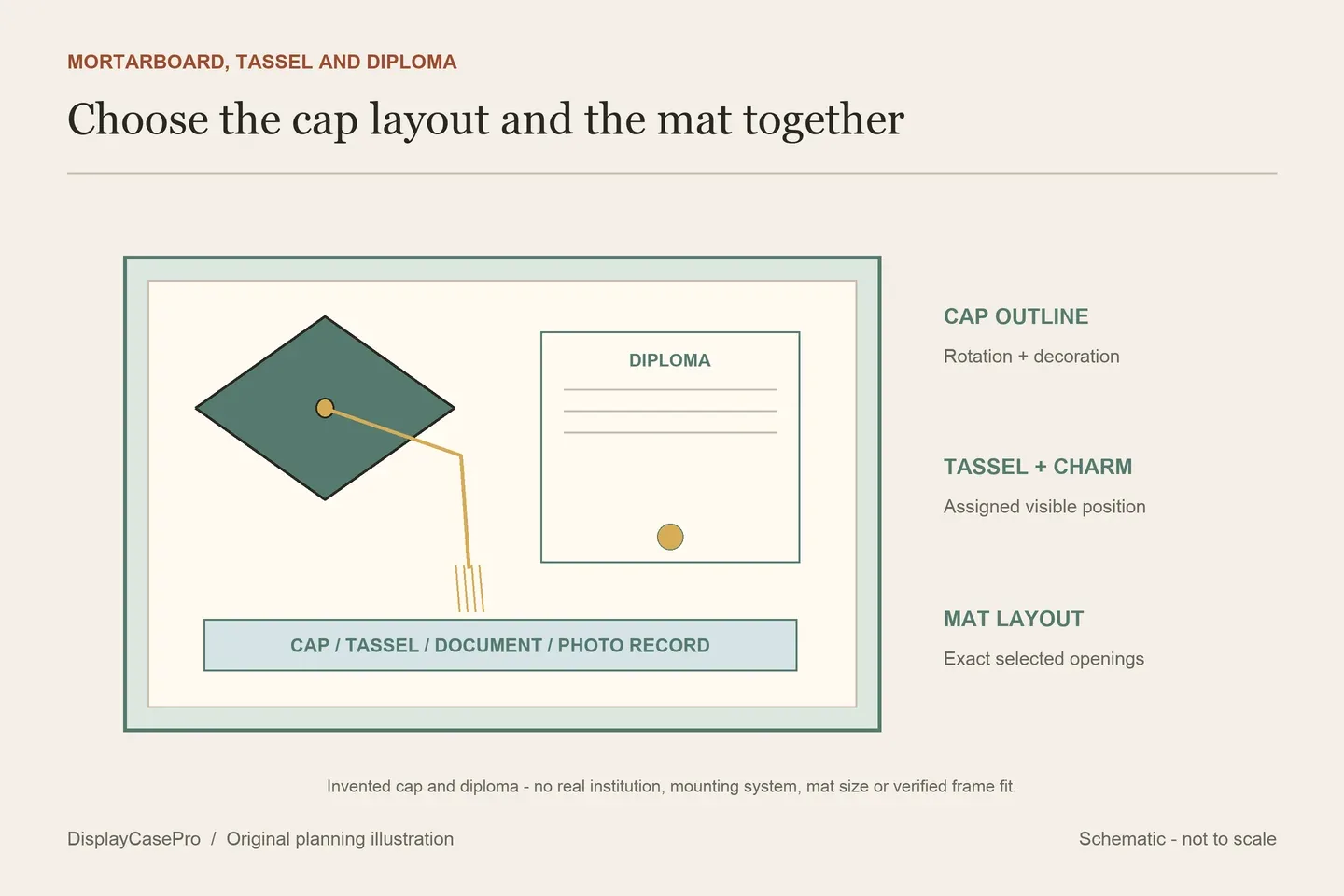
Choose a graduation cap display case for the complete mortarboard, crown, button, decoration and tassel—not just the square board seen from the front. Decide whether the cap stands alone or shares a layout with a diploma, photograph, cords or gown. Then check the actual mat openings, mounted depth and supplied accessories before choosing a frame.
Choose a cap-focused frame or a complete graduation story
A decorated mortarboard can be the main object, with its tassel and year charm given their own visible space. A diploma-led arrangement puts the document first and treats the cap as another component. A cap-and-gown composition adds fabric bulk and a different support problem.
| Layout | What defines it | Check before ordering |
|---|---|---|
| Cap and tassel | The complete decorated board, crown and chosen tassel drape. | Rotated board outline, button/decor projection and room for the charm. |
| Cap, diploma and photo | Several objects sharing specific mat openings. | Exact cap provision, document opening and photo size for the selected layout. |
| Cap with gown, stole or cords | A larger fabric arrangement around the cap. | Complete layered depth, supported fabric shape and whether a combined frame is actually specified. |
| Doctoral tam or other headwear | A different headwear form from a rigid square mortarboard. | Its own shape and support; do not transfer a mortarboard layout automatically. |
Church Hill Classics' graduation category lists separate cap, doctoral tam, honor-cord, stole and medallion shadow boxes. The category helps distinguish the objects, but it does not establish one universal cavity for all of them. Choose the actual object combination before assuming a graduation-labelled frame receives it.
If a gown is not essential to the story, do not add it simply because a product title mentions several types of regalia. Keeping the cap and diploma in separate frames can be a deliberate layout choice when their depth or support needs differ.
A square board is only part of the three-dimensional object
Record the mortarboard in the orientation you want to see. A diamond presentation occupies a different width and height from a square presentation. Include any flower, bow, raised lettering or other decoration projecting beyond the board edges.
Depth includes the crown behind the board and the button or decoration toward the glazing. Use the actual intended supported state. Do not flatten the crown, detach decoration or remove the button simply to match a shallow product's listed depth.
Choose a tassel drape and record the year charm's position. The tassel may hang from the button, extend below the board or be given a separate display area. Its position should remain legible without forcing the charm against a photograph or trapping the strands in the frame closure.
For a tam, begin a new outline rather than borrowing the mortarboard measurements. Its soft volume and support arrangement are different. A frame marketed for doctoral regalia still needs the exact headwear and complete layout checked.
Picture size, cabinet size and usable depth are different facts
These first-party descriptions were read on 17 October 2026. They illustrate specific size boundaries and layout options, not tested compatibility with your cap.
| Product | Published information | What remains unresolved |
|---|---|---|
| GraduationMall SF623 | 17 × 21-inch shadow box; maximum 16.5 × 20.5-inch picture. Wood, plexiglass and fabric interior; six stick pins and tabletop/wall provisions described. | Usable mounted depth, complete cap outline and the chosen support. The picture maximum is not a cap-cavity specification. |
| sfDisplay dc6109 large cabinet | Inside H27 × W15 × D1 inch; outside H28 × W16 × D1.75 inches. Three mat layouts are described. | The exact selected mat, diploma opening and complete cap/decor projection inside that layout. |
SF623's 16.5 × 20.5-inch maximum picture size does not tell you how deep a supported cap can be. Its 17 × 21-inch product label is not a reason to assume the same clear receiving rectangle. Ask for the relevant inside dimensions and how the displayed cap is intended to be supported.
For dc6109, keep the 1-inch interior depth separate from the 1.75-inch exterior depth. Neither is permission to compress a crown or raised decoration. A cap listed in a mat-layout description still needs its actual supported projection checked against the usable space.
The shadow box depth guide explains how glazing, backing and supports affect receiving space. Apply that method to the cap's button, crown and decoration rather than adopting a universal “two-inch box” rule.
The selected mat can change both cap provision and photo size
The dc6109 description lists three layouts: Option 1 has a diploma, 5 × 7-inch photo and tassel; Option 2 adds an engraving plate to that arrangement; Option 3 lists a diploma, 4 × 6-inch photo, tassel, engraving plate and cap. Do not assume every version has the cap provision or the same photo opening.
Record the option name as well as the frame finish and mat color. A product photograph can show a different layout from the selected order. Before buying, obtain a layout drawing that identifies which areas receive the cap, document, photo and plate.
Measure the diploma sheet and identify what must remain visible: name, institution, seal, signatures and edges. The visible mat opening and the supported sheet behind it are different boundaries. Do not trim an original diploma to match an opening, and do not infer its opening size from the cabinet's overall dimensions.
Decide whether the display uses the original diploma or a clearly identified copy. Keep that choice in the record. If a photograph is cropped to suit a smaller opening, check that the intended people and details remain visible rather than choosing a crop solely to fill the aperture.
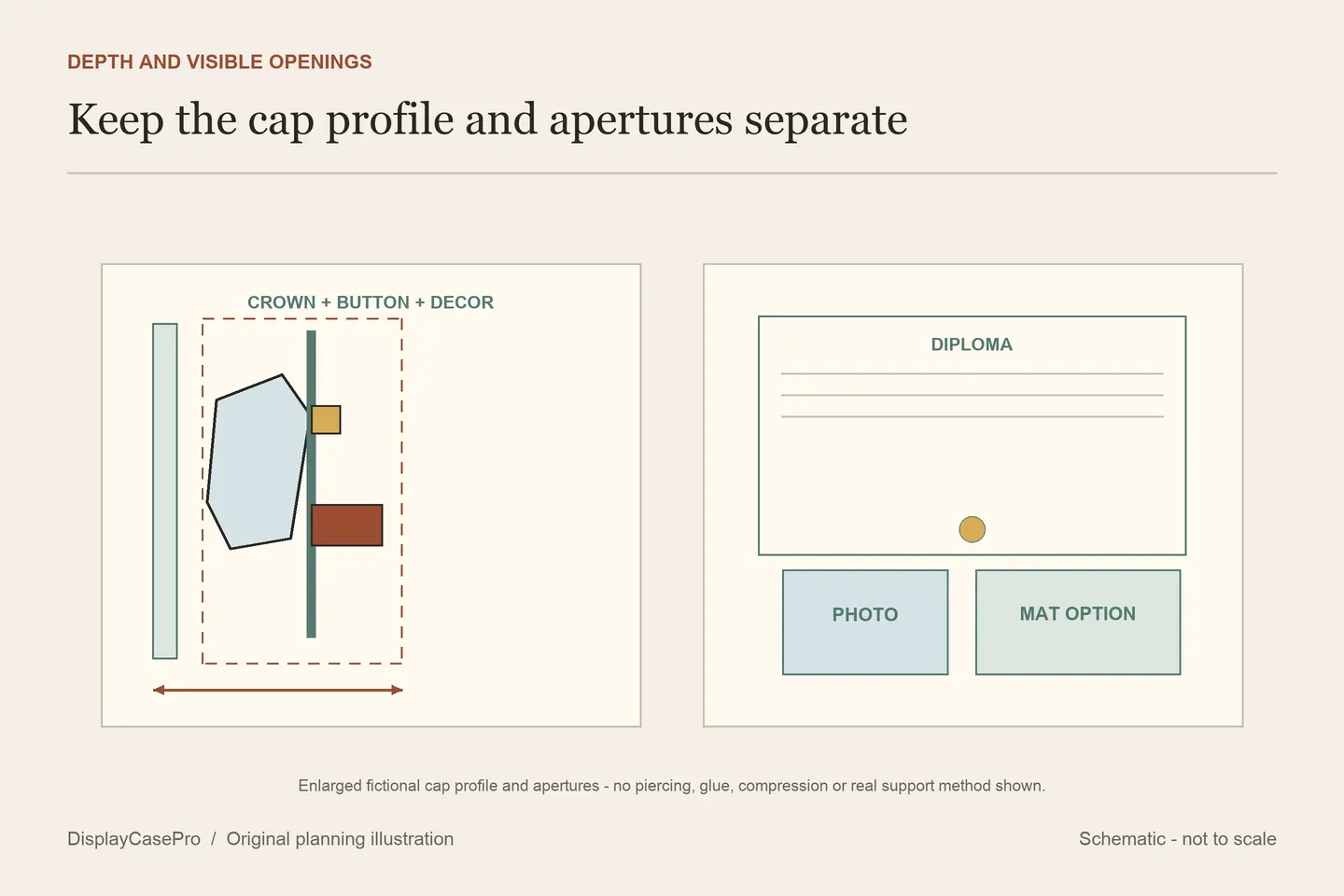
Plan support without turning a layout guide into a treatment recipe
Ask how the cap will be held, what touches its fabric or decoration and how it can later be removed. Included pins identify package contents; they do not establish that every part of a cap or original document should be pierced. A fragile or irreplaceable arrangement may need a professional framer to specify the contact and support method.
Graduation Cap and Gown's tutorial and Stoles.com's keepsake guide show why people combine caps, gowns, cords, photos and diplomas. Their generic box-size suggestions do not confirm fit for a decorated cap, and their adhesive or pinning suggestions should not replace a support plan for your materials.
Keep each object's layer visible in the proposed arrangement. A folded gown can occupy space behind a cap; cords placed on top add another projection. If the door only closes by pressing those layers flat, reconsider the layout or frame depth before fixing anything in place.
Establish how the frame opens and whether the complete arrangement can be assembled without dragging decorations past the glazing. For tabletop use, confirm the maker's intended support and complete footprint. For wall use, keep the actual frame's hanging instructions with the order rather than borrowing another model's hardware.
Choose a location where you can read the cap and document comfortably without relying on direct sunlight. A UV or “archival” label is not a promise of permanent protection for every fabric, ink and decoration. Keep material claims, actual construction and your object's condition as separate parts of the decision.
Use the cap, tassel and mat-layout worksheet to record the selected option, supported depth and document openings. For a group of frames, use the collection wall planning guide after each individual arrangement is defined.
Common questions
Will any 17 × 21-inch shadow box fit a graduation cap?
The label alone cannot answer that. Confirm the complete cap's outline, mounted depth and usable interior.
Does a diploma-and-cap cabinet always include a cap opening?
Check the selected mat layout. In the example above, the cap appears in only one of three described options.
Can I use a mortarboard frame for a doctoral tam?
Confirm the tam separately. Its shape, volume and support differ from a rigid square cap.
Comments
Share a display tip or ask a question.