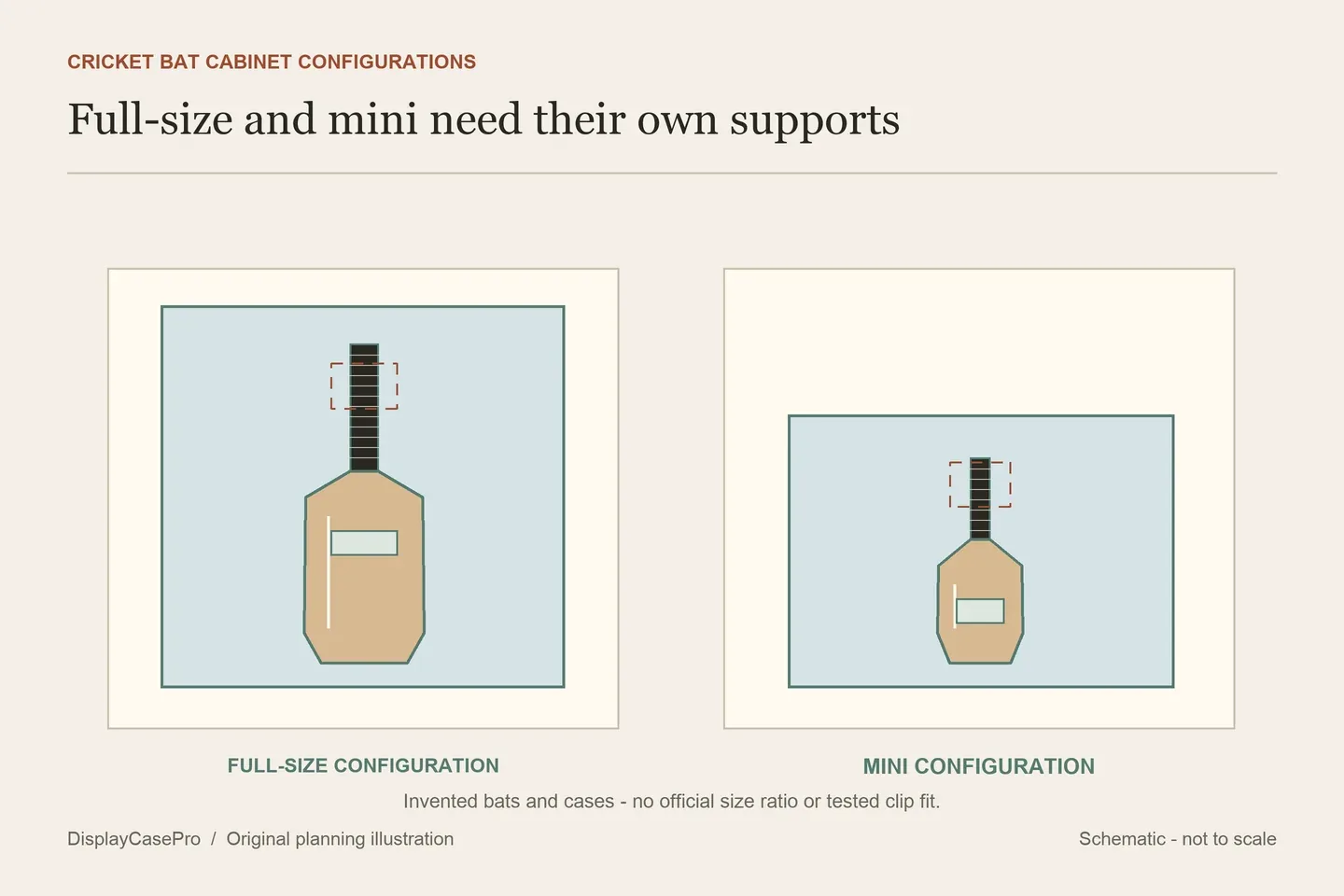
Choose a cricket bat display case by identifying a full-size bat, a miniature or a paired collection, then checking the blade, back profile, grip and intended supports together. A framed wall size does not describe the usable cavity. Handle clips, a toe slot and the opening method also belong to the product selection.
Record the broad blade and back as well as the length
Start with the bat you actually want to display, including its maker, model and existing condition. The words full-size, mini or souvenir do not supply a complete enclosure profile. Measure the entire handle-to-toe outline and identify the widest blade area.
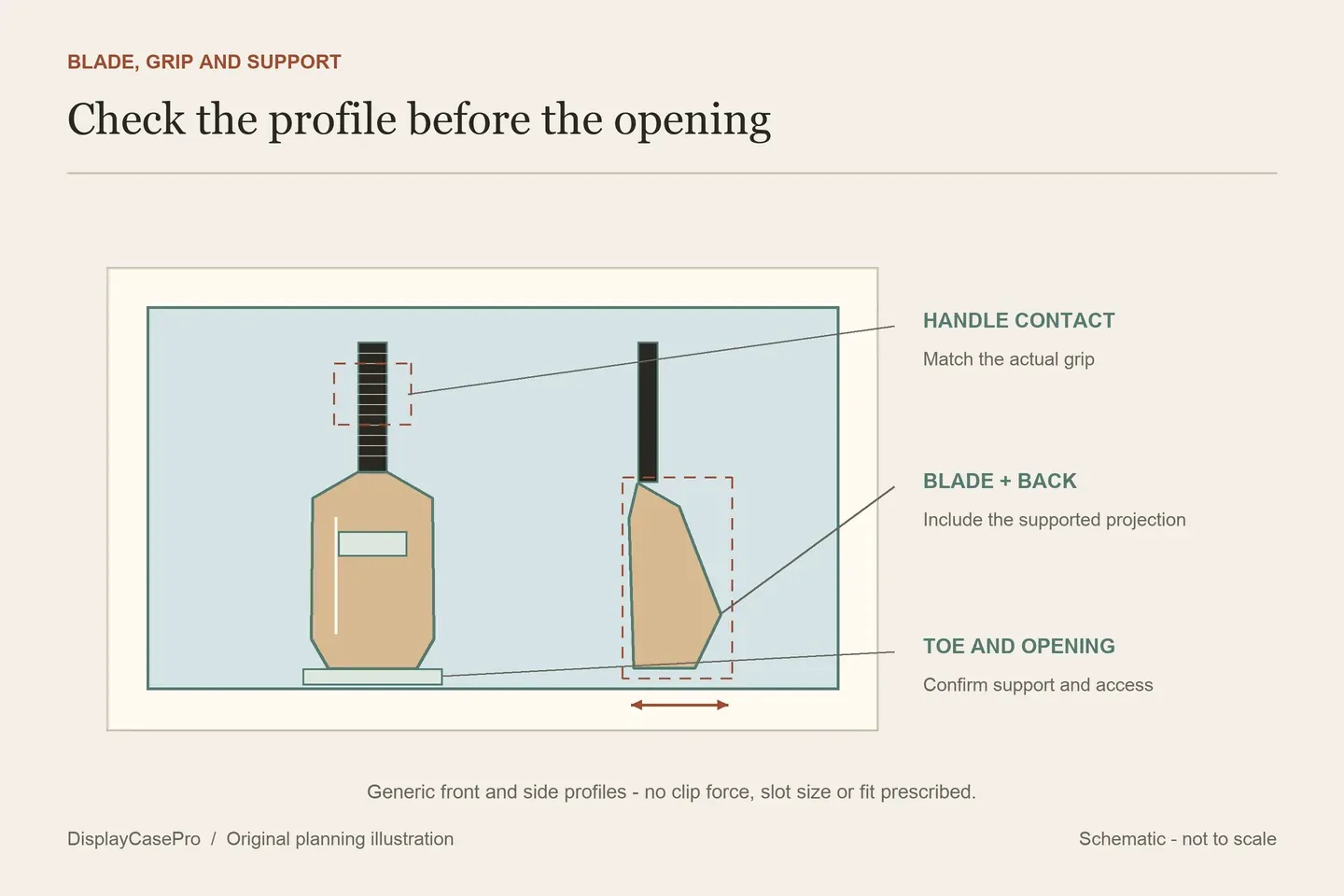
Decide which face carries the important detail, such as a signature, team inscription or personal achievement. Draw that intended front view and a side profile. The back of the blade and the grip can project differently from the face, particularly once the bat is held away from the backing.
Keep the display support in those drawings. A clip contacting the handle, a support at the toe and a cradle around a blade are different arrangements. A narrow support designed for a baseball bat's cylindrical shaft should not be assumed suitable for this bat's broader profile.
If a miniature is involved, record its actual dimensions and grip shape rather than treating it as a precisely scaled full-size bat. A mini-bat case still needs the correct contact area, clear depth and opening for that particular souvenir.
Framed dimensions distinguish products, not clear interiors
Three Sports Framing Factory listings provide a useful comparison. These Australian supplier pages were read in October 2026. Their approximate framed sizes are retained below; they are not labelled internal cavities, and availability for another destination has not been established.
| Exact product | Published framed size | Listed construction or support |
|---|---|---|
| Single full-size cabinet | Approximately 400 × 1010 mm. | One full-size bat, timber frame, mat finish and hinged front. |
| Single mini cabinet | Approximately 170 × 590 mm. | Handle clips, hinged front and rear hanging device; bat excluded. |
| Double full-size cabinet | Approximately 500 × 1010 mm. | Handle clips, hinged front and an intended two-bat arrangement. |
Request labelled usable width, height and depth for the exact version. The two-axis framed sequence does not identify space remaining after the frame, backing, clips and front panel. Do not subtract a guessed moulding thickness to invent that cavity.
The double listing's 500 × 1010 mm frame is not a doubled version of the single listing's 400 × 1010 mm sequence. Its two-bat description therefore cannot be translated into two independent rectangular compartments. Ask for labelled axes, the intended blade positions and the available space between them.
Keep graphic design separate from physical compatibility. A team background or custom caption can suit the collection, but it does not establish a different clip opening, deeper cavity or room for another bat. Choose the actual object and support configuration before the artwork.
A handle clip needs to match the actual grip
The mini and double products explicitly mention handle clips. Obtain their intended contact position and operating method. A clip described as convenient for changing bats does not specify its full opening range or suitability for every grip surface.
Tell the supplier if the important inscription extends onto the handle or back. The support should be considered alongside that existing surface and the desired view. Do not assume a generic pad, adhesive or tighter clip is an approved way to resolve an uncertain fit.
For two bats, draw both supported outlines in the same frame. Include each blade's width and back projection, the grip positions and the intended spacing. A front-view gap can conceal contact between the backs or between a raised grip and the glazing.
Also plan removal of one bat without disturbing the other. The door opening, access to the clips and a place for the released item matter as much as the closed appearance. Ask which operations the maker intends owners to perform after the case is installed.
A top-opening case changes the insertion route
The HT Framing 7186 case quotes W20 × D17 × H100 cm. Its description says the top is removed to insert the bat, with the bat's base received in a slot and accommodation at the handle. The size line does not explicitly label inside or outside.
Ask for the usable cavity, the slot dimensions and the actual handle-support arrangement. General wording about smaller or larger bats does not establish every grip and blade combination. The dimensioned layout should show where the toe rests and how the handle is supported.
A wall position beneath another frame may obstruct top insertion even when the closed case fits. Check the movement of the bat and the removable top at the intended location. The description's rear hanging holes do not, by themselves, specify the right fixings for your wall.
For a bespoke alternative, the Yageli cricket-case collection describes freestanding and wall-mounted designs with custom supports. Treat that as an enquiry route: supply the actual blade, back, grip, viewing face and support requirements. A material-thickness description is not a ready-made usable-space specification.
Choose between a hinged front, sliding cover and removable top
A hinged front allows access from the face of the display, but needs a door-swing area and a clear route to the clips. A top-opening case needs its own vertical insertion space. These are different operations and should be checked on the actual wall plan.
A sliding panel is another construction. The Napier In Frame personal bat-case project describes a clear top running in grooves. It illustrates why the direction and end clearance of a sliding cover matter. That one-owner project is not a universal support or material specification for another signed bat.
For any chosen case, identify the moving panel, its release method and where it rests while you work. Follow the maker's instructions rather than assuming a removable assembly panel is also the normal access panel. Do not bend the bat or force a grip past an unresolved opening.
Map the full outside frame and its access movement with neighboring displays. The collection wall layout guide helps place that verified outline; the shadow-box usable-depth guide explains why frame depth and clear object space need separate measurements.
Use the blank cricket-bat support and case worksheet to retain the full-size or mini identity, blade/back profile, actual grip, clip or toe support, paired layout and opening. Leave unresolved cavity or contact fields blank until the supplier answers.
Common questions
Does “full-size” define the case's usable length?
No. It identifies an intended product family. Compare your complete supported bat with confirmed usable axes and the intended opening.
Will any two bats fit a double cabinet?
Confirm both actual profiles, clip positions, depth and separation. A nominal two-bat description does not supply those details.
Can the framed dimensions be used as the interior?
Keep them as framed dimensions. Obtain a separate usable cavity, including space remaining above the backing and supports.
Comments
Share a display tip or ask a question.