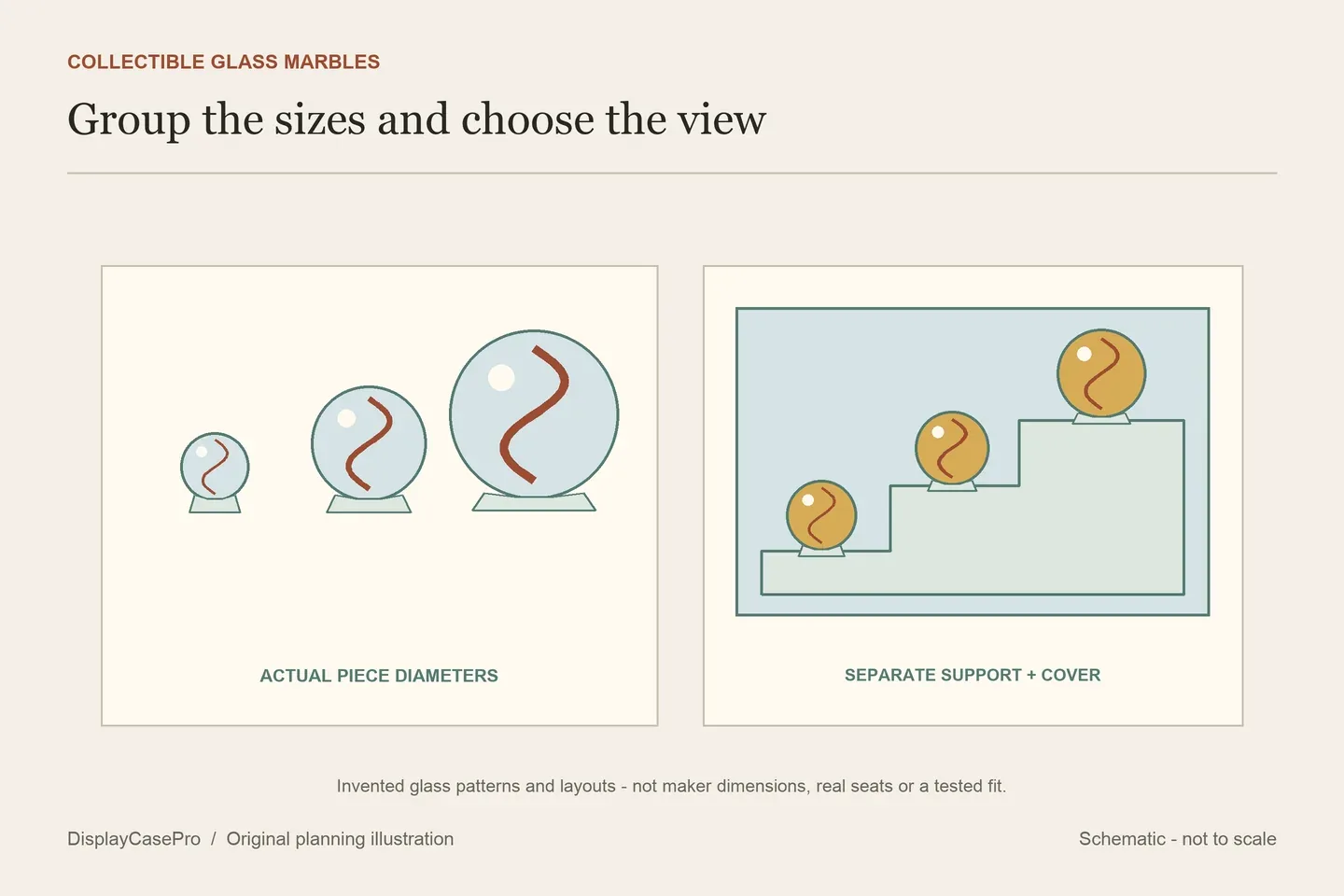
Choose a display case for collectible glass marbles by grouping their actual diameters, selecting suitable seats and deciding which patterns you want to see. Then check the complete supported arrangement beneath the cover. A case count, a stand labelled “Large” or a box made from marble stone does not establish those fit details.
Start with glass marbles and their actual diameters
This guide concerns small collectible spheres, including glass marbles. A “marble box” can also mean a container made from natural stone. That material description does not supply seats for collectible spheres or a transparent view of the objects inside.
For example, the Paolo Marble Box is a stone decorative box with a removable lid and overall L7 × W7 × H3-inch dimensions. The Joss & Main marble-box category likewise concerns stone-material decorative storage. Those are different choices from an enclosure that continuously shows a glass-marble collection.
List the diameter of each piece and retain its units. Use a measurement method suitable for its condition without clamping or scratching the surface. Keep a supplier's nominal diameter distinguishable from your own measurement, especially when choosing a close receiving position.
Do not let a name such as shooter substitute for that record. A collection can mix small playing marbles, larger art pieces and spheres with very different profiles. Also separate documented materials from appearance: a transparent or stone-like finish alone does not identify the composition.
Choose a seat before selecting the surrounding cover
| Arrangement | Useful viewing task | Check for each assigned piece |
|---|---|---|
| One stand beneath an individual cover | Feature a selected pattern or larger sphere with its own label. | Intended diameter range, contact geometry, supported height and the cover's clear interior. |
| Tiered stand inside a larger case | Show a small sequence with rear positions raised into view. | Receiving positions, loaded height on each tier and access to the rear pieces. |
| Divided tray or cabinet arrangement | Give many documented pieces individual places. | Suitable retention within each position, clear depth, visible pattern and intended orientation. |
| Open individual stands | View a selection without looking through an enclosing front. | Actual seat fit, placement and retrieval; a stand alone supplies no closing cover. |
A divider organizes locations but does not necessarily stop a sphere moving within them. Conversely, a seat can locate a marble while hiding part of the decoration. Compare the intended support and view together, rather than treating either a grid or a round recess as complete proof of fit.
Keep the support's own footprint in the plan. A small marble on a broad stand can occupy more shelf space than its diameter suggests. Raised positions also consume height beneath the same cover, so their supports need to remain part of the complete receiving record.
Published names and counts leave important dimensions unanswered
The House of Marbles collector category includes labelled 35, 40, 50, 60 and 80 mm pieces among its returned products. That range illustrates why one repeated seat size should not be assumed suitable for an assorted collection. The category labels are not measurements of every individual piece or variant.
| Support | Published description | Information to obtain |
|---|---|---|
| House of Marbles Glass Marble Stand | A glass stand with a concave ridge intended to locate the marble; Medium and Large options. The pictured marble is excluded. | Numeric receiving range, contact profile, stand footprint and supported height for the selected option. |
| Ultimate Finds Box Tier Marble Display, Part 16 | A customizable tiered display described as holding 15 marbles. | Accepted diameters, dimensions of the receiving positions, complete outer size and loaded height. |
The stand's Medium and Large labels do not define a millimetre range. Establish that range for the actual option and marble. Its concave top is a support feature described by the seller, not a tested guarantee for every sphere or for moving a loaded arrangement.
The Ultimate Finds Box category also names a single display and a separate shooter tier. Keep those products distinct. The 15-marble statement belongs to Part 16 and should not be transferred to the shooter model or interpreted as 15 mixed large spheres fitting under a cover.
Neither cited support description establishes a supplied clear enclosure. If you want a closing case, select and verify that part separately. Do not estimate its size from a product photograph or from the number of positions shown.
Show the feature you actually collect
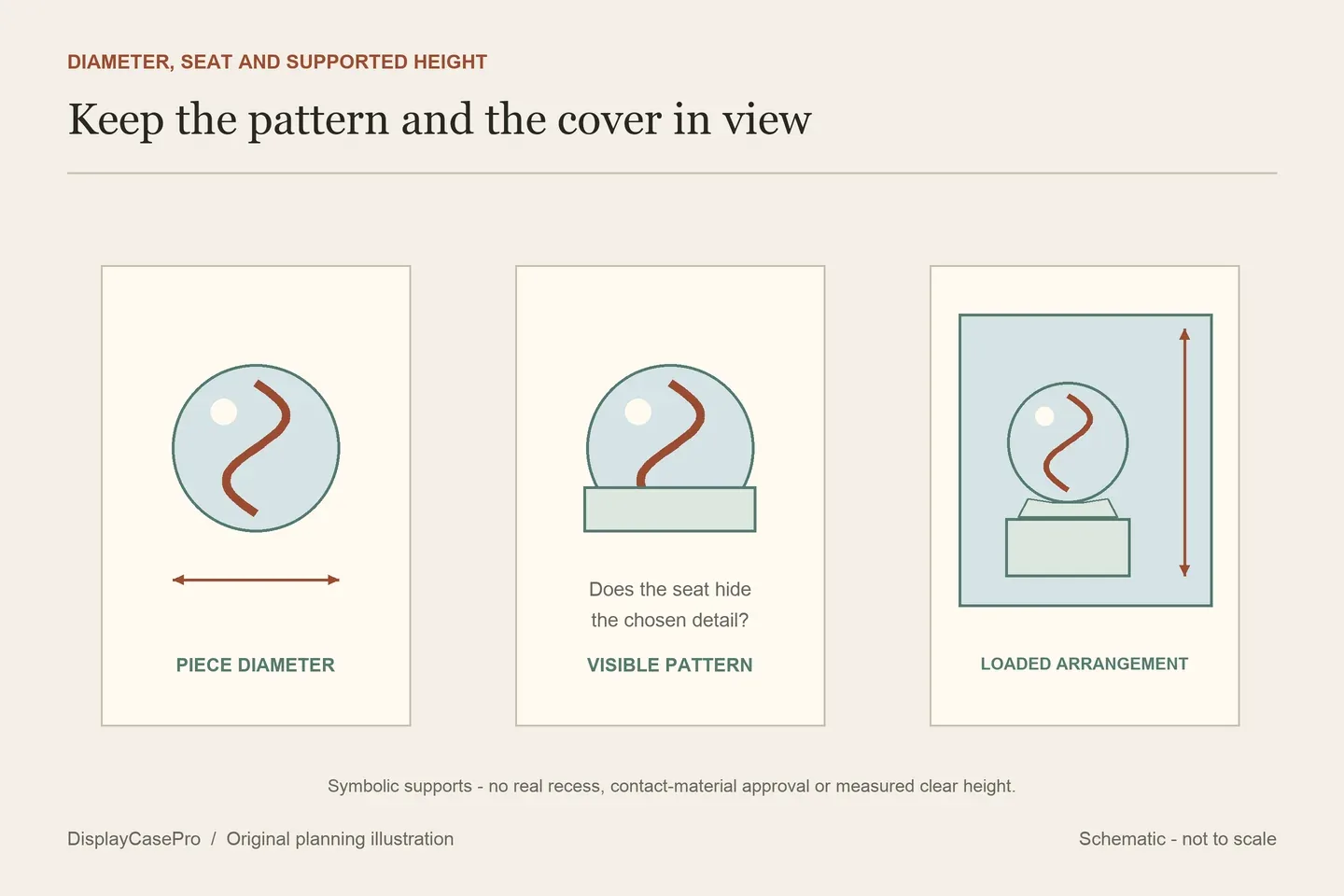
Choose a viewing direction for each assigned piece. An external motif, an internal swirl and an opaque color pattern may read differently against the same backing. A seat that covers the lowest part of a sphere can conceal a detail you want visible even when its diameter is accepted.
Compare a few representative pieces at the intended viewing height before settling the layout. Check the nearest and rear positions from the same location. Give a larger marble its own space when it otherwise blocks the view of a smaller one, rather than preserving a full nominal count at the expense of readable patterns.
A clear front adds its own reflections. Plan the room view and the light position together; the cabinet lighting guide covers that separate layout task. Do not infer a light's effect on an unknown material, or a protective rating, simply because the fitting uses LEDs.
Check the loaded supports and the opening route
For a separate cover, record the whole arrangement from its finished resting surface: supports, marbles and any labels or risers. Compare that outline with documented usable interior space. Overall case height is not necessarily the clearance above the assembled tier or base.
Plan removal from the populated display. Can the selected marble be reached without pushing against a neighboring sphere? Must a front door swing, a panel slide or a complete cover lift? Follow the actual case and support instructions, with a suitable place ready for any removed component.
Choose the intended contact materials with the support supplier's guidance. An improvised ring, adhesive or lining should not acquire a compatibility claim merely because it appears in a photograph. A documented support and an explicit unresolved fit question are more useful than a guessed universal fix.
Give each position a reference linked to the maker, acquisition details and images that are actually documented. Leave uncertain identity or age marked as uncertain. A display comparison does not authenticate a handmade marble or establish rarity or value.
Use the blank marble size, seat and viewing worksheet to keep those details together. The collection measurement guide covers the complete supported outline, while the usable-space guide distinguishes the finished interior from the outer case.
Common questions
Can every marble use the same stand size?
Confirm the actual receiving range and contact profile. Medium and Large option names do not provide that specification, and a mixed collection can include very different diameters.
Does a 15-marble tier include a clear case?
The cited Part 16 description gives a display count without specifying a closing enclosure. Confirm the supplied contents and select any separate cover around the complete supported arrangement.
Is a decorative marble box suitable for viewing glass marbles?
A solid stone box with an opaque lid provides a different view from a transparent enclosure. It also does not establish individual seats or retention for its contents.
Comments
Share a display tip or ask a question.