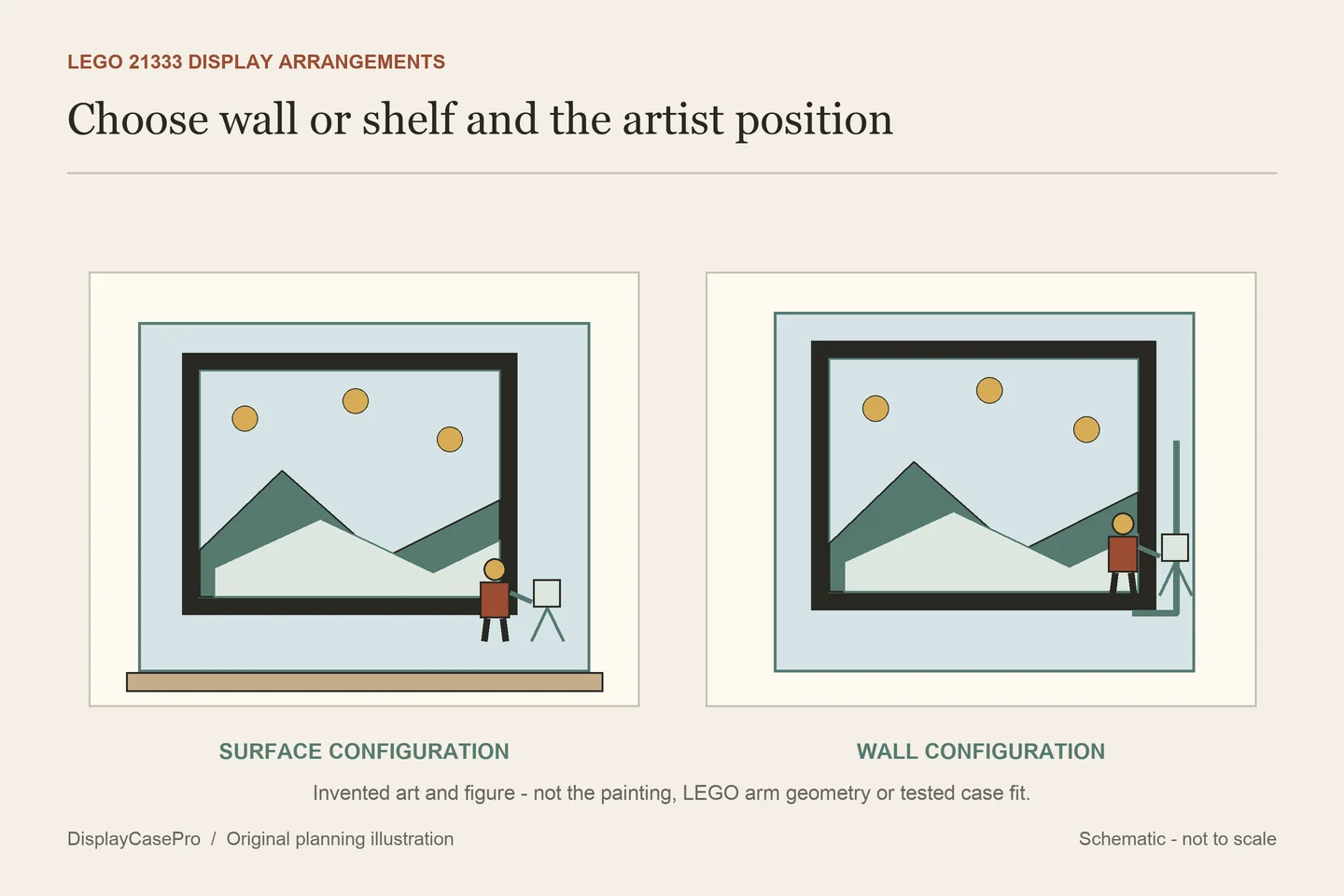
A LEGO Starry Night display case has to accommodate a three-dimensional artwork, not just a flat picture. For set 21333, decide whether you want it on a shelf or wall, and where the artist minifigure, easel and adjustable arm will sit. Those choices affect the enclosure you need.
Some products support both wall and surface display; others have separate wall and regular versions. The comparison below keeps those configurations and their dimension definitions separate. It uses published specifications checked in October 2026, without claiming hands-on fit or installation tests.
Decide what belongs inside the enclosure
LEGO’s official 21333 description identifies a relief that can stand freely or hang from its wall hook, with an adjustable display arm for the artist minifigure. Its descriptive size reference is over 30 cm high, 37.5 cm wide and 12.5 cm deep. These are published model references, not the usable dimensions of an aftermarket case or every possible arm position.
Choose your presentation before comparing products. You might want the artwork with the artist on the original arm, or prefer a separately arranged minifigure and easel on a case base designed for them. Those are different display configurations. A photo showing a figure does not establish that its support, pose and entire projecting arm are covered by the quoted case.
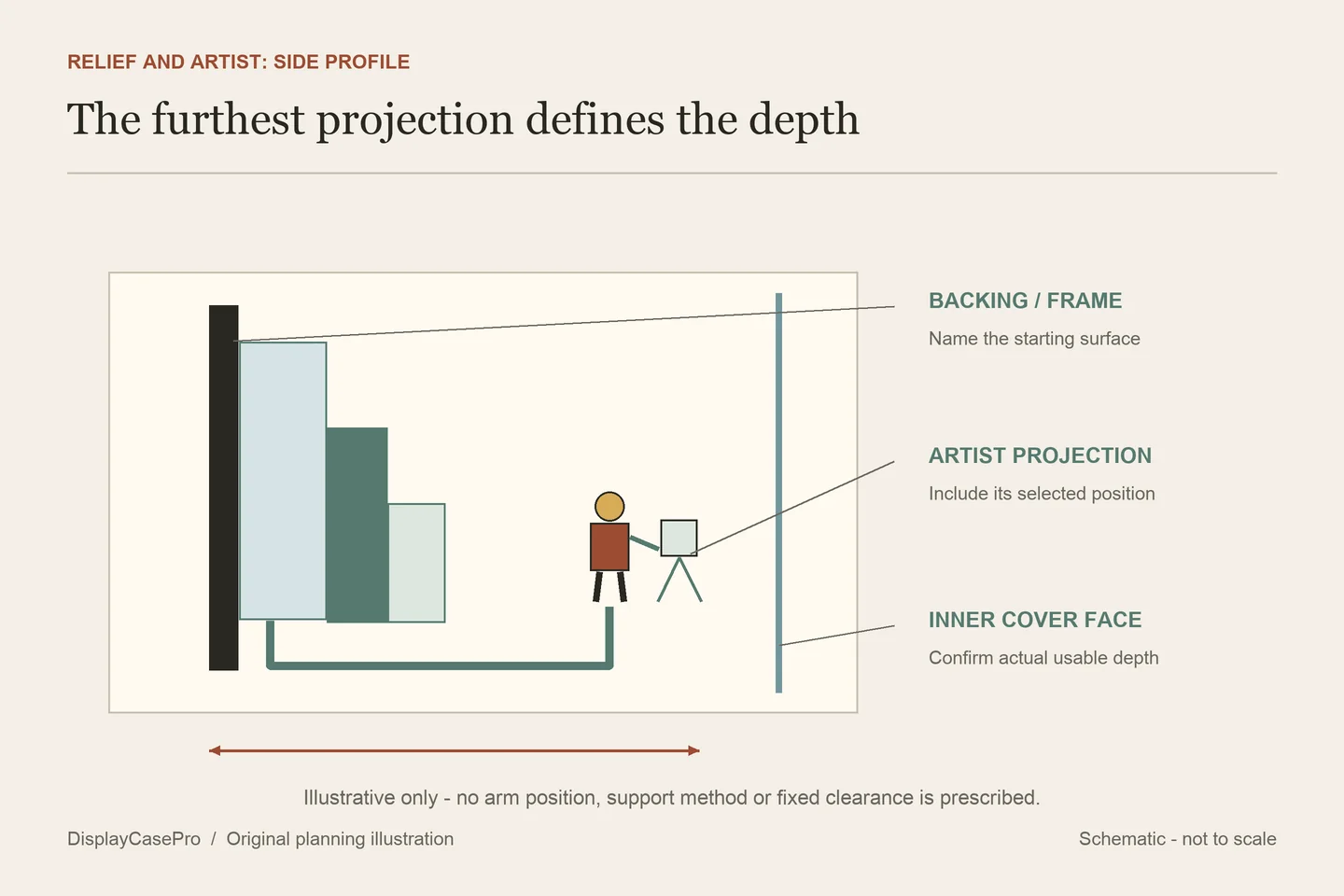
Record the furthest projection from the backing side of the completed display to its most forward detail. Include the artist arrangement, rather than measuring only the black border or the relief within it. For a wall location, that projection also affects how far the whole display extends into the room.
Keep an open frame distinct from a complete enclosure. A surrounding border can finish the appearance while leaving the front exposed. If a cover is part of your goal, check that the selected product actually supplies it and how it attaches to the backing.
Wall and shelf versions have different specifications
The table retains the suppliers’ axes and units. “With base” and “without base” describe configurations; they are not substitutes for an explicit inside/outside definition.
| Exact listing | Published figures | Definition and configuration |
|---|---|---|
| Wicked Brick 21333 | With base: W42 × D17 × H31 cm. Without base: W40.6 × D15.6 × H30.5 cm. | Wall or surface presentation. These lines do not explicitly label clear interior versus exterior. |
| iDisplayit wall case | Inside L41 × W18 × H31 cm; outside L43 × W20 × H32 cm. | Separate labeled interior and exterior for the wall-mounted version. |
| Kingdom Brick Supply 21333 | Approximate inside L39.2 × W20 × H29.6 cm; outside L40.7 × W21.5 × H30.5 cm. | Wall case with removable front. Confirm the complete artwork and artist configuration against these figures. |
| Flying Box wall case | L16.5 × W5.5 × H13 in. | The size line does not state inside or outside. Do not transfer the regular version’s depth to this one. |
| Flying Box regular case | Case L16 × W8.5 × H12 in; separate base 16.5 × 9 in. | The case line is not labeled inside/outside. The separate base footprint also needs to fit the chosen surface. |
There is no useful smallest-to-largest ranking until the definitions match. Compare the entire selected arrangement with a confirmed usable interior, then compare the complete outside with the wall location or furniture. The apparent depth difference between two products is a reason to check the intended artist position, not proof that either one fits your preferred pose.
Wicked Brick describes embedded studs for the minifigure and easel. That tells you there is an intended accessory arrangement to inspect. It does not establish every adjustable-arm position. Ask which components remain attached to the artwork and which are expected on the display base.
A published height mismatch needs an answer
The Kingdom Brick Supply interior height of approximately 29.6 cm is lower than the official model description’s over-30 cm reference. The difference could involve the configuration or the way dimensions were recorded, but the pages do not resolve that for your arrangement.
Ask for confirmation of the whole model, including its frame and intended artist presentation, and a drawing that identifies the clear interior. Do not silently replace one number with the other or use a customer’s fit report as a measurement. A successful photograph can show a different arrangement from yours.
The official product’s small dimensions widget also rounds width and depth differently from its descriptive specification. Keep the descriptive reference together rather than selecting a favorable value from each block. Your actual completed arrangement and the case maker’s confirmed usable space are the relevant comparison.
A page naming 21333 without a usable dimension block is incomplete evidence for this decision. Ask for the missing figures. Generic stacking, mounting or Formula 1 compatibility FAQs do not answer how a deep art relief and projecting artist fit inside this particular enclosure.
The artwork’s hook and the case’s attachment are separate questions
LEGO describes a hook for the model itself. An aftermarket wall enclosure introduces its own backing, fittings and attachment method. Check how the case supports the model, how it attaches to the wall and which components are included. The model’s hook does not establish that the case can use the same arrangement.
For a two-position product, follow the maker’s instructions for the selected wall or surface configuration. Removing a base changes the package; it is not simply an opportunity to subtract its thickness from every dimension in the table. Confirm the outside profile and usable interior for that exact mode.
Then plan access. A removable front may need space in front of or above the enclosure before it clears its fittings. A separate cover may follow another route. Check that nearby frames, furniture or a shelf do not obstruct the intended movement.
For a shelf display, include the entire base footprint and identify where the removed cover will rest. Keep the case’s relocation instructions with the product. Kingdom Brick Supply specifically says its case is not designed to be relocated with the LEGO set inside; an enclosure should not be assumed to be a transport container.
Prepare the enquiry around your preferred view
Use the 21333 arrangement and case worksheet to record wall or shelf mode, artist position, complete profile and the source definition of each case size. Keep a separate row for a version with the base removed.
A useful enquiry is: “For set 21333, I want the complete artwork with [artist on its arm / artist and easel in the specified base positions]. Does this exact case version accommodate that arrangement without altering the model? Please confirm clear internal dimensions, complete outside dimensions, supplied attachment parts and the front-cover removal route.”
For a group of wall displays, use our collection wall planning guide after the enclosure is chosen. The physical layout should use the complete case outline and access space. For the depth terminology itself, see usable space inside a display frame.
Will a wall case include the artist arm?
Check the maker’s intended arrangement and package. A case may provide separate figure positions rather than accommodate every pose on the model’s arm. Set-number compatibility alone does not settle that detail.
Can I use an ordinary flat picture frame?
A flat frame’s print opening does not describe space for the relief and its projections. Establish the usable depth, support and cover arrangement for the completed model before treating it as a suitable enclosure.
Comments
Share a display tip or ask a question.