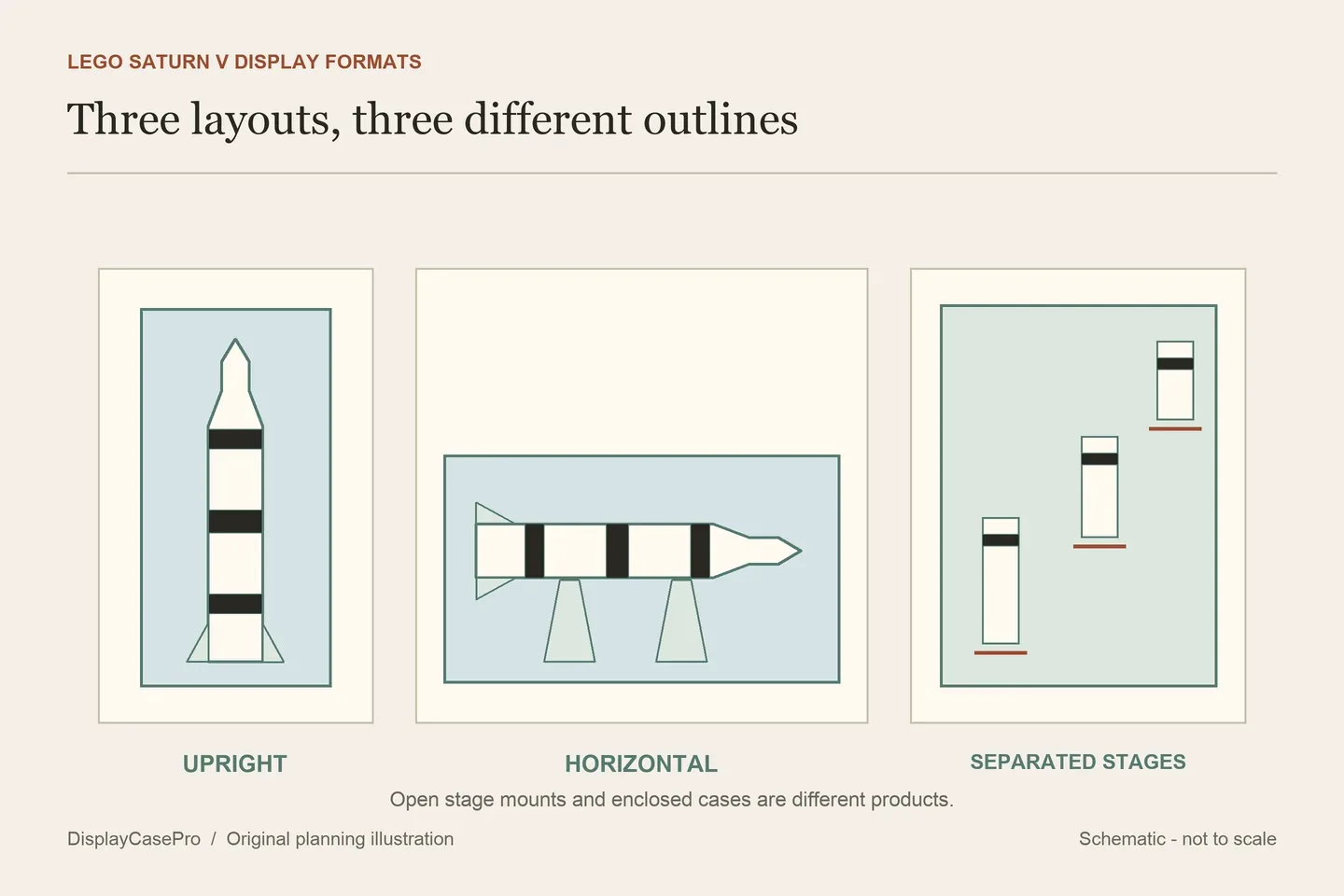
Choose a LEGO Saturn V display case by deciding what the display will contain: an upright rocket, a horizontal rocket, separated stages, or the rocket with a particular launch-tower model. Those arrangements use different supports and very different rectangles of space. A product bearing the Saturn V name does not establish all four layouts.
Choose the rocket configuration before the enclosure
LEGO's Saturn V 92176 description identifies three removable rocket stages, lunar and command components, and three stands for horizontal display. Its descriptive size reference is over 100 cm high and 17 cm in diameter. That identifies the model's general proportions, rather than an exact case interior or the outline of every separated-stage scene.
Record the set number from your own model. The listings discussed here include both 21309 and 92176. Keep a supplier's stated compatibility attached to its specific product; do not assume that a support designed for one number is interchangeable merely because both names say Saturn V.
| Presentation | What defines the display | Question before ordering |
|---|---|---|
| Assembled upright | The complete rocket, its intended support, and any components placed beside it. | What is the finished supported height and the full base footprint? |
| Assembled horizontal | The long rocket profile, cradle locations and any information plaque. | Which supports belong to the case, and do they match your set? |
| Separated stages | Each stage, its own support and the gaps forming the composition. | Is the product an enclosure, a frame or an open mounting system? |
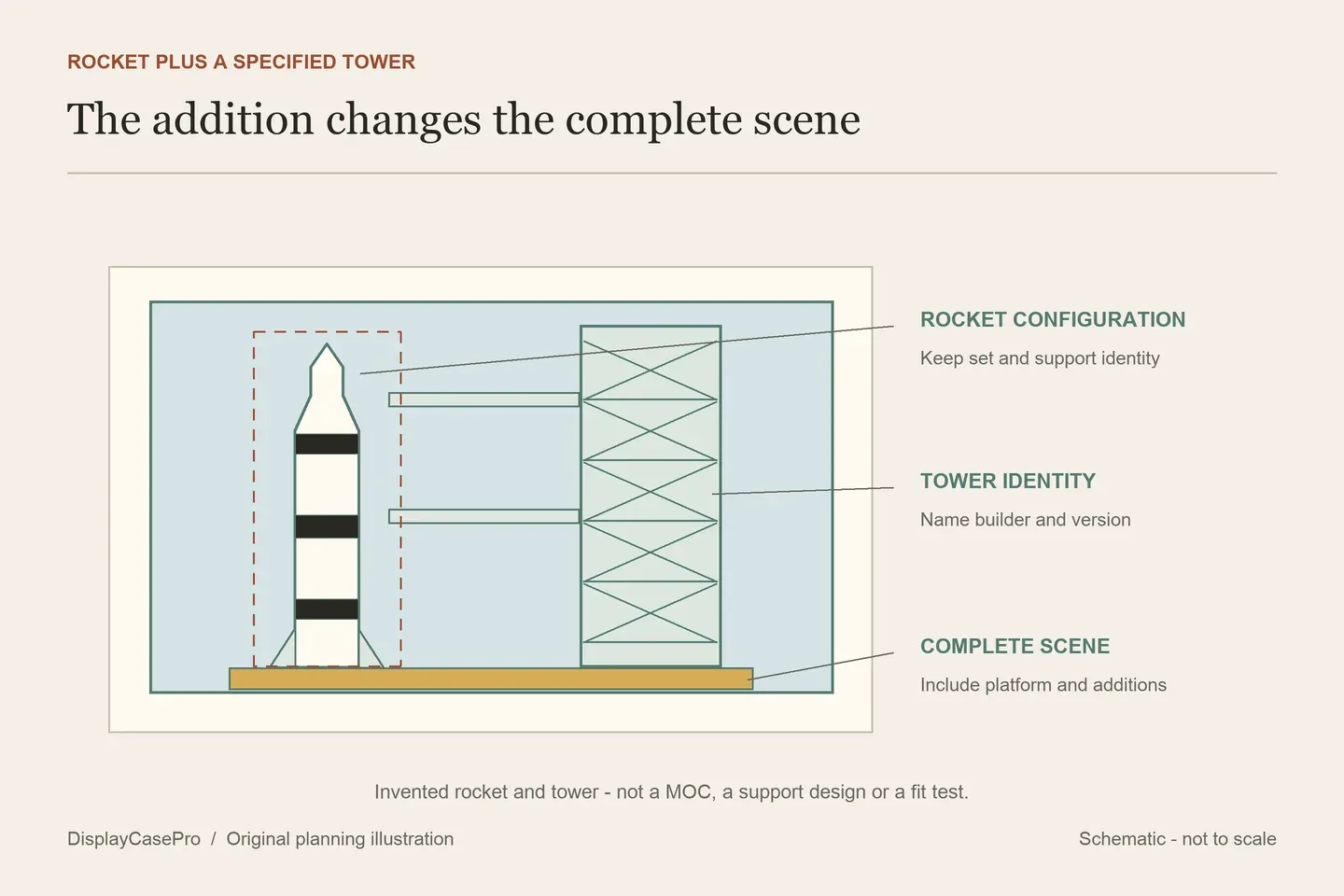
| Rocket plus launch tower | The named tower build, rocket, platform and all projecting details. | Which tower version and complete scene does the maker actually specify? |
Choose where the lunar and command components will be displayed. Placing them in front of the upright rocket uses a different footprint from placing them at one end of a horizontal display. A product image can suggest an arrangement, but the selected layout and supplied supports need to be confirmed in the specification.
Compare enclosed products without mixing dimension definitions
These supplier pages were read in October 2026. Their figures are published specifications, not measurements from our own fit tests. The tower product is included to show the scale of the configuration difference; it is not a larger substitute automatically suitable for every scene.
| Product and intended arrangement | Published metric size | What the number means |
|---|---|---|
| FantasMall vertical 92176 case | 20 × 20 × 110 cm. | The FAQ identifies the labelled size as internal. Confirm the chosen base version and full outside dimensions separately. |
| Wicked Brick horizontal 21309 case | W112 × D21 × H19.3 cm. | Explicitly external. The description supplies two clear support stems and a plaque; this is not a quoted usable interior. |
| iDisplayit Saturn V with MOC Launch Tower case | Inside L47 × W39 × H133 cm; outside L49 × W41 × H134 cm. | A rocket-and-tower enclosure. The particular tower and complete configuration still need to match the maker's intended scene. |
The vertical case's internal height and the horizontal case's external width are not interchangeable “rocket lengths.” Each belongs to a different supported arrangement and measurement boundary. Compare the actual chosen display with a confirmed usable cavity, then compare the entire case with the furniture.
The horizontal product's two stems also differ from the three stands described for 92176 by LEGO. That does not establish a defect or an alternative construction instruction. It tells you to ask which supports the case uses, which set they were designed for, and whether any original stands remain in the intended arrangement.
For the FantasMall listing, the wood-base upgrade and general FAQ exterior offsets should not be combined into an invented precise outside size. Ask for the finished base, fittings and cover dimensions of the exact version being quoted. Its FAQ also describes the painted background as nonremovable, which matters if you expect to change the view later.
Separated-stage wall displays answer a different question
The Elevenmark separated-stage 92176 display describes individual acrylic brackets for the rocket sections. Its selectable combinations include frame and acrylic wall-mount forms, and the page gives a width and height reference of 25 × 120 cm.
Keep the full selected option name. A framed composition, an acrylic wall mount and a lit version should not be treated as one identical physical product. A two-axis size line also leaves the projection from the wall unresolved. Ask which supports and surrounding panels are included in that particular option.
If enclosure is your main reason for shopping, confirm whether a clear front and enclosing sides are actually supplied. The words “wall display” do not establish a dust cover. If your priority is seeing the separate stages, plan their order, the component positions and readable labels before asking for the mounting layout.
Use the product's actual installation documentation for the complete frame or mount. This guide supplies no universal bracket spacing, adhesive method or wall-anchor recipe. The collection wall planning guide helps place the finished outline among other displays once its physical specification is known.
A launch-tower case needs a named tower
The iDisplayit product specifically describes a Saturn V together with a MOC Launch Tower. Treat that wording as a compatibility question about a second build, rather than proof that every fan-designed tower fits. Record its designer, version, platform and any additions before making an enquiry.
Include the tower's full outline and the intended rocket-to-tower position. An access arm, platform edge or separate scene element can determine the required width or depth even when the rocket itself is slender. Do not rotate, compress or remove details simply to make an undocumented layout resemble a product photograph.
Ask the maker for an arrangement drawing showing the supported rocket and tower inside the quoted cavity. If your exact tower is not covered, use its complete measured scene to request a suitable specification rather than relying on the 133 cm height alone.
Plan how the display will open where it will stand
An upright case can be awkward under another shelf if its opening requires the surround to rise over the rocket. A long horizontal surround needs a clear route and somewhere to rest while the stages are reached. Obtain the exact product's operating instructions; closed-case size alone does not describe either movement.
Decide whether stage separation is a permanent arrangement or an occasional activity outside the enclosure. Those are different access plans. Keep the rocket on the supports intended for its chosen state, and do not use a case panel as a structural support.
Use the blank Saturn V configuration worksheet to keep the set, pose, supports, stage positions, tower identity and size definitions together. Our LEGO shelf case guide covers the receiving furniture once the actual enclosure and complete scene have been identified.
Common questions
Is a 100 cm tall case enough?
The official reference says over 100 cm and is not a minimum case specification. Check the full supported arrangement against the usable interior of the selected enclosure.
Does a launch-tower case include the tower?
Check the package contents separately. A description of the intended display is not a statement that the LEGO model or the MOC is included.
Can a staged wall mount replace an enclosed case?
It can serve a different presentation preference, but confirm its actual panels and opening. Do not assume an open mounting product provides the enclosure you wanted.
Comments
Share a display tip or ask a question.