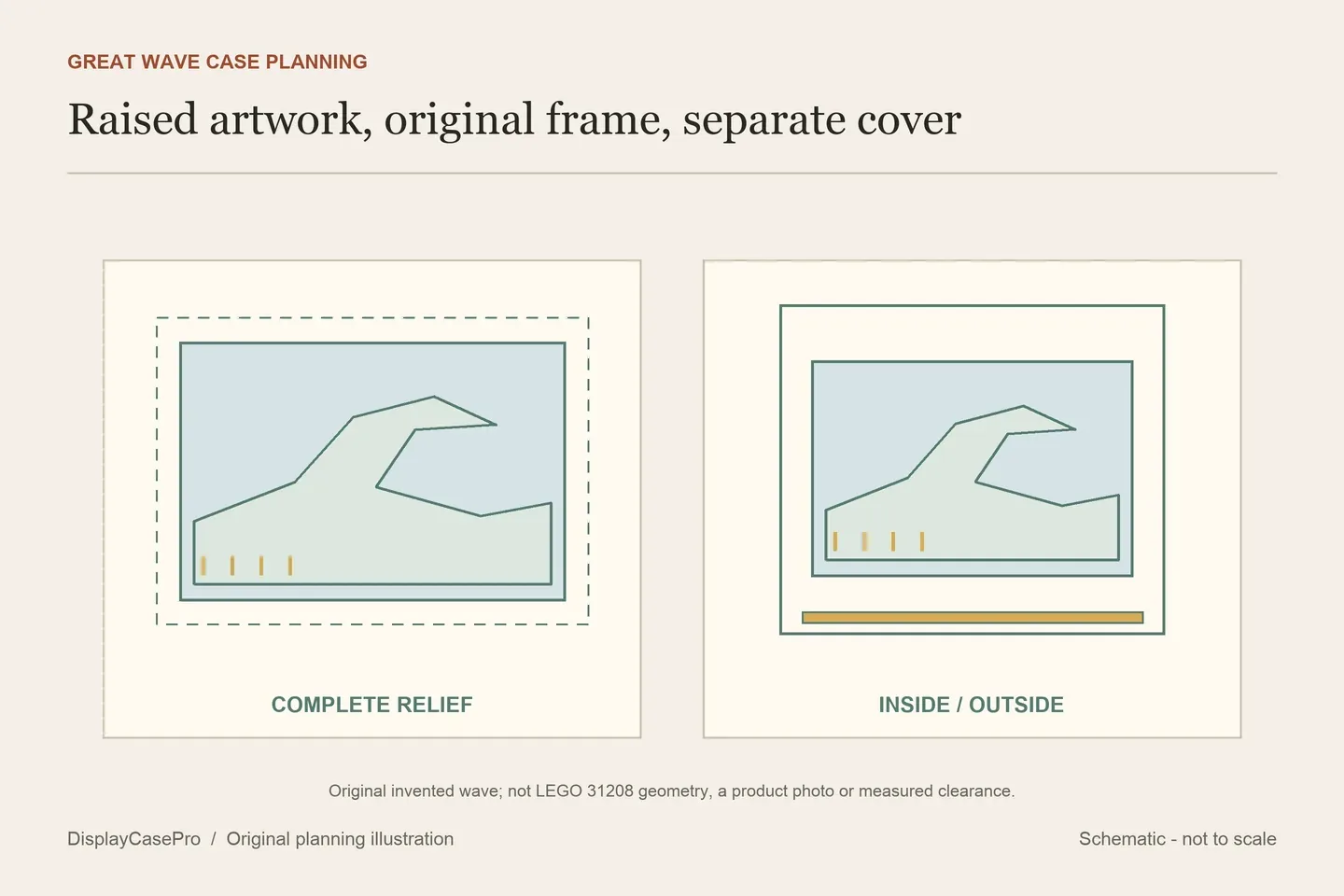
Choose a LEGO Great Wave display case for the complete layered 31208 artwork, including its original frame and rear hanging elements. A wall case’s outside depth is different from clear space in front of the relief. Compare the supplier’s actual dimension definitions, model support and removable-front route before choosing its border or backing.
Record raised artwork rather than a flat picture
LEGO’s official Hokusai – The Great Wave specification describes layered bricks, six canvas plates, two hanger elements and a decorative signature tile. Its model reference is over H39 × W52 cm. The descriptive specification read here does not give a numeric depth.
Keep the finished assembly together in the enquiry. Measure its actual rear-to-front profile, original border and furthest projecting detail. The model width and height are useful reference figures, but they do not provide the whole outside dimensions or usable depth of an aftermarket enclosure.
Six canvas plates do not establish six independently hangable pictures. Likewise, two model hanger elements do not identify every part needed by a wall case. Follow the model’s own assembly instructions and ask the case maker about the complete finished artwork.
A printed frame element on a case adds another visual border. Check that the selected presentation leaves the original artwork and signature tile visible. A clear cover, printed surround and additional backing are separate parts of the display.
Keep centimetre cavities and unlabelled inch sizes distinct
The following three case specifications were read on 18 October 2026. They are supplier descriptions, without physical fit, wall-installation or protection tests by DisplayCasePro.
| Source | Published figures | Definition to retain |
|---|---|---|
| Wicked Brick | W60 × D5.5 × H47.1 cm. | The size line does not label an inside/outside boundary. |
| Flying Box | L22.25 × W2 × H17.25 in. | L/W/H are supplied, but the clear cavity is not identified. |
| iDisplayit | Inside L56 × W05 × H43 cm; outside L59 × W06 × H46 cm. | The source literally prints 05 and 06 for W; retain the labelled rows. |
Wicked Brick’s wall-mounted product describes 3 mm clear acrylic, a 5 mm matte black base plate and screw-and-connector-cube assembly. Those component thicknesses do not supply a clear front-to-back measurement for the artwork. Ask where the quoted depth begins and ends.
Flying Box’s wall case describes 1/8-inch clear and 1/4-inch black acrylic. Its two-inch W figure belongs to the published L × W × H sequence for this shallow wall product. It is not explicitly a two-inch usable interior. Identify the axes and boundary before comparing it with another supplier’s depth.
iDisplayit labels both interior and exterior, so its rows answer different questions. Keep the model-to-case supports, front retaining parts and actual relief profile in the receiving check; a labelled five-centimetre interior alone is not a physical fit test.
Confirm the number when a product address and title disagree
The sampled ICUANUTY product page has 31218 in its address, while its displayed title and breadcrumb name The Great Wave 31208. The product description and product-size controls supplied no readable product-specific dimensions when opened.
Send the maker the actual link and the intended set number, 31208, and ask for the current case drawing and package. Do not silently change the address number, borrow a size from a different artwork or treat a generic Formula 1 FAQ as Great Wave instructions.
Robb Report’s model-release article is another sampled result, but it describes the LEGO artwork rather than supplying a fifth case. Its old release and pricing information is not a current enclosure specification. The official model page is the reference used here for the artwork’s components and size.
Identify two connections and a removable front
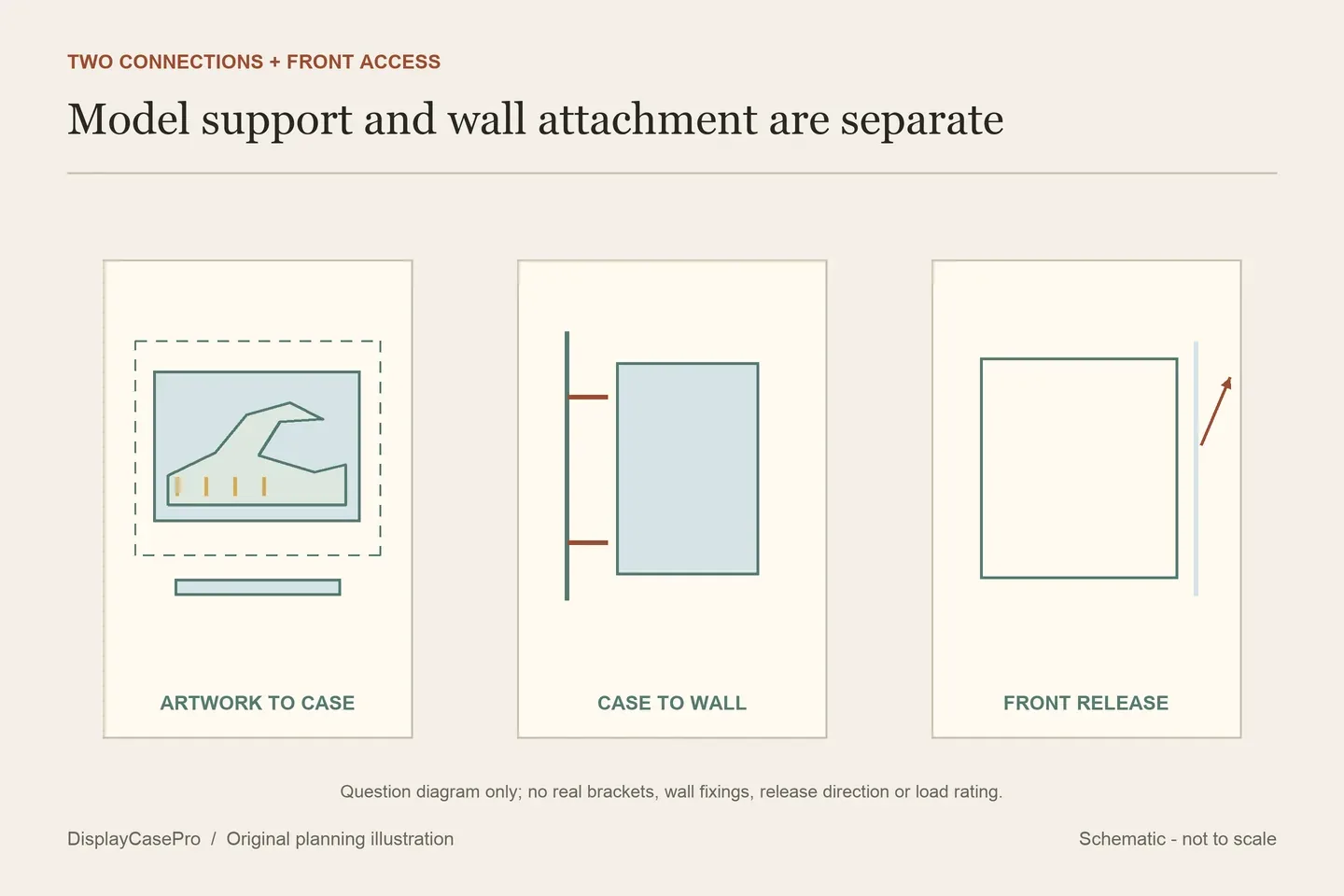
First ask how the assembled artwork is held within the selected case. Then ask how the complete loaded case attaches to the wall. The model’s supplied hangers and the case’s rear holes are different interfaces.
| Part | Ask for | Do not substitute |
|---|---|---|
| Artwork to case | The intended receiving points and current 31208 arrangement. | The presence of two model hangers alone. |
| Case to wall | The exact rear fittings, supplied parts and installation instructions. | Another model’s brackets or a generic wall-anchor claim. |
| Routine front access | Which front part releases, in which direction and how it is supported. | Assembly screw counts as a complete opening procedure. |
iDisplayit describes four screws joining the side panels, twelve attaching the sides to the rear, two rear mounting holes and a removable front using a disguised hook design. That identifies construction and an intended front release, but it does not specify the suitability of a particular wall or the complete artwork-retention arrangement.
Obtain the selected product’s current instructions for those details. The counts above are not a step-by-step installation method, and a different case should not inherit them. Keep the wall construction and full loaded assembly in the installation enquiry.
Reserve the front’s route before positioning neighboring frames
Ask how far and in which direction the front moves before it clears its fittings. A nearby frame or shelf can obstruct that route even when the whole closed enclosure fits on the wall. Decide where the removed front rests before opening it.
Use the complete enclosure width, height and wall projection in the room plan. Confirm the view of the layered artwork and printed border from the place where you expect to see it. A photo of a straight-on front does not show every reflection or side projection.
Keep soundtrack and lighting questions separate. LEGO’s QR soundtrack is part of the building experience; it is not evidence of an electric lighting kit in the case. No lighting-cable opening or lighting package is established by the 31208 descriptions compared here.
Use the Great Wave identity, depth and attachment worksheet. The usable depth guide explains measurement boundaries, and the collection wall planner helps arrange confirmed whole enclosures. A material, dust or UV claim should remain a supplier claim rather than an independent performance result.
Common questions
Can I choose a flat picture frame using the model’s width and height?
Confirm the complete raised profile, supports and clear front depth. A flat picture opening does not describe an enclosure for layered artwork.
Does the model’s pair of hangers attach the whole case to my wall?
Ask for the case’s own attachment and model-retention instructions. The two connections are separate.
Comments
Share a display tip or ask a question.