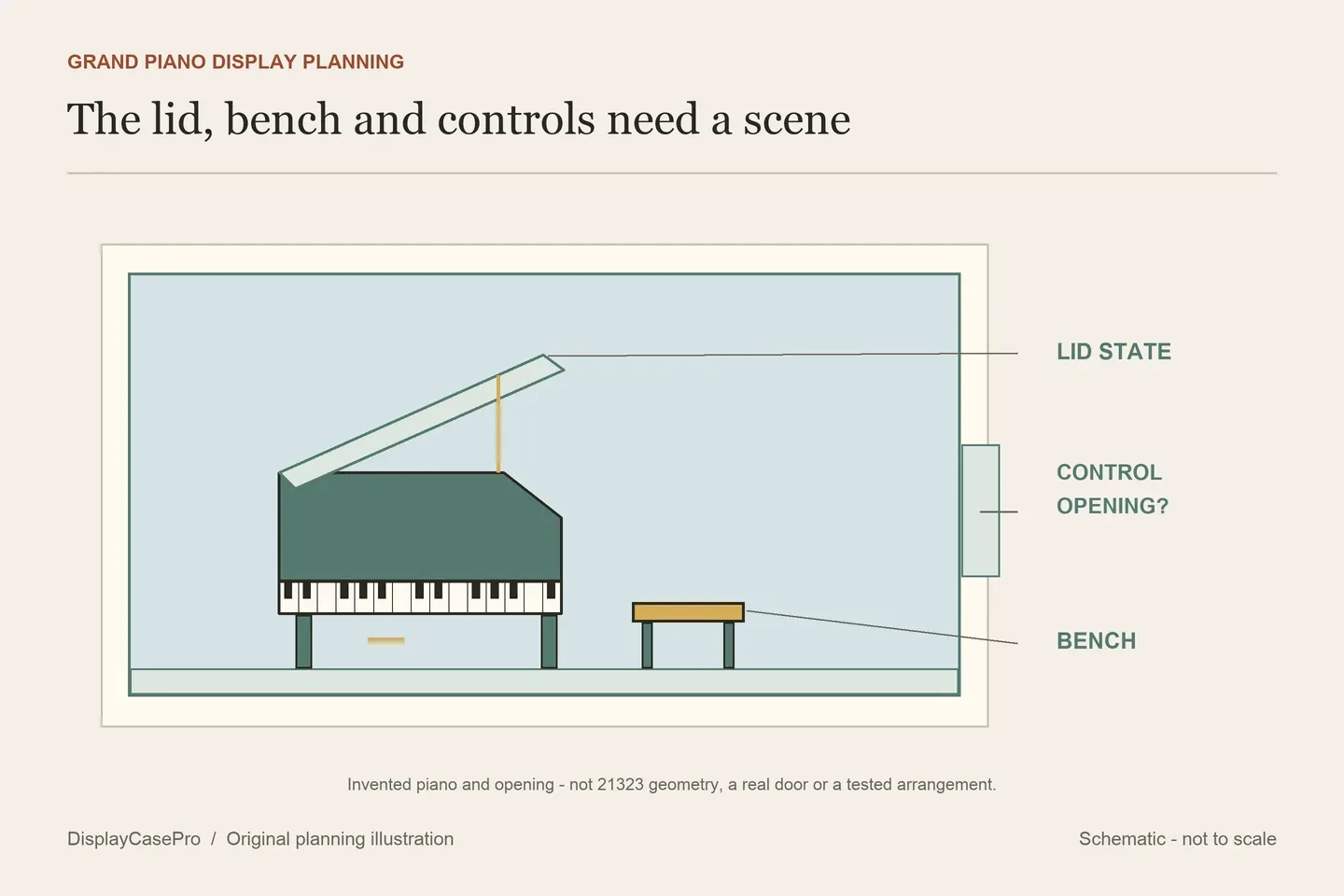
Choose a LEGO Grand Piano display case for the 21323 configuration you want to see and the controls you want to reach. The lid, fallboard, separate bench and access to the powered functions create different requirements. A case that accepts a closed piano is not automatically an enclosure in which you can open the lid or operate every feature.
LEGO's reference dimensions describe a closed piano
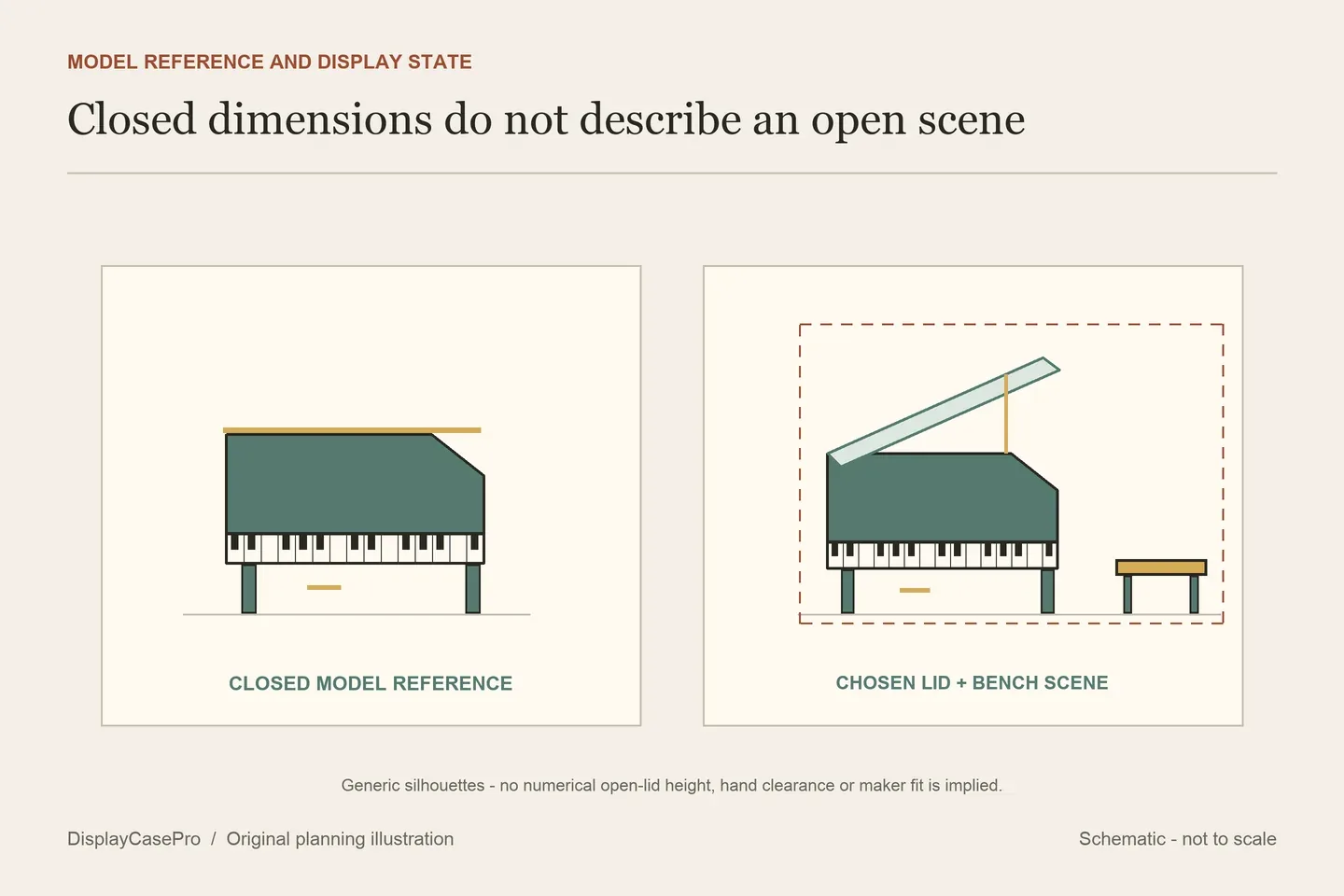
LEGO's Grand Piano 21323 specification gives a descriptive reference of over H22.5 × W30.5 × D35.5 cm when closed. It separately identifies a propped-open top lid, opening fallboard, moving pedal and height-adjustable bench. Keep the closed-state qualifier attached to those model dimensions.
The page also has a rounded dimensions widget. Use one attributed reference consistently; do not combine the widget's rounded numbers with the descriptive line to invent a more precise outline. Neither reference measures your complete piano-and-bench scene in an open-lid position.
Confirm 21323 on the model record and the selected case. A listing for a different brick piano, a protective box around the original packaging or a miniature instrument has a different receiving task. The set's name alone does not establish which object the case accepts.
Choose a resting scene and an operating scene separately
Place the bench where you actually want it relative to the keyboard. A centered seat, an angled seat and a seat presented to one side use different floor areas. Include its complete legs and chosen height rather than counting only the piano body.
| Display element | Record before selecting a case | Access to establish |
|---|---|---|
| Top lid | Closed or propped-open position and the actual highest point. | Whether changing position requires removing the cover. |
| Fallboard and keyboard | The intended visible keyboard state and its front projection. | A suitable approach for the functions you intend to demonstrate. |
| Separate bench | Position, orientation, height and the combined scene footprint. | How it is located and removed without using a case panel as a stop. |
| Powered-function controls | Actual control location for your completed build. | The intended opening and approach, separately from service or battery access. |
Measure the completed scene in each state you expect to retain inside the enclosure. Do not let the cover hold the lid at a convenient angle or press the bench into a narrower arrangement. If the case uses designated locating positions, ask which of your proposed changes those positions permit.
LEGO describes a removable 25-key keyboard and powered operation with its Powered Up app. These are model features, not evidence that an enclosed case leaves room for every action. App and device operation also remain separate from the physical opening; this guide has not tested either.
Compare matching measurement boundaries
The following product descriptions were read on 17 October 2026. They provide different measurement definitions. No piano, opening or completed case was physically tested for this guide.
| Exact case | Published size | Configuration detail to retain |
|---|---|---|
| Wicked Brick 21323, LDS162.1.7 | External W55 × D45 × H48.3 cm. | Lift-off clear cover, locating studs and a magnetic two-tier base; optional printed background. Request usable space above the finished base. |
| iDisplayit 21323 | Internal L47 × W47 × H47 cm; external L49 × W49 × H48 cm. | A side door is expressly described for access to the power functions. Its usable aperture and required model position still need confirmation. |
| ICUANUTY 21323 | 45 × 40 × 40 cm sequence. | The description does not label the axes or inside/outside boundary of this sequence. Integrated base and screw-connected enclosure are described. |
| FantasMall 21323 | 45 × 40 × 40 cm sequence, labelled internal in the page's Q&A section; also listed as 18 × 16 × 16 in. | Confirm the axes and chosen scene. The rounded inch sequence is not a second, more precise cavity specification. |
| Kingdom Brick Supply 21323 | Approximate internal L48.8 × W45.6 × H42.4 cm; external L50.3 × W47.1 × H43.3 cm. | Published 60 × 56-stud area is a separate base reference, not a measurement of the open lid or bench arrangement. |
The two 45 × 40 × 40 cm listings illustrate why identical numbers are insufficient. FantasMall explicitly calls its labelled size internal; ICUANUTY's size line does not supply that boundary. Do not silently transfer one seller's definition to the other product.
Likewise, Wicked Brick's 48.3 cm external height cannot be ranked against iDisplayit's 47 cm internal height as though both measure available room. Request a consistent usable cavity for the exact base and supported scene. Do not subtract advertised acrylic or base thicknesses to manufacture that figure.
A side door answers one stated access task
iDisplayit's description identifies power-function access through a side door. Treat that purpose narrowly: it does not specify room to remove the keyboard, reposition the bench, change batteries or raise the piano's lid. List those actions separately in the enquiry if they matter to you.
Ask for the door's position, clear opening and intended piano orientation. Compare those with the control location on your completed build. A side door can be obstructed by an adjacent cabinet or enclosure even when the closed case fits on the furniture.
Wicked Brick instead describes lifting the clear cover from the base and returning it to its grooves. Plan that full removal route above the raised piano and identify a resting place for the removed cover. A low shelf above the display can prevent this routine.
Keep the keyboard, bench and case opening useful at the shelf
Choose the main viewing side after resolving the locating arrangement. A three-quarter view can show the lid and keyboard together, but the actual combined footprint must still fit the selected base. A printed background changes that view without proving a different usable interior.
FantasMall says the background on its background versions cannot be removed. Wicked Brick lists a background option and designated base features. Keep those configurations attached to their own products; do not assume all pictured back panels are interchangeable or removable.
If lighting is planned, locate the actual hardware and its controls without closing a panel on a cable. The display lighting guide covers viewing and reflections. This case comparison does not establish UV performance, complete dust exclusion or a tested lighting effect.
Use the blank piano scene and access worksheet to keep closed dimensions, open-lid profile, bench placement and separate control tasks together. Then check the complete outside enclosure against the LEGO shelf display guide. Kingdom Brick Supply specifically says its cited piano case is not designed to be relocated with the set inside.
Common questions
Can I select a case using the official closed height?
Use it as a model reference. Measure the raised lid and complete bench scene if those are part of the display; the closed figure does not describe them.
Does the power-function door provide full maintenance access?
Only its stated control-access purpose is established. Obtain the opening and intended arrangement, and confirm other tasks individually.
Are two cases with the same printed size interchangeable?
No such conclusion follows from the sequence. Check axes, inside/outside definition, locating features and the selected background and base.
Comments
Share a display tip or ask a question.