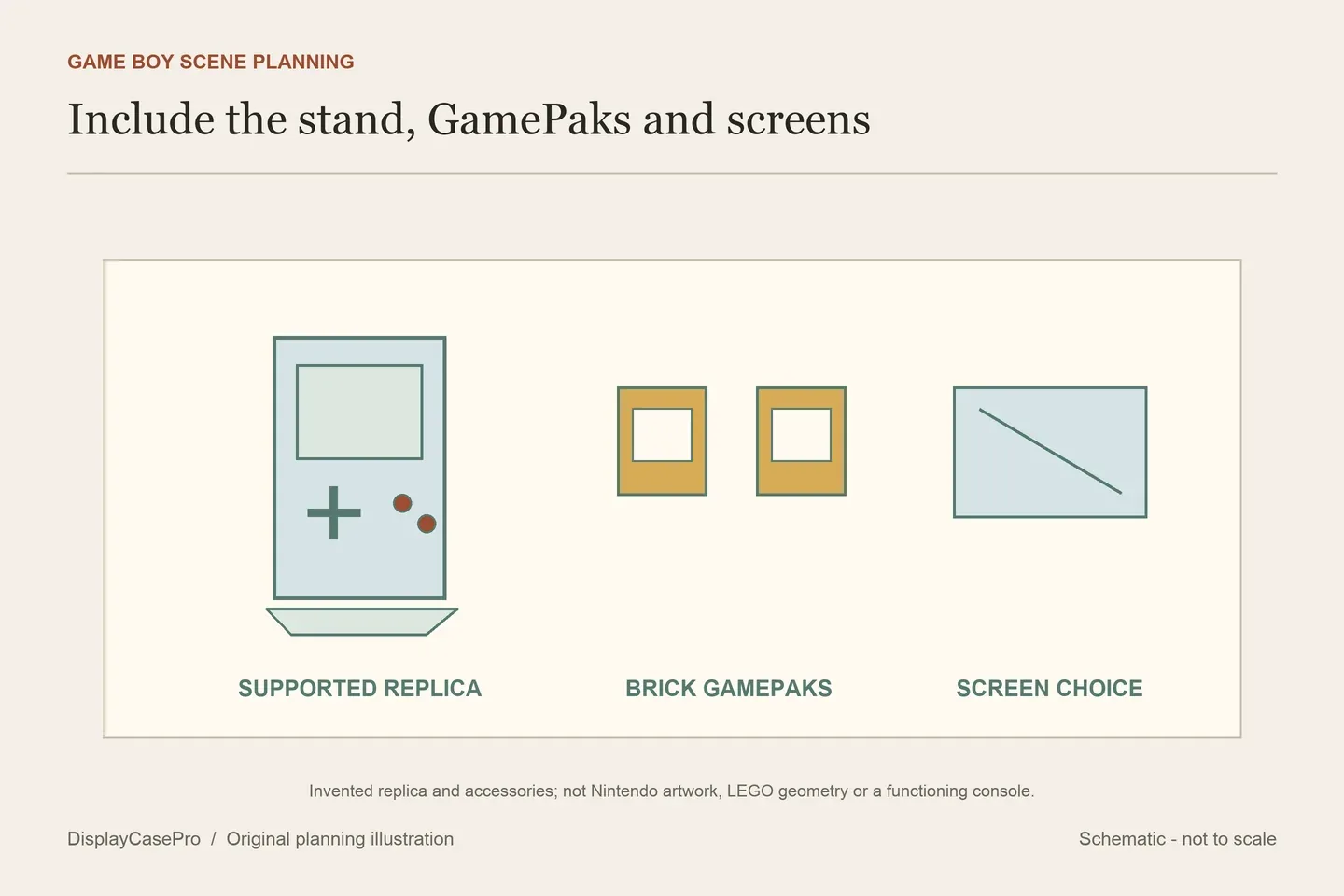
A display case for LEGO Game Boy 72046 needs a plan for the handheld-shaped build, its stand, brick-built GamePaks and lenticular screens. Choose the complete scene before comparing a compact box with a case that supplies dedicated accessory supports. Packaging-inspired printed art is a separate feature from displaying the real retail box.
This is the LEGO replica, with no digital game function
LEGO’s official 72046 description calls the build a near-1:1 replica and identifies the control pad, buttons, contrast and volume dials, and Game Pak slot. It also expressly says the model has no light, sound or digital play functions. Keep those facts together rather than describing a transparent case as a way to play electronic games.
The descriptive model reference is over H14 × W9 × D3 cm. LEGO also supplies a buildable stand, two interchangeable brick-built GamePaks and lenticular screens associated with The Legend of Zelda: Link’s Awakening and Super Mario Land, plus a Nintendo start screen. The handheld’s reference dimensions are not the measured combined scene with every separate component.
A case for an original working Game Boy, a boxed game or a grading holder has another receiving task. Confirm 72046 and the actual included LEGO components in the case enquiry. Do not apply the electronics’ package dimensions to this display merely because the names look alike.
Decide which components are inserted and which are separate
| Component | Settled display choice | Question for the receiving layout |
|---|---|---|
| Handheld replica and buildable stand | The supported position and intended face angle. | Does the combined supported profile have a designated location? |
| Two brick-built GamePaks | Which is inserted and which is shown outside the model? | Are separate supports included and where do they locate each GamePak? |
| Lenticular and start screens | Which screen is in the model and which extras remain visible? | What retains each separate screen and from where can it be seen? |
| Real retail packaging, if wanted | A separately identified physical box. | Does the receiving drawing include that box, rather than only printed box artwork? |
Make one complete top and side view of the intended arrangement. A spare GamePak behind the model can disappear from the normal front view; moving it beside the model changes the occupied width. Adding a screen support also changes the combined height or footprint. Keep those elements named instead of listing only the handheld’s dimensions.
Wicked Brick’s 72046 case describes a centre cutout and clear supports for GamePaks and lenticular tiles. Its printed base and background use original-packaging-inspired artwork. That is a supplied visual treatment, not evidence that an actual cardboard retail package fits inside.
Do not turn an unlabelled tuple into a fit result
The following supplier and publisher descriptions were read on 18 October 2026. No console, GamePak support, screen or enclosure was physically tested. Original measurement boundaries and missing units are retained.
| Source | Published size or format | Resolve before comparing |
|---|---|---|
| Wicked Brick | W25 cm, D13 cm; the returned height line reads “18.3c”. | Height unit is incomplete; obtain a corrected axis-labelled cavity and exterior. |
| Brickcessories | Inside 214 × 114 × 160 mm; outside 226 × 126 × 167.5 mm. | Axis order unlabelled; complete stand and accessory receiving plan. |
| ElevenMark | 19 × 11 × 13 cm sequence; lift-off cover and retro background. | Axes and inside/outside boundary unlabelled. |
| Flying Box | Case L7.5 × W4 × H6.5 in; separate base 8 × 4.5 in. | Case boundary unlabelled; full base and supported scene. |
| The Brick Post, BrixBox report | Retro case format with stud positions for GamePaks. | No labelled cavity in the article read; obtain the maker’s current drawing. |
The ElevenMark sequence does not say that its last value, 13 cm, is the usable height. Calling it height and then declaring it too short for LEGO’s over-14 cm model would invent an axis and boundary. Ask what each number measures before reaching a fit conclusion.
Brickcessories explicitly separates inside and outside tuples, but the read line does not label their axes. Keep that distinction rather than sorting the values to make a convenient comparison. A clear or printed 1989-box-art option also needs its own configuration record.
Flying Box lists a base larger than its case sequence. Include that base when checking the furniture. The case’s selected component layout and usable cavity still need confirmation; neither outside-looking numbers nor wall thicknesses supply them automatically.
Check the lenticular image from the intended viewing place
Choose where the display will usually be viewed before fixing the model’s angle. Inspect the actual screen from that seated or standing position and include the clear front in the final check. This guide gives no universal angle at which every lenticular image will read correctly.
Keep the GamePak labels, unused screen and information plaque visible without covering the handheld’s face. A dedicated support can solve one component’s presentation while creating another obstruction. Ask for the intended layout rather than assuming unused-looking floor space accepts any accessory position.
The Brick Post’s BrixBox report is useful for discovering a retro-case format and GamePak stud positions. Its praise, experience with other cases and shared discount code do not constitute this site’s physical 72046 fit test. No dimensions have been filled in from those opinions.
Keep screen swaps separate from the settled scene
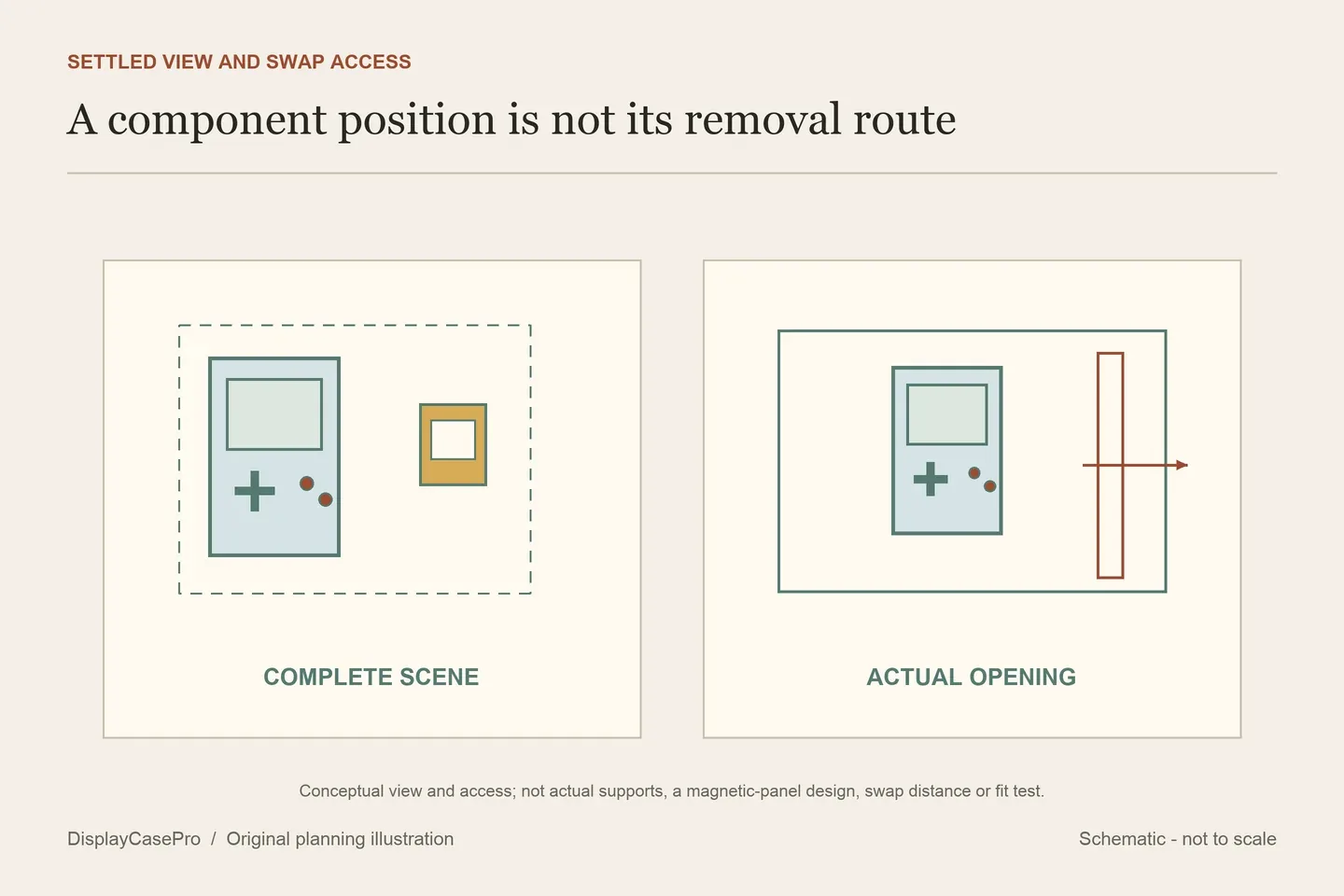
Wicked Brick describes a magnetic removable front. ElevenMark describes a lift-off cover. These are different routines: a front needs a clear forward approach and resting place, while a surround needs a route above and around the supported scene. Confirm the exact product’s instructions and which panel is intended for routine removal.
Decide whether the model and accessories will be removed before an instructed screen or GamePak change. A settled case that receives all components does not establish hand access or the removal route of an inserted component. Do not use a panel edge as an improvised support for the replica.
Use the Game Boy scene and access worksheet to record each component, actual support, missing size definition and opening routine. The LEGO shelf case guide covers the complete enclosure’s location; the display lighting guide addresses reflections separately from model functionality.
Common questions
Does packaging artwork mean the original box is included?
It describes a printed treatment in the cited case. A real retail box is a separate object whose presence and receiving space must be confirmed.
Can the LEGO replica play the pictured games?
LEGO expressly states that 72046 has no digital play functions. The GamePaks and screens are components of the brick-built display model.
Comments
Share a display tip or ask a question.