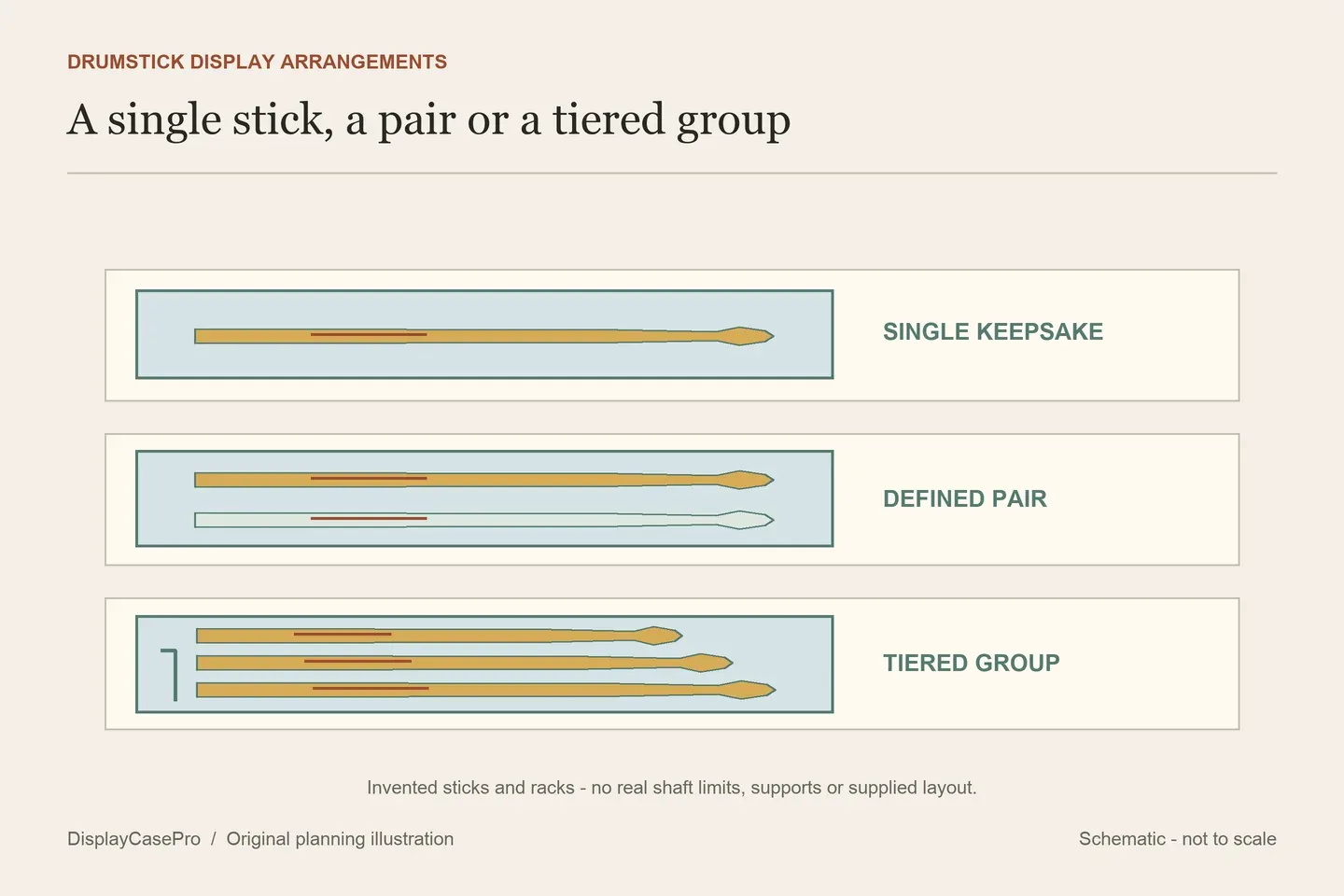
Choose a drumstick display case around the actual stick or group, the inscription you want visible and the supplied supports. A single concert keepsake, a pair and four sticks on a tiered rack require different arrangements. Retail bins and performance holders also appear in search results, so identify the display job before comparing dimensions.
Record the complete stick in the displayed direction
Measure the actual end-to-end length and the widest part of the item you want to display. Include an unusual tip, retained wrapping or other projecting part. A stick described as a standard size in one case listing does not define every marching stick, brush, mallet or modified keepsake.
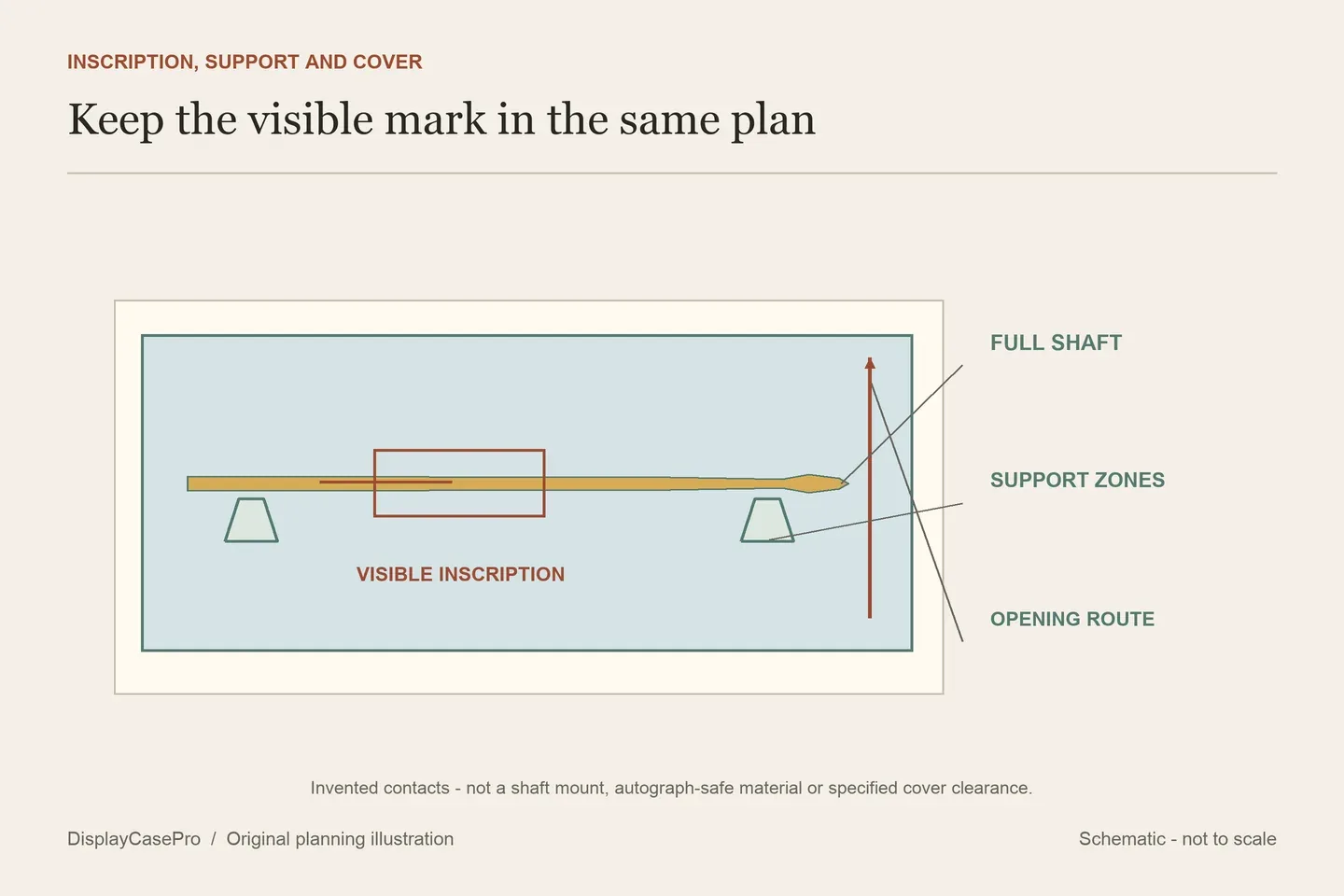
Choose the visible inscription before deciding the support positions. Rotating a round or tapered shaft can improve the view of a signature while changing where it meets a holder. Keep the supported direction and the intended lettering together in the record.
For two sticks, decide whether they are a documented pair, two separately acquired pieces or a composition you have chosen. Parallel and crossed arrangements occupy different outlines. A display that accepts one stick length does not establish room for two crossed shafts or their shared support.
For a group, identify every position rather than filling an advertised count with whatever will fit. A tiered arrangement can reveal more inscriptions, but its highest row also changes the height needed under the cover.
Identify the product's job before its capacity
| Format | Useful purpose | Receiving information to obtain |
|---|---|---|
| Single covered base | Feature one stick on an assigned resting support. | Accepted length and profile, supported height, cover clearance and release route. |
| Tiered covered rack | Show several sticks together at different levels. | Each position's receiving limits, inscription visibility and the complete loaded outline. |
| Wall frame or shadow box | Present one or two sticks, or a planned memorabilia composition. | Usable depth, internal supports, opening and which mounting parts are supplied. |
| Retail bin or performance holder | Offer stock for browsing or keep working sticks within reach. | The intended commercial or stage use. Pocket count or stand-tube fit does not specify a collectible-case cavity. |
The Drum Bum display category includes a holder and separate acrylic cases. Read the chosen product's description; a category label does not make the holder and covered displays the same assembly.
MI Displays' Drum Stick Bin, MI-SPDSB, describes six pockets, floor or countertop stacking and a front merchandising channel. Those features address a retail arrangement. The description read supplies no numeric pocket dimensions or enclosing-cover specification, so six pockets should not become a claim of six individually protected memorabilia positions.
String Swing's SH03 is for keeping sticks accessible during performances and attaches to mic, music or cymbal stands. Its stated ½–1 in range belongs to the stand tube it attaches to. It is not a maximum drumstick diameter or the inside width of a display case.
Separate a stick limit from the case or frame size
The following examples were read on 17 October 2026. They are maker descriptions with their stated limits and missing definitions; none has been physically tested here with your sticks.
| Display | Published description | Question still to resolve |
|---|---|---|
| Drum Bum single acrylic case | For one 16 in stick on a raised base; approximately L17.5 × W3 in. | The case line does not identify inside/outside or height. Confirm diameter, supported profile and clear cover space. |
| Drum Bum four-stick case | Four standard-sized sticks on a tiered rack; approximately 18.5 × 4 in. | The two dimensions have no axis or inside/outside labels. The single case's 16 in limit must not be transferred to this product. |
| Frame My Collection Drum Stick Frame | Overall 23 × 9 in; one or two standard-sized sticks. Moulding described as 1 in wide and 2 in deep. | Moulding depth is not usable depth above the finished mounting surface. Ask for the actual stick supports and receiving limits. |
| My Framing Store record & drumsticks frame | Frame-size line W24 × H20 in; drumsticks opening 2 × 20 in, alongside record and sleeve openings. | The window is not a stated maximum shaft diameter or usable depth. Ask for the complete stick count, arrangement and internal supports. |
The single Drum Bum listing explicitly names a stick length separately from its approximate case size. Keep both lines. A case longer than 16 in does not promise that a longer stick will fit, and a raised resting area occupies some of the available height.
The four-stick listing uses “standard size” without a numeric stick-length limit in the relevant description. Ask what that means for the exact rack positions. Do not substitute a catalogue's familiar drumstick label for the dimensions of an actual collected item.
Frame My Collection offers one- and two-stick options and a choice of mat colors. Confirm the actual selected layout rather than treating the extra stick as an arbitrary addition to one mount. Its frame depth describes the moulding, so the backing and supplied fittings still need to be included in the clear-space check.
Distinguish frame-hanging hardware from stick supports
Ask where each intended support meets the shaft, how it prevents movement and how the stick is released. Keep those contact areas away from an important inscription in the proposed view, with the actual finish and condition identified to the supplier.
The My Framing Store listing explicitly says only the frame's hanging hardware is included and recommends an adhesive approach for attaching contents. That does not establish that a shaft support is supplied or that the suggested adhesive suits every coating or autograph. Resolve the object's mounting method before ordering a display-only composition.
A catalogue claim of quick self-mounting or conservation-safe framing is not a complete stick-specific procedure. Obtain the instructions for the exact holder and item. This guide does not prescribe clamps, adhesive, drilling or changes to a collected stick to make it fit.
Plan the opening around the whole composition
A lift-off clear cover needs a route past the highest supported stick and a place to rest after removal. A rear-opening frame needs its own unloading sequence. Ask which opening the actual product provides rather than assuming its assembly method is also the ordinary access method.
For a record-and-sticks composition, give each component its assigned area. My Framing Store separately states sleeve, record and stick openings; these are distinct positions, not one freely usable empty rectangle. Confirm how all components are supported together without obscuring the important printing.
If a photo, caption or ticket is added, keep it independent from the shaft support. Record the documented association without claiming that a display or signature proves attendance, performance use or authenticity.
The blank drumstick layout worksheet records the complete item, visible face, mount, opening and companion pieces. Use the usable-depth guide for the mounting assembly and the collection wall guide for the finished frame and its access area.
Common questions
Does a two-stick frame accept a crossed pair?
Confirm the intended arrangement and full supported outline. Two positions in a parallel layout do not establish clearance or retention for a crossed composition.
Is a performance holder's tube range the accepted stick diameter?
Check what the dimension refers to. The cited SH03 range identifies the stand tube, so it cannot supply the receiving limit of a stick case.
Does included hanging hardware also hold the sticks?
Read the contents. Hardware for hanging the outer frame and fittings for supporting its contents serve separate tasks and may not both be included.
Comments
Share a display tip or ask a question.