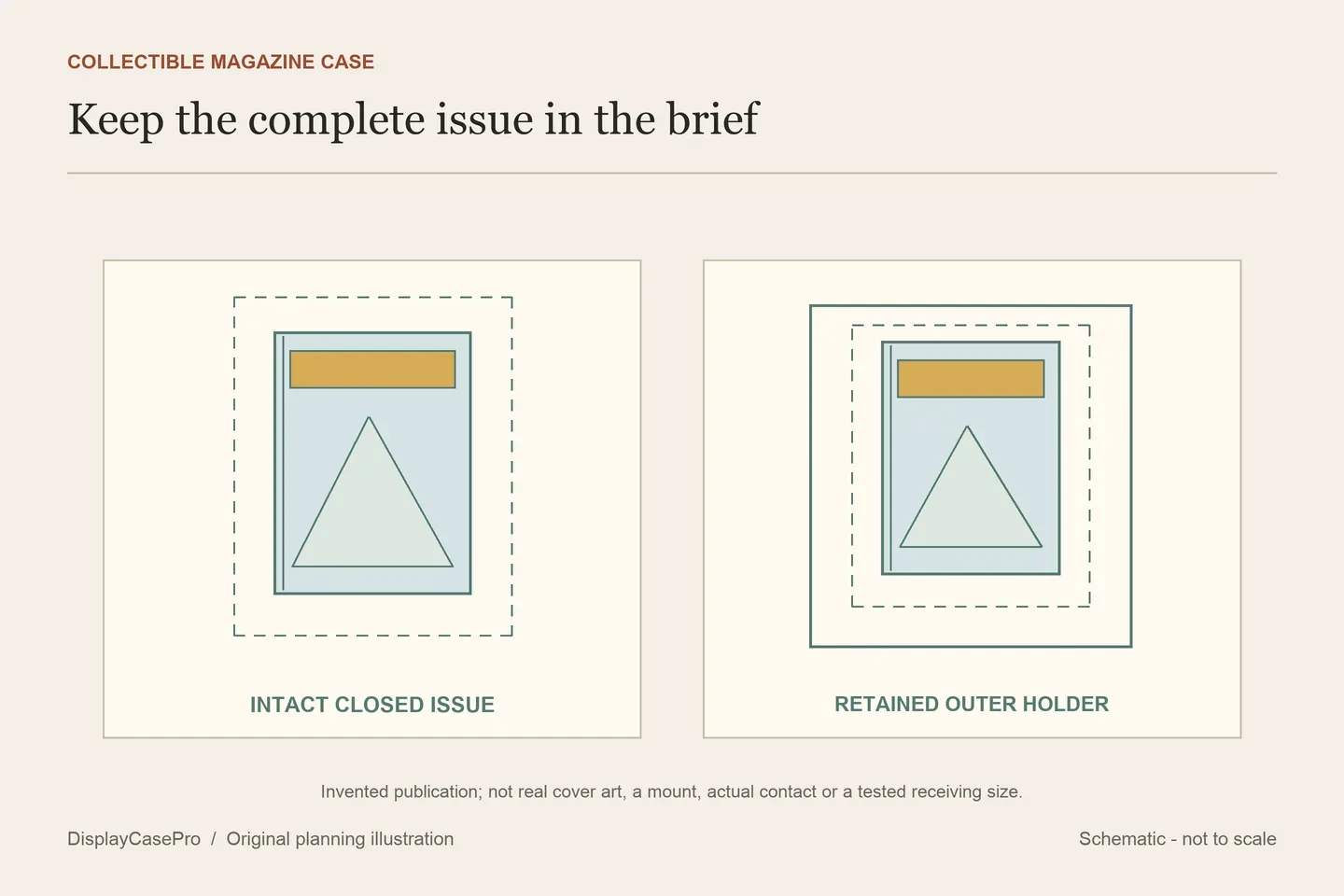
Choose a collectible magazine display case for the complete closed issue and any holder you intend to retain. A deep acrylic enclosure, a custom center-cut case and a slim top-loading holder have different receiving spaces. Keep a cover reproduction separate from an intact bound magazine.
Decide whether the original whole issue belongs in the display
Record the publication, issue date, edition and any retained insert or supplement. Measure the closed item without flattening its spine or compressing a projecting edge. A thin weekly, a thick special issue and a larger-format publication need their own records.
If the issue stays in a suitable bag, board or rigid holder, compare that complete outside package with the case. Include seams, the closed flap and the holder's projecting edge. Removing an existing enclosure solely to meet a smaller case changes the display you are asking the maker to receive.
CustomFrames’ display-case category mentions a prized magazine cover among its examples. Ask whether the proposed layout receives a complete issue or a single image. A clearly identified reproduction can tell a cover story without presenting the copy as the original publication.
Separate an exhibition case from an outer storage box
| Format | What it receives | Selection question |
|---|---|---|
| Deeper display enclosure | One complete issue and its intended support or retained holder. | Usable depth, support and release route. |
| Custom center-cut case | An individually specified closed magazine package. | Accepted outline, center depth and actual total thickness. |
| Top-loading holder | One issue within that holder’s own cavity. | Full holder exterior if placed inside another case. |
| Storage bin or portfolio | A stored group of issues. | Capacity and retrieval; not that many visible cover positions. |
BCW’s magazine category mixes bags, boards, bins and top-loading holders. A pack of ten holders is not a ten-issue wall enclosure, and a storage capacity does not state how many covers can be seen. Choose the actual display task before comparing package counts.
SAFE’s broad display catalogue distinguishes enclosed cases, open easels and framed displays. Its first page also shows many other collectible types. Neither the catalogue's total nor an open stand's name establishes a magazine-specific support or cavity.
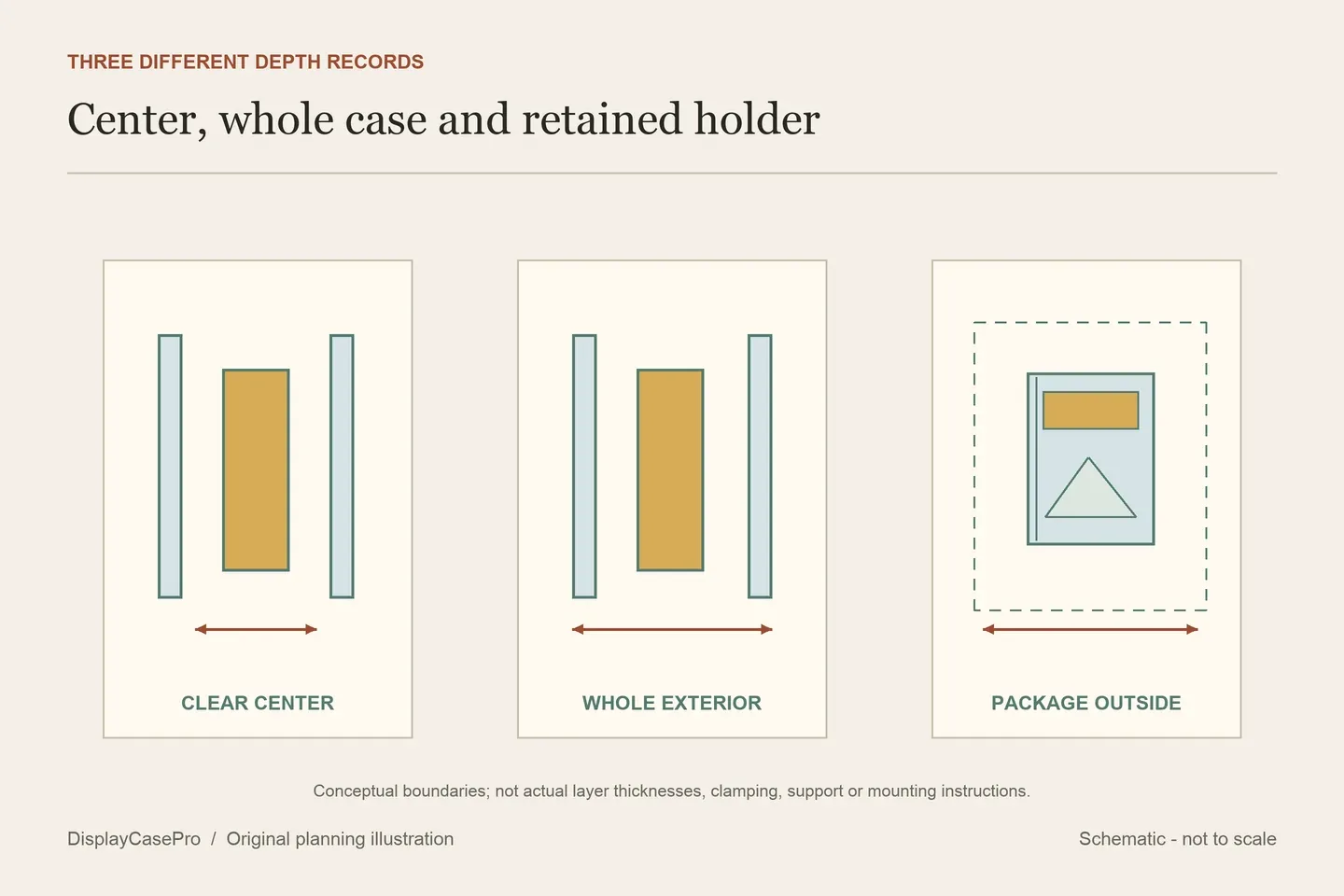
A one-inch exterior depth is not a one-inch interior
The following specifications were read on 18 October 2026. They are attributed descriptions rather than our measurements. Keep the actual magazine package, named size and supplier's dimension boundary together.
| Product | Published inside, inches | Published outside, inches |
|---|---|---|
| Better Display Cases A119 | H11.10 × D0.6 × W8.6. | H11.5 × D1 × W9. |
| Better Display Cases A136 | H12.10 × D1.10 × W9.6. | H12.5 × D1.5 × W10. |
| BCW 1-TLCH-MAG-5MM | 8.5 × 11.25 × 3/16; axis order unlabelled. | 8 15/16 × 11.5 × 1/4; axis order unlabelled. |
Better Display Cases’ shared product page lists multiple sizes and a sliding removable back. Choose A119 or A136 explicitly. A further slim size appears in an extra paragraph under A119 and elsewhere under A134; do not treat it as an alternative cavity of the same ordered A119.
The cited BCW holder's “5MM” name does not state five millimetres of usable depth. Its category also uses a 9 × 11.5 magazine-fit phrase that disagrees with the numeric interior above. Obtain confirmation for your issue rather than choosing the larger wording. If retaining that holder inside another case, compare its whole exterior instead.
A quarter-inch center and half-inch center are different orders
Red Wolf Collectibles’ case category separates regular and XL magazine cases, with quarter- and half-inch center choices. Those are magazine products alongside comic cases and accessories; this guide does not assess graded-comic slab frames.
The regular quarter-inch listing says it can be cut for magazines up to W9.75 × H12 inches. It describes an eighth-inch front and back, a quarter-inch center and four fasteners. Supply the actual package dimensions and ask how the whole issue rests and releases; maximum custom-cut limits are not a universal magazine size.
The regular half-inch-center listing also calls the complete case half an inch thick while naming an eighth-inch front, half-inch center and eighth-inch back. Those statements do not describe the same total. Ask for the current layer drawing and complete outside thickness; do not silently repair the total and present the result as a verified product dimension.
Both regular listings say the pictured easels are sold separately. Include the intended stand or confirmed wall arrangement in the enquiry. A completed acrylic case does not automatically supply its own upright support, and a fastener description does not establish that pressure against the magazine is an appropriate retaining method.
Plan the supported issue and the next cover change
Choose what must be visible: the publication title, date, full border, an inscription or the cover image. Keep a separate caption outside the original issue. A case receiving the package still needs a view that does not hide the detail you wanted to display.
For a sliding back, identify the release direction and where the supported package rests during access. A wall-mounted case may need to come down before an issue change. For a fastened custom case, follow the supplied opening sequence rather than changing the center depth by tightening it against the pages.
Keep condition and material-contact questions separate from the dimensions. A transparent enclosure or a UV-filtering material option does not establish an unrestricted display period. An important or fragile publication may need a specialist support assessment or a labelled-copy route.
Use the magazine package and case worksheet to record the issue, retained holder, depth and release plan. The usable depth guide explains measurement endpoints; the collection wall planner helps arrange confirmed whole enclosures.
Common questions
Can a magazine case receive an issue already in a top-loader?
Confirm the complete holder exterior and support with the case maker. The bare issue and its retained holder have different receiving dimensions.
Is a half-inch-center case half an inch thick overall?
The cited listing gives inconsistent total and layer figures. Obtain a current drawing for that exact version.
Comments
Share a display tip or ask a question.