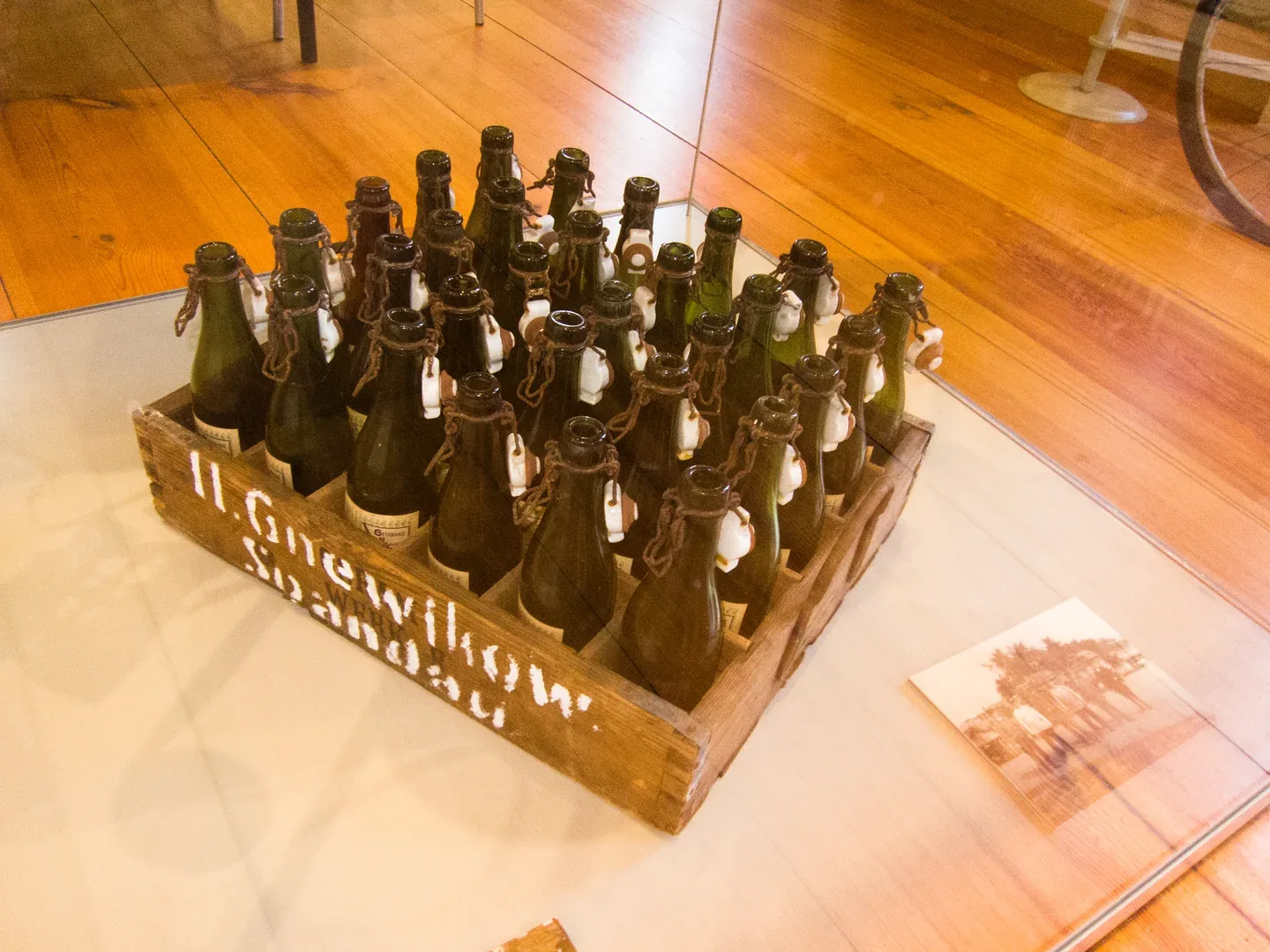
Choose an antique bottle display case around the bottle’s complete profile, retained closure, readable labels and associated packaging. Separate a modern enclosing cover from an old presentation case that is itself collectible. Wine-bottle sizes, can capacities and a broad antiques category do not establish fit for every historical bottle.
Keep the bottle, closure and package connected
Record an identifier, the label and embossing as present, the documented source and any uncertainty about date or maker. Keep a closure or original box associated with that record. Similar glass colors or a convincing old-style label do not independently authenticate a group.
Record the object in its retained condition, including known or unknown contents, existing repairs and any existing support. Include the closure’s full outline when it remains in the display. A bottle’s shoulder, swing fitting or stopper can project beyond the apparently simple body.
If the original presentation case matters to the collection, treat it as another object in the display. The BBC Antiques Roadshow clip page describes a 1926 whisky display case. Its public description illustrates that different meaning of the phrase; no appraisal, condition judgement or value is adopted here.
An original package and a new cover have different jobs
| Retained contents | Useful display aim | Receiving question |
|---|---|---|
| Bottle with its normal closure | Read the label, embossing and complete silhouette. | Whole supported profile, exact contacts and removal route. |
| Bottle with an associated box or crate | Keep the documented group visible together. | Complete group footprint and independent support for each retained part. |
| Historical presentation case as an object | Show the case, fittings and documented bottle association. | The old case’s own condition and a new outer housing if needed. |
American Farmhouse Style’s vintage-bottle article discusses grouping by color and mixing shapes and sizes. Use that as a composition choice while keeping each object’s own record. Its styling interview is not an assessment of your labels, residues, closures or proposed cleaning process.
Start the layout with existing photographs or paper outlines. Decide whether the front label, side embossing or original package explains the group. A second documented view can be more useful than rotating an uncertain object repeatedly just to fill a cabinet arrangement.
Retain both the interior and exterior of a new case
The following modern wine-case examples were read on 18 October 2026. They provide labelled receiving boundaries, without an antique-bottle fit, contact-material or preservation test.
| Exact variant | Outside and inside | Question still open |
|---|---|---|
| A017 single-bottle format | Outside 13.25 × 5.5 × 5.5; inside 12.85 × 5.10 × 5.10. | Actual retained bottle, closure, support and access through the opening. |
| A078 single-bottle format | Outside 15 × 6 × 6; inside 14.60 × 5.60 × 5.60. | Finished supported outline and selected back/mounting version. |
| A120 triple-bottle format | Outside 15 × 6 × 12; inside 14.6 × 5.6 × 11.6. | Actual bottle group; the name does not prove room for any three bottles. |
The case description identifies a sliding back and several rear treatments. Check the actual opening and the surfaces that remain visible in the selected version. A mirrored or opaque rear can change how the reverse label is seen, while the receiving cavity stays a separate question.
Keep the whole exterior for the furniture or wall plan and the labelled interior for the supported contents. A close numerical match does not establish a removal route, and a closure or retained package can change the profile. Ask for the intended receiving arrangement instead of resting an unusual bottle in a convenient empty corner.
A wine holder’s diameter limit is not an antique mount specification
The same supplier’s regular A056 tabletop holder lists a 5.2-inch length, 2-inch width and 3-inch height, with a 3-inch large cut-out and 1.223-inch small cut-out. It says a 3-inch-diameter bottle will not sit flush and larger bottles will not fit that version.
Those are wine-holder limits for that specific arrangement. They do not establish suitable contact on your bottle’s shoulder, label, applied seal or repaired area. The separately described larger and counter-balanced versions need their own intended objects and receiving instructions; a litre or 750 ml label alone does not supply the complete profile.
Check the actual product behind a broad category name. SAFE’s vintage-and-antique category includes watch, lighter, thimble, figurine and pen formats. Its age-related heading is not a bottle-specific receiving statement.
Similarly, Keepsakes Under Glass’s bottles-and-cans category currently shows five named can-display cards, including 12 oz and 16 oz formats. The category introduction mentions bottles, but a can volume does not define a bottle’s height, neck or closure.
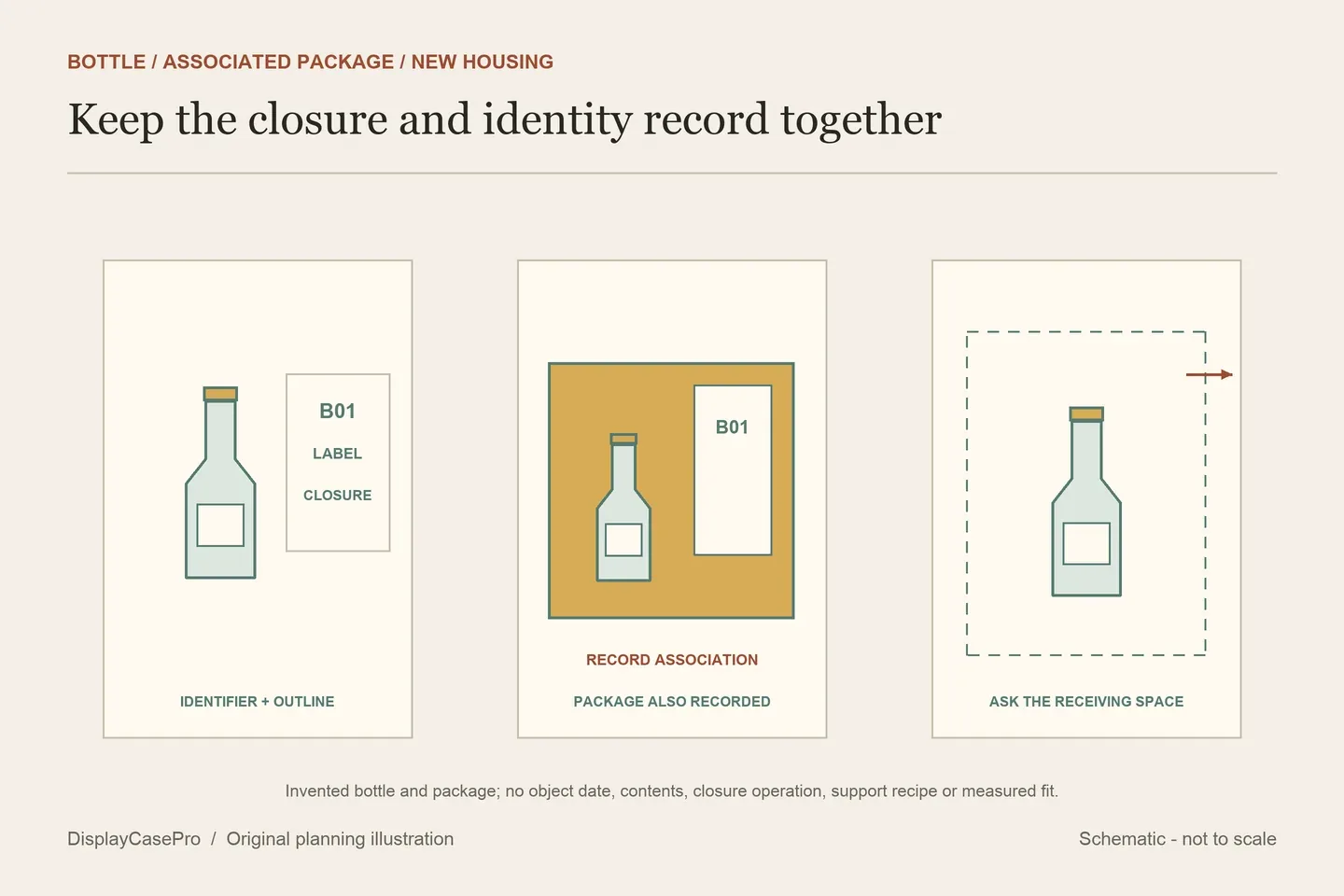
Keep information readable without losing the association
Give each visible bottle an identifier connected to the catalogue and its existing photographs. Record where an associated stopper, box or label fragment is retained if it is not shown alongside the bottle. An engraved nameplate should repeat documented information rather than supply a guessed date or maker.
For a group, map the bottle and package as separate supported outlines. Leave a clear approach to the selected object and an appropriate waiting location for the intended handling routine. The ability to open a door does not establish how a retained bottle-and-package group should be lifted.
Confirm the support and condition questions before adding risers or another row. A deep case gives space, without supplying every required mount. The usable depth guide explains the separate finished-depth boundary; the display lighting guide addresses viewing and reflections after the receiving arrangement is resolved.
The cover shows a museum bottle group. Photo: Thom Quine (Commons: Thomas Quine), 27 July 2013, CC BY 2.0. Whole composition retained, proportionally resized and compressed to WebP, including crate lettering, closures and reflections. It is context, without authenticating the objects or recommending their supports or a modern enclosure.

Use the bottle, closure and package worksheet with the collection measurement guide to keep the existing group and the proposed new housing in separate records.
Common questions
Will a standard wine case fit an antique bottle?
Compare the complete supported bottle, closure and retained group with the exact labelled cavity and opening. A wine or antique label does not establish compatibility.
Should an original display box count as the new enclosure?
Record its historical association and present condition as part of the collection. Decide separately whether that collected package needs another receiving display.
Comments
Share a display tip or ask a question.