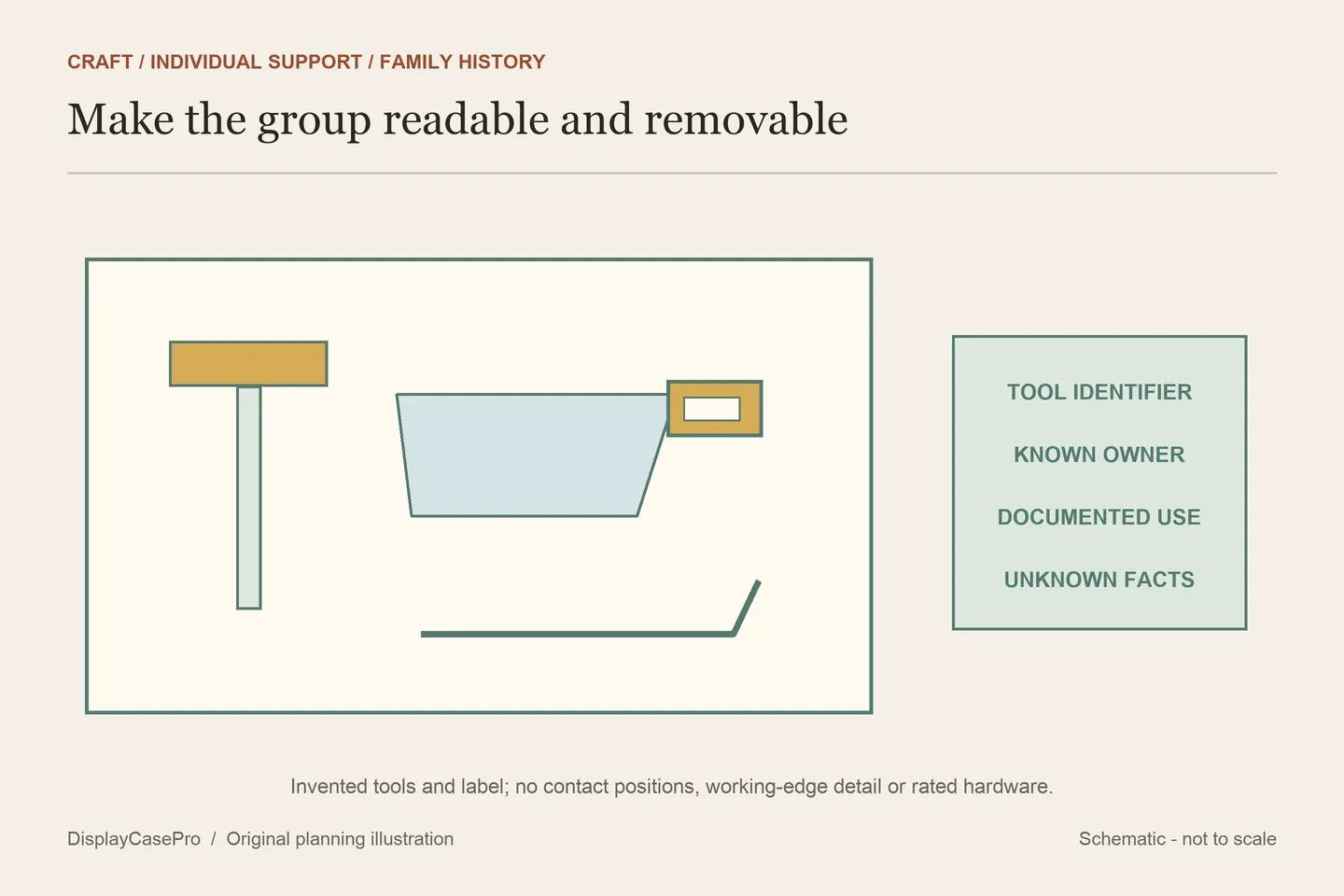
Display antique tools as a readable group with individual support and a documented story. Choose whether you are retaining collected objects, keeping tools available for work or intentionally repurposing old equipment before committing to a board, shelf or enclosed case.
Those choices can produce a similar rustic appearance while making very different demands on the objects. A family hand plane retained for its history is different from a spare carrier chosen as a planter. Decide what you want to keep intact before selecting the decoration around it.
Decide what “display” means for this collection
Separate tools you intend to retain as collected objects from those still used in a workshop and those chosen for repurposing. Record that intention alongside each identifier. Neither visible rust nor an old-fashioned shape establishes an age, maker or value.
| Intention | Main display question | Keep separate |
|---|---|---|
| Retain | How can the complete object and its marks remain visible? | Cleaning, repair and permission to alter it. |
| Use | Can it be stored, retrieved and inspected appropriately? | Operation and workshop maintenance. |
| Repurpose | Which changes are you deliberately accepting? | Claims that decorative reuse preserves the original tool. |
Lora Bloomquist’s tool-caddy ideas use former carriers as containers for bottles, flowers and seasonal arrangements. That answers how to decorate with a caddy. It does not establish how to support the old tools that once occupied it or whether altering a particular family carrier is appropriate.
Build a group around a craft, owner or documented task
Start with a small selection whose relationship you can explain. A group might show one person’s workshop tools, several stages of a documented craft or contrasting forms of the same implement. Use the relationship you know rather than inventing a complete toolkit from objects bought separately.
Lay out paper silhouettes and label positions before mounting the tools. Orient maker’s marks and distinctive working parts where they can be seen from the room. Let the heaviest or most awkward object’s support needs influence its position; visual balance cannot establish that a small contact can carry it.
Angie of Knick of Time’s guest project on My Repurposed Life displays inherited tools together and proposes a plaque identifying the family member. The documented family connection is a useful starting point. Its pallet-board, wire and screw attachment choices are a personal build, not a support specification for another collection.
Keep enough separation for the shapes to remain distinguishable. A dark metal head can disappear against a dark board; an unrelated decorative object can hide a stamp or handle. Compare background samples and the paper plan from the intended viewing distance.
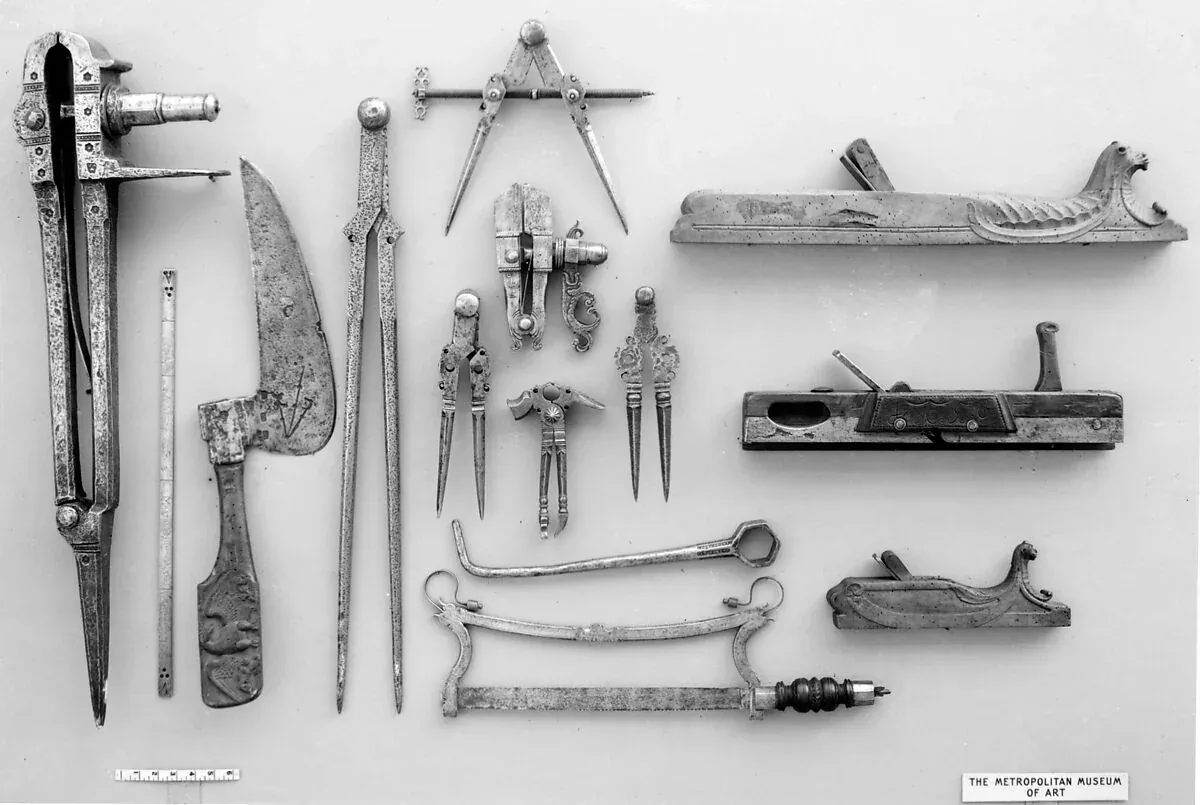
Record materials and condition before making them match
A tool may combine a wooden body, a steel working part and brass fittings. Record visible damage, loose parts, finishes and existing labels without disassembling it merely to complete the display. Keep uncertain identification and condition questions open.
The Canadian Conservation Institute’s tool-care guidance distinguishes wood and metal components and notes the importance of existing metal finishes and stable patina. It also cautions about linseed-oil buildup on retired tools. A desire for a consistent appearance is not a reason to scrub, polish or oil every object in the group.
Songbird’s wooden-plane flower display is a repurposing project involving preparation and water-filled tubes. Enjoy the composition as an idea while keeping treatment, moisture and pressure from inserted props out of an unassessed retained tool. Flowers beside a supported object can provide a seasonal connection without making the object a container.
Give each tool an appropriate restraint and removal route
Record the full outline in the intended display state, including projecting screws, handles and adjustable parts. Identify where the maker’s marks need to remain visible. The smallest footprint is not necessarily the right orientation for support or later inspection.
For a wall board, ask what carries each tool and how the board and its complete contents attach to the structure. For a shelf, establish the supported footprint and the furniture’s instructions. For a case, include the completed mount, front clearance and access opening.
The CCI guidance calls for protecting sharp edges and avoiding piling, rolling and bumping in storage. Apply those questions to the proposed display: can one tool be removed without reaching across another working edge or moving a loose neighboring object? Edge protection is a separate requirement from an attractive position.
| Detail | Record | Resolve before mounting |
|---|---|---|
| Contact | Materials, finish and proposed support locations. | Whether the contacts suit this object. |
| Profile | Whole outline and projecting or movable parts. | Restraint and usable receiving space. |
| Edge | Working parts and appropriate protection. | A clear route for hands and adjacent objects. |
| Release | Who removes the tool and how. | Access without prying, pulling or dismantling it. |
Our usable-depth guide helps distinguish outside case depth from the space above the completed backing and supports. A count of tools does not establish a board’s, shelf’s or enclosure’s capacity.
Keep the history and the display decisions accessible
Give each tool an identifier linked to photographs of its marks and a short provenance note. Separate confirmed owners and uses from family recollections or unknowns. Keep a label beside the object rather than attaching a new explanation across an old mark.
Outdoor inspiration needs an explicit decision. Make it a Garden advocates coherent themed groups but accepts weathering and eventual loss. Flea Market Gardening shows reader arrangements on sheds and gates. Those are decorating examples, not evidence of suitable exposure or restraint for a retained heirloom.
Use the antique tool display worksheet to keep intention, history, contacts, edge protection and removal together. Photograph the approved arrangement and inspect objects according to their assessed needs.
Common questions
Should old tools be polished before display?
Resolve material, finish and condition first. This display guide does not prescribe polishing or rust removal; a bright uniform group is not the only readable presentation.
Can an old tool carrier hold the entire collection?
Check its condition, intended role and suitable object supports. An original or decorative carrier does not establish safe capacity or an inspection route merely because the tools fit inside.
Comments
Share a display tip or ask a question.