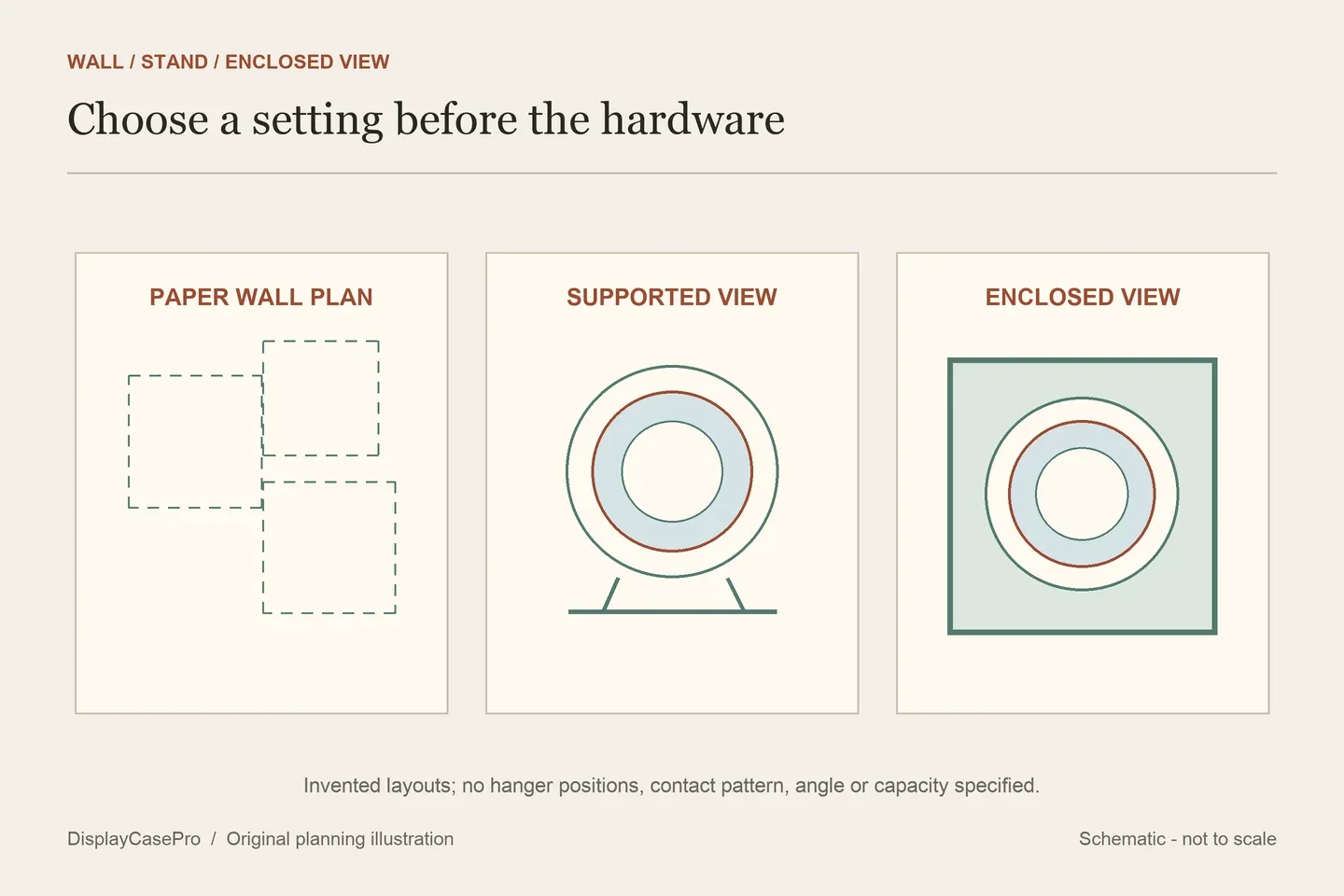
Display antique plates by choosing between a wall arrangement, a supported tabletop view and an enclosed presentation. Let the plate’s condition and contact points settle the support before a decorative layout commits you to a particular hanger or frame.
A plate can look flat in a photograph while its rim, foot and curved center occupy considerable depth. A pattern you want to see may also be on a vulnerable surface. Start with the individual object, then choose the setting that lets you see and remove it comfortably.
Identify the face, profile and fragile areas
Record the maker, date and family history only where documented. A display plan does not authenticate a plate or estimate its value. Keep any uncertain attribution visible in the record rather than turning a remembered story into a label fact.
Check for cracks, repairs, loose decoration and vulnerable rim edges before considering an upright display. Do not test an old repair by flexing the plate. If condition is uncertain, have the support assessed first. Note the face and orientation you want visible, including whether the rim pattern or central scene is the main detail.
The Canadian Conservation Institute’s ceramic care guidance warns about fragile rims and decoration, recommends appropriate wood or plastic plate stands, and advises against spring-type metal plate hangers. Lift ceramics with both hands rather than relying on a handle or other projecting part. Those principles do not establish a particular stand’s capacity.
Choose where the plate can be supported and reached
A wall frees a horizontal surface but makes attachment and later removal important. A stand keeps the plate accessible while occupying the full supported footprint. An enclosure adds a front panel, access opening and interior supports; it still needs a mount suitable for the plate.
| Setting | Useful when | Resolve first |
|---|---|---|
| Wall | The decorated face is best viewed upright from the room. | Object contact, wall fixing and a supported removal route. |
| Stand | You want a visible plate on suitable furniture. | Plate profile, stand footprint and protection from knocks. |
| Enclosed | A glazed view and defined access suit the room. | The complete mount, usable depth and opening clearance. |
Ann Marie’s decorating guide compares grids, clusters, lines and shelf presentations. Use those visual choices to identify a preferred setting. A suggested hanger type or repeated spacing cannot answer whether it suits a repaired antique plate.
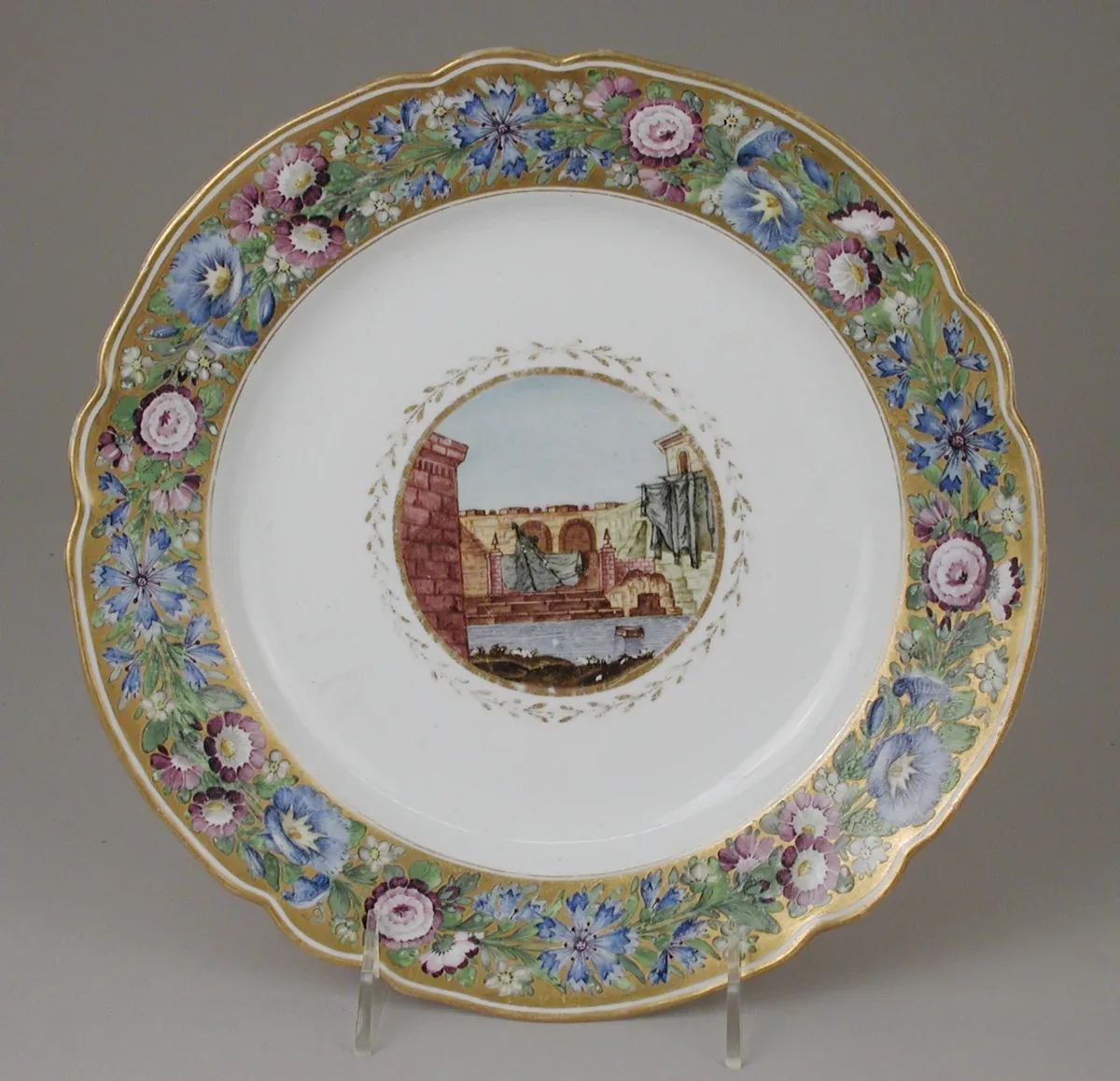
Build a wall arrangement with paper before hardware
Trace the general outline onto separate paper using recorded dimensions or a photograph; do not repeatedly position the actual plate against the wall. Mark the intended upright orientation on the paper. Choose one plate as the visual anchor, then arrange the other silhouettes around it.
The Honeycomb Home’s dining-room gallery shows the value of an anchor and a trial arrangement. Keep that planning idea separate from its personal hanger choices and reported results. Those do not override the object-specific concerns about spring contact.
Classic Casual Home offers symmetric and more organic groups. Try both on paper from the usual viewing distance. Let the actual plates, their supports and the room determine separation rather than applying one universal gap.
Check how the display relates to moving doors, chairs and people reaching past it. Choose a location where a plate can be removed onto a prepared surface without reaching through another object’s support. A balanced layout on the wall is only part of the plan.
Assess where the support touches the plate
Record diameter, curved profile and weight where they can be established appropriately. Ask the support maker how the exact plate sits at the lower contact, behind the body and around the rim. Keep contact away from vulnerable decoration or repairs as determined by the object assessment.
Do not choose by diameter alone: a shallow plate and a deep dish with the same width can sit differently. Follow the exact stand’s assembly and use instructions, place its entire base on a suitable surface, and account for the plate’s tilted profile. A groove in furniture is not proof of adequate restraint.
| Detail | Record | What it changes |
|---|---|---|
| Rim | Shape, fragile finishes and repairs. | Suitable contact locations. |
| Profile | Depth and intended viewing angle. | Support shape and total footprint. |
| Weight | Measurement or reliable documented value. | Support and installation requirements. |
| Removal | Hands, approach and waiting surface. | Spacing and access around the display. |
Check the whole plate-and-mount assembly inside a frame
Victorian Frame Company’s collector-plate article compares easels, vitrines and glazed frames. Its dated product sizes do not establish current availability or usable depth. Measure the supported object, including anything projecting in front of or behind it.
Use our usable shadow-box depth guide to distinguish the closed receiving space from the outer frame dimensions. Check that the front can close without touching the rim and that the plate can enter and leave the enclosure without scraping its edges.
Follow the Yellow Brick Home’s collection account illustrates rotating selected vintage dishes through different settings. A smaller group can make the patterns easier to read and leave a simpler removal route. Record where the remaining pieces are stored; a display decision does not establish suitability for food use.
Keep the selected setting, condition questions and support details in the antique plate display worksheet. Photograph the final arrangement so the next rotation starts from a known plan.
Common questions
Can antique plates go on a wall?
Sometimes, after the object and mounting arrangement have been assessed. Age or diameter alone cannot identify an appropriate hanger. Use a stand or another display if the proposed contact is unsuitable.
Does a glazed plate frame preserve the plate automatically?
No. It provides an enclosure, while support, contact, access and the room conditions remain separate decisions.
Comments
Share a display tip or ask a question.