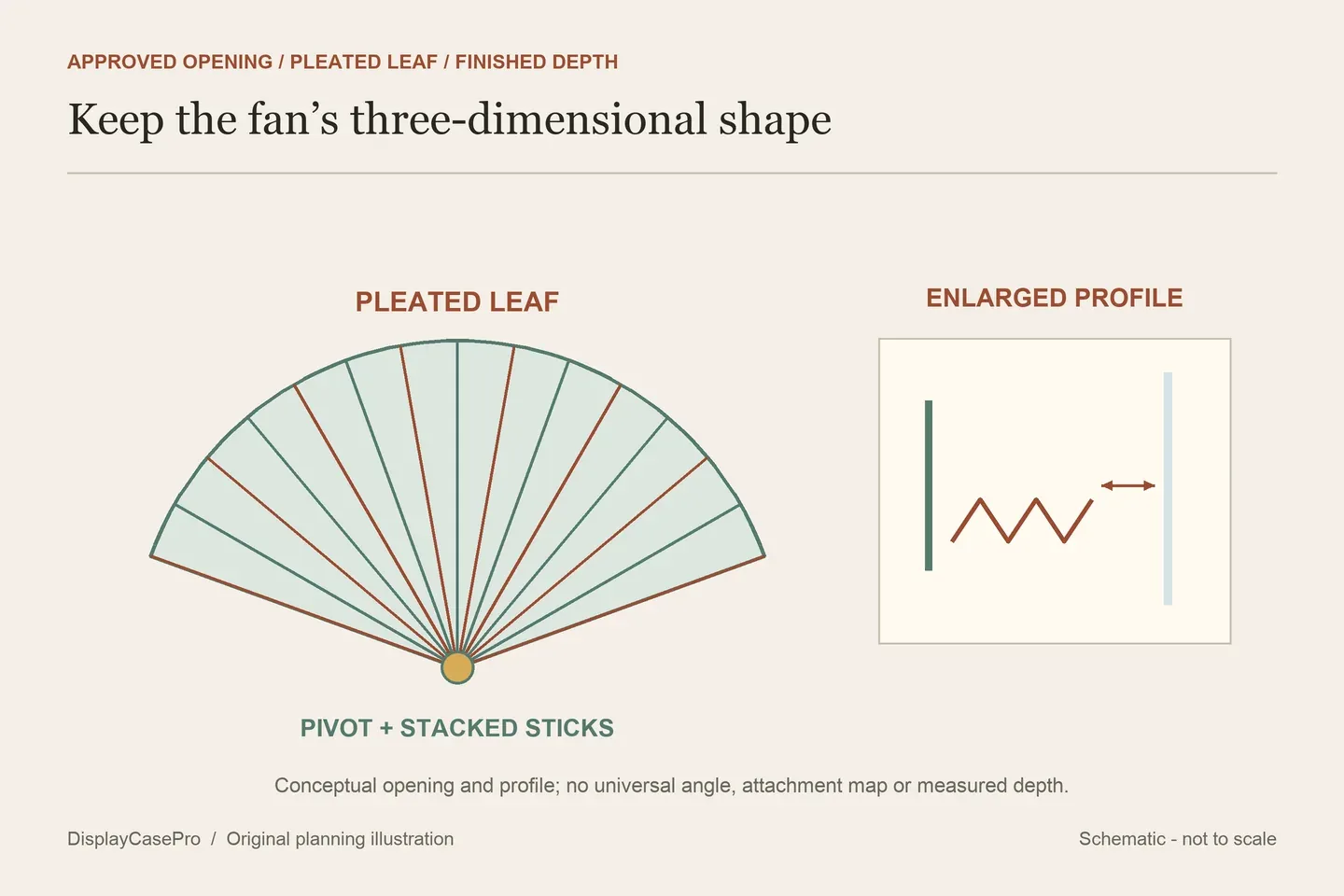
Display a folding fan by establishing how far it can appropriately open, supporting that shape and then choosing an enclosure around the completed mount. Its pleated leaf and stacked sticks make it a three-dimensional object, even when the front view looks almost flat.
For a fragile or historic fan, ask a conservator to assess the opening and support before arranging it. A case advertised for fans cannot establish whether your fan should be fully spread, how its pivot sits or what the painted leaf can tolerate.
Record condition before deciding the spread
Identify the materials where documented: the leaf, sticks, outer guards and pivot need not be the same material. Record tears at folds, loose or broken sticks, old repairs and any difficulty opening. Do not force the fan wider to match a photograph or to make the two sides look symmetrical.
The Fan Museum’s conservation guidance describes fans as delicate objects combining different materials, and distinguishes stabilization from restoring a new appearance. Give the assessor clear photographs and known history before agreeing treatment or mounting. A visual layout is not permission to repair a stick or reattach a leaf.
There is no single display angle for every folding fan. Write down the assessed opening and who established it. If displaying it closed is more appropriate, keep that option in the brief instead of treating a full spread as the only acceptable result.
Choose the face and details you want to see
Decide whether the front decoration, reverse painting, guard or family association matters most. Use photographs for composition trials. If both sides are important, discuss a support and viewing arrangement designed for that purpose rather than expecting to turn the fan inside a finished frame.
Ever So Scrumptious’s family-fan framing account shows a personal float-and-mat presentation. Its attractive view does not establish the right support for another fan, and the author’s repair with glue is not a repair instruction to transfer to an heirloom.
| View | What to establish | What it affects |
|---|---|---|
| Front | Approved opening and visible leaf decoration. | Outline and background. |
| Reverse | Whether it can be presented without unsupported turning. | Mount design and access. |
| Both sides | A suitable support and viewing arrangement. | Housing, handling and space behind the fan. |
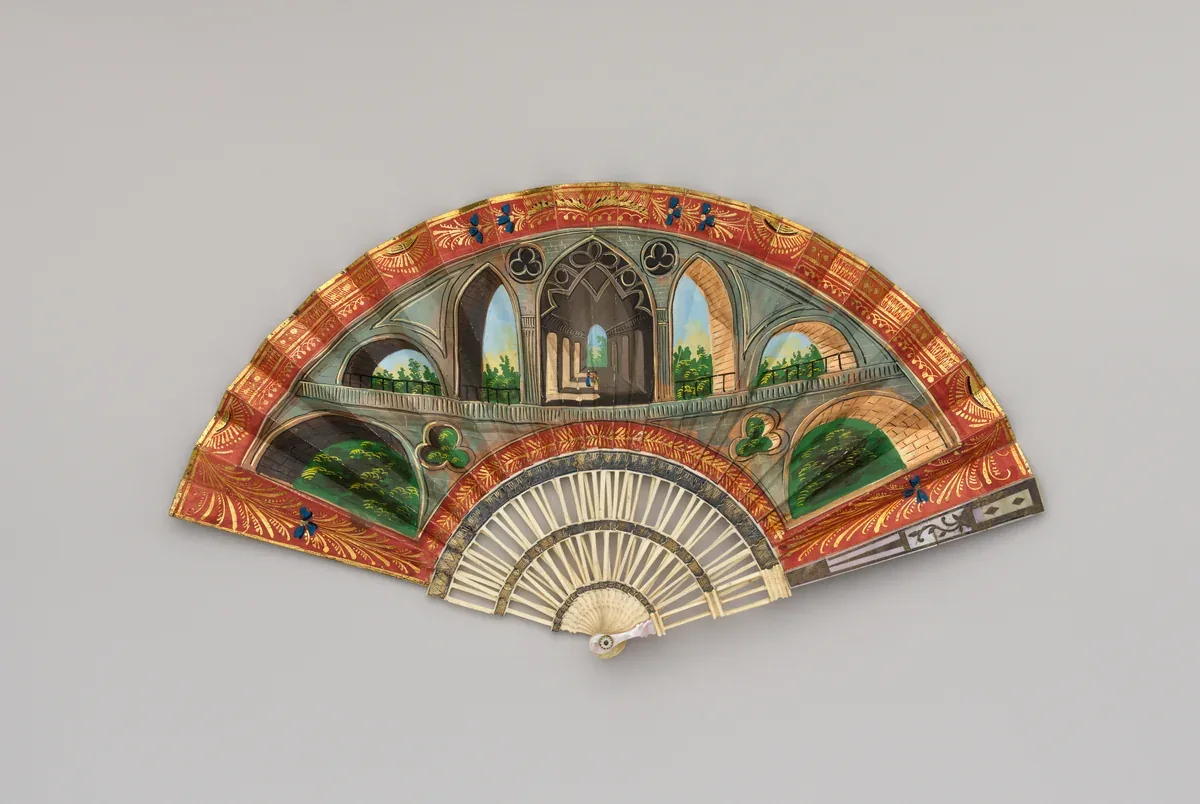
Support the actual contour rather than flattening it
Holly Maxson’s AIC/BPG paper on constructing a folding-fan support explains why the shape matters: stacked sticks create changing height, while the leaf retains its folds. Its individually formed support accommodates that three-dimensional construction. The article also considers viewing both sides and the housing around the mount.
Use that example to ask better questions, rather than copying its fabrication procedure. Where will this fan be supported? How will the pleats be accommodated? What keeps the guards and pivot from becoming pressure points? How can the mounted fan be released? The answers depend on this object and its condition.
A flat board behind the fan and tight glass in front do not automatically supply appropriate support. Neither does a hook through an available opening. Keep proposed contact and attachment locations in the mount specification, with a person responsible for assessing them. Do not improvise on the decorated leaf merely because the attachment would be hidden.
Compare an open wall view with an enclosure
Up to Date Interiors’ foyer project arranges modern decorative fans on a wall. It is useful for understanding the visual effect of a fan group, while its adhesive-strip method is not evidence for mounting a historic leaf or retaining access to fragile sticks.
Weekand’s fan-display article compares wall arrangements, shadowboxes and shelf displays. Treat the settings as appearance options. Its adhesive and tape methods do not establish appropriate contact with a collectible fan.
An open presentation leaves the supported object exposed to its surroundings. An enclosure can separate it from routine contact, but adds glazing, a closure and access requirements. Specify how the support attaches to the housing without making the fan carry a fastener’s load. Neither setting promises permanent preservation.
| Part | Include in the record | Check against |
|---|---|---|
| Outline | Width and height at the approved opening. | Visible opening and receiving area. |
| Profile | Leaf folds and stacked-stick projection. | Contoured support and front separation. |
| Guards | Projections and pivot position. | Back, sides and closure clearance. |
| Mount | Complete supported depth and release route. | Closed housing and access opening. |
Order from the supported shape
Establish the mount before ordering the enclosure. Measure its full receiving footprint and highest projection, including the guards and pivot, without pressing the leaf down to obtain a smaller number. Add the assessed separation from the front panel as part of the complete assembly.
Our guide to usable shadow-box depth distinguishes the outer housing from the space available when it is closed. Confirm those dimensions and the access opening with the maker; a named frame size alone cannot describe them.
Place the fan’s known identification on a separate label. Retain “perhaps,” approximate dates and other qualifications in museum or family descriptions. Keep the assessment, mount instructions and unresolved questions in the folding fan display worksheet.
Common questions
Is this the same as displaying wedding favor fans?
No. GetMyFan’s wedding guide concerns distributing fans from baskets, tables or seats. Retaining one collectible requires a different support and access plan.
Will UV-filtering glazing make continuous display harmless?
No glazing establishes unlimited display life. Discuss the location, lighting, inspection and periods away from display with the assessor for the actual composite materials.
Comments
Share a display tip or ask a question.