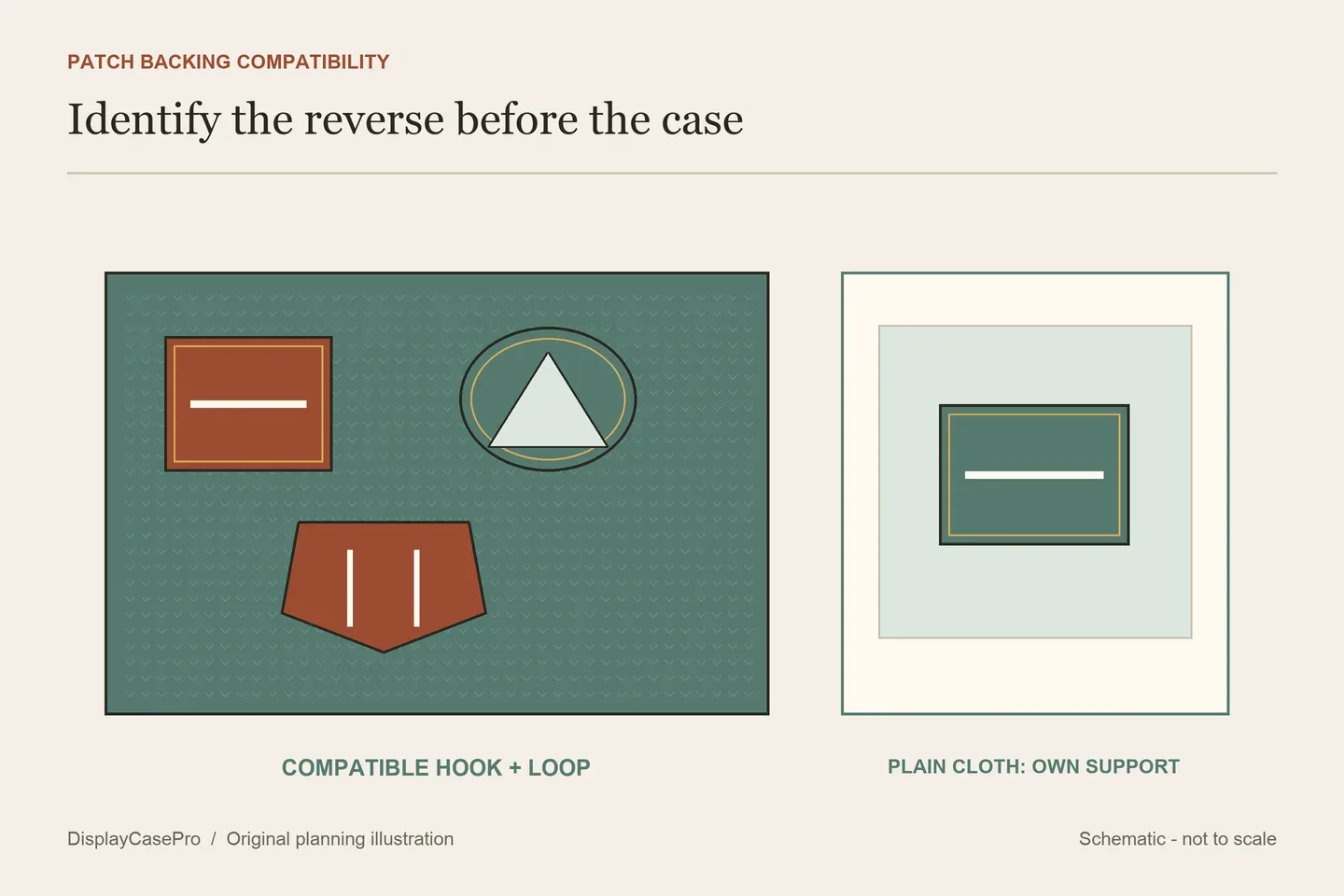
Choose a military patch display case by checking the back of each patch before choosing the case backing. A hook-backed patch can use a compatible loop panel; a sew-on or historically important cloth patch needs a different support decision. Felt, foam and loop material are not interchangeable attachment systems.
Identify the attachment already on each patch
Record each patch as it is. Note its dimensions, construction, condition and any attached backing or original packaging. Keep documented service or acquisition information separate from what a design merely resembles. A unit-style emblem in a collection does not by itself prove that someone served in that unit.
| Observed reverse | Display route to investigate | Avoid assuming |
|---|---|---|
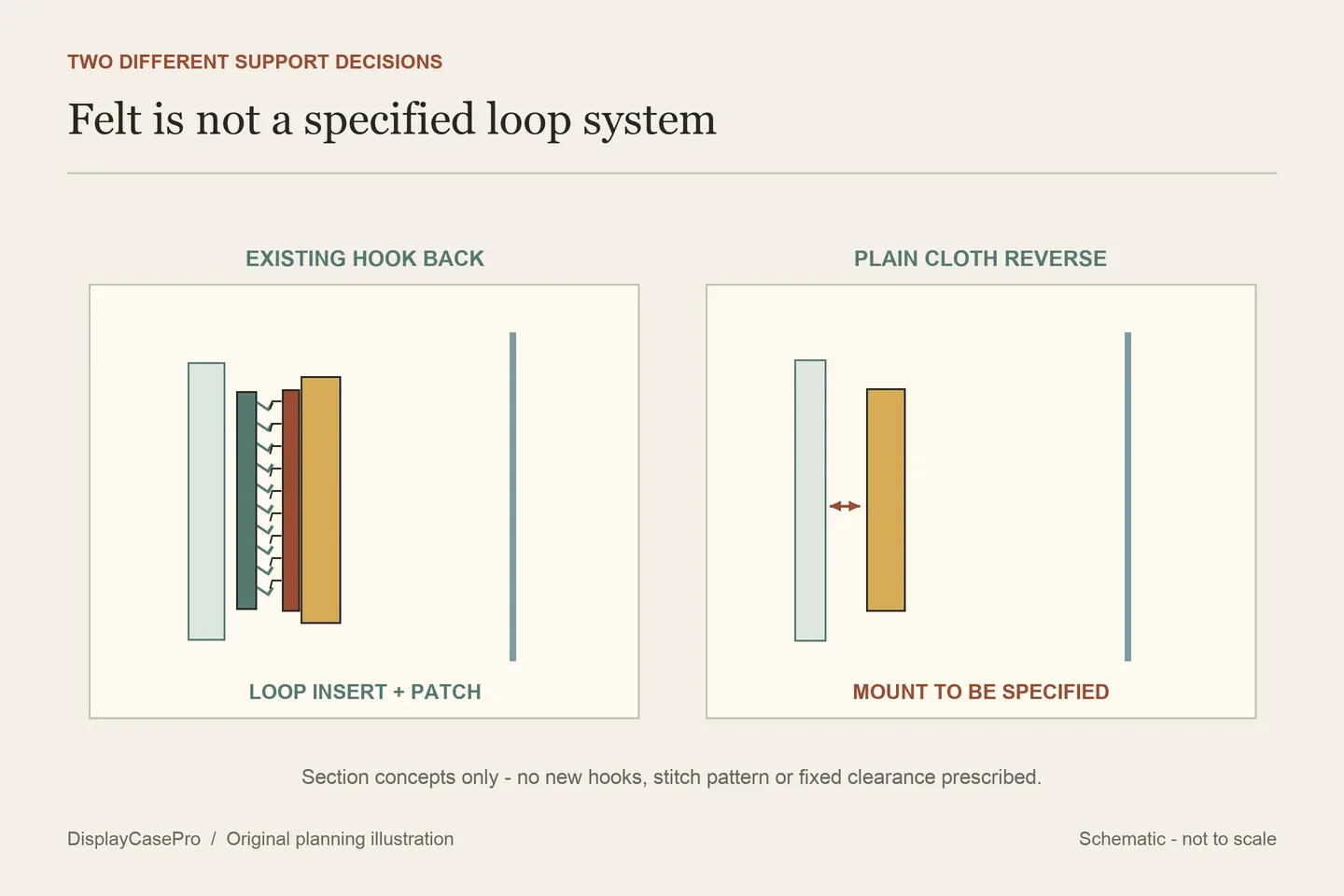
| Existing hook backing | A purpose-made compatible loop panel or removable loop insert. | That decorative felt will engage the hooks or that every patch can tolerate repeated removal. |
| Sew-on cloth without hooks | An independently specified textile support appropriate to the actual patch. | That it must be converted to a hook-backed patch, pierced with push pins or glued down. |
| Adhesive, heat-activated or uncertain backing | Identification of the existing construction and a suitable support plan. | That a garment-application method is also an appropriate framing method. |
| Patch still attached to a garment or an intact historic group | A display plan for the complete existing assembly. | That detaching it is a necessary first step in making a patch collection. |
Do not peel, heat or dissolve an unknown backing to make a patch match the display you already bought. For a fragile or important historic textile, resolve the condition and mount first. The Canadian Conservation Institute's guidance on small, light, flat textiles describes prepared support and condition-dependent stitching. It advises seeking a qualified textile conservator for soiled or poor-condition pieces. It is not a blanket recommendation to pin every patch onto craft foam.
Choose access before enclosure style
A loop wall panel suits a changing collection of compatible hook-backed patches. For example, Tactically Suited's large black wall display is described as a 27.5 × 39.5 in panel with soft loop material and six eyelets. That is an open panel, not a glazed display case. Its description of hook-backed patch use does not establish a preservation mount for an unbacked historic textile.
An enclosed case may be preferable when you want a fixed, readable group behind a front panel. Specify its interior mounting system, usable depth and opening method. A loop insert added to a case changes the assembly's thickness; the bare case's depth does not automatically remain available above that insert.
A collection book offers another access pattern for suitable modern hook-backed patches. A small visible group can stay on a panel while other identified patches remain in an organized book. Do not choose a display capacity by assuming every patch has the same rectangle or thickness.
What real case descriptions leave to confirm
These examples show different backing and depth information. They are not tested fit, security or preservation recommendations.
| Named product | Published information | Decision still required |
|---|---|---|
| Pennzoni large Medal / Award / Patches Display | Outside 38 × 34.5 × 2 in deep; inside 36.5 × 33 × 1.5 in deep. Felt background and hinged acrylic front; the text describes adding hook-and-loop material or using pins. | Which added attachment is intended for your patches, its contact materials and how it changes the usable depth. Felt alone is not specified as a loop panel. |
| The Military Gift Store medal, pin and patch cabinet | Outside 19 in H × 14 in W × 2.25 in D; interior 18 in H × 13 in W. The text specifies 0.5 in between foam and glass. | The clearance datum is the foam surface, not the cabinet's external depth. Its pin-into-felt description does not establish hook-backed patch attachment. |
| Flags Connections Award Medals, Patch Display Case | Oak frame, glass front and black velvet on a removable laminate-wood backing. | The main description supplies no usable dimensions or patch-specific attachment specification. A removable backing is useful information, but it does not fill either gap. |
A fourth kind of description is more specific but still has limits: shopRedwire's patch case describes push pins supplied for its mission patches and an interior of 10.5 × 13.5 in, 1.5 in deep. That is an instruction for the named presentation, not evidence that push pins suit every military cloth patch. The two interior face dimensions also need orientation confirmation for a planned layout.
Commercial UV percentages, lock descriptions and customer testimonials do not resolve these mounting questions. Ask for a current labeled drawing and attachment details where the main specification is incomplete.
Make a map that keeps the collection understandable
Use paper outlines or existing reference images to arrange the group before moving the patches repeatedly. Give each patch an ID and mark its intended position. Preserve the uncertainty in a label when the unit, date or original wearer is not established.
A changing modern collection
Group compatible hook-backed patches by documented theme or acquisition, leaving a practical route to reach an individual patch. Keep a return-position map if pieces are regularly removed. Check that peeling one patch as directed does not catch a neighboring embroidered edge.
A documented service or family group
Keep each person's material identifiable. Put related captions beside the group without implying that decorative order is official uniform placement. If a photograph, medal or nameplate is included, give it its own support; it should not pin a cloth patch in position.
Mixed shapes and larger name tapes
Place the broadest patch and longest tape on the paper plan first. A repeated grid can still contain different outlines. Reserve space for the full edges and captions rather than folding a tape or obscuring a border to keep all rows identical.
Check depth from the finished insert and plan removal
Include the complete patch's raised embroidery, layered badge, hook backing and any support. Measure projection from the surface that will actually remain in the case. A frame that closes over bare felt may not close over a separately mounted loop panel and a thick patch.
Check the opening without using the glazing to flatten the collection. Identify whether the whole backing comes out, the front opens, or both. A front door can expose the patches while leaving the insert's rear attachment inaccessible.
Use the blank patch-backing and position worksheet to record each reverse, intended support, caption and removal method. The shadow box depth guide explains the general reference surfaces; apply it to the finished patch-and-insert assembly.
Choose a display location and review arrangement appropriate to the actual textiles. A closed door is not proof that light exposure or material contact has been resolved. If you notice distortion, a loose edge or surface change, review the support rather than pushing the patch harder against the backing.
Common questions
Will hook-backed patches stick to a felt-lined case?
Do not assume so. Identify a compatible loop surface and the maker's intended installation. Decorative felt and a specified loop panel are different materials with different intended uses.
Should I add hook backing to every sew-on patch?
It is not required to make a display. Choose support for the patch's current construction and significance. An important original may need a textile specialist's mount rather than alteration.
Can patches and medals share one case?
They can be planned together when each has suitable independent support, clearance and accurate labels. Their different attachment systems should remain explicit in the plan.
About this guide: This guide covers collection display choices, not uniform regulations, insignia authentication, textile treatment or a physically tested case installation.
Comments
Share a display tip or ask a question.