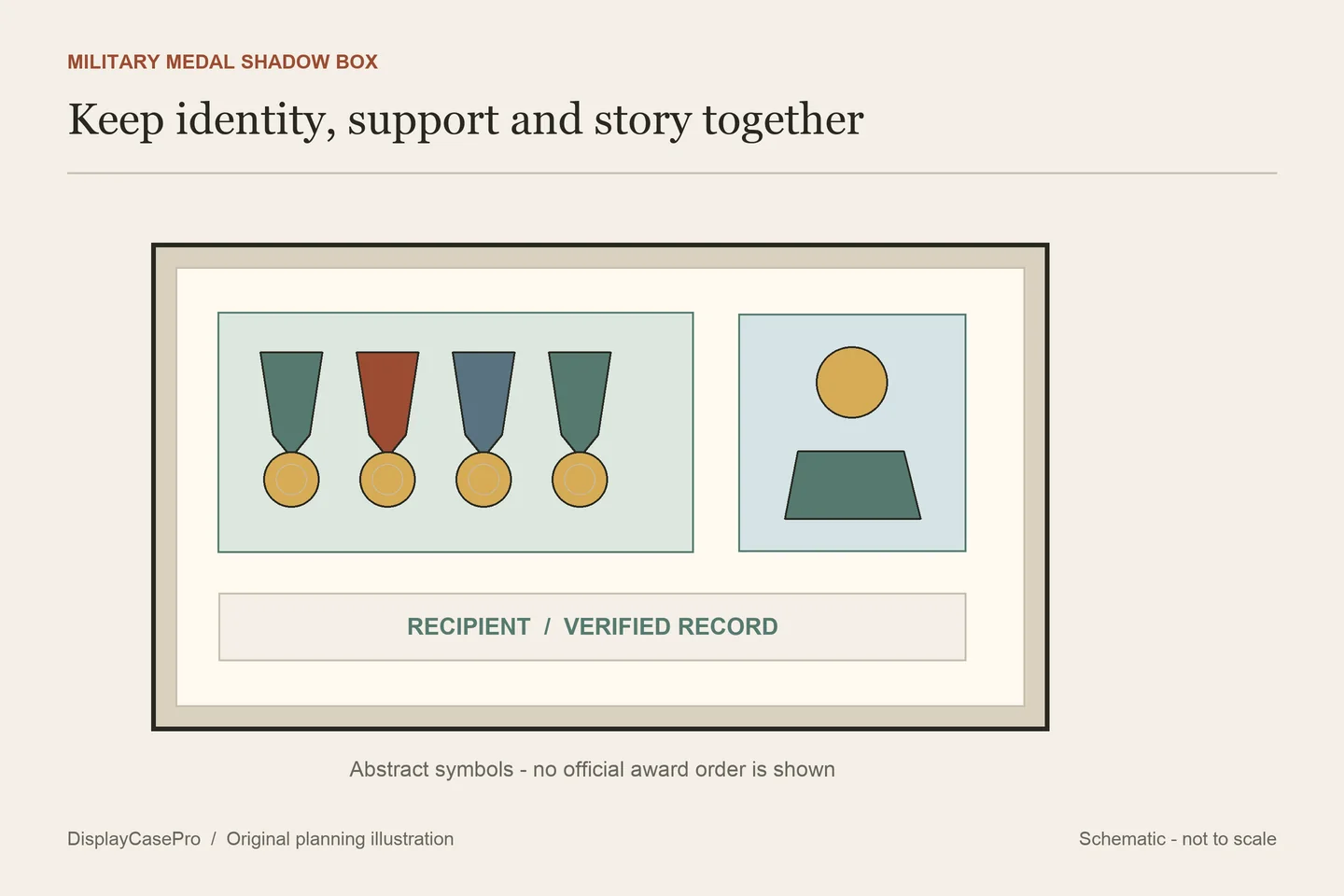
Display military medals in a shadow box by keeping each recipient's group identifiable, supporting mounted groups securely, checking the ribbon condition, and testing the complete layout before mounting. Select the case after measuring the medals, their supports and any accompanying items.
The most useful starting point is an inventory. An original medal, a replacement ribbon, a miniature and a commemorative copy can each belong in a family story, but they should not be made to look like interchangeable evidence of service. This researched guide covers a personal display; ceremonial wearing and award entitlement require the relevant official guidance.
1. Record what you have before moving the medals
Photograph the front, back and existing mounting arrangement while the group is supported. Note inscriptions, associated documents and packaging without removing fittings solely to make them easier to photograph. If something is loose or damaged, record that condition rather than attempting a repair as part of the layout exercise.
| Record | What to write | Why it changes the display |
|---|---|---|
| Recipient and source | Confirmed name and the record or family source connecting the object to that person. | Keeps different people's groups from being accidentally combined. |
| Object status | Original, replacement, miniature, replica or not yet established. | Allows accurate labels and separates a representative display from original material. |
| Existing assembly | Individual medal, mounted group, ribbon rack, badge or presentation case. | Determines what needs support and what should remain together. |
| Condition and access | Loose stitching, unstable ribbon, damaged pin, surface change and whether the item will be worn again. | Helps choose specialist assessment or a removable arrangement. |
Do not rearrange an intact group to match the color pattern of a photograph. If you want to reproduce an official order, verify it for the recipient's country, service and award types. U.S., British, Canadian and Australian groups cannot be treated as one universal sequence. Where the records are incomplete, say so in the inventory.
2. Choose a layout around the medal group
Cut a paper rectangle to the case's usable opening, or work with a proposed opening before buying. Mark fixed compartments and door overlaps. Move paper outlines of the objects first; repeated trial arrangements need not involve repeatedly handling original ribbons.
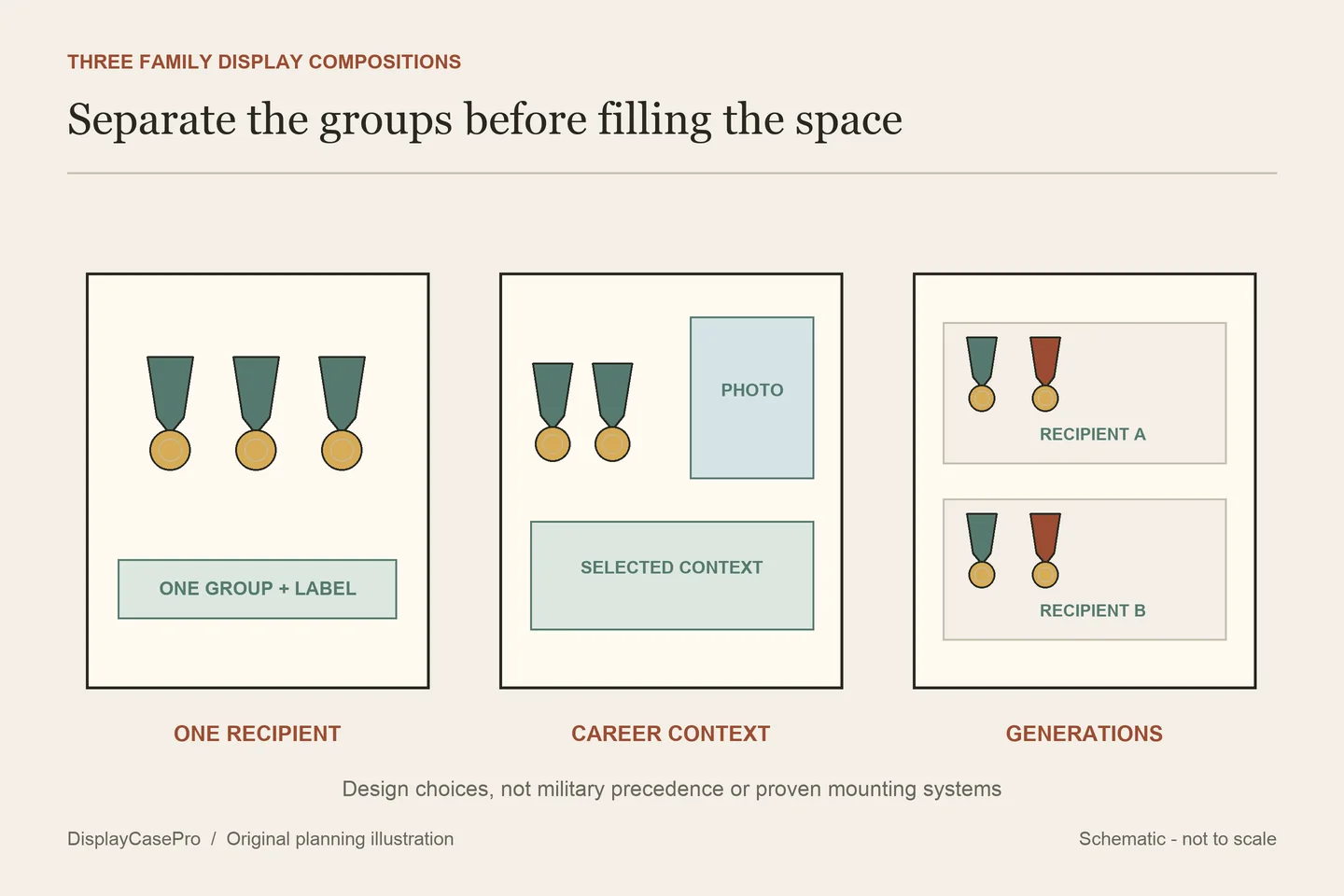
These are optional composition ideas for family displays. They do not prescribe military precedence.
A single recipient: one readable group
Use the existing medal group as one unit, with its caption nearby. A small portrait can sit beside it if the picture does not cover the ribbons or push the group against an edge. Keep a visible area around the suspension and lower edges so viewers can distinguish the parts.
A career display: related items in separate zones
Put the medal group in one zone and selected badges, a portrait or a copied document in another. Choose items that explain a particular period or role. You can keep additional photographs in an album instead of squeezing them behind the medals. Each object needs its own support and enough room to be removed.
Several generations: clearly divided panels
Give each recipient a separate labeled band or panel. Different generations may have different kinds of awards and incomplete records; equal visual space does not require inventing a matching set. Avoid one continuous ribbon row that could imply all the awards belonged to the same person.
3. Support the hardware and plan for removal
Identify which part of each assembly is intended to carry it. A mounted group's bar or brooch, an individual medal's suspension and a badge's pin are different structures. Do not assume that a visible ribbon is strong enough to bear the metal's weight indefinitely.
- Keep a sound existing assembly intact. Ask a specialist about a weak or damaged mount before separating it. A mount made for wearing may also require additional support for display.
- Choose a compatible removable panel or holder. Establish how it supports the assembly and how it attaches to the case. A soft fabric surface alone does not demonstrate load capacity.
- Check both sides. Front projection includes bars, clasps and the medal itself. Pins, clutches and support fittings also need room behind the mounting surface.
- Plan a removal sequence. Record what must be released first and where the object will be supported while it is removed. Avoid a layout that requires pulling on the ribbon to retrieve a medal.
- Confirm closure without pressure. The glazing should not be used to clamp the objects into position. Change the mount or the case if the door would press on them.
Keep adhesive off original medals and ribbons. If you cannot establish a secure, suitable attachment, have an experienced framer or conservator prepare it rather than experimenting on the original. A display of clearly labeled replicas can be an alternative while vulnerable originals remain appropriately stored.
4. Check materials, depth and the complete contents
The Canadian Conservation Institute's medal-care guidance distinguishes metal objects from their light-sensitive ribbons. It also cautions that wood emissions can affect metals and calls for stable case and lining materials. A wood finish or a fabric color does not establish the suitability of the interior.
Ask what the backing, lining and support components actually contain. “Archival” without a material specification leaves the decision unresolved. UV-filtering glazing is not a promise of no fading, so choose the location and exposure period with the ribbons and any paper contents in mind.
Measure the deepest complete assembly from the finished panel to its frontmost point. Add the room required by the actual support system; do not subtract rear fittings from front clearance by guesswork. Our shadow box depth guide explains the difference between external dimensions and usable space.
If the box includes a folded flag, use a separate compartment with a verified fit. Do not compress the flag to create more medal space. Coins, photographs and nameplates likewise need separate supports. A crowded case can be replaced by a focused medal display plus another format for the remaining collection.
5. Make the labels useful to the next person
Put names, dates and object identifications on separate labels or on the display panel, rather than writing on ribbons or medal surfaces. Keep a reference number connecting each item to your inventory. Include uncertainty honestly: “family attribution, not yet documented” conveys more useful information than an unsupported definitive claim.
A short public caption might contain the confirmed name, service period and identification of the group. Keep sensitive identifying documents in private records and use suitable copies where a document belongs in the display. Label replacements and replicas so a future owner can distinguish them without dismantling the box.
The 48th Highlanders Museum's published policy illustrates the value of recording changes and retaining replaced components. It is that institution's policy for its collection, not an instruction for every family or military service.
Use the medal display inventory to keep identity, support, depth and caption decisions together. Store a copy of the finished layout photograph with it.
6. Review the display after installation
Install the case according to its own wall-mounting instructions and loaded weight. Once it is in place, compare the objects with the layout photograph. A tilted medal, slack support, strained ribbon or new surface deposit is a reason to inspect the arrangement, not simply straighten it through the door.
Keep a dated condition record and choose an inspection interval appropriate to the objects and setting. Do not make polishing every piece to the same brightness a routine maintenance step: original coatings and finishes can be significant. Seek object-specific advice for changes to valuable originals.
Common questions
Can medals and ribbon bars share a shadow box?
Yes, when each group is accurately identified and independently supported. Leave enough separation for viewers to understand what each represents. Do not invent a medal counterpart for an award that exists only as a ribbon.
Should I replace a faded ribbon before framing?
Not automatically. Record its condition and provenance first. A replacement changes the assembly and should be documented; a fragile original may need separate care. Discuss important historic material with an appropriate specialist.
What is the correct medal order?
It depends on the relevant honours system and the awards involved. Keep the existing group documented and consult the applicable official service guidance if ceremonial accuracy is part of your display. Decorative balance is not evidence of correct precedence.
Comments
Share a display tip or ask a question.