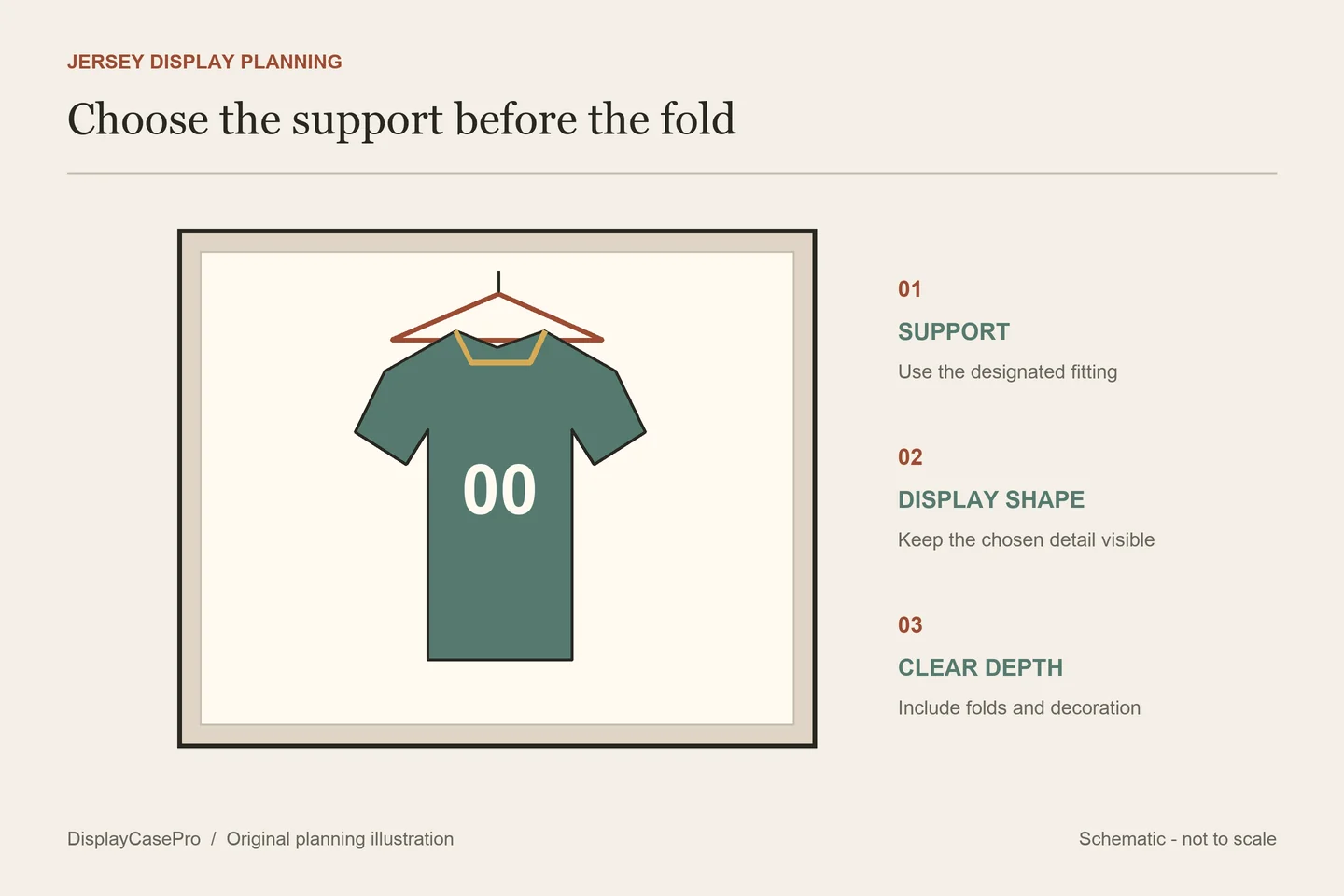
To hang a jersey inside a display case, choose a support that works with both the garment and the case, arrange the shirt without pulling it tight, and check that the closed door clears every fold. Hanging the finished case on the wall is a separate job with its own hardware requirements.
A lightweight replica shirt and a fragile signed jersey may look similar behind glazing, but they do not call for the same treatment. This guide helps you complete a fit and mounting plan, including a practical sequence for a case supplied with a jersey hanger. It is a researched guide, not a hands-on review of a particular case.
1. Choose the support before arranging the jersey
Open the empty case on a clean, stable surface and identify its actual mounting system. Does it have a hanger rail or hook, a removable pinnable panel, or a plain decorative backing? A fabric-covered board is not automatically designed to take pins or carry a garment.
| Route | What it can help you do | What to establish first |
|---|---|---|
| Case-supplied jersey hanger | Show the shoulders and let a suitable modern shirt hang more naturally. | Hanger width, attachment method, garment condition and clearance below the hem. |
| Manufacturer's insert and pinnable-board system | Hold a compact folded arrangement with the name, number or sleeve detail facing forward. | The exact kit instructions, permitted attachment points, backing construction and pin clearance. |
| Custom conservation mount | Support a vulnerable, historic or valuable garment with an object-specific approach. | An assessment of the fabric, decoration, signature and proposed display period. |
One real example of the first two options is sfDisplay's XL double-matted jersey case, whose listing describes a hanger and a pinnable background. Those features belong to that model; they do not establish that another case works the same way or that its materials suit an irreplaceable textile. We have not tested it.
For conservation framing, the Canadian Conservation Institute's flat-textile guidance stresses suitable mounting materials and separation from glazing. Its scope is flat textiles, so it should not be treated as a universal sewing pattern for a heavy jersey. A damaged garment needs a textile conservator's assessment.
2. Decide which face and details should remain visible
Write down the one feature the display needs to show: a player's back number, a front crest, a signature or the complete shirt. Photograph the garment in its current condition before you reposition it. Keep any provenance record separately; a display arrangement cannot authenticate an autograph.
Make a paper outline of the available opening, including any mat overlap. Use another paper shape to explore sleeve positions before repeatedly folding the actual shirt. A back-number layout may need sleeves turned inward; a sleeve signature may require an extended arm and a wider case. Give the signed area its own unobstructed space.
Do not use the frame border to pull the garment into shape. If a cuff or hem has to disappear behind the mat, check that it lies comfortably there rather than bunching into a hard ridge. A narrower composition is useful only if it does not create excessive bulk or hide the feature you chose to display.
3. Mount a suitable modern jersey on the supplied hanger
Use this sequence only when your case instructions allow hanger mounting and the shirt is sound enough for that support. A garment with splitting seams, brittle fabric or unstable decoration belongs on a different route.
- Fit the empty hanger first. Check how it engages the case's designated hook or rail. Confirm that it sits securely and that the door closes with the hanger in place. Do not improvise screws into an unidentified backing.
- Remove the hanger to dress it. With the shirt supported on the work surface, guide the hanger into it without stretching the neck opening. Do not force a broad hanger through a narrow collar.
- Settle the shoulders. The hanger ends should support the garment without creating pronounced points or pulling the sleeves outward. If the shoulder shape is wrong, change the support rather than stretching the shirt to fit.
- Return it to the designated fitting. Support the garment's weight while engaging the hanger. Check that the hem can hang within the opening and does not collect against the lower frame.
- Arrange only permitted folds. Follow the case's instructions if the layout needs a folded hem or sleeve retainers. If the case has no suitable way to support a fold, choose a different layout or mount instead of adding tape.
- Inspect before closure. Look for collar strain, sharp shoulder points, compressed decoration and contact with the door. Keep supporting the case as instructed while checking its final position.
A hanger holds the shirt; it does not necessarily hold folded sleeves, photographs or a nameplate. Give each additional object its own attachment system. Do not let a loose accessory share the garment's space where it can fall against fabric or a signature.
4. Measure the mounted arrangement, including its folds
The jersey's clothing size is a poor substitute for its display measurements. Record the width and height after choosing the face and sleeve arrangement. Then account for the support, folded fabric, stitched patches and any raised number or signature area.
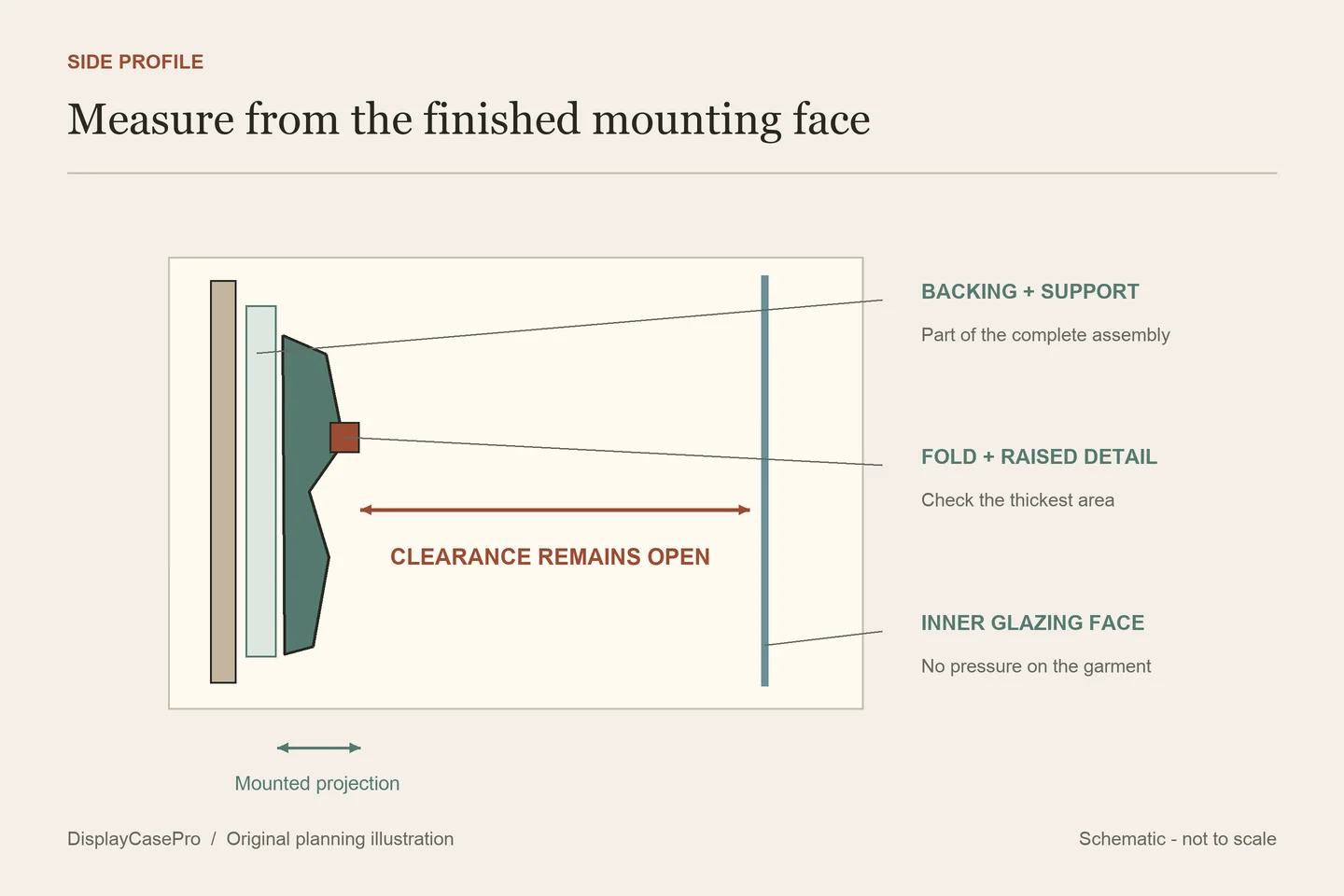
Ask for the distance from the finished mounting surface to the inside of the closed glazing. Exterior depth includes the frame and other components. For a general explanation of these reference points, see our guide to shadow box depth and usable space.
Check the thickest area, not just the center of the torso. A fold behind a sleeve can project farther forward than the visible number. Do not close the door against resistance to see whether the fabric will flatten. Rework the layout or choose a deeper case.
Download the jersey fit and support worksheet to record the reference surface, displayed size, deepest feature, chosen support and unresolved questions. Blank fields mean a measurement is still needed; they are not allowances to estimate from a product photograph.
5. Install the complete case using its own instructions
Wall attachment must suit the case's designated hanging points, the wall construction and the total loaded weight. A pin used inside the display is not wall hardware. Follow the current instructions for your model, including any required number of attachment points and orientation limits.
Choose a location where the door has room to open and the shirt can be accessed without reaching over furniture. Check whether the maker tells you to load the case before or after wall installation. Have a suitable helper support a large case during handling rather than using the glass door as a handle.
Keep the display away from direct sun and concentrated heat. UV-filtering glazing does not stop every form of light damage; controlling exposure still matters. After installation, check the fabric position and door clearance again, then save photographs of the front and the mounting arrangement for future inspections.
Common questions
Can I mount a jersey without putting pins through it?
A compatible supplied hanger may work for a sound modern shirt when the case has enough room. A carefully fitted custom support is another route. Neither option guarantees that every fabric, signature or decoration can tolerate hanging. Assess the garment before choosing the method.
Should I iron the jersey before framing it?
Do not make ironing or steaming a default preparation step. Follow the garment's care information and assess any applied decoration or autograph separately. For an important signed or historic piece, get appropriate advice before heat, moisture or cleaning is introduced.
How many pins should I use?
There is no case-independent number. The panel, insert, garment and attachment method all matter. Use the instructions for the exact system or ask a suitable framer to design the mount. More pins do not turn an incompatible backing into a sound support.
Can the same frame hold adult and youth jerseys?
Possibly, with different arrangements. Compare each shirt's displayed outline and mounted depth with the actual opening. Do not infer a fit from the word “adult,” “youth” or “universal” on its own.
Comments
Share a display tip or ask a question.