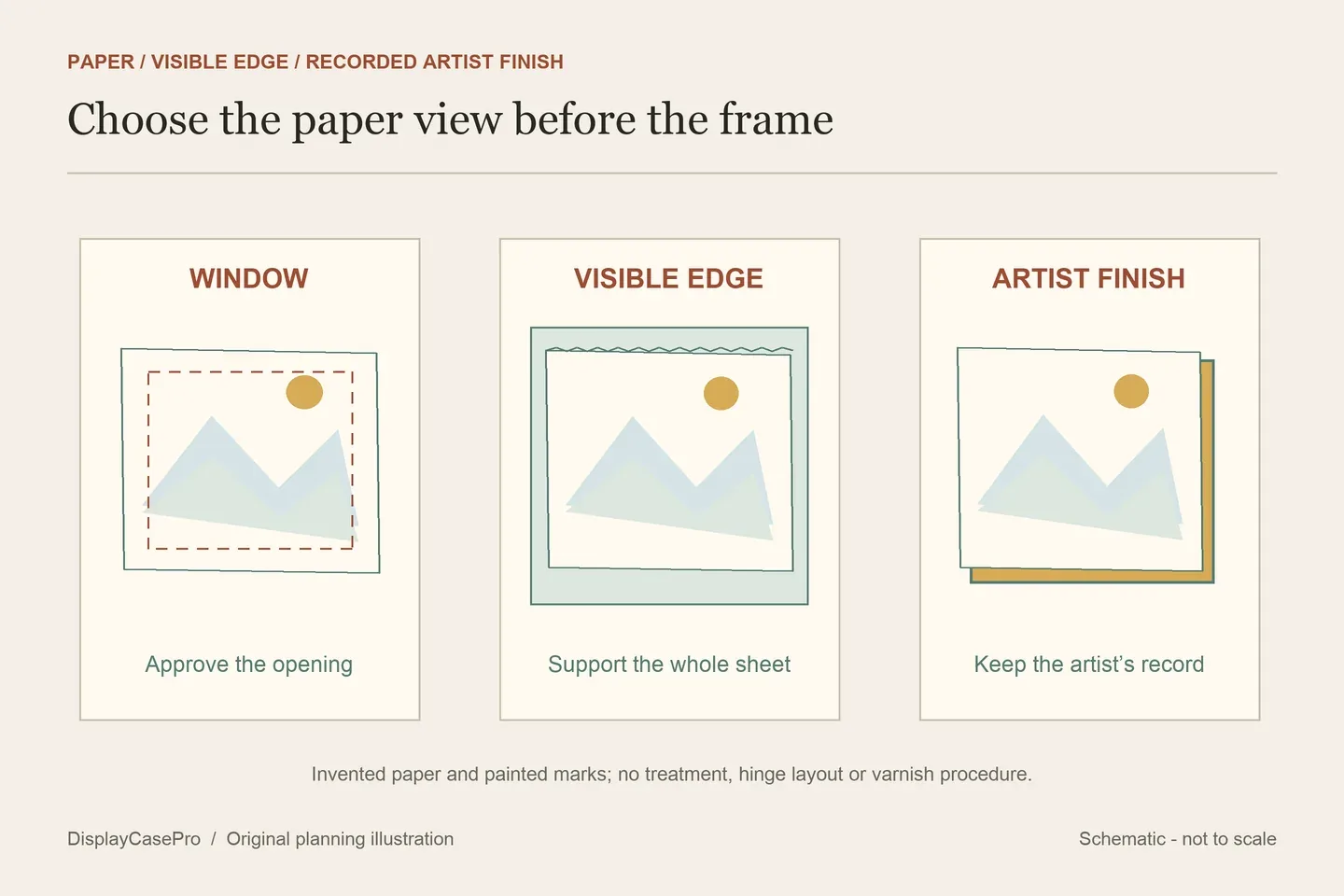
Frame a watercolor painting by identifying the paper and its condition, choosing the visible image and edge, and specifying a suitable mount with clearance from the glazing. An untreated work on paper and a watercolor already bonded and finished by its artist need different decisions. Choose the complete framing package before trying to make the sheet fit.
Identify the work before opening or preparing it
Record the artist, title, medium and support where known. Distinguish an original watercolor from a reproduction, and loose paper from a work already attached to a board or panel. Keep an existing artist’s finish or mounting record with the painting.
Look for undulations, tears, old tape, staining, a fragile edge or a previous attachment. A sheet that is not perfectly flat does not automatically need ironing or wetting. Have a suitable framer or paper conservator assess a condition problem before treating the original.
This is a useful boundary in Painting With Watercolors’ tutorial. It describes the author’s preparation and installation into a particular premade kit. Its flattening routine, long strip of hanging tape and hardware positions should not become standard instructions for a collector’s different painting.
Choose the visible image, signature and paper edge together
Measure the entire sheet in its intended orientation, then mark the painted image, signature and any edge you want visible on a reference photograph. A mat opening can be smaller than the paper behind it. A catalogue’s artwork size does not settle how much of a signature near the edge will remain visible.
For a deckled edge, decide whether seeing that edge is part of the intended presentation. Showing it calls for a supported arrangement, rather than leaving the paper loose because the frame is called a “float frame.” Ask the supplier to describe the actual assembly.
| View | What stays visible | Resolve first |
|---|---|---|
| Window mat | The image and intended signature inside a defined opening. | The actual sheet, supported mount and any edge covered by the mat. |
| Supported float | The whole sheet or chosen deckled edge above a visible backing. | How the paper is supported and attached, plus clearance above the completed mount. |
| Artist-finished mounted work | A watercolor intentionally bonded and surface-finished for its existing presentation. | The artist’s record and suitable framing instructions for that completed object. |
American Frame’s watercolor hints discuss mat overlap, signatures and deckled-edge presentation. Use those subjects to review an actual layout proof. Its numerical overlap and proportion suggestions do not define the right opening for every sheet or image.
Separate an artist’s finishing process from a collector’s mount
The following references were read on 19 October 2026. Some discuss framing paper behind glazing; others describe artists deliberately changing how their own paintings are supported and finished. That difference matters more than simply choosing “glass” or “no glass.”
| Reference | Starting point | Question for your work |
|---|---|---|
| Painting With Watercolors | An artist’s premade double-mat frame kit. | The actual paper condition, attachment and matching kit directions. |
| Brienne Brown | The artist’s own bonded-board and varnished presentation process. | Whether your object was created with such a finish, rather than assuming an untreated original should receive it. |
| American Frame | Mat, window, material and visual-design suggestions. | Your approved view and mounting package, beyond a generic size formula. |
| Northwest Watercolor Society | An article discussing artists’ no-glass options and a 2019 exhibition context. | Current exhibition requirements and the suitability of any proposed surface treatment. |
| Janine Helton | Collector guidance for the artist’s unframed originals. | The window or visible-edge view, glazing separation and location. |
Brienne Brown’s account bonds paintings to rigid support as part of her process. The society article also discusses applied wax, varnish and panel presentations. These are surface and support changes, rather than simply removing the front panel from an existing paper frame.
If you bought a watercolor already finished that way, retain the artist’s instructions. If you own an untreated original, obtain appropriate advice before adopting the process. For a show entry, read that event’s current requirements; the two older articles do not establish a rule for every watercolor exhibition today.
Specify support, attachment and glazing as a package
Ask for the mount description to identify the supporting materials, the attachment to the paper, the connection to the frame and what later removal would involve. “Acid-free” names a property of a described component; it does not identify everything touching the artwork.
The Canadian Conservation Institute’s framing note for works on paper discusses a package of mat, backing and glazing. Use it as a basis for resolving the complete assembly with a suitable framer, rather than taking a single suggested depth as a universal specification.
The Library of Congress matting guidance calls for keeping paper separate from glazing. Confirm that separation over the completed mount, including the paper’s actual surface profile. A visible-edge float arrangement can occupy a different depth from a window-matted sheet.
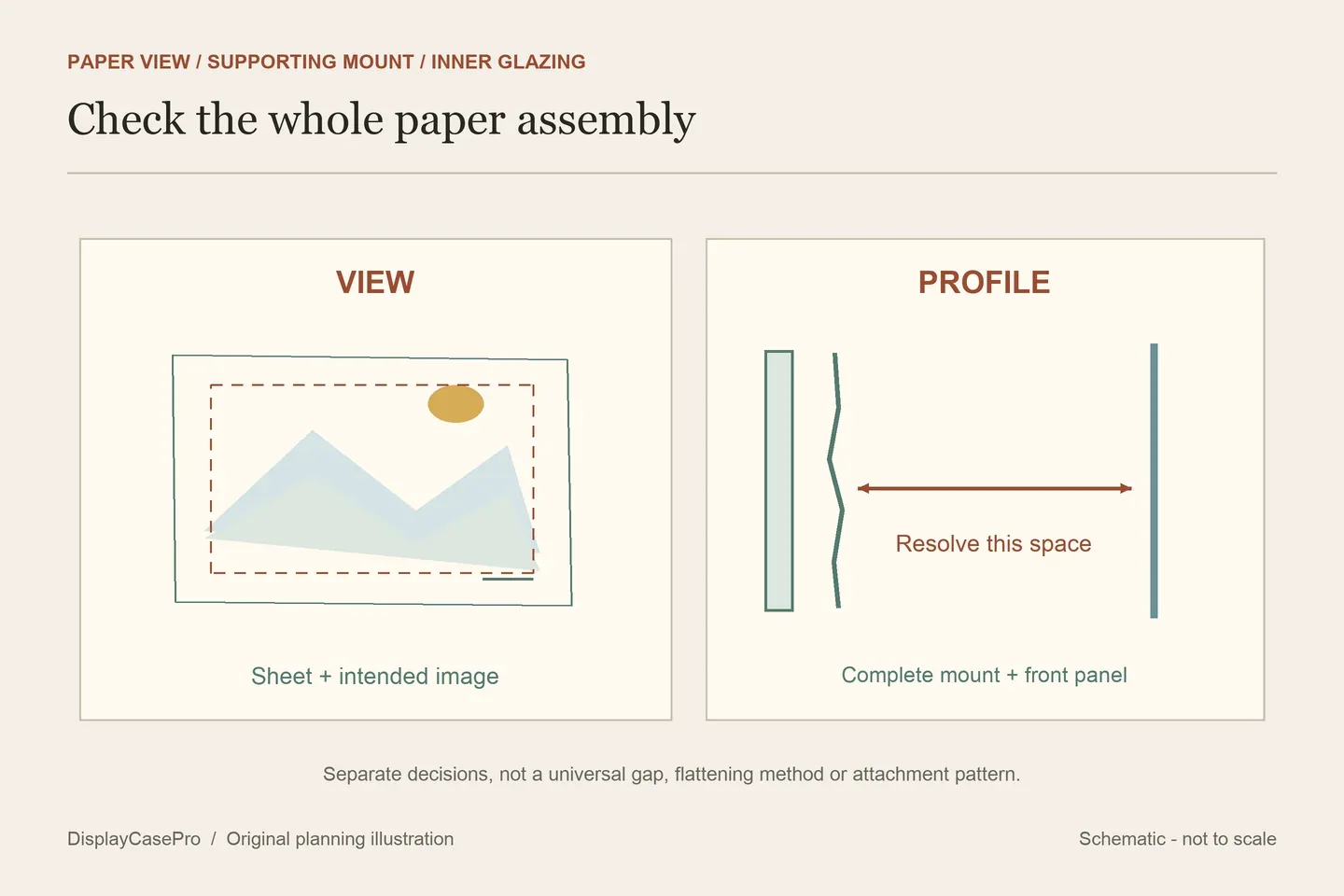
Use the usable frame-depth guide to record the receiving surfaces after those parts are known. A deeper outside moulding alone does not establish clearance or a suitable paper mount.
Review the actual assembly and room position
For a supplied frame kit, identify its closure and component arrangement before opening it. Keep the specified support and insertion instructions with that exact frame. The example in Painting With Watercolors uses flexible points; a different closure needs its own directions.
Before closure, compare the mounted view with the approved reference. Check the complete signature and chosen edge, then confirm that the assembly closes normally without compressing the paper. Keep glazing cleaning separate from work on the original painting and follow the glazing maker’s instructions for its actual surface or coating.
Choose the viewing position and inspect reflections in the room. Keep direct sunlight, splashes, cooking activity and regularly steamy locations out of the display plan. A named glazing product or an “archival” label does not establish an indefinitely harmless display period.
Keep the paper, view and finish information together
The watercolor framing record separates the whole sheet, painted image, signature, visible edge, mount and glazing. Save the approved layout, any artist-finish information and the current frame instructions with it.
This guide compares published framing approaches. No original watercolor, attachment, glazing, flattening method or surface treatment was physically tested for this article.
Comments
Share a display tip or ask a question.