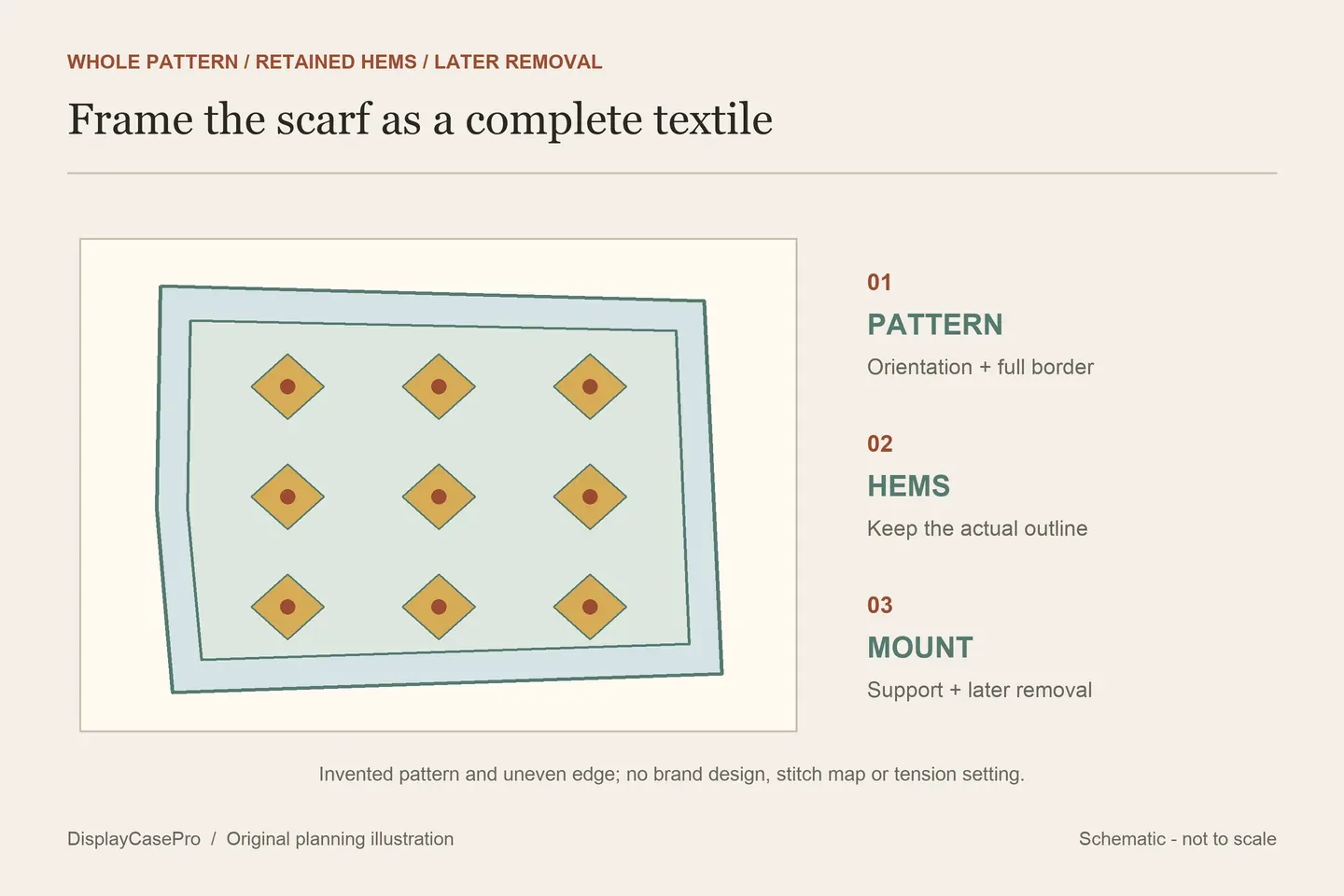
To frame a silk scarf intact, decide how much of the pattern and hem must remain visible, then agree on a support and frame that accommodate the whole textile. A scarf can become wall art without being cut into panels. The important decisions are the view, the attachment and what happens when you want it removed.
Decide whether the scarf must remain a complete textile
Begin with the scarf’s role in your collection. Is it still worn, a family keepsake, a collected design or fabric bought specifically for decoration? Record whether alterations are acceptable before choosing a visual treatment. Buying a frame does not itself answer that question.
This distinction changes how you use inspiration. Framebridge’s scarf article describes cutting a scarf into three pieces for a triptych. That may suit a project intended to create separate artworks, but it cannot preserve an intact scarf. If keeping the original complete is your aim, exclude cutting from the brief before requesting a quote.
Check the cloth without stretching it into a perfect square. Note uneven edges, old folds, thin areas, loose hems, stains, fringe and any previous attachments. Identify the material from a reliable label or record rather than appearance alone. Leave cleaning, pressing and repair decisions separate from the frame order; a neat photograph is not a treatment instruction.
Choose the orientation, border and hem view together
Lay out a reference photograph in the intended orientation. A scarf that looks balanced as a worn accessory may contain lettering, a signature or a scene with a clear top when shown flat. Mark those details, the complete border and the edges you want visible. Use that reference to approve the layout before the textile is attached.
Measure the whole cloth in that orientation and keep the original units. A nominal square size can conceal an uneven hem or a projecting label. Ask how the finished support will present those features without making the outer edge artificially straight.
| Desired view | Check on the scarf | Approve with the framer |
|---|---|---|
| Complete pattern and outer edge | All borders, rolled hems and any fringe. | The edge position, visible support around it and how the whole cloth is carried. |
| Pattern within a mat window | Lettering, signature and design close to an edge. | The actual visible opening and any cloth hidden behind it; do not infer this from the sheet size. |
| Backed presentation | Translucent areas and the appearance of the reverse. | The backing color and contact materials, using the actual textile rather than a screen color alone. |
| View through two transparent panels | Whether the reverse is meaningful and how the wall shows through. | The support and attachment, panel separation and a finished mock-up; transparency is not a mounting method. |
A rolled hem is part of the object. Its shape can differ from the flatter printed field, so the support, window and glazing need to be considered as a package. Do not order a shallow frame first and then decide how to accommodate the hems.

Read framing accounts for the decisions they actually document
These five independent-site pages were read on 19 October 2026. They include personal projects, a framing business and a styling article. Their different purposes matter when adapting an idea to your own scarf.
| Source | Useful reference | Check for your project |
|---|---|---|
| Framebridge | A staff scarf-to-triptych project and alternative pattern presentations. | Whether cutting is excluded and how an intact scarf would be supported instead. |
| Abby Murphy | A vintage Lanvin scarf, a local specialist and backed versus transparent presentation. | Your cloth’s condition, attachment and backing; the account includes affiliate links. |
| Framed Silk Scarves | A merchant’s description of its stitching, backing and glazing approach. | The proposed attachment for your object; one business’s method is not the only possible suitable solution. |
| CoCo Zentner | Framed-scarf placement as part of an interior. | The separate mounting specification; room styling does not establish textile care. |
| Ashley Brooke | A disclosed gifted framing project for a vintage Hermès scarf. | Current service capacity and collection arrangements; older article and comment details are not today’s policy. |
Use these references to describe the result you want. A photograph can communicate a border width or a backed appearance, but it cannot show every attachment or prove that the textile will return unchanged to wear.
Agree on the support before selecting the frame depth
Ask the framer to describe what will carry the textile, which materials contact it, where attachment occurs and how the hems are accommodated. Keep this description with the quote. “Hand mounted” or “archival” on its own leaves too much of that arrangement unspecified.
The Canadian Conservation Institute’s guidance for small, light, flat textiles makes condition and appropriate support central to the decision. Its preparation directions for backing materials are not directions to wash or iron your scarf. A fragile or soiled textile needs appropriate specialist assessment.
Do not copy a stitching pattern, pin spacing or tension setting from an unrelated project. Those details need to suit the actual cloth and its condition. Likewise, a transparent presentation needs a deliberate support; trapping the scarf tightly between panels should not be assumed to provide it.
Once the support is resolved, record the finished assembly depth, including hems and other projections, and confirm the intended separation from the glazing. The guide to usable frame depth explains which receiving surfaces and obstructions to measure. The outside thickness of a decorative frame does not specify that space.
Confirm current service limits and later removal
Send the current dimensions, condition notes and reference photographs when requesting a quote. Ask whether the work is accepted through a shop, by mail or through another arrangement, and confirm the current size limits. Old blog prices, turnaround times and readers’ comments should prompt a question rather than settle the order.
Make the removal question explicit. Who can open the package, release the mount and return the scarf, and what limitations do they anticipate? If continued wear is essential, discuss that before framing. A claim that a mount can be undone does not by itself establish that the cloth will have no marks, folds or changes.
Approve the final pattern orientation and edge view, then choose the wall location with lighting and reflections in mind. Avoid direct sunlight and intense illumination. A glazing label cannot establish an indefinitely harmless display period or make a particular location suitable.
Keep one record for the cloth and its frame
Use the silk scarf framing record to retain the whole-cloth measurements, border and label positions, approved view, support description, current quote and removal arrangements. Keep alteration or treatment permission separate from approval of the visual design.
This guide compares published accounts and planning decisions. No scarf, mount, stitching method, glazing or return-to-wear outcome was physically tested for this article.
Comments
Share a display tip or ask a question.