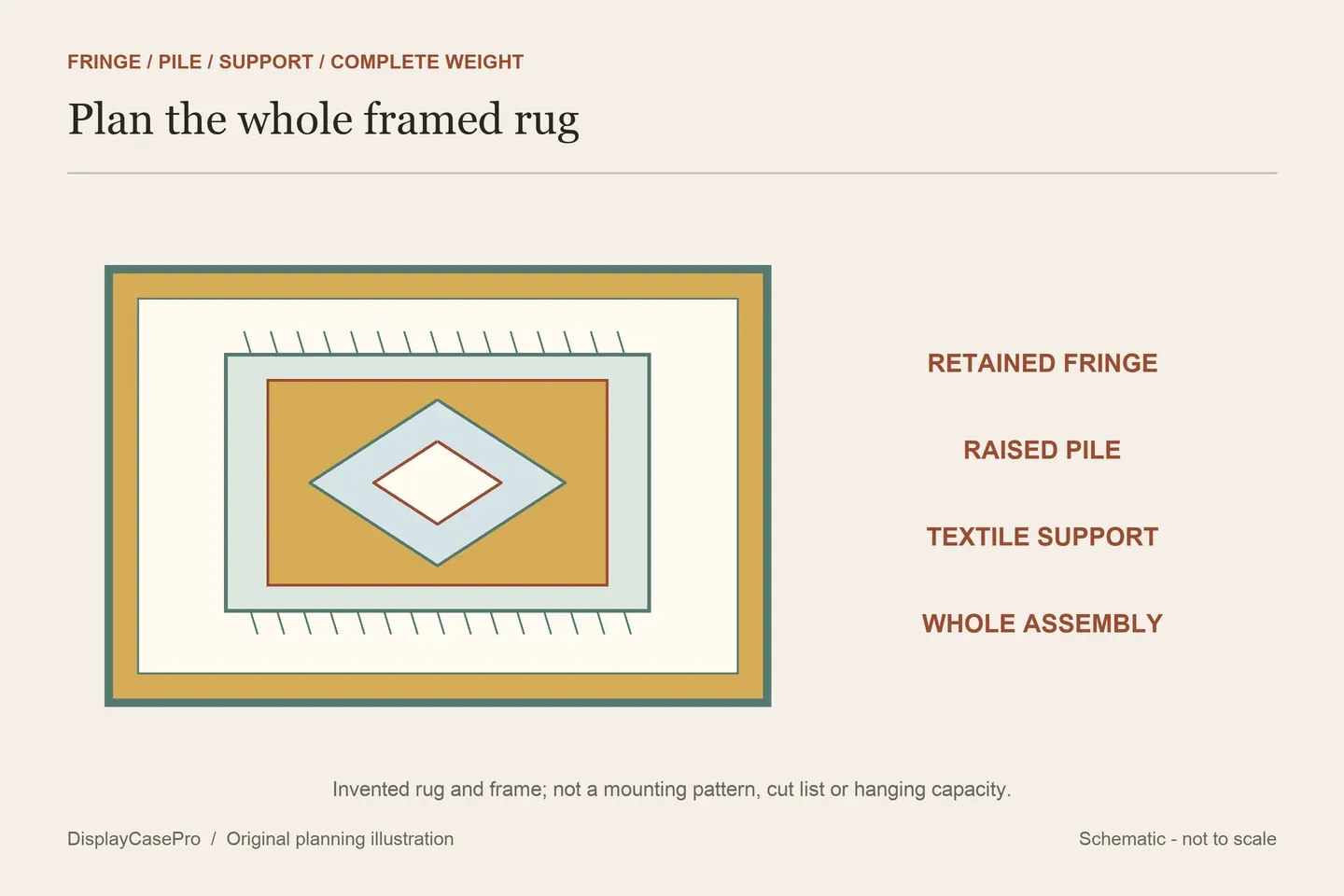
Frame a small rug or an existing rug fragment by keeping its retained fringe and pile within a planned, supported composition. Resolve the textile mount before choosing the surrounding frame, then check the complete depth and assembled weight. A frame for displaying a finished rug is a different thing from a workframe used to make one.
Decide what must remain intact
Record whether you have a complete rug, an already separate fragment or a contemporary textile bought for an art project. Keep provenance, labels and known material information. A worn edge can be part of an object’s history; it is not automatically permission to cut a rectangle from the middle.
Note loose pile, broken foundation threads, weak edges, stains, existing backing and old adhesive. Have a textile specialist assess a fragile, damaged or important rug before mounting. Choosing a frame is separate from cleaning, repairing or altering the textile.
Bigger Than the Three of Us turns a worn rug into framed art by cutting and gluing it. That is a personal decorating project. For an intact collectible, keep the frame brief around the object you are retaining rather than following its cut-to-fit sequence.
Include the fringe and the pile in the composition
Use an existing photograph to choose the orientation and the section you want to see. Check both ends of the rug: fringe can extend beyond the woven body, and its appearance may be important to the intended view. Measure the actual outline rather than treating a nominal rug size as the frame opening.
| Detail | What to retain | Approve before ordering |
|---|---|---|
| Fringe | The intended end view and any irregular surviving lengths. | Its support and space within the visible opening. |
| Pile | The raised surface and chosen direction. | Front clearance without flattening the texture. |
| Edges | The actual outline, binding and any existing fragment boundary. | The mount around weak or uneven areas. |
| Pattern | The full motif or intentionally selected existing fragment. | Which parts a mat or frame lip would conceal. |
View the reference in the intended orientation from more than one position. Pile can make a rug read differently as the viewing direction changes. Save the chosen top edge on the reference so the mounting and hanging discussions use the same orientation.
Specify what carries the rug
The inner support, attachment to the textile and decorative surround have different jobs. Ask the framer to describe each, including contact materials and later removal. A border that looks substantial does not show how the rug is attached behind it.
Samantha Potter’s contemporary rug project makes an inner frame and a separate decorative floating frame. That distinction is helpful when describing an order. Her nailed attachment and timber dimensions belong to that project, not to a different historic rug or its load-bearing mount.
The Canadian Conservation Institute’s flat-textile framing note discusses suitable contact materials, solid support and separation from glazing. It excludes glues, adhesive-coated boards, staples and nails from direct contact with textile artifacts. Its small-textile mounting route does not supply a structural design for a large, heavy carpet; have the actual rug assessed.
For a large or heavy piece, ask whether a separately designed textile hanging system is more appropriate than picture framing. The Mission Motif’s wall-display guide describes several hanging formats. Choose among them with the rug’s construction and condition established, rather than assuming a clamp, adhesive strip or rod suits every textile.
Decide whether the frame has an enclosing front
A decorative surround can be open. The Wild Decoelis’ vintage-rug build explicitly describes a project without glass. Its wooden border does not provide the same enclosure as a glazed frame. Make that choice explicit in your own quote.
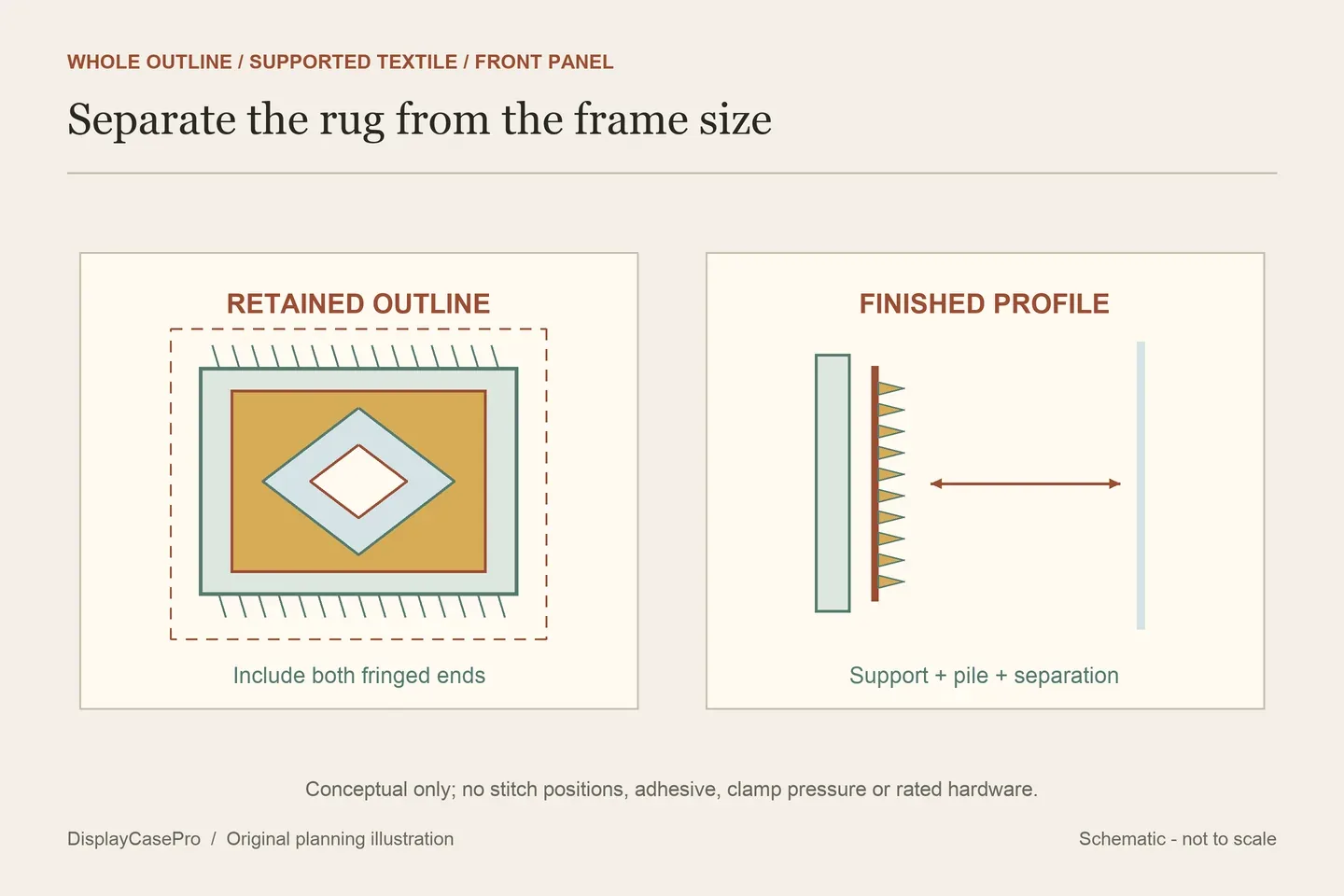
For a glazed frame, establish the completed mount’s profile: support, contact layers, retained fringe arrangement and highest pile. Confirm the receiving depth and separation above that assembly. A shallow frame should not rely on the glass or the back pressing the rug flatter.
| Boundary | What to record | What it does not settle |
|---|---|---|
| Textile | Full retained outline, including fringe. | The size of the complete supporting board. |
| Mount | Finished support and front projection. | The room left behind the closed glazing. |
| Opening | The pattern, edges and fringe actually visible. | The outer wall footprint or complete receiving size. |
| Exterior | Assembled frame dimensions and weight. | Permission to change its hanging hardware. |
Use the usable frame-depth guide to identify the receiving surfaces. Confirm all measurements with the chosen frame supplier after the mount is resolved.
Treat the whole framed assembly as the hanging load
Include the rug, support, glazing and surround when obtaining the assembled weight. Keep the frame maker’s hanging instructions and the installation plan for the actual wall together. The weight of the rug alone is insufficient.
Stay Home Style’s project includes a later correction after an improvised hanging wire failed. The useful lesson is to retain the intended hanging arrangement and assess the complete assembly, not to derive a universal hardware capacity from that incident.
Plan who can open and support the framed rug during inspection. Keep direct sunlight, damp conditions and room contamination in the location discussion. CCI’s textile-care guidance notes the need for custom supports for oversized textiles and that light damage accumulates. A glazed frame does not establish unlimited exposure.
Keep the mount and object history together
The rug framing record separates the retained outline, pile, support, receiving space and complete weight. Keep the approved photograph and current supplier instructions with it. No rug, attachment, frame or hanging system was physically tested for this article.
Comments
Share a display tip or ask a question.