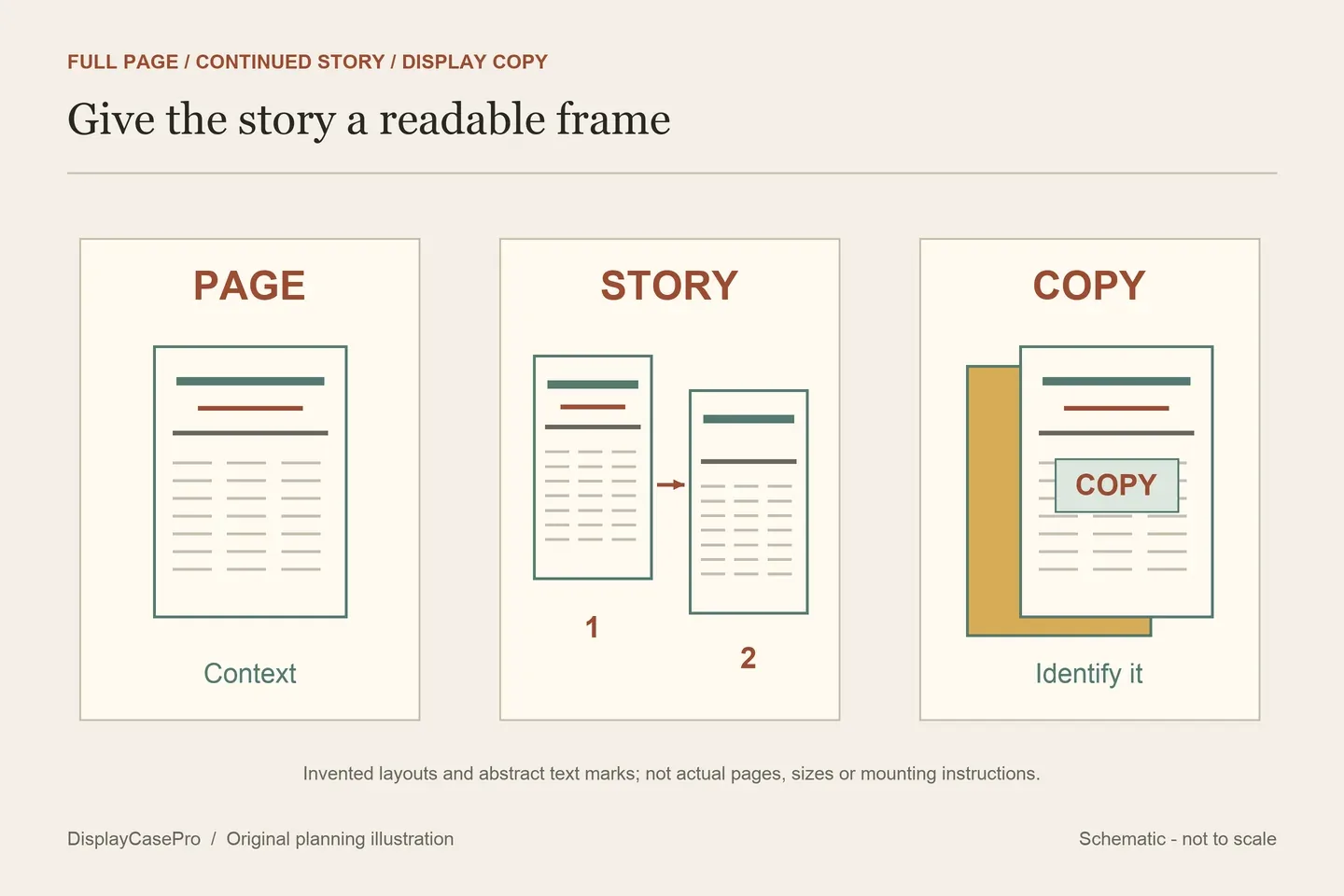
To frame a newspaper, first choose what you want to show: an intact page, an existing clipping, a complete story spread across several sections, or an identified display copy. Preserve the publication name and date, keep the reading order clear, and check the visible text area before ordering the frame.
Decide whether the physical paper needs to be on the wall
A signed page, a family announcement and a story saved from a website can call for different displays. Identify the item before choosing its presentation. Is it the original printed sheet, a later reprint, a scan of that sheet, or an online article that never had a newspaper-page layout?
The Library of Congress framing guidance recommends a well-made reproduction instead of long-term display of valuable paper originals. Framing can limit some risks; it does not make light exposure harmless. A display copy lets you enjoy the story while keeping the collected paper separately.
Check condition before moving or opening an old page. The National Archives’ paper-record guidance specifically includes newspaper clippings among acidic records for which a facsimile may be useful. It also says to leave stiff, brittle or damaged folds that resist gentle opening to appropriate conservation care. Do not iron, wet, spray or force a newspaper flat as a framing preparation step.
If the original is already enclosed or mounted, record that arrangement. Removing old tape or separating adhered pieces is another task, rather than a necessary first step toward a display. Obtain suitable paper-care advice where condition prevents safe handling.
Keep the story complete without cutting away its context
Make a story map on a separate note or reference image. Identify the headline, byline, relevant photograph and caption, publication, edition, date and page number where available. Follow every continuation: a front-page introduction may finish much later in the issue, and the reverse may contain information worth retaining.
| Display route | Keep visible or recorded | Resolve before ordering |
|---|---|---|
| Intact full page | Masthead, date, relevant story and surrounding page context. | Can the important text be read at the intended distance, and is the whole sheet supported? |
| Existing clipping | Complete headline, columns, captions and any surviving source information. | Will the mat hide text? Put missing verified context on a separate label. |
| Continued story | All sections in an unambiguous reading order, with their page references. | Would separate windows, separate frames or one identified copy work better? |
| Display copy or rebuilt article | Source identity, readable content and a clear description of what was reproduced or rearranged. | Is it a page facsimile or a newly composed layout, and what permission and proof approval are required? |
Use a copy of the page to explore crops and arrangements. An intact historical sheet does not need to become a clipping because a smaller rectangle looks tidier. Equally, an existing clipping should not be presented as a complete front page. If its newspaper or date is unknown, retain that uncertainty in the record.
For a continued article, label the sequence on your planning sheet: first section, continuation and final section. Keep those additions separate from the original paper. If a display omits part of the story, describe it as an excerpt. A reader should not mistake a rearranged or shortened composition for the publication’s original layout.
Choose between framing a sheet and creating a new print
These services start with different material. Check what you must supply and what comes back before comparing frame finishes. The pages below were read on 19 October 2026; their instructions and preservation claims have not been physically tested for this guide.
| Source | Starting point | Useful order question |
|---|---|---|
| Frame It Easy | A measured sheet entered into a custom frame designer. | Which field is the sheet size, and what part will the selected mat cover? |
| Modern Memory Design | Original-paper or reproduction framing, including continued stories. | Does the quote include copying, multiple windows and a mount selected for this paper? |
| Frame Destination | A DIY clipping-and-frame project. | What support and window suit the intact item, rather than a freshly trimmed rectangle? |
| YourFramedArticle | A story rebuilt into a new print layout, often from an online link. | What source material, reproduction permission and layout proof are needed? |
| First4Frames | A full page, clipping or copied display with contextual details. | How will the date, meaningful reverse and continued sections remain connected? |
A scan, a facsimile print and a reconstructed article are different deliverables. Ask whether a service reproduces the entire sheet, adjusts its appearance or rearranges text and images. For any supplied reproduction, confirm the necessary permissions with the source or rights holder. Being featured in a story does not establish ownership of its text or photographs.
Test the story at its intended viewing distance
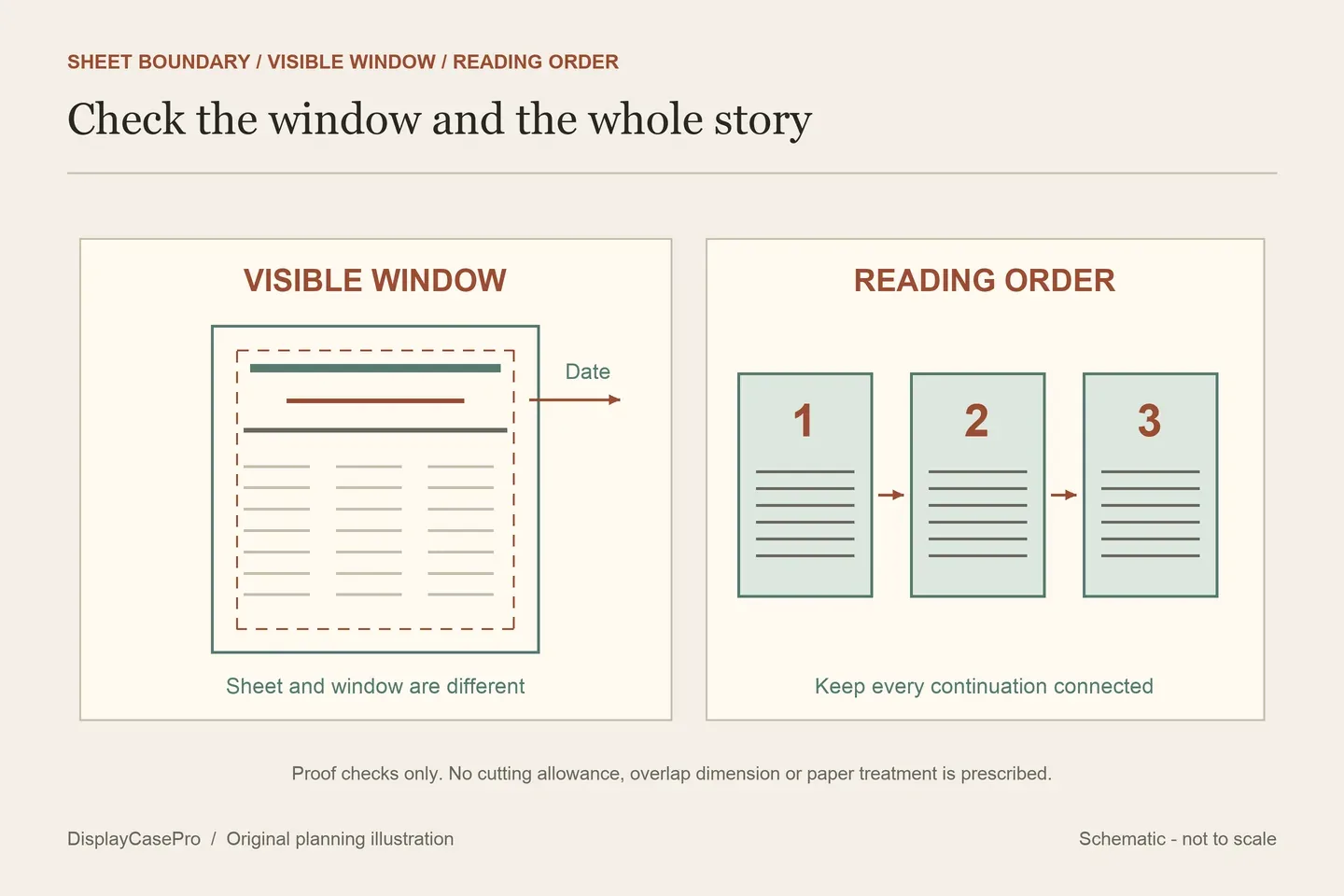
Measure the complete sheet separately from the text you need to see. On a disposable reference copy, mark the proposed window and every essential edge: the last letters of a column, photograph captions, publication date and continuation lines. Check each aperture when a layout uses several windows.
Make a physical proof at the proposed display size. Place it where the frame will hang and read the smallest important text from the position people will actually use. A headline readable across a room does not establish that a narrow column is readable there. If necessary, choose a closer viewing position, a larger permitted reproduction or a clearly identified excerpt.
Ask for a mat-window proof rather than treating the frame’s nominal size as the visible area. Borders need to support the chosen layout without hiding words. There is no universal newspaper border or window allowance: the sheet, text position and mounting plan decide what is appropriate.
Specify support and glazing separately from the visible border
Ask the framer to name the mat, backmat, backing, attachment and glazing in the proposed package. Library of Congress guidance calls for chemically stable materials and separation between paper and glazing. A wooden frame or attractive border alone does not establish those details.
The Library’s mounting-corner guidance explains that corners can avoid adhesive on the object, but also warns that some commercial corners can allow adhesive to creep onto it. Have the actual mount assessed for this sheet and condition; a label saying “archival” is not the complete answer.
The Canadian Conservation Institute’s framing note cautions that a spacer may not prevent distorted paper from contacting glazing. Extra depth is therefore not a substitute for examining folds or buckling. For a mixed display with medals or other projecting keepsakes, keep their supports and clearance separate from the paper mount.
Choose the location and display duration with the original’s needs in mind, away from direct sunlight and intense light. No lifespan is promised here. A UV-filtering option should not be treated as permission to hang an irreplaceable original in bright daylight indefinitely.
Keep the frame connected to the source and stored original
Use the newspaper display record for publication details, continued sections, original-or-copy status, sheet dimensions, visible window and proof approval. Link the display copy to the stored original through a collection record code. Keep captions on a separate label rather than writing on the newspaper.
Before approving the order, confirm the complete story, readable text, visible date, mounting proposal and exact deliverables. If the display includes three-dimensional objects, the shadow-box usable-depth guide explains the separate depth definitions. This guide plans a display; it does not prescribe paper treatment or certify preservation performance.
Comments
Share a display tip or ask a question.