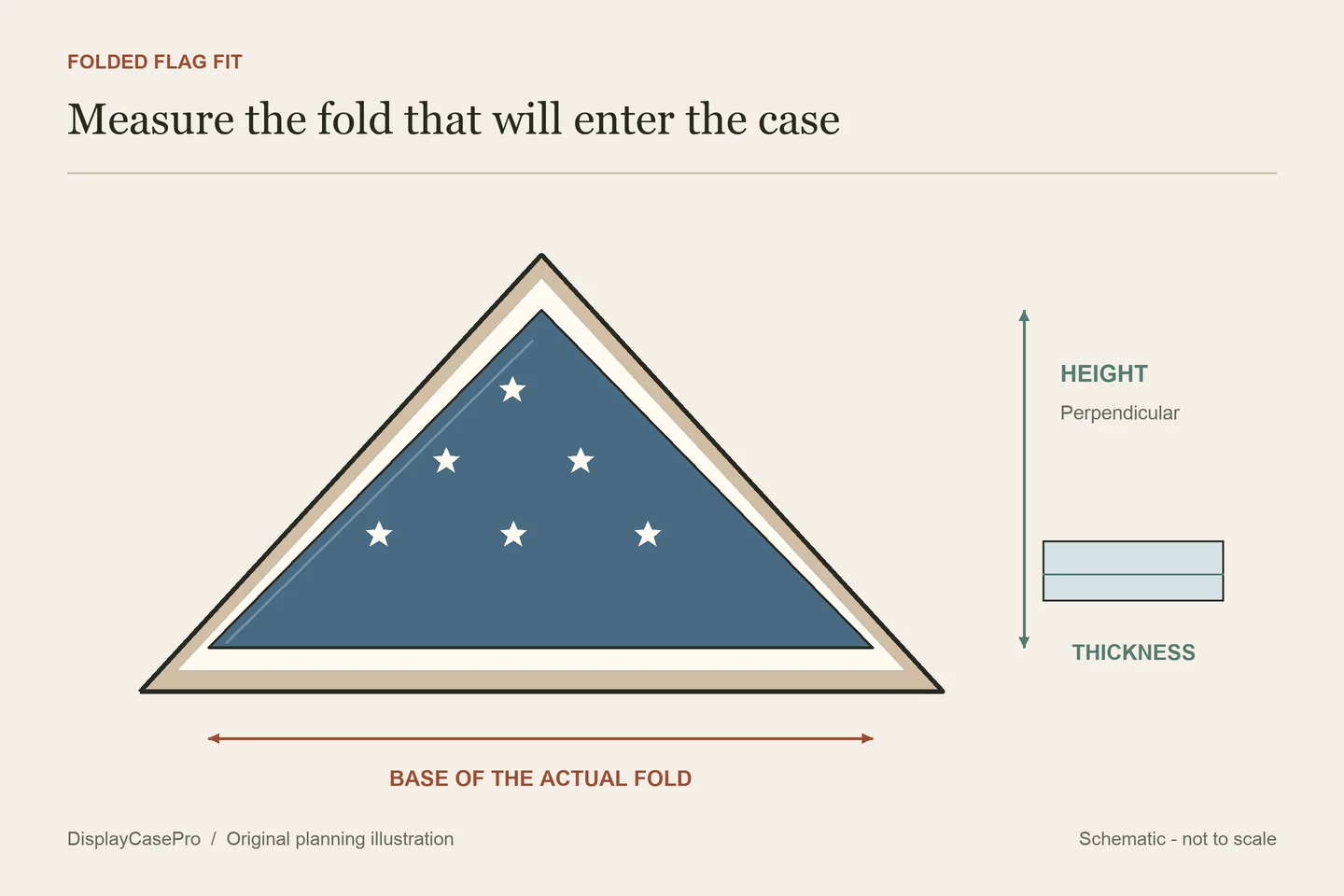
Choose flag display case dimensions from the flag's actual folded outline and the case's usable flag compartment. Record the triangle's base, perpendicular height and thickest depth, then check its sloping edges and the opening through which it will enter. A label such as “for a 5 × 9½ ft flag” describes the intended unfolded flag category; the folded fit still needs checking.
Separate unfolded size, folded size and case size
Flag-case listings often place several sets of numbers close together. Give each a separate line in your notes so you can use it for the right decision.
| Dimension | What it describes | What you use it for |
|---|---|---|
| Nominal unfolded flag size | The flag laid out before folding, when known | Identify the maker's intended flag category. |
| Actual folded profile | The current base, height, thickness and outline | Check the shape you want the case to accommodate. |
| Case outside dimensions | The complete case or frame | Plan wall, shelf or mantel space. |
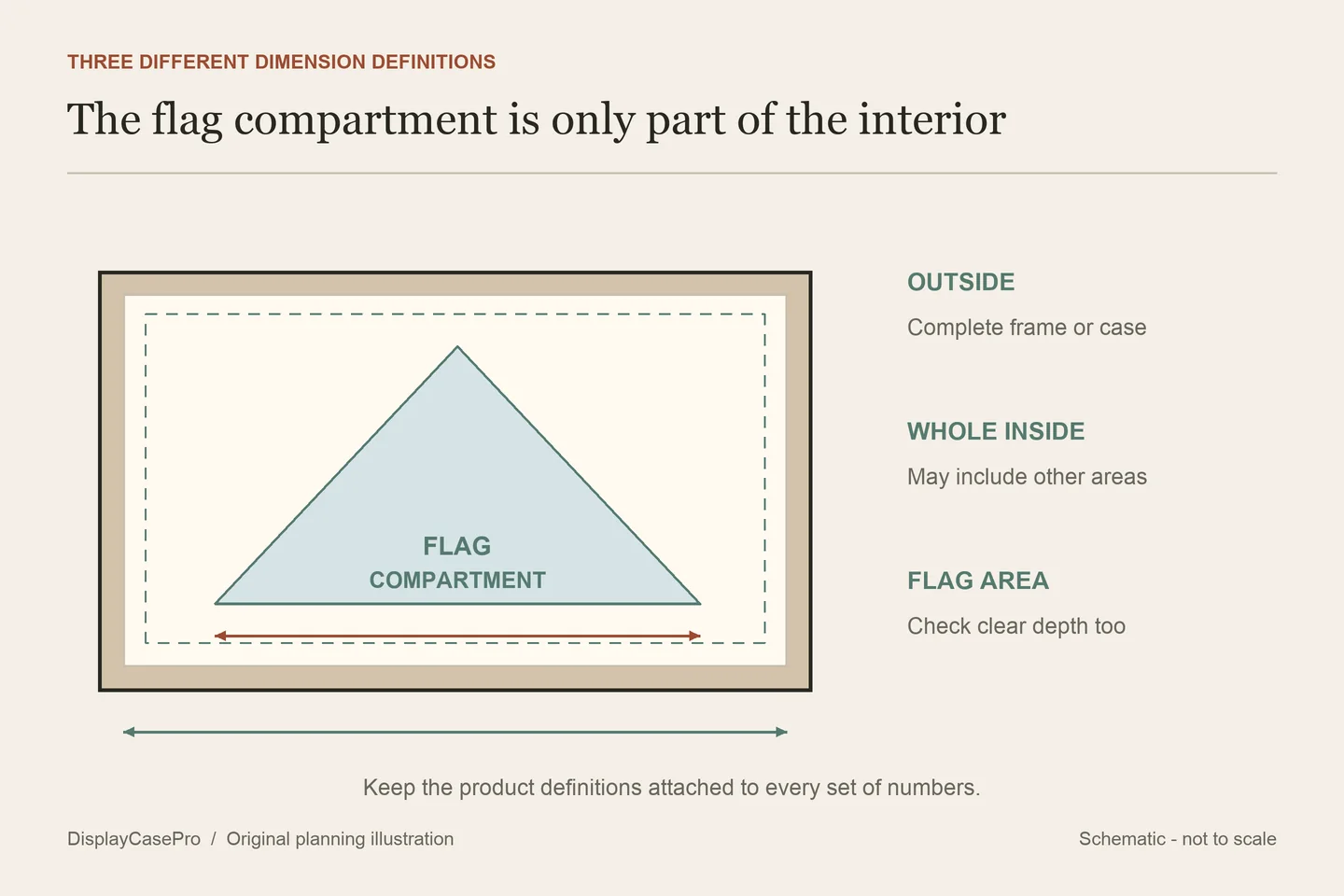
| Whole interior dimensions | The enclosure's internal space | Understand the overall interior, including other compartments. |
| Usable flag compartment | The space actually assigned to the folded flag | Compare its shape and clear depth with the folded profile. |
The examples here concern U.S.-market triangular cases. They are not a universal folding specification for flags from every country. Keep the original units visible when comparing an inch-based listing with measurements taken in centimeters.
Measure the flag in the fold you intend to preserve
First establish whether the current fold has personal or ceremonial importance. Record its appearance and any associated information before making changes. You can plan the case around an existing fold without unfolding the flag simply to discover its original size.
- Prepare a clean, clear working area. Make room to support the folded flag without balancing it on its point or decorative objects.
- Record the longest lower edge. This is the triangle's base width, measured from end to end in the intended display orientation.
- Record the perpendicular height. Measure from the base line toward the highest point. The length of a sloping side is a different measurement.
- Record the thickest area. Check the folded layers and tucked area without squeezing them to obtain a smaller number.
- Record the outline. A photograph and a separate paper sketch can show rounded corners, an uneven point or an edge that sits outside a neat geometric triangle.
- Include the intended support. Record any backing or support that will occupy space in the compartment.
Keep a measuring tool beside the textile rather than dragging it over the fabric. Avoid attaching tape, pins or marks to the flag for the purpose of measuring. If its condition makes routine handling difficult, arrange for appropriate assistance before continuing.
The U.S. Department of Veterans Affairs' Burial Flag FAQ points readers to display and folding guidance and notes that its cotton burial flag is unsuitable for outdoor display. This guide deals with fitting an indoor enclosure; it does not replace ceremonial folding guidance or determine benefits eligibility.
A real specification shows why compartment dimensions matter
Ceremonial Supplies' Military Flag and Decorations Display Case, SKU ML0064, publishes three different dimension sets. The figures below retain the listing's definitions. They are supplier specifications, not measurements we have taken.
| Listing definition | Height | Length | Depth |
|---|---|---|---|
| Complete outside | 12½ | 25¼ | 3½ |
| Whole inside | 11¾ | 24½ | 2½ |
| Flag compartment | 11 | 22½ | Not separately stated |
The flag compartment is smaller than the whole interior. A folded flag's base therefore needs comparison with the stated 22½-inch compartment length, rather than the 24½-inch whole-interior length. The separately unstated compartment depth remains a question for the supplier. A whole-interior depth figure does not reveal every fitting, lining or obstruction in the flag area.
This example illustrates how to read a listing. It does not confirm compatibility with your flag, and another model may use different labels or a different compartment shape. Ask for an internal drawing or a clear explanation whenever the dimension names are ambiguous.
Check the complete outline and the entry route
A base width and peak height describe only part of a triangular fit. Rounded folds can meet the sloping sides before the base reaches its intended position. Frame lips or the back-panel opening can also reduce the space through which the flag must pass.
Compare a paper outline of the planned folded shape with a reliable compartment drawing, keeping both at the same scale. Include the thickest folded area in a side-view note. A supplier can use these records to answer a more precise question than “Will this fit a large flag?”
For an existing case, check the compartment while it is empty. Record the opening, the inner glazing face and any retaining parts. Follow the model's access instructions, including removing a wall-mounted case when the rear panel cannot be reached safely in place. Our guide to usable shadow box depth explains the separate depth check.
During placement, the fold should retain its intended shape without using the glass or back panel to compress it. Close the case carefully and check for pressure at the point, tucked edge and thickest section. If it only closes after pressing firmly on the back, stop and reassess the available space.
- The base fits but a corner catches: compare the full outline with the sloping interior and frame lip.
- The shape fits but the back will not close freely: check depth, backing and retaining parts.
- The flag moves or slumps: resolve a suitable support with the case maker; avoid filling gaps with unrelated objects.
- The fold must change substantially: reconsider the case choice and the significance of the existing fold before proceeding.
Keep plaques and memorabilia in their own planned space
A nameplate, medallion or medal group can occupy a dedicated area around a flag compartment. Mark those positions on the layout before choosing a combination case. Keep their supports independent so their weight or fittings do not press into the textile.
Read the nameplate from the usual viewing position and check whether a frame edge hides the text. Retain accurate records of names, dates and the flag's origin; leave uncertain details out of the engraving until resolved. A decorative service emblem should not be used to establish an undocumented history.
For a tabletop or mantel location, compare the complete case footprint with the available surface, including any pedestal. For a wall location, follow the exact case's installation instructions and the requirements of the wall. Interior fit and wall installation are separate checks.
Download the blank folded-flag fit worksheet. It keeps nominal flag size, actual folded profile, compartment definitions and unresolved depth questions separate. The general collection measurement guide provides additional help with openings and assembled supports.
Common questions
What size case holds a 5 × 9½ ft flag?
Start with cases marketed for that unfolded category, then compare the actual fold with the usable compartment. The category label alone does not establish the folded width, height or thickness of your item.
Can I calculate the folded height from the base width?
A geometric drawing can describe a designed triangle, but a layered textile can have rounded edges and an uneven fold. Measure both dimensions and record the outline instead of relying on a fixed ratio.
Should I refold a flag to fit a case I already own?
Consider the flag's condition and the significance of its present fold first. A case that accommodates the intended fold may be the better choice. Obtain appropriate folding or textile advice when needed; squeezing the flag behind the glazing is not a fit solution.
Comments
Share a display tip or ask a question.