
Choose a comic book display frame for the thing that will actually go into it: a loose issue, an issue kept in its bag and board, or a graded slab. Those are different packages. Compare the holder area, visible cover, depth and removal method before choosing the frame's outer size or finish.
Start with the issue and its present enclosure
Write down the title, issue number, edition or variant where known, and the enclosure in which you intend to display it. A “current,” “Silver Age” or “graded” category helps narrow a catalogue; it does not replace the measurements and identification of your particular package.
| What goes in the frame | Measure and record | Resolve before ordering |
|---|---|---|
| Ungraded issue without an outer holder | The actual closed issue, including projecting or irregular edges and thickness. | How the whole issue is supported without using its cover, staples or glazing as a clamp. |
| Issue retained in a bag and board | The complete package, including the board, seams and flap in its intended closed position. | Whether that package is accepted by the frame and what the frame contacts. |
| Graded issue in a rigid slab | The slab's overall width, height and thickness, plus its maker and identifiable version. | Holder compatibility, label visibility, retention and how the intact slab releases. |
Keep an important original's existing condition in mind. The Library of Congress comic-book guidance calls for supportive enclosures and cautions against tape, glue and rubber bands on comics. It also notes that brittle paper can be affected by electrostatic charge from polyester film. A frame should not become a reason to improvise a new enclosure on a fragile issue.
If you already use a suitable bag and board, decide whether retaining them is part of the display requirement. Taking the board away solely to fit a smaller frame changes the package being evaluated. For a slab, evaluate the complete sealed holder; this guide does not call for opening it or assess the grade.
Separate raw-issue frames from slab frames
A raw-issue frame may use an insert, recess or other support intended for a particular issue format. Ask whether the published opening describes the visible window, the supporting pocket or the largest accepted package. Those dimensions can serve different purposes even when they appear beside the same product photograph.
A graded frame instead receives the rigid holder. It should accommodate the actual slab, including its thickness and label area, without requiring the comic to leave that enclosure. A maker's list of grading companies is useful, but a thicker annual or older holder can still need a different frame.
Multi-issue frames add another decision. A set of four raw issues and four slabs can have very different overall footprints. Choose the issue order and enclosure type first, then confirm that every opening in the exact frame accepts its assigned package.
What three published frame descriptions do and do not establish
The following examples illustrate specification differences. They are published descriptions, not hands-on tests or a ranking of frame quality. Prices, stock and customer ratings are not part of the comparison.
| Named frame | What the description supplies | Question still to resolve |
|---|---|---|
| BCW Current Comic Book Frame, 1-CBF-CUR | 13 × 16 in exterior, rear access and a supplied mat. The specification calls 6 7/16 × 9 15/16 in the “Comic Recess.” | The FAQ also describes that figure as the accommodated comic size. Obtain clarification of the recess, visible opening and accepted complete package; do not silently treat them as interchangeable. |
| The Collectors Resource graded Museum Edition, 1GBMUS01 | Its description distinguishes standard slabs 0.5–0.6 in thick from thicker 0.75 in cases, which it excludes. Overall size is stated as 10.25 in wide, 15 in tall and 0.75 in thick. | Confirm the actual slab's complete dimensions and version. The frame's overall thickness is not its accepted slab thickness. |
| Perfect Cases Single Graded Comic Book Frame, SCMCGRD | 13 1/4 × 18 in exterior, double matting and a flexible removable backing described as accommodating thicker comics. | No numeric maximum slab thickness is given in the description read. Request one for your holder rather than borrowing the limit from another maker. |
On the Collectors Resource page, the general attribute fields and the written description label the outer axes differently. The table above follows the explicit written overall-size sentence. If the outer footprint is decisive, have the maker confirm a labeled drawing as well as the slab fit.
The broader catalogues show further variation. Frame My Collection offers a frame and a frame with a mat, and asks customers to specify a different comic size. A category's reference to graded comics does not itself provide the maximum slab depth. Frame Destination's comic category offers several frame profiles; the category name alone does not define a comic-specific holder or enclosure depth.
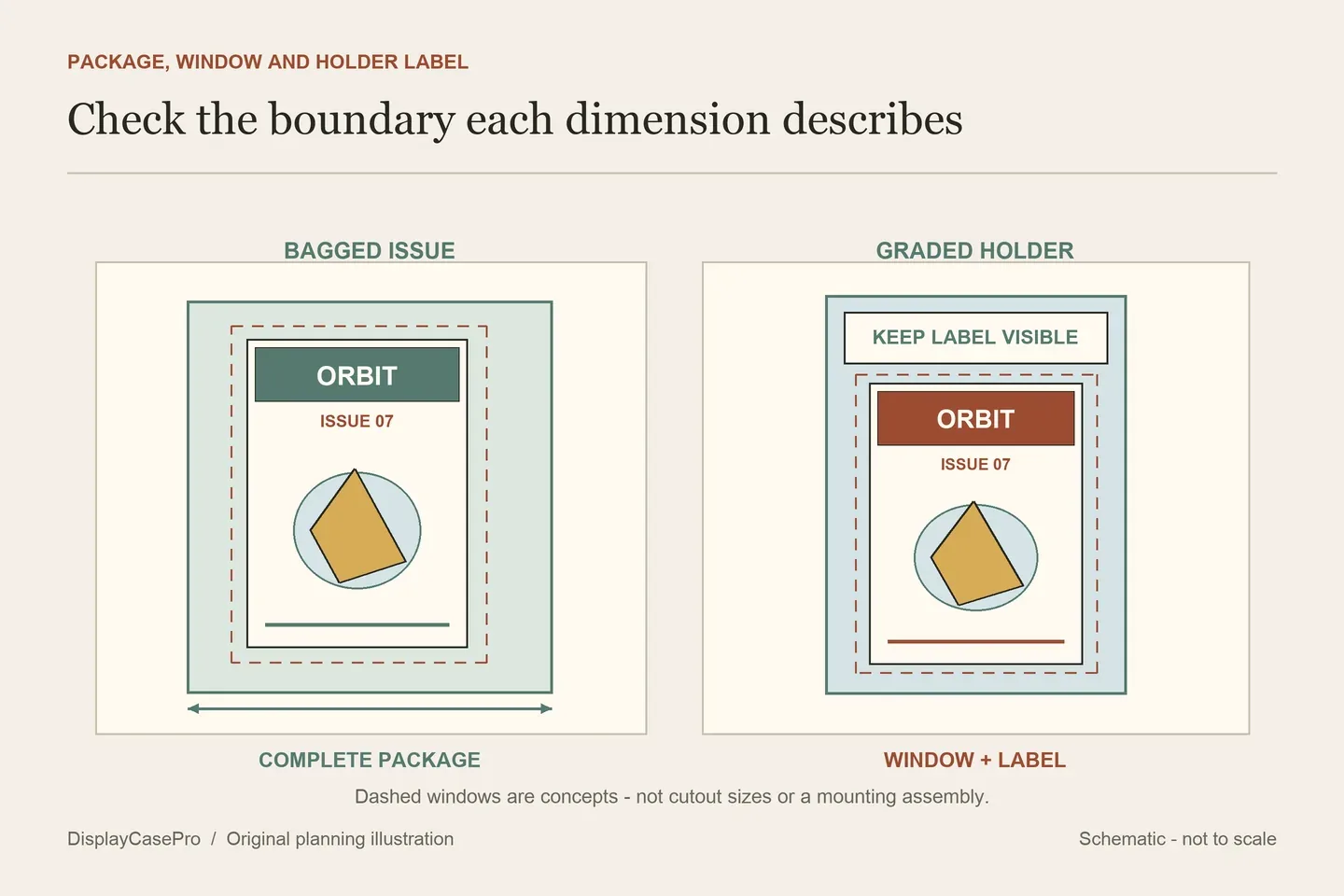
Check the visible cover separately from the holder fit
Decide what must remain visible: the full cover, a printed border, the title, the issue number, a signature or the grading label. Mark those features on a reference image or paper outline. Compare that view with the proposed mat opening before choosing a frame.
A holder can accept a package while its window hides something important. Conversely, a generous window does not demonstrate that the issue is adequately supported behind it. Ask for both the accepted-package dimensions and the visible area. Keep an added caption outside the comic and its enclosure.
A cover reproduction is another route when the original's exposure or condition makes regular display unsuitable. Identify it as a reproduction. The Library of Congress recommends minimal light exposure and no direct or intense light for comics; a glazing option's UV percentage does not establish a harmless display period.
Make changes possible without disturbing the issue unnecessarily
Choose the access frequency honestly. A frame opened for a yearly change serves a different routine from one you want to open every reading session. Rear-loading access may require taking the frame down and laying it on a suitable surface before releasing the backing.
- Identify what releases. Establish whether clips retain the insert, the complete bagged issue or the slab. Follow the exact maker's sequence.
- Plan somewhere to receive it. Have the intended support or enclosure ready before removing the package. Avoid placing a loose issue against wall hardware.
- Check every assigned position. An oversized special issue or thicker slab can break an otherwise repeating series layout.
- Record the return position. Keep the issue ID and enclosure details with the frame-position map, without adding adhesive labels to the comic.
Use the blank comic-frame compatibility worksheet to separate package, window, outer frame and release method. Once individual frames are resolved, the collection wall layout guide can help arrange their outside footprints.
Common questions
Does a “modern comic” frame fit every modern issue?
No universal fit follows from that label. Confirm the actual issue or complete enclosure, the supporting area, visible window and depth. Specials and differently packaged editions need their own check.
Can a graded frame hold an ungraded comic?
Only if the maker supplies an appropriate support or insert for that use. A recess intended for a rigid slab does not by itself support a loose issue.
Should I buy a bigger frame to keep the bag and board?
Specify the complete package and the intended support, then choose the frame that accepts that arrangement. A larger outer frame without a suitable internal holder does not resolve the fit.
About this guide: This is a researched selection guide. It does not authenticate issues, assess grades, certify preservation performance or claim that a named frame has been physically tested with your comic.
Comments
Share a display tip or ask a question.