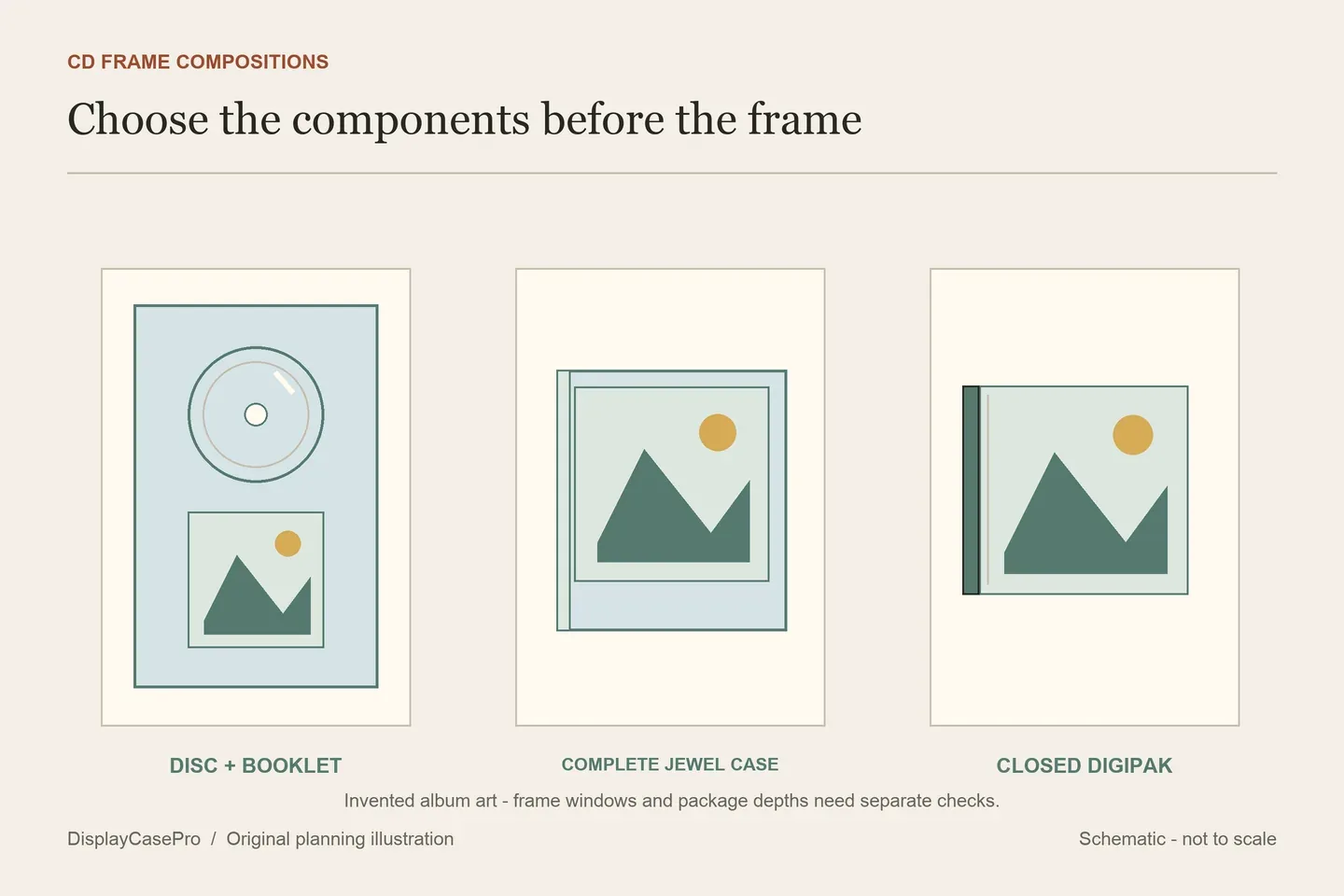
Choose a CD display frame by identifying what will sit inside it: the optical disc, a booklet or cover insert, the complete jewel case, or a closed cardboard digipak. A frame made for a disc beside its cover is a different purchase from one that holds an intact album package.
Decide whether the album stays in its case
A disc-and-cover composition makes the printed disc label part of the view. A booklet-only frame puts the artwork first and leaves the playable disc elsewhere. A jewel-case or digipak frame retains the package as a complete object. Begin with that choice rather than a generic “CD size.”
| Displayed object | Record first | Question for the maker |
|---|---|---|
| Disc and booklet separately | The actual disc format, closed booklet size, visible artwork and layout. | How does the disc attach and release, and what holds the booklet without altering it? |
| Booklet or cover insert only | The sheet or booklet you intend to display, including thickness and important edge details. | What is the visible opening, and how is the complete item supported behind it? |
| Complete jewel case | The closed case, including any thicker multi-disc package or retained outer sleeve. | What package thickness is accepted, and does the complete case come out for playback? |
| Closed digipak | The actual folded cardboard package, spine and projecting parts. | Is that edition accepted, and how are its edges retained and released? |
Check the actual release. A multi-disc jewel case, a slim case, a digipak and an expanded edition are different packages. The frame's music category does not establish compatibility with all of them. Keep a slipcover in the measurement if you intend it to remain in place.
For a signed booklet, identify where the signature sits in relation to the proposed window. A correctly sized receiving area can still leave the signature partly hidden by the mat. Do not trim original artwork or a signature border to suit an available opening; choose another frame or an accurately identified reproduction instead.
Separate exterior, opening and accepted thickness
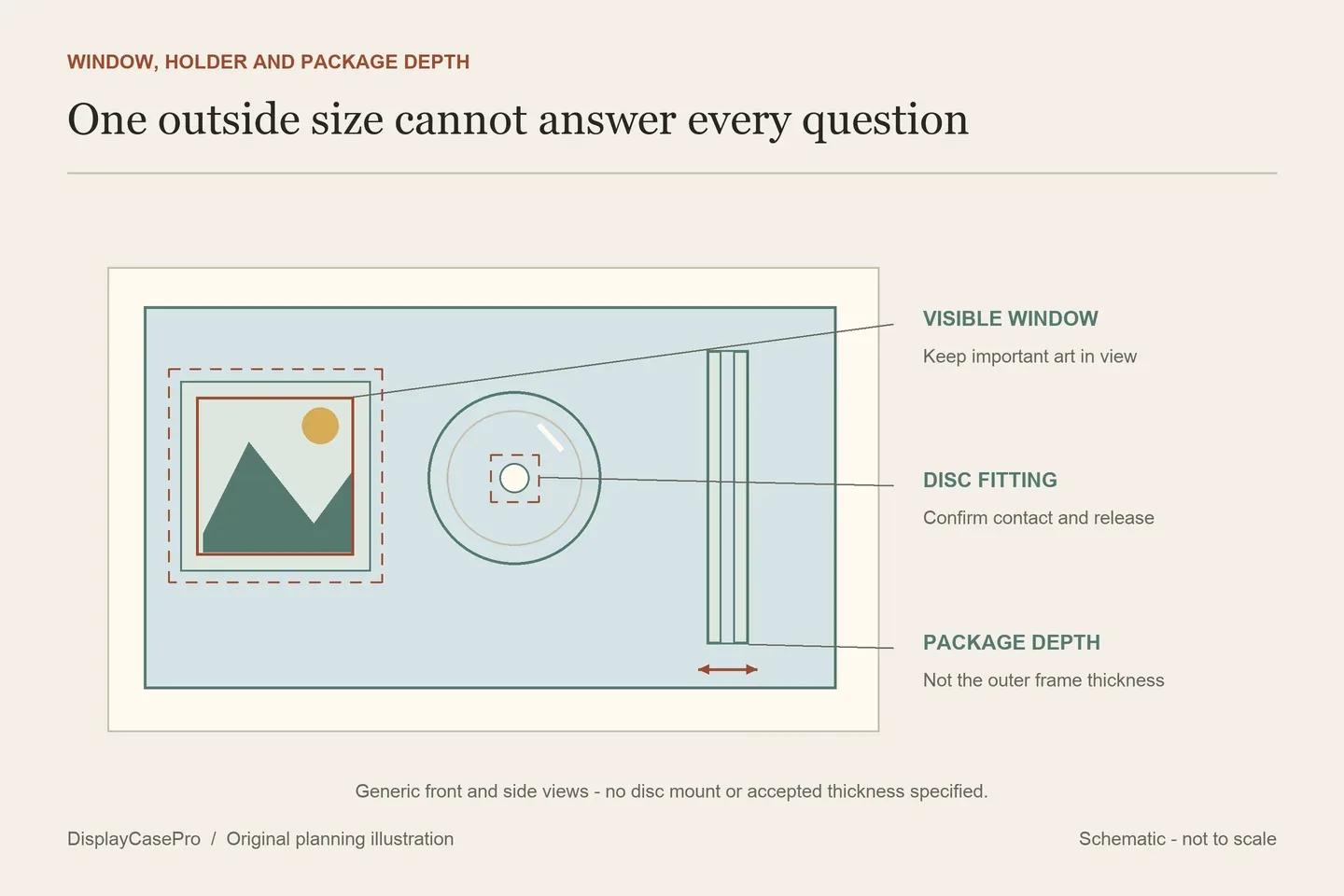
Frame specifications describe several boundaries. The full exterior determines the wall footprint. The mat opening determines what you see. The receiving space and accepted thickness determine what the frame can hold. A dimension labelled “frame size” should retain that label until the maker explains its meaning.
| Named frame | What is published | What it does not establish |
|---|---|---|
| Hobby Lobby Black Wood CD Frame, 638957 | Exterior H7.69 × W13.13 × D0.69 in; frame size 6 × 11.5 in; square mat opening 4.38 × 4.38 in. | The square opening is not the circular disc seat. Exterior depth does not provide a maximum jewel-case thickness. |
| Frame My Collection Digipak or Jewel Case / Booklet Frame | 6 3/4 × 6 in overall; the description names cardboard digipaks and plastic jewel cases/booklets. | No numeric maximum package depth or visible aperture is supplied in the description read. |
| CustomFrames horizontal CD & Cover Frame, 476051 | Approximately W15.5 × H10.5 in overall, with black matting, white Aspen moulding and acrylic. | The overall rectangle does not define the cover window or the disc retaining mechanism. |
| Wexel CD Wall Frame | Three CDs and covers; two 10 × 19 in acrylic panels, 3/16 and 1/8 in thick, with a 1/8 in mat. | Panel thicknesses are material dimensions, not the free gap or accepted thickness of a complete CD package. |
These examples are attributed product descriptions, not hands-on frame tests. Preserve the difference between a supplied dimension and an unanswered fit question. Do not combine figures from different products to create a specification that no maker supplied.
Where a frame includes multiple openings, confirm each assigned object and its orientation. A frame advertised for several CDs can have a fixed relationship between disc positions and cover windows. It may not provide an arbitrary empty area for a thicker package or an additional concert memento.
Ask how the disc releases before loading it
The Library of Congress audio-visual guidance recommends handling optical discs by the edge and centre hole, avoiding the playing surface. It also identifies jewel cases as acceptable storage and says replacement cases should retain the disc by the centre hub. Those are handling and storage principles; they do not certify every decorative spindle, adhesive pad or commercial frame.
Ask what the selected frame contacts and how its disc fitting disengages. A photograph of a neatly centred CD does not show whether it is removable, whether the fitting matches the disc, or whether the user needs to take the entire frame down. Obtain the product's actual loading sequence before pressing the disc onto an unfamiliar mount.
Resolve the paper component separately. A mat can hide an edge without supporting a thick booklet. A package frame may use an insert intended for a closed jewel case rather than a loose cover sheet. Confirm which supplied parts belong to your composition, and keep the disc and paper off the glazing unless the maker's intended arrangement specifies their positions.
The expanded framing section on CustomFrames' 476051 page describes easy-open backs and generic document-mounting materials. That text does not supply a disc-specific retaining procedure. Request the instructions for the CD product rather than treating general document-framing copy as permission to tape or clamp the disc.
Count the steps needed to play the album
A display changed once a year can suit a different opening routine from an album you play every week. Find out whether the backing releases from the rear, whether the frame must leave the wall, and whether opening it also disturbs the paper insert.
For a complete-case frame, check the route for removing the jewel case or digipak intact. The original package's hinge or folded panels can then open on a suitable surface. Do not assume that a package can be opened while held in the frame, or that its hinge can be used as a convenient retaining hook.
For a disc-and-booklet display, identify the storage position of each component while the other remains on the wall. If you display an empty package, record where the disc is kept. If the framed disc is a display copy, identify it clearly in the collection record.
Craig Frames' CD category includes single, double and four-CD compositions and describes rear tabs. That is useful format information, but a product-family description does not prove that every version gives the same access or uses the same holder. Confirm the exact frame, mat and loading parts you will receive.
Keep a series readable without changing the releases
Choose the organizing principle: release order, a particular artist, an album with its tour keepsake, or a few covers chosen for their artwork. Record the edition before assigning a frame. Reissues can have different covers, additional discs or thicker booklets, so a repeating wall layout still needs individual compatibility checks.
Leave the important title, disc label and any signature visible. Give a separate ticket or caption its own position rather than laying it over the original cover. The collection wall layout guide can help arrange the completed outside frame footprints once their contents are settled.
Use the blank CD-frame worksheet to keep the visible opening, accepted depth, disc fitting and release route in separate fields. Choose the location with light exposure in mind; a UV option does not establish an unlimited safe display period for the printed cover or disc.
Common questions
Can a CD frame hold a jewel case?
Only where its intended holder and accepted depth suit that complete package. A disc-and-cover frame may be designed for the components outside their original case. Ask for the exact package limit.
Is the mat opening the size of the booklet it accepts?
Not necessarily. The opening controls the visible area, while the booklet may extend behind the mat. Ask for both the window and the supported package dimensions.
Can I use a vinyl-record mount for a CD?
Use a mount specified for the actual optical disc. A similar-looking centre hole does not establish the fitting or release method, and a record-frame category can contain separate products with different mounting systems.
Comments
Share a display tip or ask a question.