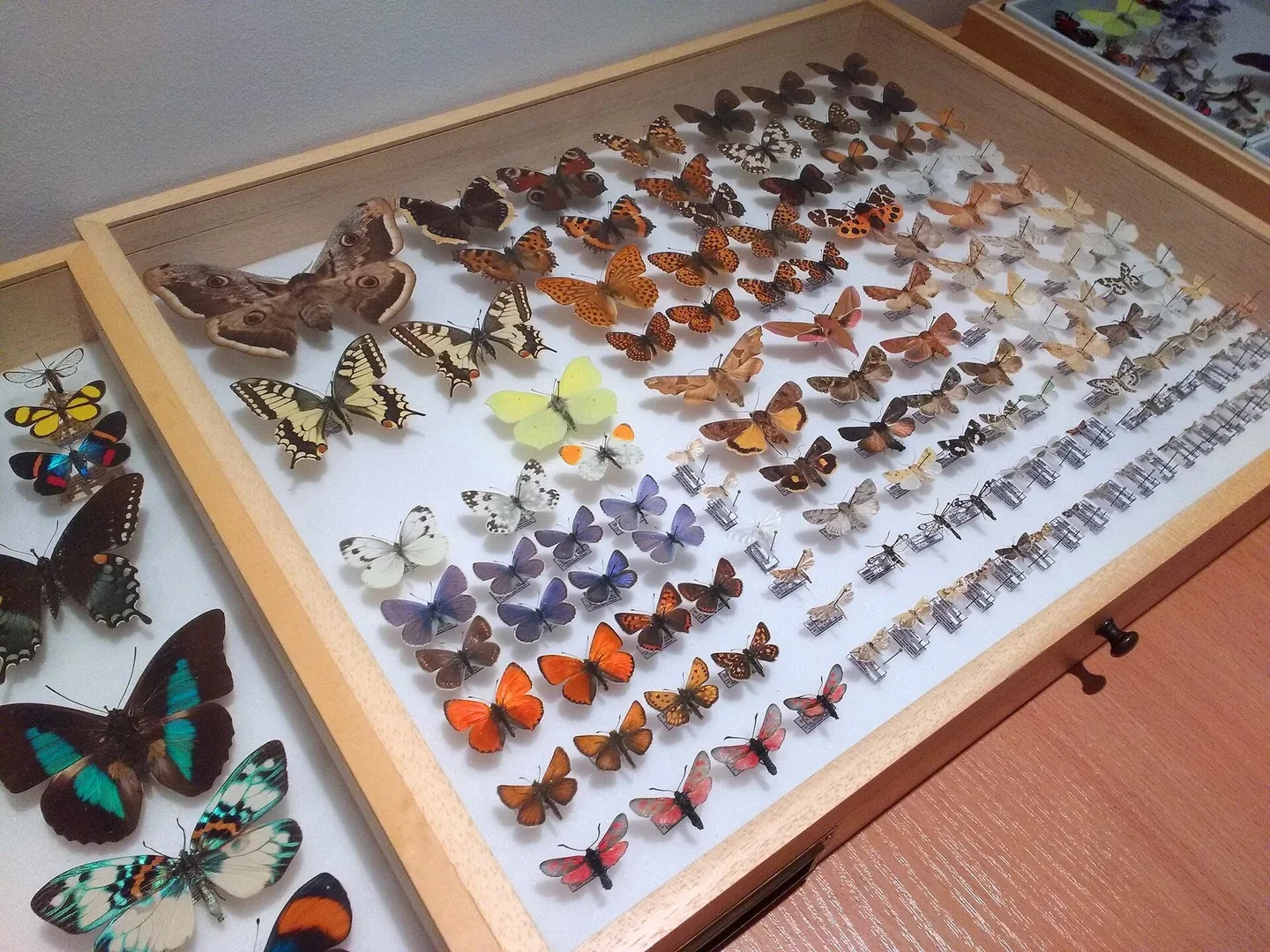
Choose a butterfly display case by deciding what you are buying: finished framed artwork containing a specimen, or an empty enclosure for an already prepared collection. Both appear under the same search phrase. Their photographs, size labels and included parts answer different questions.
For finished art, check the actual composition, viewing sides and identification label. For an empty box, establish the existing specimen support, clear space above the liner and lid closure separately. This guide compares those purchase decisions; specimen preparation and mounting require their own appropriate instructions.
A photographed butterfly may be the artwork, not an example of capacity
Start with the listing's contents. Does the order include the pictured butterfly in its completed frame? Is it an empty box with a foam liner? Is a specimen mount already fitted, or does the purchaser need a separate appropriate support? Write these as distinct lines in the order record.
A finished arrangement can have a particular background, specimen position and label location. It should be considered as that artwork. Its apparent spare space does not establish that you can open it and add another specimen, nor that a differently prepared butterfly would use the same mounting system.
If you already own a prepared specimen, retain its existing support and associated information in the display plan. Do not select a smaller frame on the assumption that the specimen can be flattened, re-pinned, glued or detached. Resolve an unsuitable or uncertain support before assigning the specimen to a new orientation.
Compare the finished view with the empty receiving box
| Format and example | What the source describes | Purchase question |
|---|---|---|
| Butterfly Utopia acrylic artwork | Completed clear three-dimensional frames, with a thin clear rod supporting the specimen and a hanger supplied. | Which faces can be viewed in the completed arrangement? Is this the exact artwork being ordered? |
| Bug Under Glass framed butterflies | Finished wood shadow-box pieces, with species information and gift presentation. | Confirm composition, label and actual frame specification; a title size is not an empty receiving cavity. |
| Empty lined insect box | An enclosure and liner intended to receive separately prepared specimens. | What suitable specimen support is already present or supplied, and how much space remains above the finished liner? |
| Butterfly Designs framed art | Parchment, black, white and designer arrangements; identification is placed differently between formats. | Will the relevant label be visible from the front or accessible on the back? |
The acrylic artwork's clear rod is a feature of that maker's completed construction, not a transferable home mounting recipe. Likewise, a wood frame's finished composition does not establish a removable opening or a suitable material environment for every specimen. Request the actual construction when those details determine the purchase.
Keep the liner datum beside the size
The following descriptions were read in October 2026. They are supplier specifications, not our measurements or a tested preservation comparison.
| Exact product | Published information | What still needs confirmation |
|---|---|---|
| Home Science Tools BE-CASELRG | Interior 12 × 16 × 1.25 in; approximate exterior 12.25 × 16.25 × 2 in. Half-inch white polyethylene foam liner. | Tuple axes are not explicitly labelled. Ask whether the stated interior depth starts above the installed foam. |
| Bugs Direct entomology box, Large | 23 × 30 × 5.5 cm; cloth-covered construction, Plastazote foam and a fitted glass lid. | Inside/outside and axis labels are unstated in the size line. The 5.5 figure is not proven space above the foam. |
For BE-CASELRG, the description identifies a cardboard telescoping top and bottom, with an acrylic viewing panel glued into the top. Specimens and an adhesive wall hanger are excluded. Four provided pins secure the lid; they should not be counted as a specimen-mounting kit.
Do not subtract the foam thickness from the interior figure without knowing the measurement datum. That could subtract an allowance already excluded by the supplier. Ask instead: “What is the clear gap between the installed liner's upper surface and the underside of the closed viewing panel?” Keep the supplier's answer with the exact SKU.
The foam, specimen support and lid closure perform separate jobs
A liner description identifies one component. It does not by itself establish the mount required for a fragile specimen, the permitted orientation or the amount of projection above the liner. Record the complete already supported profile, including any projecting support and associated label, using existing documentation or appropriate handling.
Keep lid-retaining parts in a different inventory field. A pin that closes a lid is not automatically a pin supplied to mount an insect. A fitted glass lid is not a promise that loose contents will remain in place when the box is turned upright. Obtain the intended opening and orientation instructions rather than adapting one product's hardware to another.
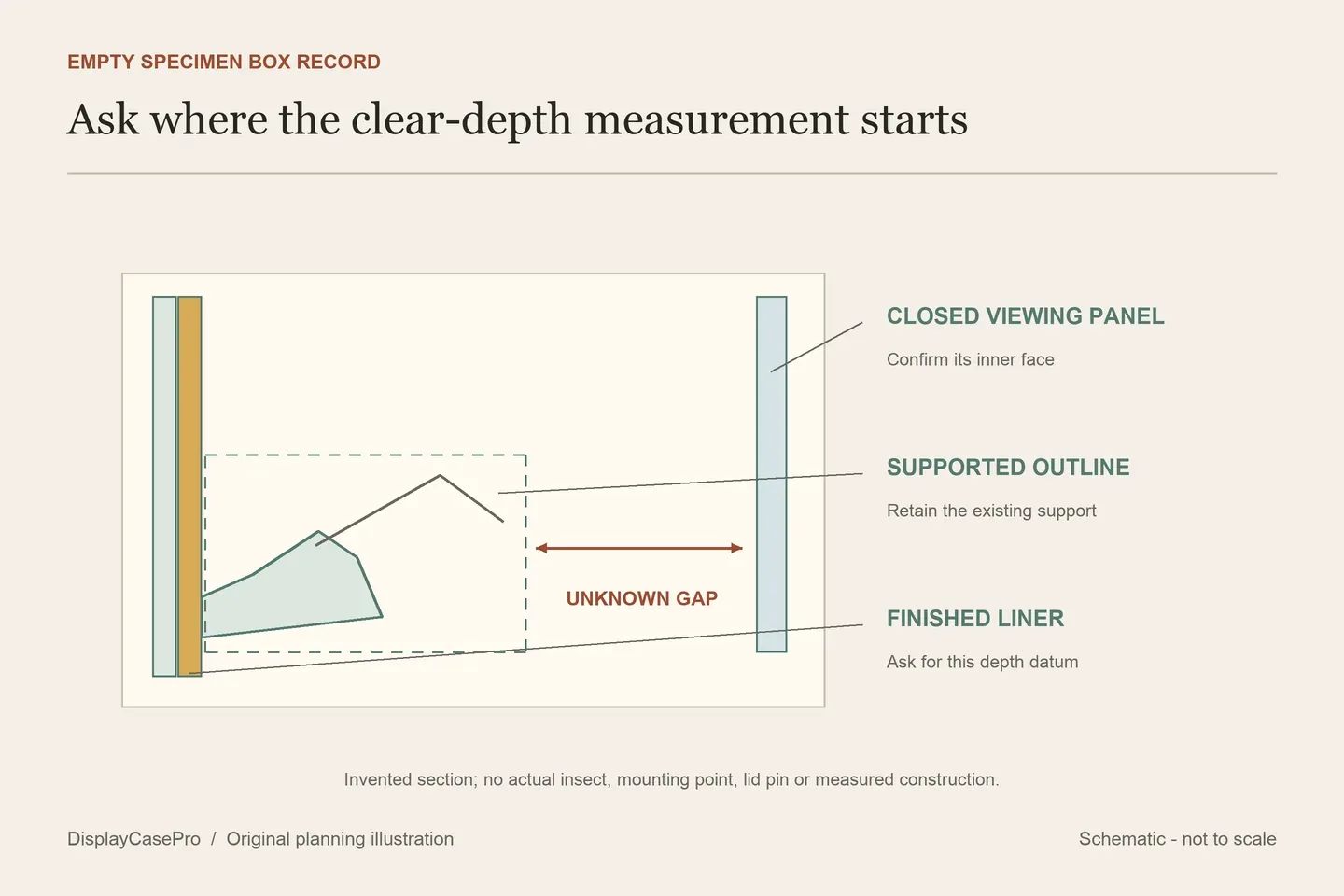
Choose the viewing side without losing the record
A clear-sided artwork and a front-facing shadow box offer different viewing experiences. Try the intended view with an existing image of the completed piece. Check whether a frame edge, hanger or background hides the part you want to see; do not reposition a specimen simply to improve that trial view.
Butterfly Designs describes name and country information on the front of its parchment format, while other formats carry a back label. That distinction affects how the information is consulted once the artwork is placed. It does not independently verify the supplied identification or origin. Keep the maker's wording and its source with the collection record.
For a group, connect each displayed position with its original label or documented identifier. Leave uncertain identification marked as uncertain. The cover photograph shows a museum specimen drawer with associated labels; it illustrates an existing arrangement, not a home mounting method or evidence that the pictured species fit either product above.
Photo credit: Marek Ślusarczyk, museum insect specimen drawer, 18 May 2019, CC BY 3.0. The full retrieved composition is retained, proportionally resized and compressed to WebP.

Use the butterfly artwork and empty-box worksheet to separate supplied specimens, supports, liner datum and lid parts. The usable-depth guide explains the measurement boundaries; the collection measurement guide covers the complete supported outline.
Common questions
Does a butterfly display case include the butterfly?
Read the itemized contents. Finished artwork and empty specimen boxes are both sold under related terms; a demonstration photograph is not a contents list.
Is overall box depth the available specimen height?
Ask for the clear gap above the installed liner and the full supported profile. Outer depth, interior depth and space above foam can describe different boundaries.
Can a finished frame be used as an empty collecting box?
Only the maker's actual construction and opening instructions can establish that use. Do not assume the completed specimen or its mount is intended to be removed.
Comments
Share a display tip or ask a question.