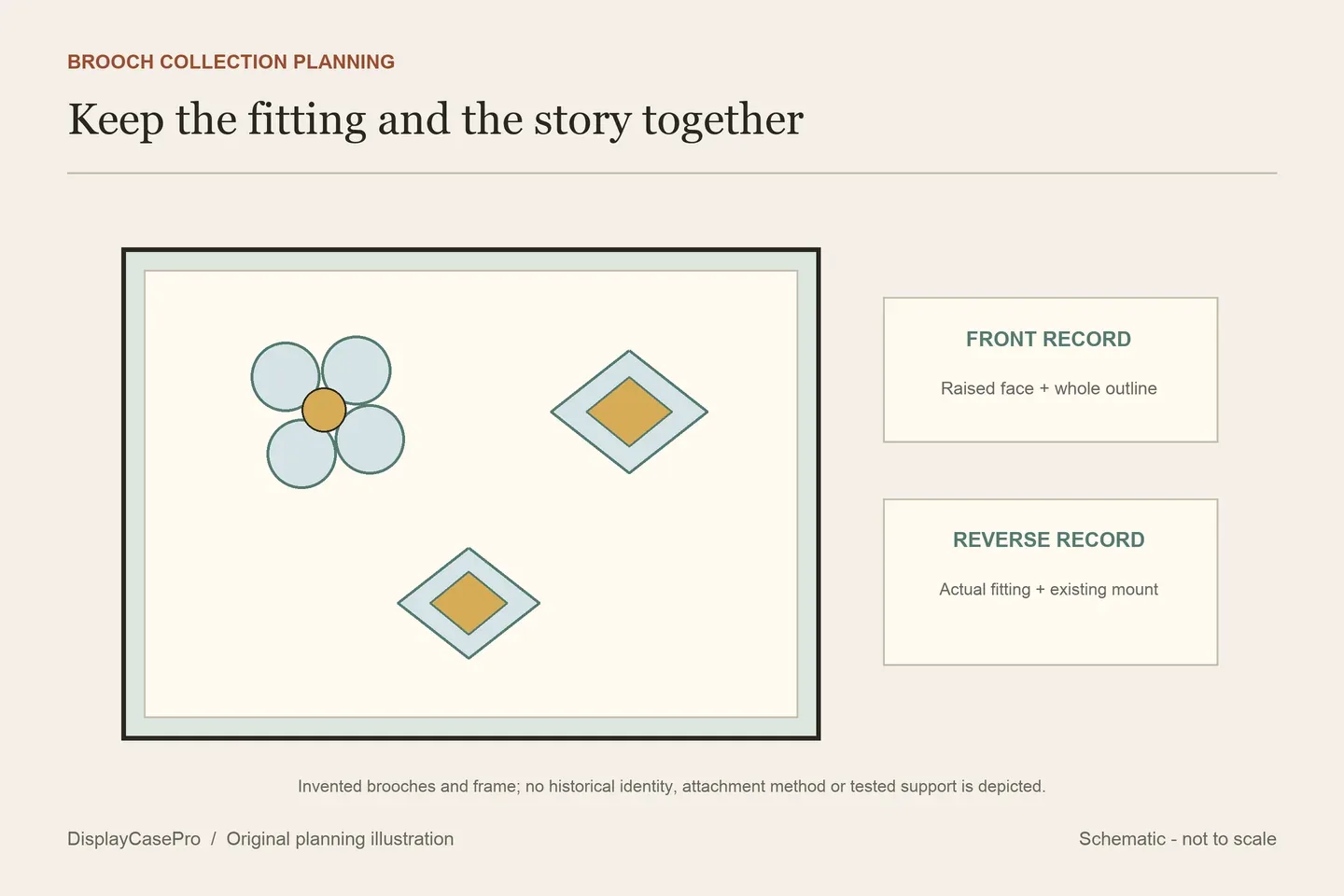
Plan a brooch display case from both sides of the brooch: the raised front you want to see and the fitting or existing mount behind it. Choose between a frequently accessed collection, an open stand and a framed keepsake group. Keep the support, clear depth and release method together so a neat arrangement remains practical to use.
The decorative front does not identify the mounting method
Begin with the actual piece. Record the outline of the front, any raised stones or sculpted detail, and the complete reverse fitting. A brooch with a hinged pin bar and catch needs a different receiving plan from an enamel badge with short posts and detachable clutches.
Do not assume that all brooches have the same back. Keep a different fastening, a pendant conversion or an already attached mount in the record if it belongs to your piece. Identify a combined brooch-and-pendant arrangement as that actual configuration rather than removing a fitting to resemble another example.
For a hinged pin-bar fitting, record its closed resting position, hinge and catch projections. Ask the display maker how that particular fitting is intended to be received and released. A thick padded board may provide an attractive front surface without establishing a suitable fastening or room behind it.
If the brooch is already mounted, include the whole mount. Its thickness, shape and ownership are part of the new frame enquiry. A display planned around the existing assembly can be a different project from a new mount made for a loose brooch.
Choose access before choosing a decorative frame
| Format | Useful purpose | Decision to resolve |
|---|---|---|
| Accessible case or framed board | A wearable collection with identifiable return positions. | Whether the opening also exposes the actual release points, including the reverse where required. |
| Framed keepsake group | A coordinated composition handled infrequently. | Piece-specific supports, clear space around raised faces and a documented reopening method. |
| Individual covered presentation | One brooch with its own caption or associated record. | The supported profile, receiving surface and cover path around the whole object. |
| Open stand | A collection viewed without an enclosing front. | Actual support suitability, independent removal and the location where it will be used. |
An open stand can be a deliberate format. In Jane Edwards's example on Jewelry Making Journal, crochet-thread balls sit on a repurposed stand made with an oil-can base and wooden spool. It is an attributed creative example, rather than an enclosed case or a tested contact-and-retention system for your brooches.
Take the format question from that example: do you want the pieces accessible in the room, or a collection enclosed behind glazing? Do not transfer its reused materials or way of inserting brooches to an heirloom whose condition, surface and fitting have not been assessed.
A hinged front is also only one part of an accessible display. If the release point remains behind a fixed board, opening the front may not let you remove a brooch as intended. Establish the complete release sequence before choosing a frame for jewelry you wear.
Make a group with a reason for each position
Give every brooch a simple identifier and make a layout with complete measured outlines or your own suitable photographs. Include raised edges, dangling parts and reverse fittings in the associated record. Try the arrangement before committing the real pieces to a support.
A documented family group can keep associated pieces together with a short caption and separate records. Use only names, dates and relationships supported by your information. An unknown detail can remain unknown; a matching colour does not establish a shared owner or date.
A form or colour study can compare floral, geometric or other designs without claiming a common maker. Place broad outlines first, then check whether the smaller pieces remain individually legible. A tight mosaic can obscure the actual edges that make the designs interesting.
One focal brooch with a small supporting group can leave room for a readable caption or a separately retained associated item. Identify what the focal piece contributes to the story, then give the other pieces their own clear positions rather than filling every empty patch.
For a wearable selection, reserve a changing section and keep an identifiable return position for the removed piece. A small record behind the display or in the worksheet can be more practical than adding a large label to every position.
A brooch-framing project shows why the existing mount matters
The Patrick Ireland framed-brooch portfolio, read on 17 October 2026, describes building up an Oxford-profile frame around an heirloom that was already on cushioned velvet. Its project record lists a bespoke PW32 frame, client-provided velvet and standard float glass.
That account identifies an individual framing solution. It does not publish a universal usable depth, explain the brooch's attachment to the velvet, or promise that the finished object can be removed for wearing. Those are separate questions for a new project.
The useful starting point is the complete existing mount, rather than only the brooch's front height and width. Ask a framer to identify the receiving support, finished clear space and future access for your actual assembly. A chunky decorative profile does not, by itself, tell you the usable space behind its glazing.
| Record | What to include | Question for the maker |
|---|---|---|
| Front view | Complete outline, raised face and any hanging or projecting part. | How will these details remain clear of the glazing and neighbouring pieces? |
| Reverse fitting | Actual closed pin bar, catch, hinge or other construction. | What support and release method are intended for this fitting? |
| Existing mount | Whole board or cushion, its dimensions and what is known about its attachment. | Can the existing assembly be received, and which parts of the proposed work change it? |
| Use and access | Wearable rotation or an infrequently opened keepsake group. | What opens, what releases, and what must be removed to reach one brooch? |
| Finished frame | Actual cavity reference, glazing, backing and complete exterior. | Which specifications belong to the selected order and completed mounting arrangement? |
Keep the glazing specification as its own field. Standard float glass in one portfolio project does not establish a UV-filtering figure, an airtight enclosure or an anti-tarnish environment for another case. Obtain the actual selected materials and their stated properties.
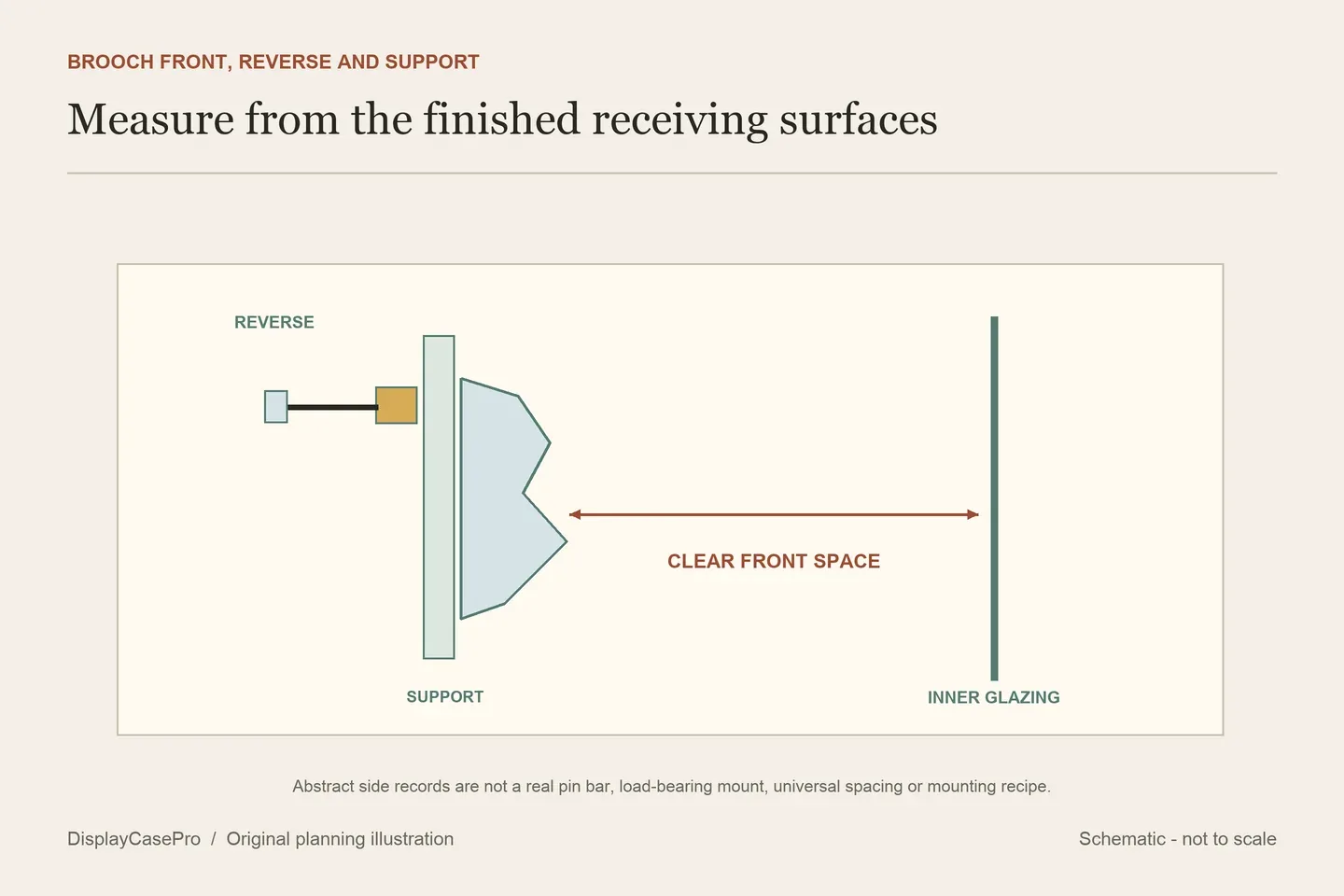
Check the finished support and the route to one brooch
Use the frame's actual reference surfaces. Padding, an existing board and a newly supplied support can each occupy part of the available space. Confirm the room needed around both the raised front and the reverse fitting, rather than treating the empty frame's depth as space available on both sides.
The usable-space guide covers those general depth references. For brooches, the additional task is to establish the support and release points for the actual fastening. Avoid choosing a universal backing thickness or attachment method from a decorative photograph.
Resolve an uncertain fitting, old mount or fragile detail with an appropriate jewelry specialist or framer before choosing how it will be supported. Do not bend a pin bar, flatten decoration or glue the reverse simply to make a chosen frame work.
Finally, follow the intended case-opening method and trace access to one identified brooch. Decide where a lifted cover, removable board and released piece will rest. Check that neighbouring brooches and captions remain clear of that route.
Use the brooch fitting, mount and access worksheet to retain front and reverse records, caption evidence and unanswered questions. Keeping those details together also makes a future change of layout easier to discuss without losing the identity of the pieces.
Common questions
Can I use the same board as short-post enamel pins?
Check the actual brooch fitting and intended receiving method. A hinged pin bar and catch do not use the same space or release sequence as short posts and clutches.
Does a deep-looking frame give enough clearance?
Obtain its usable reference after the chosen support or existing mount is included. The outside profile does not supply that answer.
Can a framed brooch still be worn?
Specify that use before framing and confirm the complete reopening and release method. An attractive finished frame does not document removal access.
Comments
Share a display tip or ask a question.