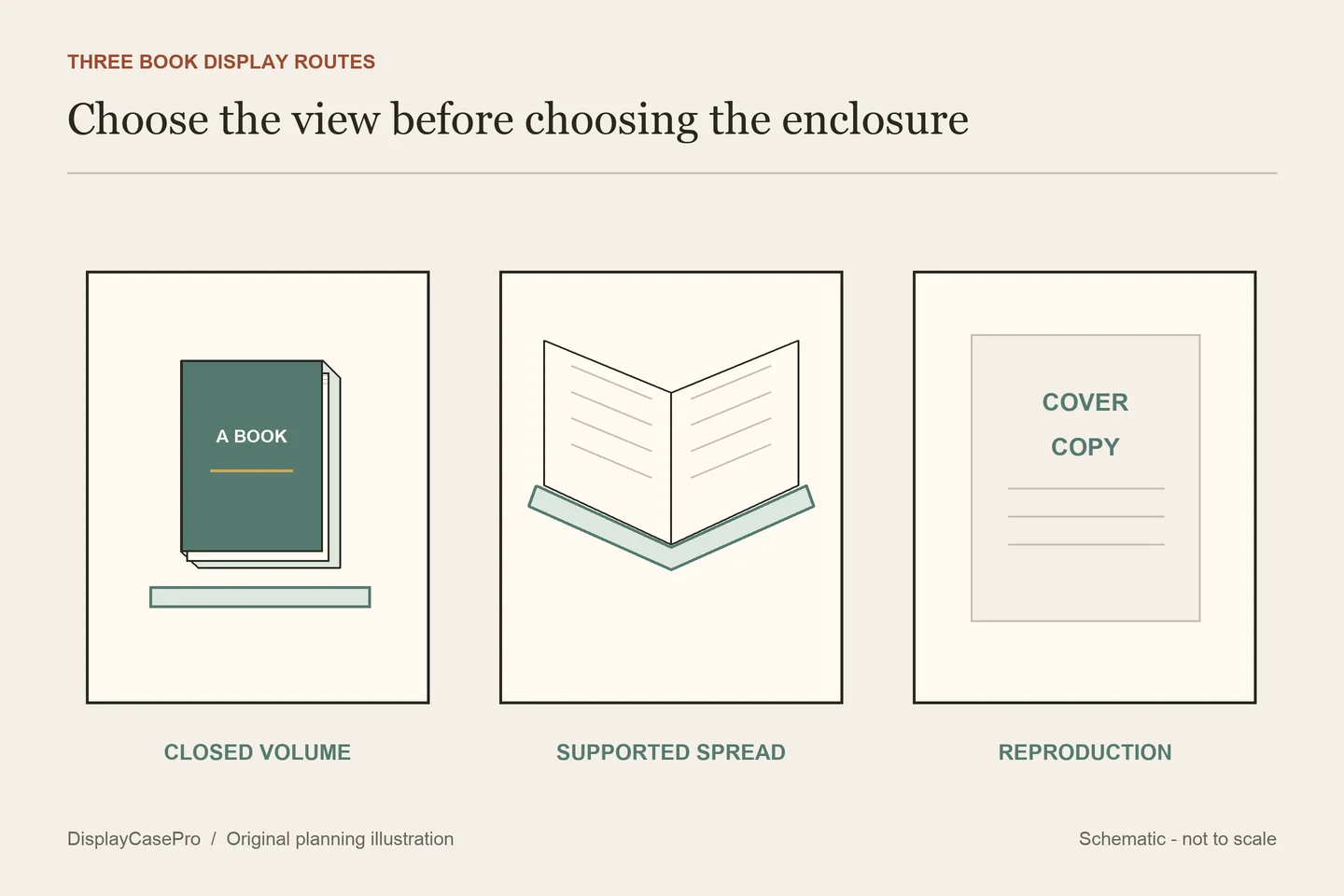
To display a book in a shadow box, choose the view first, arrange a support for the complete bound volume, then size the enclosure around that assembly. A closed cover, an open spread and a reproduction need different layouts. The frame backing and glazing should not be used to squeeze the book into position.
1. Decide what the viewer should see
Write one sentence describing the feature you want to show: the cover artwork, a dedication, a particular illustrated spread or a memory associated with the book. This prevents you from choosing a shallow frame for a display that later requires a wide, supported opening.
| Display goal | Layout route | Decision before selecting the case |
|---|---|---|
| Recognize the book by its cover | Keep the volume closed on a suitable support. | How will the complete book rest without hanging from its cover? |
| Read a chosen page or spread | Use a book-specific cradle for that opening. | What opening and viewing angle suit the binding? |
| Show an image or tell a book-related story | Display a clearly labeled reproduction or associated objects. | Does the original volume need to occupy the frame at all? |
A book-themed collage and a displayed bound volume are different projects. Pencils used while writing, a reading ticket or a photograph can tell a story without the physical book. Label the objects accurately so a copy, replica or later edition is not presented as the original item.
Record the book's title, edition or other identifying details and any visible condition concerns. Note a loose cover, detached page or existing enclosure before planning the mount. If the binding needs assessment, resolve that before placing it in a permanent-looking display.
2. Plan the support before attaching anything to the backing
The Canadian Conservation Institute's Display Methods for Books explains that a mount must account for the binding and the book's weight. A closed volume shown at an angle needs support beneath its textblock. An open book needs a cradle suited to its natural opening, including support for the covers. Many bindings cannot open flat without damage.
For a closed-cover display, decide where the lower edge and the body of the volume will rest. A supported shelf or fitted mount can carry the book while leaving the cover visible. The retaining arrangement has a separate job: keeping the supported volume in its intended position. Gluing the cover to a board does not explain how the weight of the pages will be carried.
A straightforward closed-cover layout
Consider a tabletop shadow box viewed from above, provided the case permits horizontal use. Lay out the closed book on a suitable supporting base with its cover facing the viewer. Put the caption in a separate area and check that the transparent cover can be removed without crossing the volume. Resolve any movement with an appropriate support or retaining arrangement. Before turning the display upright for a wall, establish its weight-bearing mount; an arrangement that rests on a table has not demonstrated vertical retention.
For an open-spread display, show the proposed opening to the person making the mount. An inscription near the front of the book creates a different arrangement from an illustration in the middle. Record that exact view and the intended orientation so the mount is designed for the real display.
For a vertical wall box, request a book-specific mounting plan that shows where the volume's weight rests and how it will be removed. If an appropriate open-book support requires more depth than the wall box can provide, consider a tabletop enclosure or the reproduction route. The desired page can remain the focus without forcing the original binding into a flatter shape.
Ask a framer or book conservator about an important or fragile volume. A generic craft tutorial that secures other keepsakes with string, putty or pins does not establish a suitable book mount. Avoid improvising a strap or magnet arrangement without understanding the book and the contact points.
3. Measure the book and its finished mount as one assembly
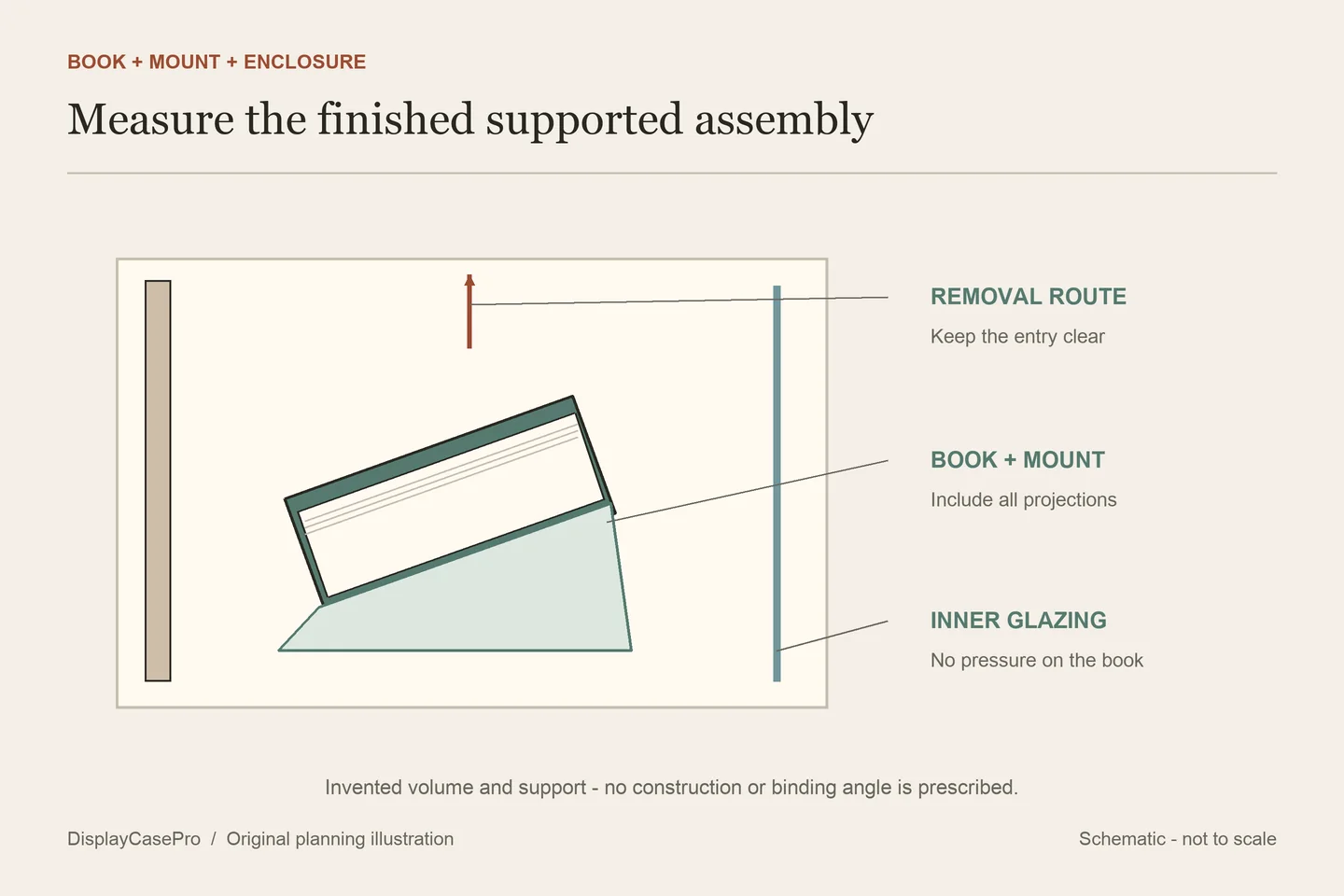
Take the measurements in the orientation you will actually display. A closed book's spine thickness is only one component; a stand, an angled presentation or an open spread can occupy considerably more space.
- Record the chosen state. Closed cover, a specified opening or a reproduction should be clear on the measurement sheet.
- Record the complete supported width and height. Include both covers, any projecting page edge and the mount itself.
- Record the deepest projection. Include the support behind the book and any raised part of the assembly.
- Check usable case depth. Obtain the clear space between the intended mounting face and the inner glazing, including fittings that intrude into it.
- Check the entry and removal route. The supported volume must pass through the opening without catching a page or cover.
Use our shadow box depth guide to distinguish outside frame depth from usable internal space. Keep the framer's stated measurement reference beside your own figures so you are comparing the same surfaces.
4. Arrange the context around the supported book
Make a paper layout before loading the frame. Give the volume or displayed spread the space it needs, then add a short caption and only the associated items that help explain it. Keep their supports separate. A ticket, photograph or writing tool should not become a prop that holds the book at an awkward angle.
For a closed cover, place the caption where it can be read without covering the title or relying on reflection from the glazing. For an open spread, check whether a frame lip hides text near the bottom of the page. A deeper box may help the assembly fit, but it can also change the viewing angle from which the page is readable.
Use clearly identified copies when you want enlarged text or an image that is otherwise difficult to see. Keep a record of what was reproduced and why. This also makes it easier to update the display without repeatedly handling an original page.
Ask about the materials that will be in contact with the book and how it can be released from the mount. “Reversible” should describe a practical removal method for this object; it is not enough for a fastener merely to be removable from the frame backing.
Download the blank book display worksheet. It records the chosen view, binding question, support plan, assembled profile, access route and review dates.
5. Check closure, location and future access
With the supported display in place, close the enclosure carefully. Check that the glazing does not touch the book, that fittings clear the covers and that loose associated items cannot fall onto the pages. Resolve any movement with the mount maker rather than tightening the frame back against the volume.
The CCI guidance also recommends controlling light exposure and keeping books away from direct light and heat sources. A transparent cover alone does not resolve these conditions. Choose a location where the chosen page can be seen with modest illumination, and plan when the display will be reviewed.
Keep a short display record: the opening shown, when it was placed, the mount used and any later observations. If you change the spread, check the support again; a mount arranged for one opening may need adjustment for another. Keep the book's normal storage plan available for periods when it is out of the display.
Follow the frame maker's instructions for supporting or hanging the completed enclosure. Include the book, mount and all other contents in the planned load. Position the case so opening it for a condition check does not require balancing the book over furniture or another display.
Common questions
Can I attach a paperback directly to the backboard?
Plan support for the complete volume and a suitable retaining method first. Adhesive on a cover can make removal difficult and leaves the page-block support question unanswered. A copy of the cover may suit a decorative project better when the original book should remain accessible.
Can fishing line hold an open book in position?
A line across a book does not by itself provide a cradle or explain where its weight rests. For a real volume, have the page-opening and retaining arrangement assessed as part of the book-specific mount.
How long can the book stay on display?
Set a review schedule based on the volume's condition, chosen opening and display environment. There is no universal permanent-display period established by putting a book behind glass. A reproduction can preserve the visual story when continued display of the original is unsuitable.
Comments
Share a display tip or ask a question.