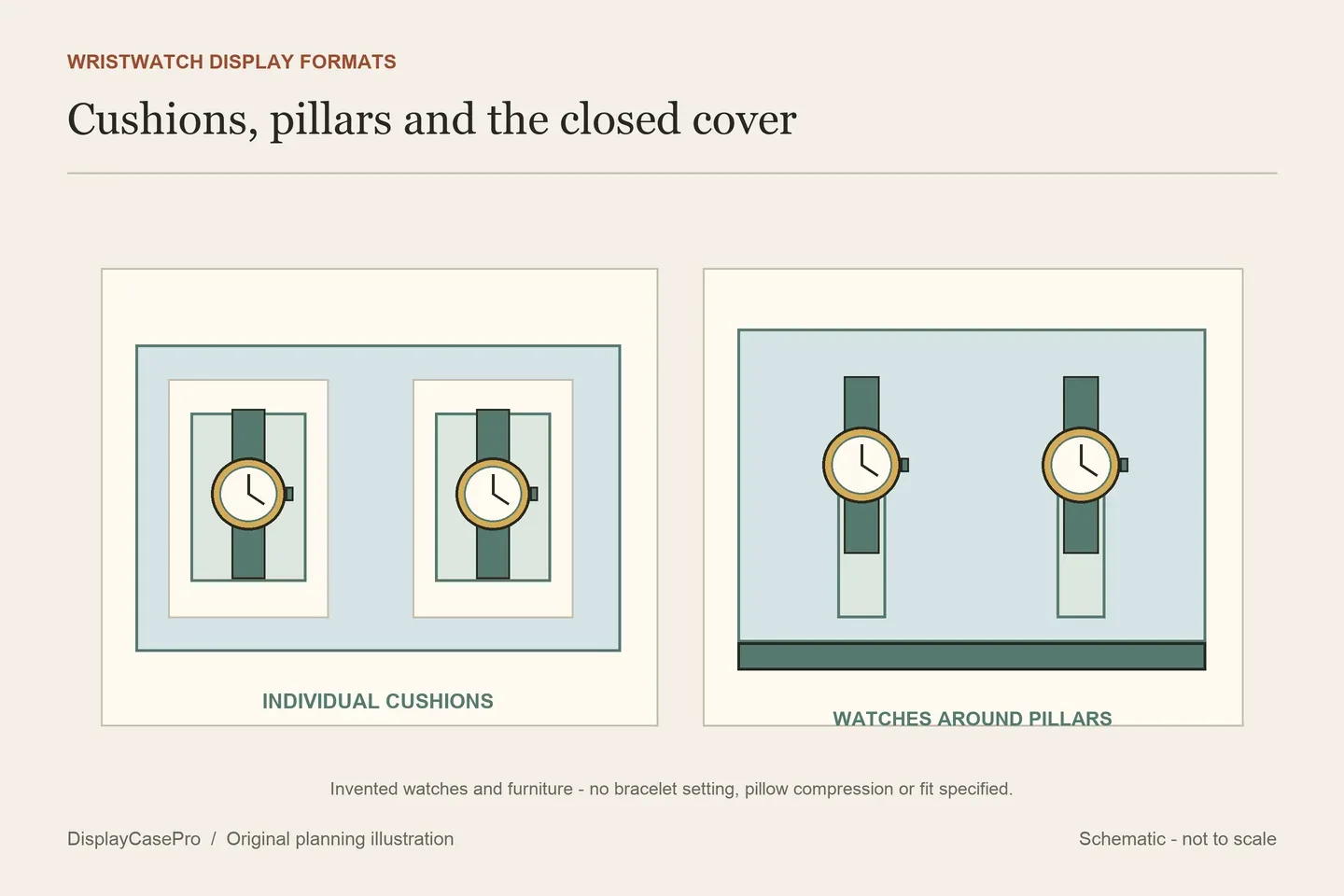
Choose a watch display case for the complete wristwatch on its intended support: case, crown, clasped band and pillow or pillar. A watch that fits by dial width can still sit poorly around the support or touch the lid. Separate band fit, watch clearance and the space needed to open the box.
Measure the watch in the state that will enter the box
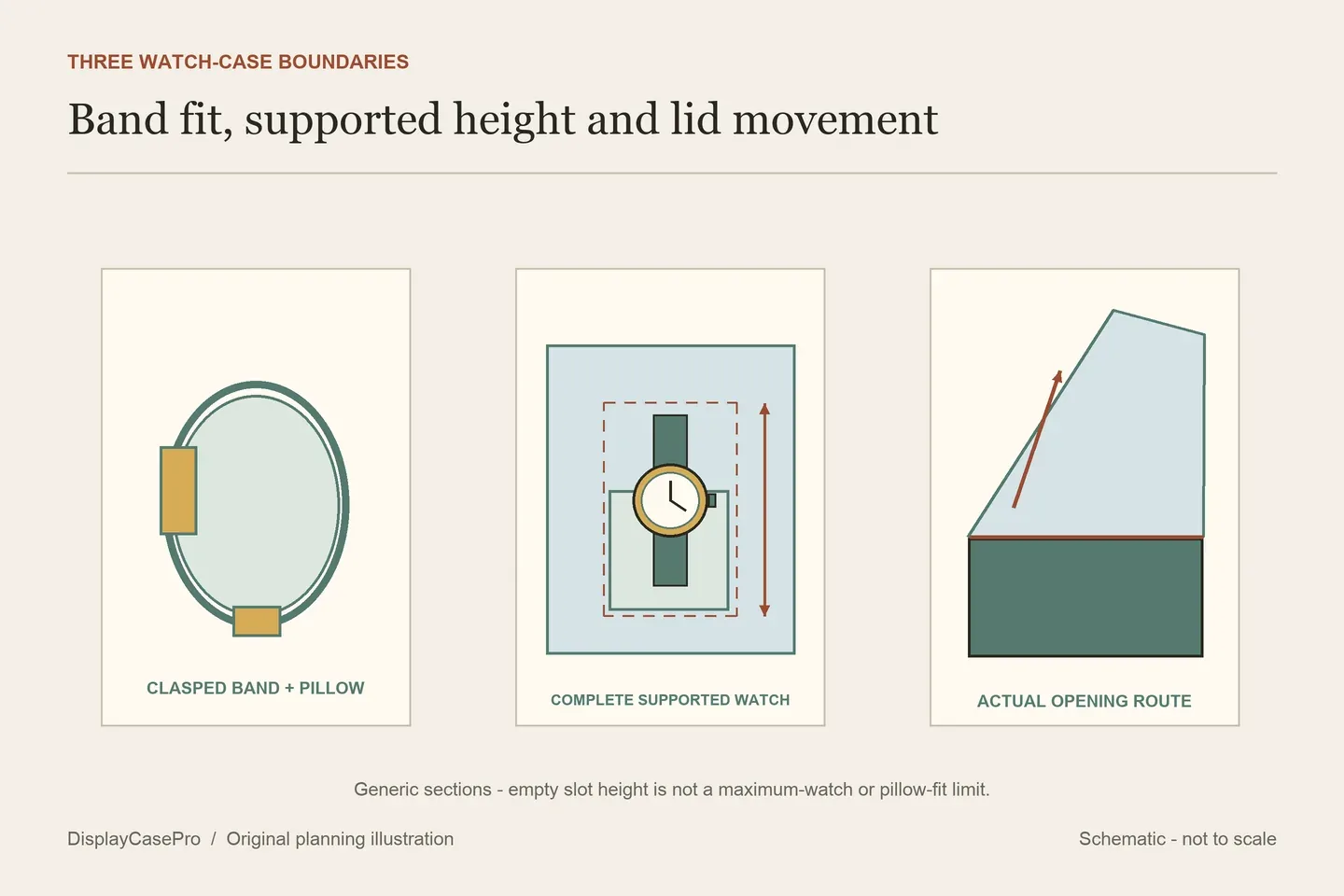
Record the exact watch and its current band or bracelet. Include the crown, projecting controls, clasp and any other part that changes the complete outline. A watch-case diameter alone does not describe the depth or width of that supported assembly.
Choose the intended presentation before measuring. A bracelet closed around a cushion, a strap wrapped around a pillar and a watch resting flat occupy different profiles. Keep the actual support in the fit check instead of comparing the empty box with the bare watch head.
Check the watch's normal clasped state without forcing the band around an unsuitable support. If the intended cushion is too large or too small for the already sized bracelet, resolve the support choice rather than altering the bracelet solely to fit the display.
For a collection, record the watches separately. An advertised number of slots describes an intended arrangement; it does not establish that every combination of large cases, thick bracelets and extended clasps fits all neighbouring positions.
Treat pillow circumference as a separate specification
A pillow's width can determine how it sits inside a compartment, while its circumference affects the band around it. Neither measurement should be substituted for the other. Ask for the intended watch-and-pillow arrangement and the available support sizes.
Tawbury's Bayswater 8-Slot Chestnut Brown page gives three pillow choices with separate recommended wrist ranges. The figures below belong to that product's sizing system; they are not universal cushion standards.
| Pillow option | Pillow circumference | Maker's recommended wrist range |
|---|---|---|
| Standard | 7.5 | 7.1–7.5 |
| Small | 7.1 | 6.5–7.1 |
| Extra Small | 6.5 | 5.5–6.5 |
Notice that pillow circumference and recommended wrist size are not identical fields. Use the exact maker's fit instructions and the watch's existing band configuration. A reading on your wrist does not by itself describe the rigid space inside a closed bracelet around a particular pillow.
A pillar display creates another receiving shape. Confirm the pillar's dimensions, any padding and the clasp's intended position. A general claim that pillars fit virtually any watch does not supply a minimum closed-band size or demonstrate fit with every bracelet.
Keep maximum-watch dimensions separate from empty-slot dimensions
The Bayswater page illustrates another distinction. It lists a watch slot W2.2 × D3.4 × H2.5 in, but separately gives maximum watch width 2.2 in and maximum height up to 1.2 in including the strap or bracelet. The 2.5 in slot height is not permission to substitute a 2.5 in-tall supported watch.
Retain both definitions when comparing your watch. Ask the maker to confirm the height reference and complete support arrangement if the fit is close. Do not derive a more generous limit by subtracting an assumed cushion height from an empty compartment.
For neighbouring watches, check the full width with the crown and intended orientation. A case may describe accommodation for large watch heads without giving every slot's receiving width or the clearance between two projecting crowns. The actual arrangement still needs to match that statement.
Keep accessory storage separate too. A shallow drawer can suit straps or other specified items without accommodating a complete watch on a cushion. Record the drawer's clear height and intended layout before treating it as additional watch-display capacity.
Compare compartments, pillars and opening space
The following examples are published product descriptions, not hands-on tests or a ranking. Their different dimension definitions are part of the comparison.
| Case | Published information | Question to resolve |
|---|---|---|
| Tawbury Bayswater 8-Slot Chestnut Brown | Exterior W10.7 × D8.7 × H5.9 in closed; 13.2 in high open. Drawer internal height 1.3 in. | Use the separate pillow, slot and maximum-watch limits for the actual watch. Check the full opening height at the intended shelf. |
| Rothwell 12-Slot with Drawer, Tan/Brown, RW12ATBR-GS1 | Exterior L16 × W9 1/2 × H5 1/2 in; drawer clear height 1 1/4 in. Description says watches up to 60 mm can sit next to each other. | The interior-top dimension line is incomplete. Obtain actual supported-watch height and pillow/band fit; 60 mm is not stated as a compartment width. |
| Holme & Hadfield Watch Deck | Four visible pillars and an accessory drawer; 13.4 × 4.6 × 5.6 in size sequence. FAQ describes a hinged acrylic cover and no lock. | The sequence has no axis or inside/outside labels. Confirm pillar fit, the actual lid version and usable space over the supported watch. |
The Watch Deck page also uses the name Watch Deck Pro in its body. It describes a wooden-trim lid for the walnut version and a clear acrylic lid for the black version. Confirm the exact finish and version supplied rather than treating every photograph as the same closure. The four visible positions remain separate from the drawer's accessory space.
The Rothwell description's broad all-size clearance language does not replace the missing numeric top-interior dimensions. Its drawer height is an actual separate figure, not the space above the watch cushions. Keep each limit in the field it describes.
Choose the routine as well as the closed appearance
For a watch worn frequently, identify the release sequence: open the lid, lift the complete supported watch as directed, release its clasp and put the empty support somewhere suitable. Choose a position that can be reached without lifting another watch across it.
A hinged lid needs space above and behind the case according to its actual motion. Check the intended furniture with the box open, not just its closed outside height. A shelf that accepts the closed Bayswater's 5.9 in height has not thereby provided its published 13.2 in opening height.
Keep travel protection and powered winding as separate selections. Case Elegance's watch category includes static boxes, travel rolls and separate winders. Their appearance together does not make a static display a travel restraint or an operating winder. Follow the watch's own instructions for operation and servicing.
The Cincinnati Watch storage category also lists several familiar accessory models. A matching reseller listing is useful for identification, not a second independent fit test. Keep the exact model and selected variant in your record.
Use the blank watch-case fit worksheet for the watch, band, support, slot, maximum-watch limit and opening height. The collection measurement guide covers the complete supported outline. Once fit is settled, the display lighting guide can help assess dial visibility and reflections without claiming protection or a powered enclosure configuration.
Common questions
Will a large watch box suit a small closed bracelet?
Check the support's receiving shape and sizing options. A spacious compartment does not make an oversized pillow suitable for a bracelet that cannot close around it as intended.
Can I use empty-slot height as maximum watch height?
Keep the maker's separate limits. A listed maximum may include the band and intended support arrangement, while an empty-slot figure uses another reference.
Does a glass-top watch case keep a watch running?
A transparent static display provides no winding function by itself. A winder is a separately specified product whose compatibility and operation belong with the relevant maker's instructions.
Comments
Share a display tip or ask a question.