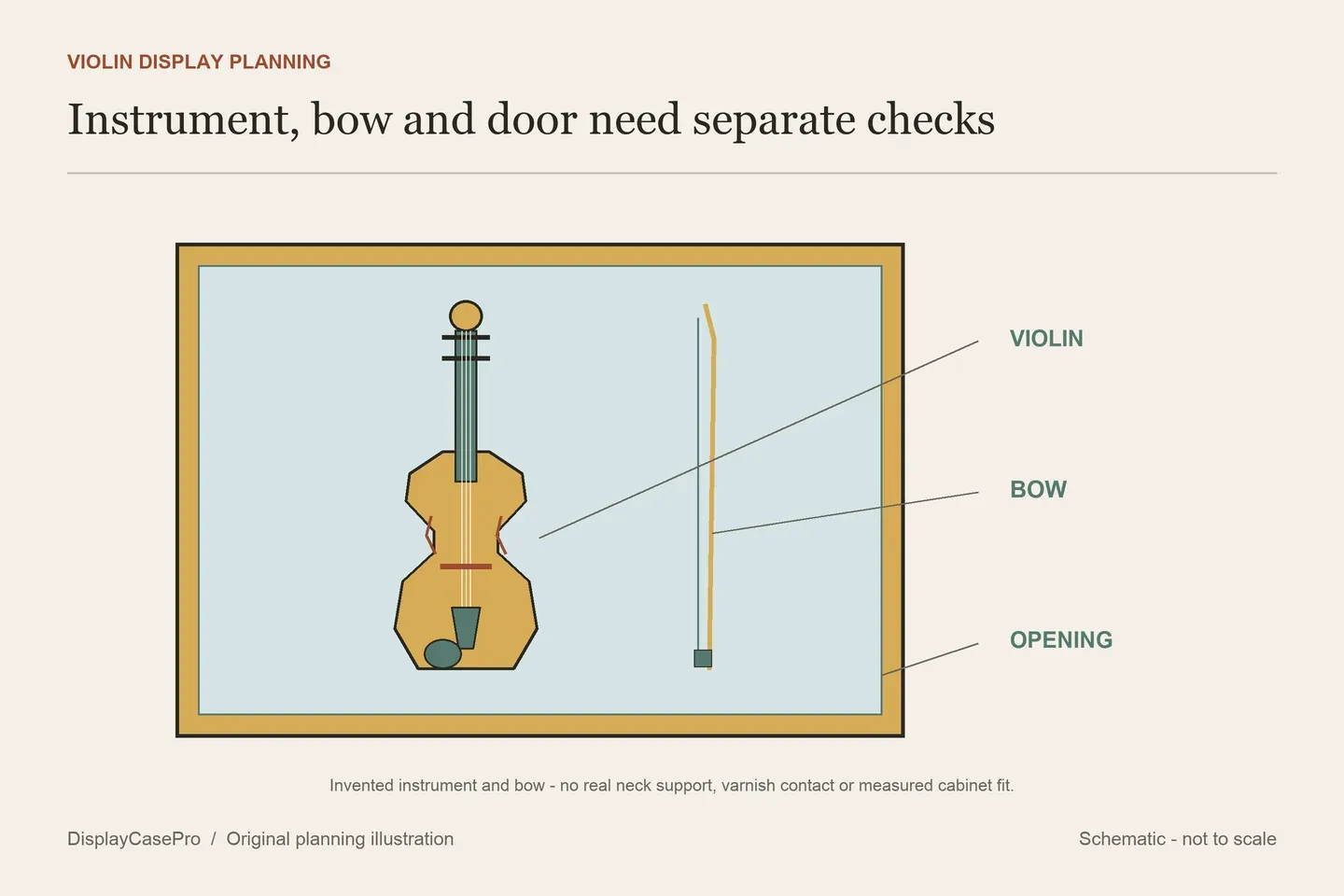
A violin display case needs to accommodate the instrument, its intended support and the bow if you want them together. A transparent wall cabinet, an open hanger and a padded carrying case serve different purposes. Choose the arrangement around the actual violin and its use, then confirm the receiving space and access rather than relying on a full-size label.
A family keepsake and a regularly played violin need different access
Begin with the actual instrument and the reason for displaying it. A family violin shown with a bow and a caption creates a different daily routine from an instrument taken down for practice. Record which accessories remain attached and which are displayed separately.
Identify the full instrument outline, including scroll, pegs, tailpiece, chinrest and any retained accessory. Include the depth in the intended supported position, not just the width of the body viewed from the front. Do not remove or change a playing setup merely to match a case number without appropriate instrument advice.
The bow has its own length, fittings and support question. Measure the intended bow arrangement separately rather than assuming it can occupy any empty strip beside the violin. A violin's size label does not establish the total scene with a bow, hanger and caption.
For an old, repaired or valuable instrument, settle the suitability of the proposed display and contact arrangement with an appropriate violin specialist. A product described for antique instruments does not establish that every finish, repair or structural condition can use its supplied hook.
Separate transparent display from transport protection
| Format | Purpose to evaluate | Information still needed |
|---|---|---|
| Front-opening wall cabinet | Show violin and bow together behind a transparent front. | Supported positions, clear cavity and door/removal route. |
| Open violin hanger | Accessible presentation without an enclosing front. | Exact instrument compatibility, contact arrangement and installation. |
| A custom instrument enclosure | Accommodate a particular instrument or composition. | A labelled drawing and written support/opening specification. |
| A shaped or rectangular carrying case | Transport or storage under its own product instructions. | Instrument size and carrying-case suitability; it does not supply a transparent wall display. |
sfDisplay's violin category includes both a cabinet and an open hanger. That is a useful distinction: a hanger can be a component of a display, while a cabinet adds a surrounding structure and opening routine.
The five-site search sample also included Gator's violin carrying-case category and Fiddlershop's instrument and bow case categories. These serve a real case-shopping task, but a padded carrying case is not interchangeable with a glazed wall cabinet. Do not carry a retailer's 1/2, 3/4 or 4/4 transport-case label across to an unrelated display enclosure.
Do not silently repair conflicting cabinet specifications
The following product descriptions were read on 17 October 2026. The figures are published descriptions, not measurements or instrument-fit tests made for this guide.
| Source | Published dimensions or format | Question before purchase |
|---|---|---|
| sfDisplay violin cabinet | Inside W13.25 × H32.25 × D5.25 inches; outside W14 × H33 × D6.25 inches. | Confirm instrument and bow positions with the supplied mounting kit, front door and actual accessories. |
| Fine Home Displays SF8503 | Outside W14 × D6.25 × H33 inches. Its inside line states W13.25 × D5.25 × H33.25 inches. | The printed inside height exceeds the outside height. Obtain a corrected drawing for this listing. |
| Charlie B Woodworking instrument case | A mandolin-and-violin display listing with project photographs; no textual cavity dimensions were exposed. | Request the intended instrument arrangement, mount positions, clear dimensions and opening method. |
The two catalogues' similar product descriptions do not justify replacing Fine Home Displays' 33.25-inch inside height with sfDisplay's 32.25-inch figure. Keep each number with its own URL and ask the supplier to resolve the inconsistency for the exact item being ordered.
Likewise, the sfDisplay cavity is not the whole mounting specification. Its 5.25-inch inside depth needs to accommodate the actual supported instrument and projecting fittings. The padded neck mount's placement can change where the body and pegs sit relative to the back and door.
Charlie B's product page does not provide enough textual dimensions to compare a receiving cavity. Photographs can communicate a composition, but they cannot establish a measured aperture or the contact arrangement for your instrument. Treat those as questions, not dimensions to estimate from image proportions.
Give the violin and bow separate, documented supports
The sfDisplay cabinet describes a padded metal neck mount and a mounting kit for one violin and bow. Ask how the supplied parts are intended to be positioned and which instrument features they support. The presence of padding does not by itself establish contact compatibility with a particular varnish or repair.
Decide the relationship between instrument and bow before placing a caption. Record the bow's actual resting outline and the location of its supports. The bow should not simply be assigned whatever space remains after choosing the violin's position.
If the shoulder rest or another accessory remains attached, include it in the supported depth and the removal record. If it is displayed separately, identify its own position. This prevents an apparently empty area in a photograph from being treated as guaranteed storage for unmeasured accessories.
Keep an instrument mount and the cabinet's wall hardware distinct. One holds the violin within the cabinet; the other secures the cabinet to the building. A supplied hardware packet does not establish the correct fixing for every wall or the total load of an altered arrangement.
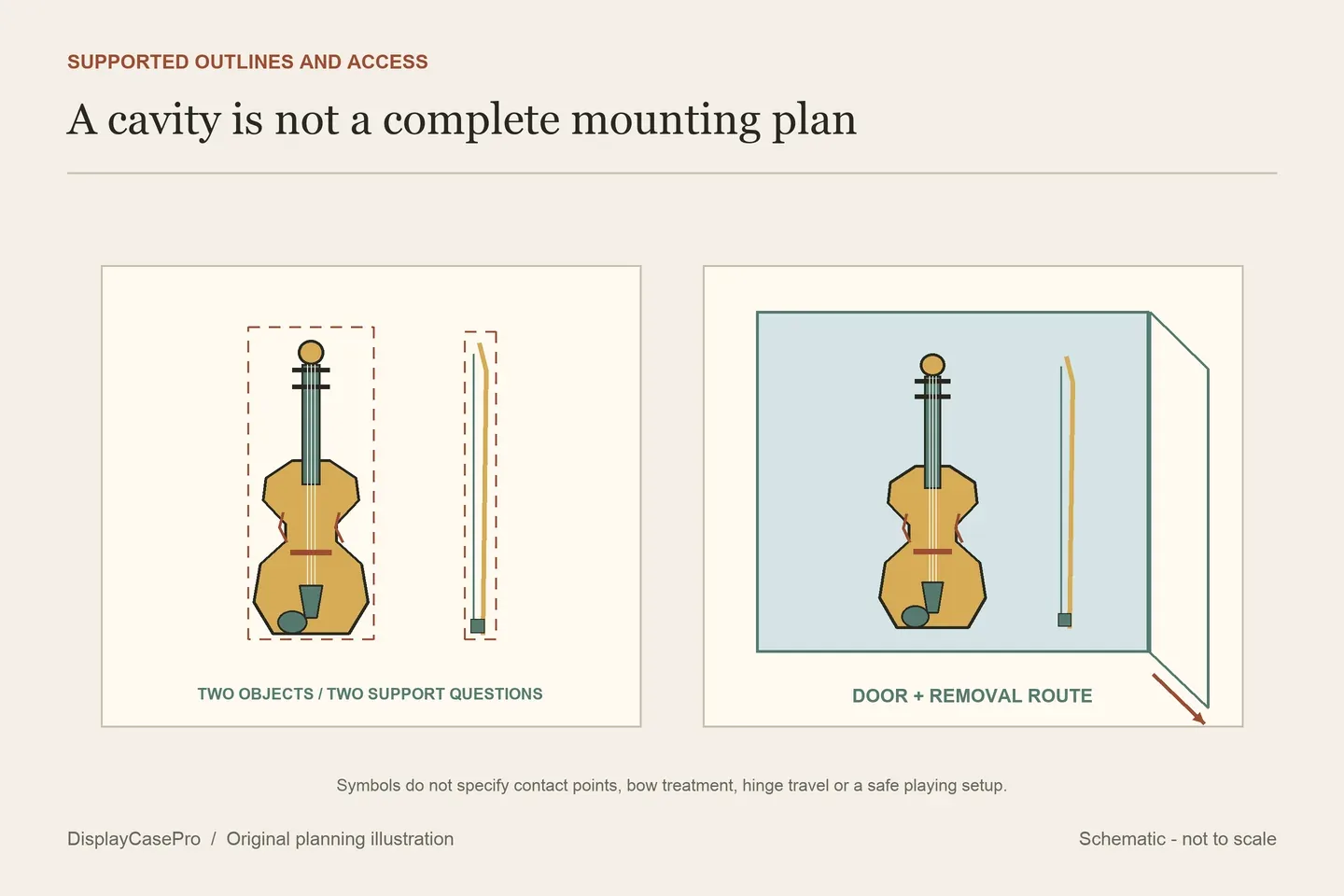
Rehearse the opening routine before arranging the wall
Establish which side the door opens from, how far it needs to open and where you approach the instrument. Do this for the selected cabinet version rather than inferring hinge direction from a cropped product image. A nearby frame or furniture edge can obstruct a door even when the cabinet itself fits the wall space.
For a regularly played violin, ask the supplier to explain the intended lifting and replacement sequence. Then assess whether the violin, bow and any retained accessories can follow that sequence at the planned location. Do not invent a universal hand gap or assume the clear interior is also the clear door aperture.
For an occasional keepsake display, leave a clear route for later inspection and removal. A deep cabinet or high mounting position does not remove the need to reach its retaining parts. Use the manufacturer's installation instructions and appropriate help for the actual wall and handling task.
The violin, bow and access worksheet records the instrument, mount questions, corrected size request and playing routine. The collection wall guide covers the surrounding composition. A transparent door, optional LED or advertised UV percentage does not establish a controlled environment for an instrument, and this guide does not prescribe humidity or instrument treatment.
Common questions
Does a full-size label guarantee display-cabinet fit?
No. Record the actual instrument, support, retained accessories, bow and opening. A transport-case size label is not a clear-cavity measurement.
Which Fine Home Displays height should I use?
Request a corrected drawing. Its published inside and outside heights conflict; another supplier's figure does not resolve this listing automatically.
Can I judge a custom cabinet's interior from photographs?
Use photographs to discuss the arrangement, then obtain labelled dimensions and support details. Image proportions are not a reliable substitute for that specification.
Comments
Share a display tip or ask a question.