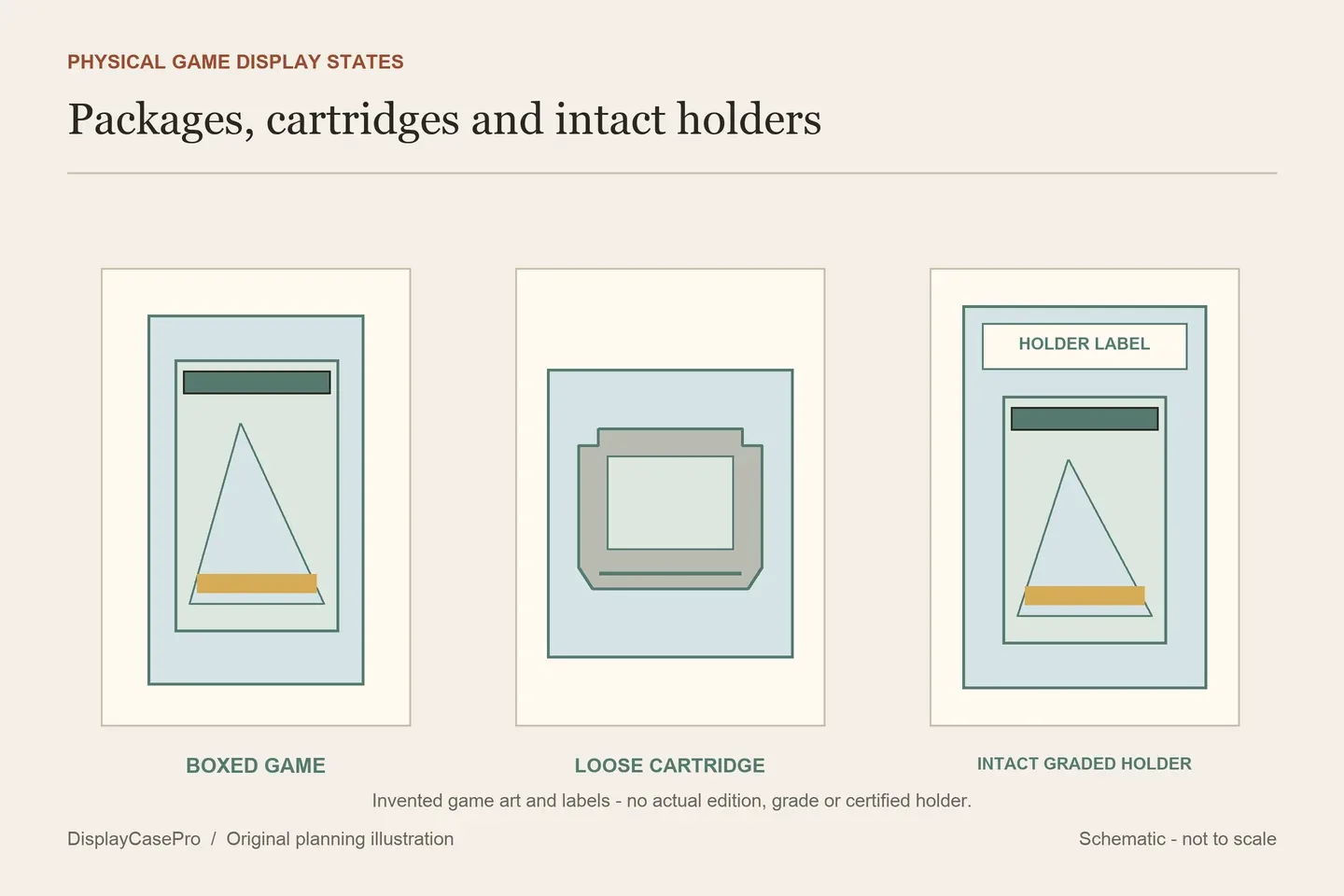
Choose a video game display case for the physical object you own: a loose cartridge, a boxed game, a disc package with an outer sleeve, or a game already inside a grading holder. Then choose between a removable overcase, a wall composition and an intact-holder display. The console name alone does not establish the fit.
Record the edition, region and packaging state
Start with the actual title, console, edition and region where known. Record whether the object is loose, complete in its box, retained in an outer sleeve, sealed or already graded. These descriptions identify different packages without making a claim about authenticity or condition.
A game's console family is only a catalogue starting point. A single-disc jewel case and a multi-disc case can need different depth. A long-box release, a different regional package and a collector's edition may need a different enclosure altogether. Measure the complete intended package rather than a generic game-cover image.
For a loose cartridge, record its own shape, any projecting features and the label face you want visible. Do not substitute the dimensions of the original cardboard box. If a manual, insert or box is displayed separately, keep its identity and location with the game record.
A sealed game should remain in its chosen state during the display-planning task. Likewise, a game in a grading holder is measured as the complete intact holder. This guide does not call for opening packaging, assess a grade or suggest changing the object to fit an available case.
Choose the product family before comparing dimensions
| Format | What it displays | Fit and access question |
|---|---|---|
| Removable acrylic overcase | A particular game package or loose cartridge inside a second enclosure. | Does the complete object fit the clear interior and pass through the actual opening? |
| Game wall frame | A case, cover or case-and-disc composition in designated positions. | Which package and disc mounts are supplied, and can each item be released intact? |
| Grading-service holder | A game encapsulated as part of a certification service. | How will the complete sealed holder be supported, with the relevant label still visible? |
| Retail display cabinet | Several items as shop merchandise, often alongside sales-counter fixtures. | Is the actual task shop furniture, or an individual collectible enclosure? |
The retail interpretation is a real distinction. Displays2Go's video-game store page groups locking counters, glass cabinets, racks, signs and demo-monitor furniture. Those products address a store layout. Their presence under the same phrase does not make them substitutes for a fitted overcase around one boxed game.
For a home collection, decide which component needs to be visible. A wall frame showing a loose disc beside its case differs from displaying a sealed complete package. Keep that choice explicit before selecting the background, plaque or finish.
Retain the exact package and opening specification
CGA's PSOne game case describes a sliding bottom and two depths: 7/16 in for the single-disc version and 1 1/8 in for multi-disc games. The depth wording is not marked as inside or outside. Obtain the full labelled interior for your package rather than treating those figures as measured clear space.
The same page links separate PAL and long-box products. Keep those distinctions when identifying your release; “PlayStation” does not describe one universal physical package. Nor does a product's general added-clearance statement replace a drawing for the exact case you intend to order.
The Display Geek acrylic catalogue also separates single-disc and double-disc PS1 boxes, DVD-style game packages, boxed NES games and loose cartridges. A card's wall-thickness description is a construction detail, not the amount of spare room around the game. Read the exact product's receiving dimensions and closure method before using a catalogue label as a fit decision.
- Keep every intended layer. Include the original package, outer sleeve and any retained secondary protector in the actual outline.
- Identify the opening. A bottom slider, removable top and hinged front have different handling routes.
- Check insertion and removal. Confirm that the complete package can pass through the opening without pressing its corners or catching a sleeve.
- Separate inside and outside. Use the usable interior for the object and the full exterior for its position on the shelf.
The collection measurement guide can help record those boundaries. For a group of overcases, plan the full closed footprint and the opening route, not just a row of bare game boxes.
Check the actual wall-frame configuration and supplied contents
Game frames can present the cover alone or the game case and disc in separate positions. For example, Frame-A-Game's Xbox 360 Exhibition frame lists slipcase and MagFrame Dock mounting choices, disc-above or disc-below layouts, and W280 × H470 × D40 mm dimensions. That dimension line does not state the usable interior datum.
The maker asks buyers with a thicker case or outer sleeve to confirm whether a suitable slipcase is available. It describes a raised disc spindle 15 mm above the backing. That spindle height belongs to this composition; it is not the accepted thickness of a boxed game or a spare-clearance allowance for another frame.
The page title says “Use Your Own Game,” while its feature copy also mentions supplied cases/discs, PAL versions and possible reproduction cases. Confirm the actual contents for the chosen order before buying. This unresolved copy does not justify claiming that an original game is included, replaced or required.
Record the exact mounting option and loading instructions, especially where a magnetic dock is selected. The maker's material or UV description is not a physical test by this site. Keep the game's own region and edition separate from a caption's generic release date, and choose any plaque text from information you can support.
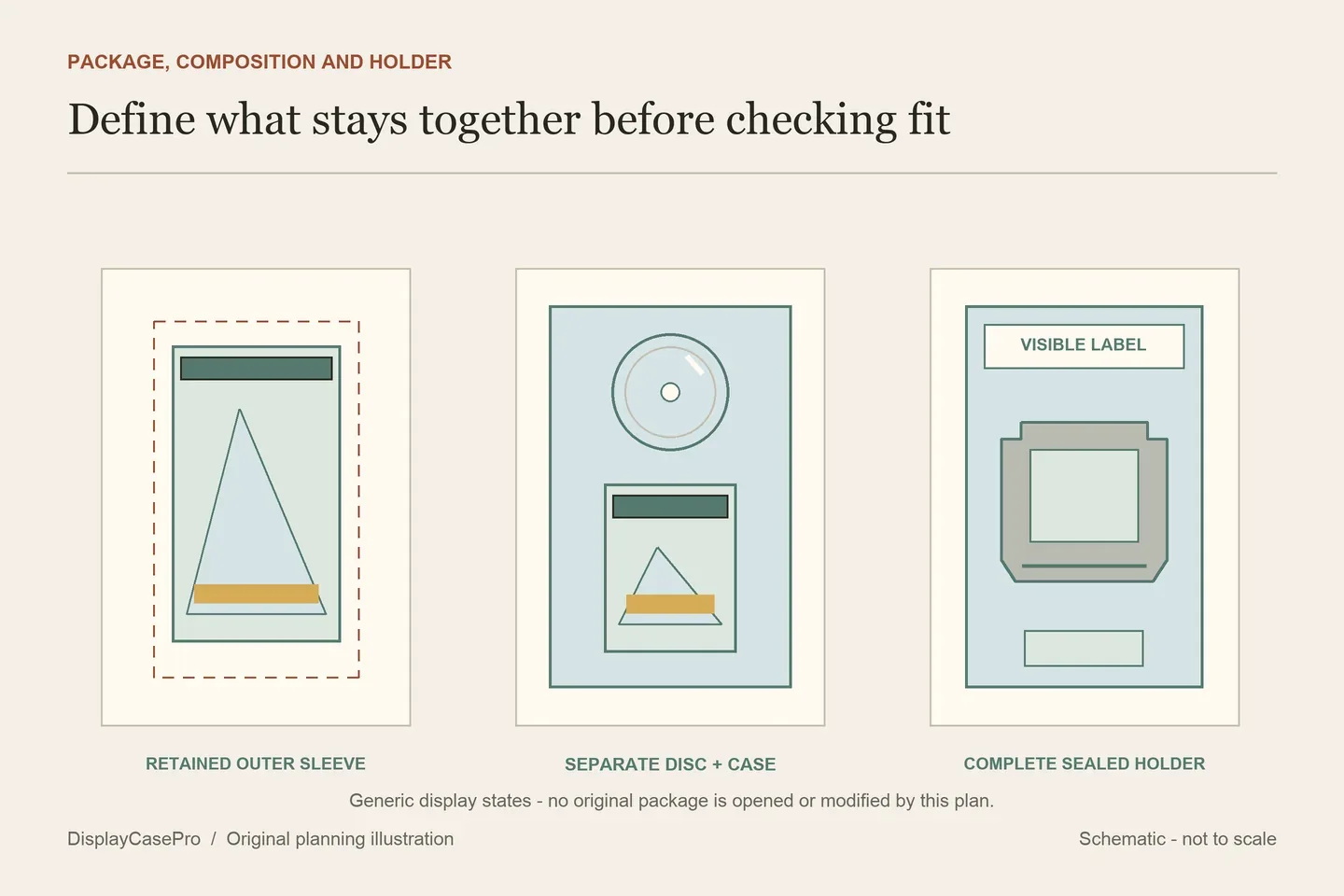
Treat the grading holder as the object entering the display
CGC's holder explanation describes multiple holder sizes and wells, an ultrasonically welded case and a certification label. That is a service encapsulation, not the same opening system as a retail sliding-bottom overcase.
If your game is already graded, record the holder maker, identifiable version, complete outside dimensions and important label areas. Choose a secondary stand, frame or cabinet for that complete assembly. Do not apply the raw game's box dimensions to the slab or assume that one holder example represents every generation.
Keep the title, certification number and any relevant label area readable from the intended view. A visually tidy arrangement that hides the identification defeats part of the reason for displaying an intact holder. Keep a separate collection caption outside it, and avoid adding a new adhesive label over the certification information.
Plan access according to use. A removable boxed game that you still play needs a practical return routine; a sealed holder is a fixed collectible package. Use the blank game-display worksheet to record package state, opening, region and any conflicting product copy. For wall arrangements, the collection wall guide addresses the separate task of placing the finished frame footprints.
Common questions
Will one acrylic case fit every game for a console?
Confirm the actual package and edition. Disc count, outer sleeves, long boxes and regional packaging can change the shape. A console-family label is not a universal dimensional standard.
Does buying a display case grade the game?
No grading service follows simply from purchasing an empty retail enclosure. Check the service and holder documentation separately if certification is the intended task.
Can I frame a game I still play?
Choose a frame whose prescribed release sequence suits that routine. Confirm whether the whole case comes out, whether the disc mounts separately, and which parts must be disturbed each time.
Comments
Share a display tip or ask a question.