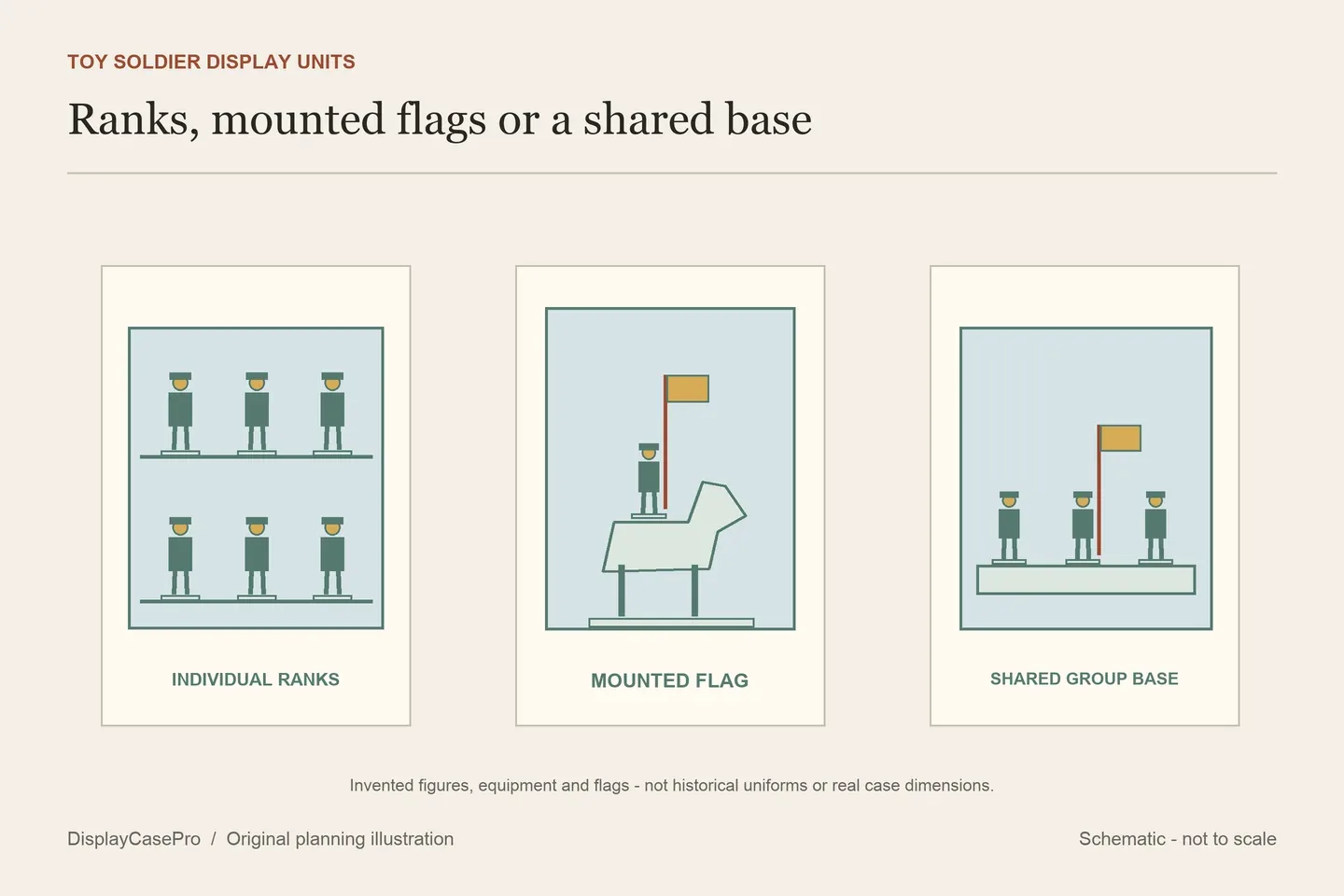
Choose a toy soldier display case around the group you want to present: a rank of separate figures, a mounted flag bearer or a complete scene on a shared base. Record the full bases, raised flags and projecting equipment before choosing shelf openings. A nominal figure scale does not define the loaded group or the space needed to retrieve it.
Separate ranks from mounted figures and shared bases
Make a simple inventory by complete display unit. A standing figure on its own base, a mounted figure, a vehicle with accompanying figures and a diorama on one scenic base should have separate records. Their handling and occupied footprints differ even when they belong to the same period or manufacturer.
Record the highest and furthest projecting parts in the intended arrangement. A flag, lance, raised instrument or extended arm can determine the required opening before the figure's body does. Include the horse and its base for a mounted piece, rather than applying an infantry-height reference.
Use nominal scale or millimetre labels for identification, while keeping measured display outlines separate. A 54 mm label does not specify a scenic base, flagstaff height or a whole marching group. Nor does it identify the material, condition or support requirements of an older figure.
Choose the view you want to maintain
| Collection unit | Format to investigate | Main space question |
|---|---|---|
| A rank of individually based figures | A long enclosed shelf with a planned sequence. | Complete base widths, projecting equipment and retrieval from the middle. |
| Mixed individual figures | A cabinet or divided display with suitable bays. | Actual bay sizes and headroom for the unusual tall or wide pieces. |
| Mounted flag bearer | A suitably tall cover around the complete horse, rider, flag and base. | Flagstaff height, lateral projection and the cover's opening route. |
| A complete battle or parade scene | An enclosure around its finished shared base. | The whole scene footprint, highest feature and permitted handling unit. |
The Troops of Time display category distinguishes towers, a cavalry flag-bearer case, soldier-set cases, a parade case and vehicle arrangements. Those names identify useful formats; they do not establish a universal count of soldiers or an accepted base size.
The personal Collecting Toy Soldiers displays page shows another range of approaches: mixed printer-box compartments, grouped shelves, cupboard dioramas and a glass case. Treat those as one collector's arrangements, rather than receiving specifications, material treatments or tested mounting instructions for your collection.
Keep the opening distinct from nominal shelf height
The following maker and retailer descriptions were read on 17 October 2026. They are not our measurements or fit tests. Missing units, axes and interior definitions remain questions for the selected product.
| Display | Published information | Check before assigning the group |
|---|---|---|
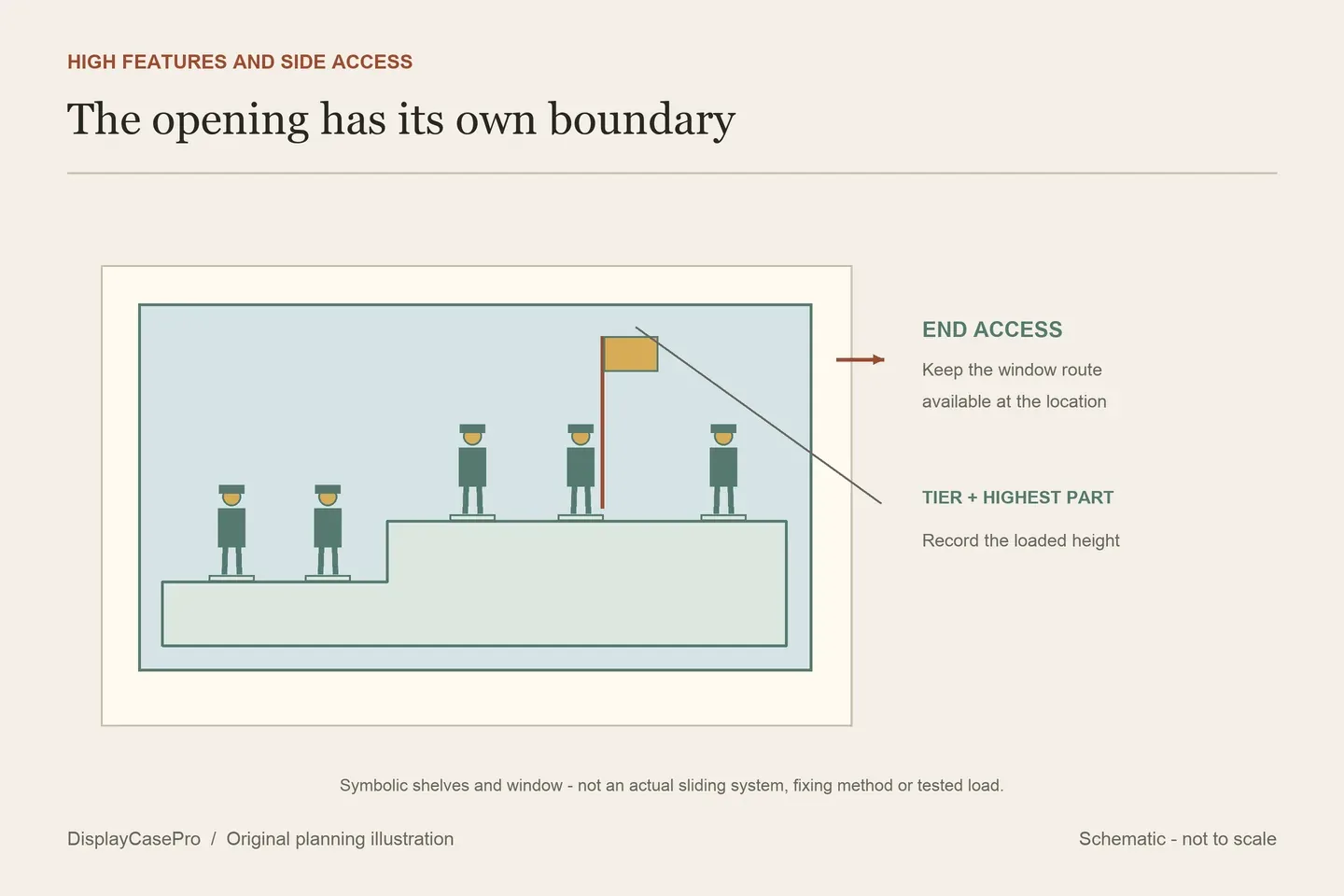
| Showcase Express Military Wargamer 3000 | Inside depth 3.95 in and opening 4.45 in. A shelf section's outside size is H5.16 × D4.25 in × 4 ft long; other category copy calls shelf height 4.5 in. | Use the stated opening for its own boundary. Confirm receiving space above any mat or step and access to the side-inserted window. |
| Troops of Time Cavalry Flag Bearer Case, DT007 | The line reads “7 High,” W6 in and L6 in; mirror back and black base. | Confirm the height unit and inside/outside definition. Neither the name nor the size line proves room for a particular flag and mounted figure. |
| Troops of Time Parade Case, DT009 | The line reads “5 1/2 High,” W5½ in and L23 in; mirror back and black base. | Confirm the height unit, usable base and opening. A long case does not specify the number of complete bases it accepts. |
The Showcase Express 4.45-inch opening should not be rounded into the separate 4.5-inch shelf wording or confused with its 5.16-inch outside height. An added mat or stepped shelf also changes the arrangement inside. Retain the exact system and accessory combination in the fit record.
A further example, the JOYTOY Individual Soldier Hangar, Armor White, lists product scale 1:25 and a size sequence of 11.8 × 7.2 × 6.6 cm, with ABS/PVC material. The text does not label those axes or define a clear cavity. Its A, B, C and set-of-three options need their own contents check.
Do not transfer that product's scale field to an unidentified soldier or infer a closing front from the word case. Obtain the actual supplied parts and receiving arrangement for the selected version. A themed display environment and a long cabinet of ranks answer different needs.
Raised rows need their own loaded headroom
Use a front-view position map to decide what remains visible in a rank. A rear figure's face may appear above a front row while its base caption or uniform detail remains hidden. Choose which information matters and check the populated view from the normal standing or seated position.
The Showcase Express category offers a stepped shelf for its 3000 series. That is a named accessory, not proof that every elevated flag or mounted piece clears the window. Record the supported height on each tier and follow the actual system's mounting and loading requirements.
Its clear vinyl windows are described as inserting from the side, with end caps closing the shelf sections. Check the side approach at the installed location as well as the front view. A shelf ending close to another object may need a different access plan even when the closed display fits the wall.
The Michigan Toy Soldier plastic-case category mixes case shapes and an aircraft stand. Product size lines in that returned listing do not establish units or clear interior for every item. Select the exact case and obtain its receiving dimensions rather than applying the category label to an entire regiment.
Keep the planned group identifiable and retrievable
Give each independent base or shared scene an identifier. Group by a documented set, maker or period if that helps explain the collection. Keep replacement pieces and uncertain identifications distinguishable rather than making the row appear to be a complete original set without evidence.
For a shared scenic base, establish which part is the intended handling unit. For separate figures, plan how a middle position leaves without catching adjacent equipment. Do not use a flagstaff or another projecting detail as a handle to make a crowded arrangement work.
Keep boxes and any detached components linked to the right record. If a figure moves into a playing group or a different scene, update its position reference so an empty bay is explainable. Follow the maker's guidance for the actual figure and support; a neat visual rank alone does not establish retention.
The blank soldier-group and opening worksheet records the base, highest projection, assigned row and removal route. Use the collection measurement guide for the complete group and the wall layout guide for the finished outside display footprint.
Common questions
Can scale alone choose a soldier case?
Include the actual base, flags, mounted figure and other projecting parts. The nominal scale does not describe the complete group or its opening route.
Does adding a step create more usable positions?
Check the loaded height and view on each level. A raised row consumes headroom and may change access even when the accessory belongs to the case system.
Can a long parade case be sized by adding base widths?
Arrange the complete group first. Projecting equipment, gaps, labels and the permitted handling route can change the occupied footprint.
Comments
Share a display tip or ask a question.