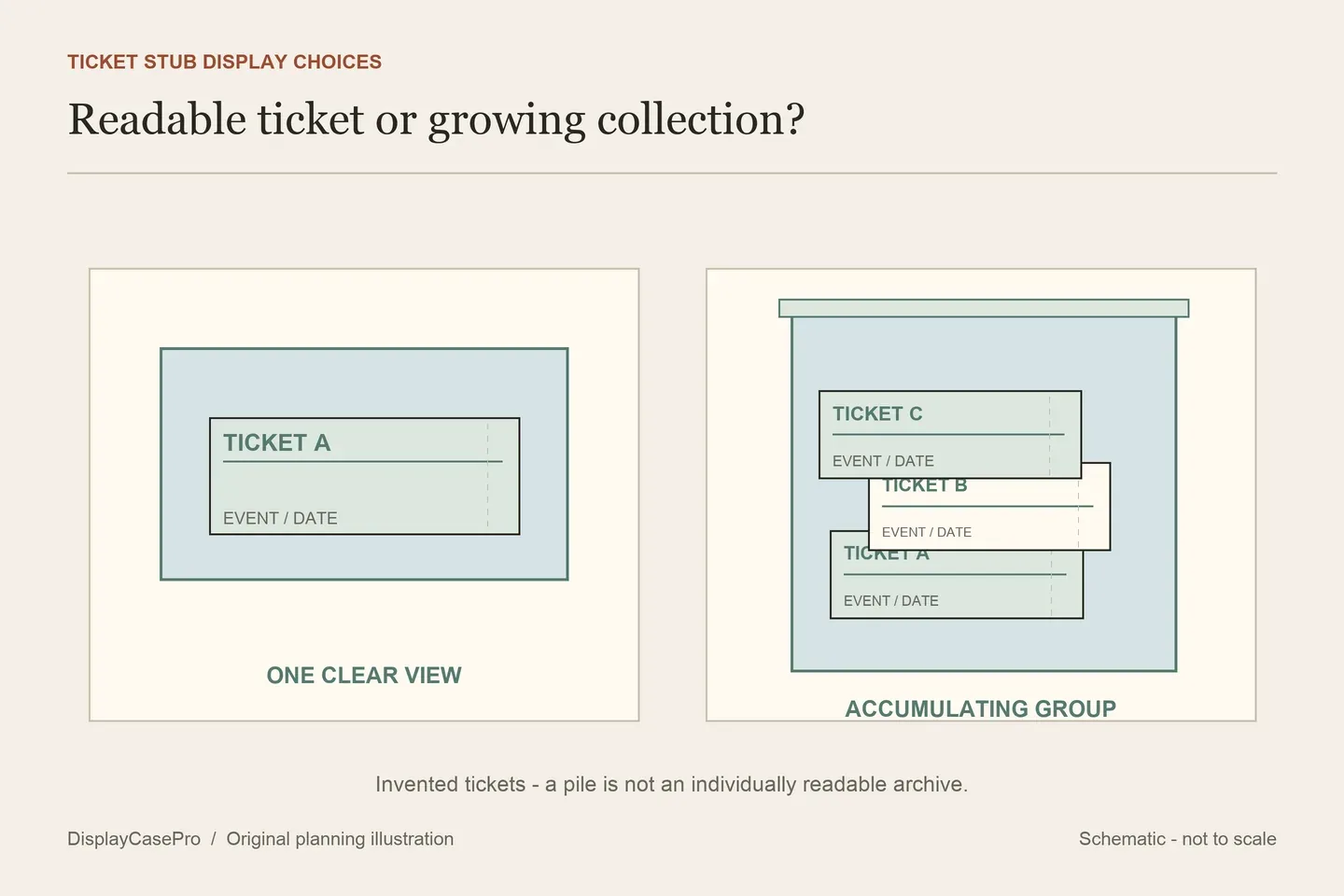
A ticket stub display case can serve three different jobs: show one ticket clearly, collect many tickets as a growing keepsake, or tell the story of one event. Choose that job first. A box that holds a pile of stubs will not keep every date readable, and a single-ticket holder will not necessarily accept a folded printout or an extra-long ticket.
One readable ticket, a growing collection or an event story?
| Main purpose | Suitable format to investigate | What the format cannot answer by itself |
|---|---|---|
| Read one ticket's event, seat and date | A ticket-specific rigid holder or an individually mounted frame. | The actual accepted ticket size, print stability and supported viewing angle. |
| Keep adding tickets from different outings | An accessible collection box, with a verified opening and retrieval route. | Whether tickets can enter without folding, or remain legible once they overlap. |
| Explain one event with a ticket, photograph and caption | A planned multi-object frame or shadow box. | How each item is supported and whether its information remains visible. |
A drop-in collection can be appealing as a record of accumulated experiences. If reading individual tickets matters equally, retain an indexed reference image or use a separate organized record. The visible pile and the readable archive do different work.
Make a record while the print is readable
Record the event name, venue, date and any seat details that are actually documented. Photograph or digitize the front and any meaningful reverse, using a process suitable for the ticket's condition. Keep the image connected to the original through a record code, rather than relying on a caption written from memory years later.
Do not assume every pale receipt-style ticket has the same print process, or that every old ticket is stable. The U.S. National Archives' paper-record guidance explains that thermal papers vary in stability; deterioration can include paper darkening and fading information. It advises considering copies of unstable or fading records to retain their content. For a personal collection, a clearly identified display copy can preserve a readable account while you keep the original separately.
Label that relationship accurately: for example, “Display copy of ticket T-014; original retained in collection.” A downloaded design commemorating an event should likewise be identified as a commemorative print if it was not the admission ticket used. A photograph cannot establish attendance, authenticity or a missing date.
Keep adhesives off the ticket. NARA cautions that adhesive tapes can stain, distort or damage paper, including products advertised as archival. If a ticket already carries old tape, do not turn display preparation into an attempt to remove it; get appropriate paper-care advice.
Compare pocket size with outside size
Two published products show why “extra long” and “ticket holder” are insufficient dimensions. The following are maker descriptions, not physically tested compatibility results.
| Holder | Published accepted area | Outside size and remaining questions |
|---|---|---|
| TAP Plastics Sports and Concert Ticket Display Case: Extra Long | Inside pocket: 2 9/16 in wide × 6 1/4 in high × 1/8 in deep. | Outside: 4 1/2 in wide × 8 1/8 in high; outside depth is not supplied in the table. Confirm how the ticket enters and is retained. |
| Ultra PRO Lucite Ticket Holder, SKU 81340 | For tickets up to 2 1/2 × 7 in. The description calls the holder 1/4 in thick. | Outside: 3 1/2 × 8 in, with four-screw closure. No separate usable pocket-depth figure is stated. |
The TAP pocket is wider in one direction but shorter in the other than the Ultra PRO's stated accepted ticket area. Neither is simply the “larger ticket case.” Compare both axes in the ticket's intended orientation, plus the complete thickness. Do not treat the overall thickness of one holder as its internal paper capacity.
A 7 in long ticket is not established to fit the TAP pocket merely because that case's outside height exceeds 8 in. Likewise, a printout folded to nominal dimensions has a different profile from a flat stub. Keep the original intact and change the display format or use a labeled copy when the intended holder does not accept it.
Search results can also use “ticket” to mean a retail price label. Acme Display's Plastic Ticket Holder explicitly describes a countertop price-tag holder. Its product name does not establish an enclosure for a collectible event ticket.
For a growing box, check entry and retrieval separately
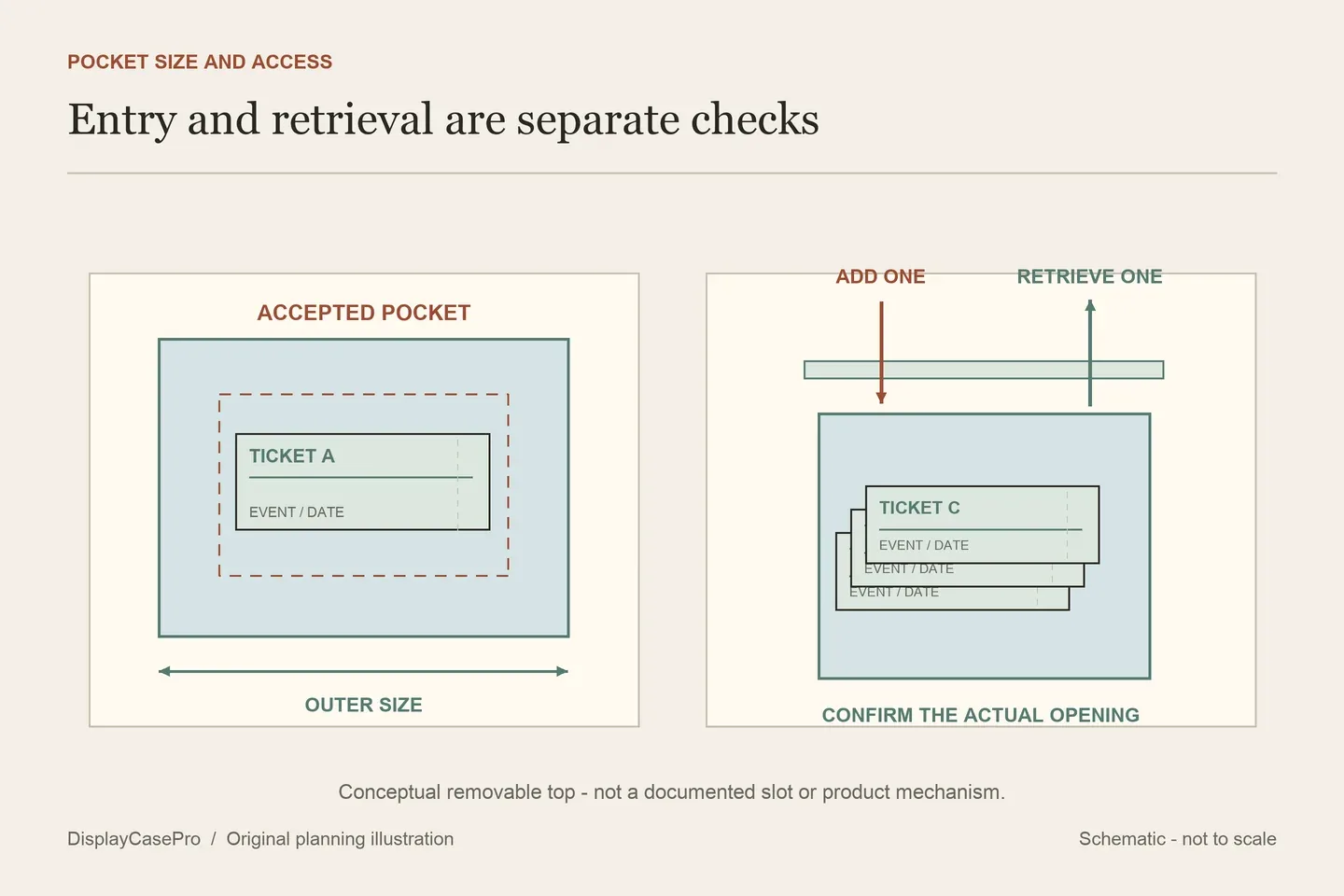
Ask how a new ticket enters. A narrow top slot needs its own clear width and thickness specification; a removable top is a different mechanism. Do not infer either one from a photograph of tickets already inside.
Better Display Cases A051 is a useful comparison: its description gives an outside size of 12 in tall × 8 in wide × 3 in deep and an inside size of 11.6 in tall × 7.6 in wide × 2.6 in deep. It describes a sliding removable top and wall or surface placement. Those details do not specify a drop-in slot, individual ticket retention or how a loaded wall display should be opened.
Before selecting a box, answer these practical questions:
- Can the largest complete ticket enter without bending or catching?
- How is the removable part reached in the intended location?
- Must the box come down before it is opened, according to its instructions?
- Can one ticket be retrieved while the rest remain supported?
- Will a second box or a separate indexed collection be needed when the view becomes crowded?
Keep paper tickets separate from loose bottlecaps or corks simply shown as alternative uses for the same box. A product's versatility does not make a mixed loose pile an appropriate arrangement for every paper original.
For one event, give the ticket its own readable position
Choose the main piece of information: a concert title, a first game with a family member, or a documented journey. Arrange a paper outline of the ticket beside a photograph or brief caption. Leave the event and date visible rather than letting an oversized added title cover the actual evidence.
Specify the ticket mount independently from the photograph and any three-dimensional keepsake. An off-the-shelf shadow box category offers many sizes, but does not define how an individual paper ticket is supported. Avoid trimming a stub, covering its information with glue or trapping it under a heavier object to complete the composition.
Use the blank ticket-display worksheet to record original or copy status, ticket dimensions, pocket or slot size, retrieval and the event caption. For mixed objects, check the assembled mount against the shadow box's usable depth. The depth of the outer box is not the clearance above the finished mounting surface.
Common questions
Will a display case stop a thermal ticket fading?
A case alone does not establish that result. Record the readable content and choose original or copy display with the paper's condition and exposure in mind. A material or UV label is not a guarantee about the ticket's print process.
Can all my tickets go into one drop-in box?
Only after checking the actual entry route, complete sizes and the collection's needs. An overlapping keepsake display may work for the view you want, while an important or fragile original may need independent housing.
Should I fold a long ticket to fit?
Choose a holder that accepts the intact ticket or display a clearly identified copy. A larger outer case can still have a short internal pocket, so check the accepted area first.
About this guide: This guide compares display functions and attributed specifications. It does not authenticate tickets, prescribe paper treatment or claim hands-on testing of the named products.
Comments
Share a display tip or ask a question.