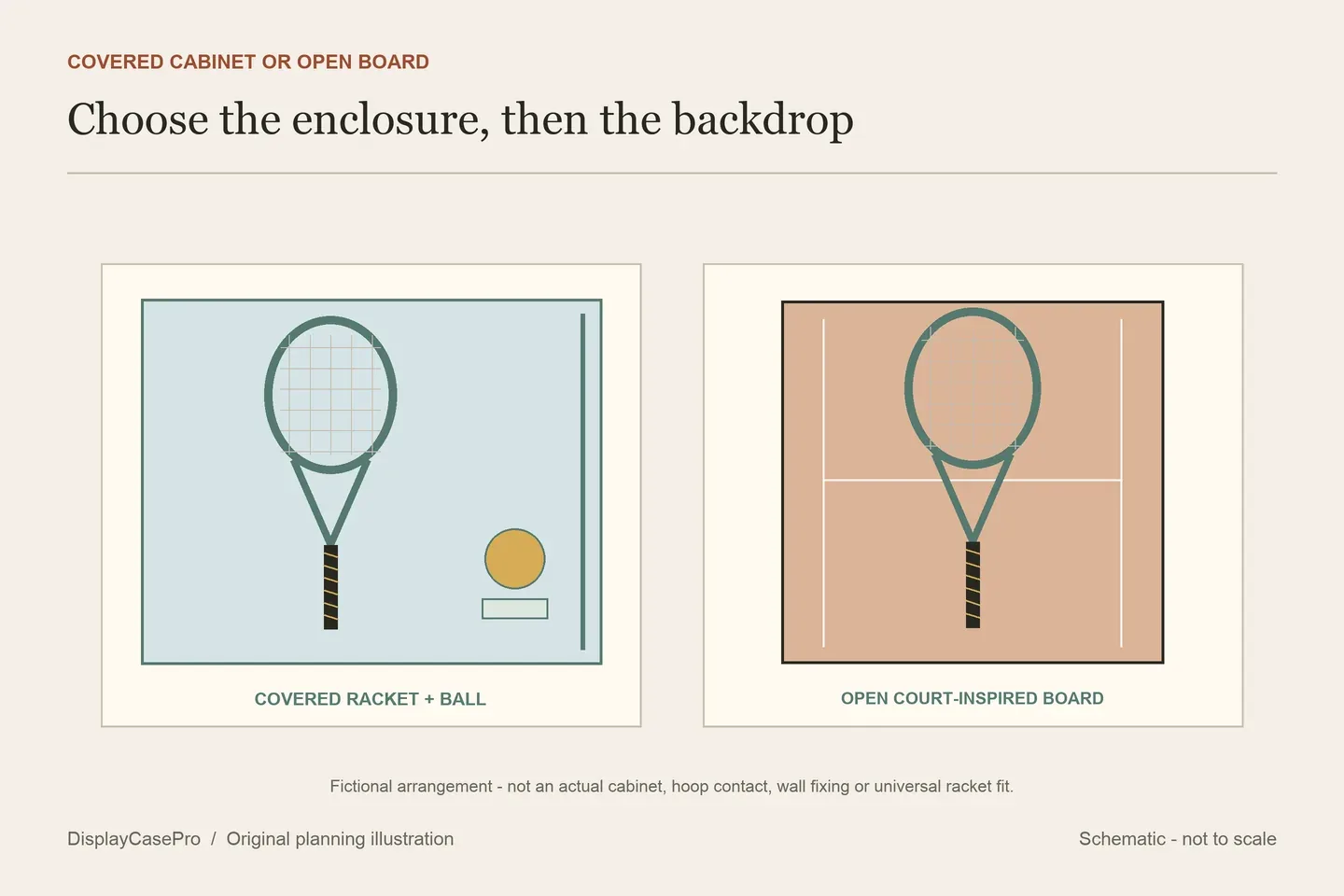
A tennis racket display case can mean a covered cabinet or an open court-themed wall frame. Choose that physical format first. A retired signed racket with a ball needs a different arrangement from a racket you lift off the wall for regular play. Check the hoop, throat, handle, support and complete projection rather than treating the board's length as proof of fit.
Decide whether you need a cover or quick access
A front-opening cabinet places a physical panel between the racket and the room. An open frame leaves the racket exposed and easier to remove. That difference affects dusting, handling and wall projection; a decorative court background does not resolve it.
| Format | Useful for | Selection check |
|---|---|---|
| Covered racket-and-ball cabinet | A settled keepsake arrangement with a separate ball position. | Receiving depth, hook and ball stand, door access and the complete supported racket. |
| Open wall board or frame | An accessible racket against a decorative court backdrop. | The intended support interface, loaded projection and lift-off route. |
| Frame with unclear enclosure details | A possible visual format still needing clarification. | Whether a front cover exists, what its size refers to and what mounting parts are included. |
FantasMall's frameless racket board explicitly describes an open face and a hook behind the racket neck. ONE MAAY's clay-court display also says it is open-air, with a wood block and brass hook. Neither should be selected as though it were a sealed shadow box.
ONE MAAY mentions a tempered-glass surface in its materials description while also stating that the racket display has no glass case. Read those statements together: a glass-faced backdrop is not a cover enclosing the racket. If dust separation is your main reason for buying, establish the actual front and side construction.
The hoop outline and support interface are separate checks
Record the full racket in its intended orientation, including the grip end and any overgrip or attached detail you intend to retain. A diagonal presentation changes the occupied rectangle compared with a vertical one. Do not use only the advertised playing length or string-bed area.
Next identify where the intended holder receives the racket: a throat or neck interface, a frame contact, or another maker-defined arrangement. Do not assume that any hook can rest against strings, a fragile finish or a signed surface. A vintage wooden racket and a current racket need their own compatibility confirmation.
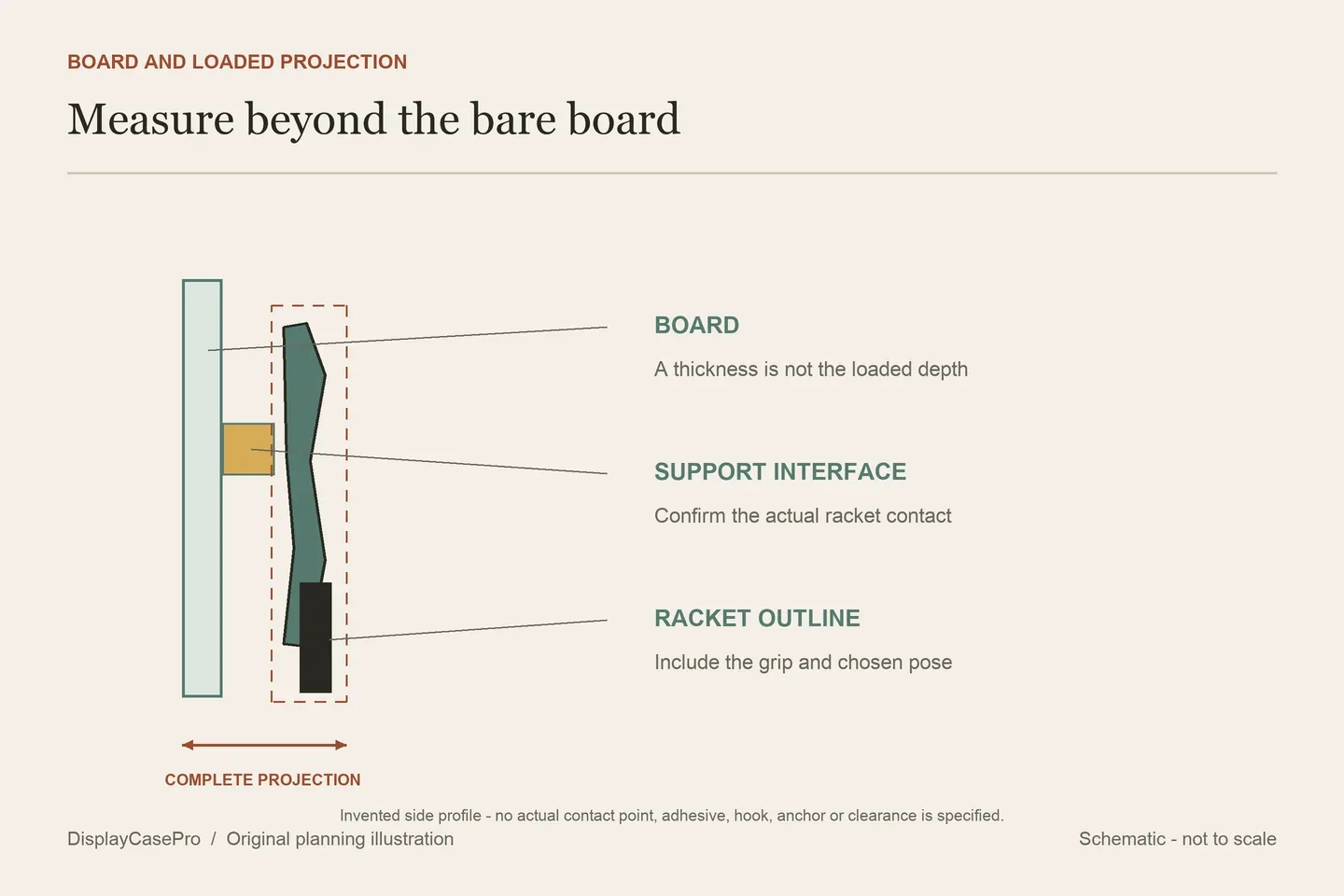
Depth starts at the mounting surface and includes the support, racket frame and projecting handle or grip. The racket can fit within a board's width and height yet project farther into the room than the bare board. A nearby door, curtain or walkway should be assessed using that complete mounted outline.
Read cabinet dimensions and board dimensions differently
These first-party descriptions were read on 17 October 2026. They show different formats and size boundaries. They are not a tested best-product list.
| Display | Published information | Keep unresolved |
|---|---|---|
| sfDisplay racket-and-ball cabinet | Inside W44 × H17 × D3.25 inches; outside W45 × H18 × D4 inches. One racket hook, one ball stand and front-opening door. | The exact supported orientation and clear space around both items. |
| Elevenmark wall frame | Length × width 31.50 × 15.75 inches / 80 × 40 cm; aluminum frame and ambient lighting described. | Cover construction, receiving area, loaded projection and the actual light configuration. |
| FantasMall open board | 31 × 16 inches / 78 × 40 cm; acrylic panel and 3D-printed mount components. | Actual support interface and dimensions in the chosen units; paired numbers are not exact conversions. |
| Tennis Frame Paris Clay | Standard size 16.5 × 32 inches; real wood frame, brass hook and walnut base described. | What the size measures, compatible racket profile and complete mounted depth. |
| ONE MAAY clay-court board | Board 16 × 31.5 inches, thickness 1 inch; listed weight approximately 2500 g. | The added racket/support projection and actual mounting arrangement. |
The sfDisplay cabinet's 3.25-inch interior depth is different from its 4-inch outside depth. Check the racket as received by the supplied hook and the ball on its stand; do not allocate the full depth to the racket alone. The published width/height axes are retained here rather than automatically relabelling them for a portrait wall layout.
ONE MAAY's 1-inch board thickness does not describe the complete projection with the hook, block and racket installed. Likewise, Tennis Frame's 16.5 × 32-inch standard-size line does not establish an equally large clear interior. Ask for the actual receiving or board drawing when a close fit matters.
Elevenmark's lighting description is a product feature claim, not an independent assessment of heat, glare or protection. Confirm the selected version, power arrangement and cord route. Adding light does not turn an open display into an enclosure.
A ball, plaque or photograph changes the arrangement
If a ball belongs with the racket, assign it a supported position before choosing the case. Keep it clear of the throat, grip and opening route. A ball placed in the middle of a hoop may hide strings or a signature even when it fits inside the same cabinet.
The sfDisplay product explicitly describes a ball stand as well as a racket hook. An open wall frame's racket support should not be assumed to hold a ball or a photograph. Confirm any additional holder as part of that product's actual system.
Keep the story specific: a racket used by a family member, a separately acquired signed piece, or a documented event keepsake. Label a display copy of a photograph or ticket accurately. A tournament-inspired court backdrop establishes a visual theme; it does not establish that the racket was used at that tournament.
Check the removal route at the chosen wall position
For an open frame, identify the maker's intended lift-off direction and the hand space needed to grasp the racket. Avoid arranging another frame, shelf or light immediately where that movement must occur. For a cabinet, check the door swing and whether the ball stand or caption obstructs removal.
Keep the racket's condition in the decision. A display for everyday equipment can prioritize access, while a fragile or irreplaceable racket may need a specialist support plan. Do not transfer another product's adhesive, anchor capacity or wall-fixing instructions simply because its board looks similar.
Use the racket format and projection worksheet to record the actual support, ball position and enclosure status. For spacing several pieces on the wall, use the collection wall planning guide. Keep the display format decision separate from the visual arrangement of multiple frames.
Common questions
Does a tennis display frame have a protective cover?
Some products are explicitly open; others need clarification. Check for a front and sides rather than relying on “frame” or “case” in a title.
Can I choose a frame using standard racket length?
Also check the hoop width, intended orientation, support interface and grip projection. A nominal length does not settle those dimensions.
Does a court-themed background prove a match connection?
No. Keep the decorative theme separate from the racket's documented history.
Comments
Share a display tip or ask a question.