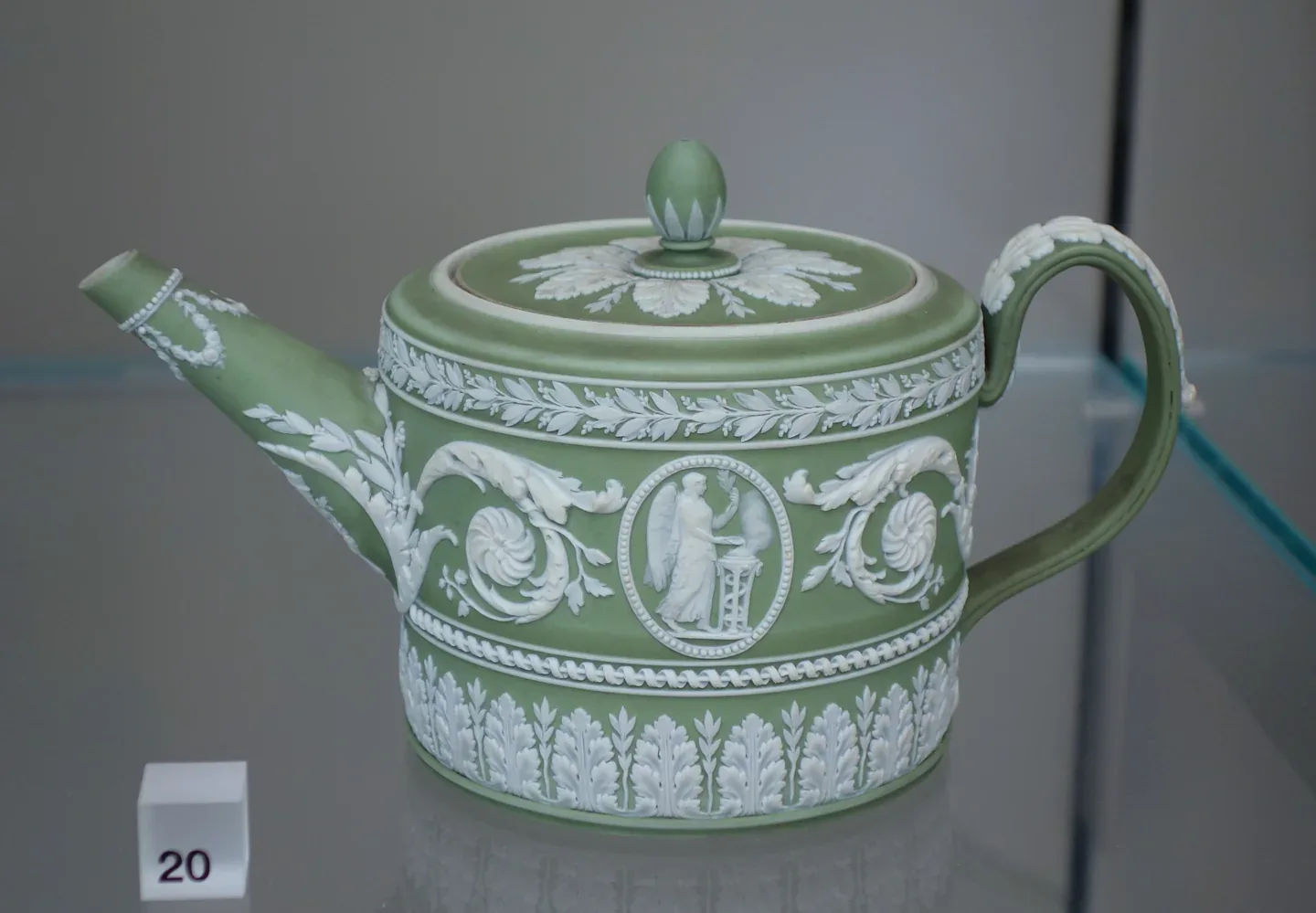
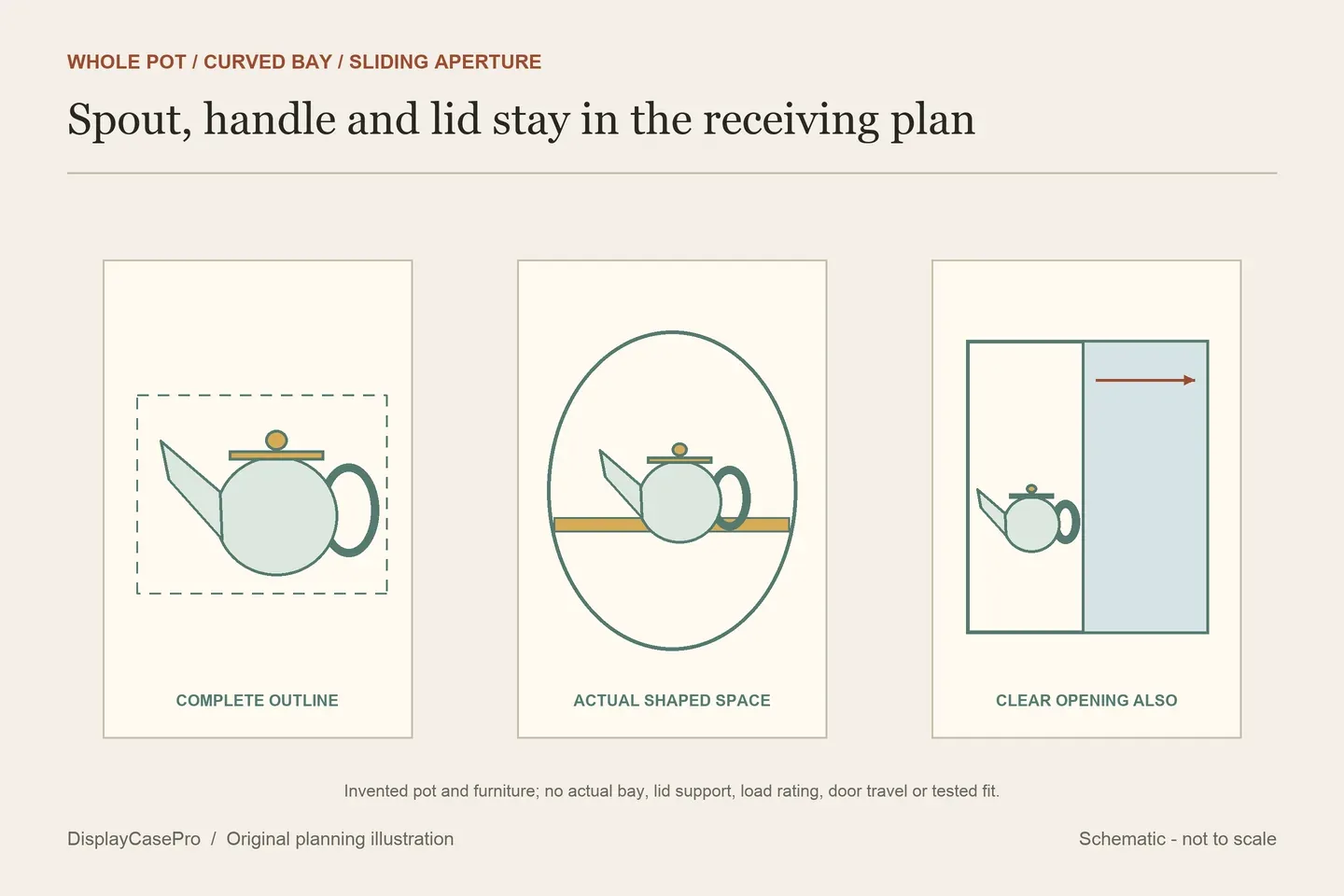
Choose a teapot display case for the whole pot, not just the round body. The spout, handle, fitted lid and lid knob determine the visible outline and removal route. A curved open shelf, a sliding-glass cabinet and an individual cover need different receiving questions, even when each is advertised for tea accessories.
Keep the lid and the pot connected in the record
Record the pot’s identifier, known maker or source, documented material and condition. Include any existing repair or mount in the enquiry. A style name such as antique does not independently establish an object’s age, and an attractive display photograph does not authenticate the teapot shown.
Choose whether the fitted lid remains in place or is already supported separately under appropriate guidance. Keep its association with the pot explicit. A neighboring lid with a similar pattern is not proof of an original match.
Record the complete supported outline from more than one view. Include the furthest spout tip, handle, raised knob and base or stand. A front-facing circle around the body misses the projections that may meet a shelf edge, a curved frame or a door.
Decide whether the display receives one teapot or a changing group
| Format | Useful view | Receiving question |
|---|---|---|
| Individual transparent cover | One complete pot and its associated caption. | Whole supported outline, clear cavity and the cover’s removal path. |
| Open shaped or tiered shelf | Several pots in separately visible positions. | Exact bay shape, usable shelf depth and support at each chosen position. |
| Glass-front cabinet | An enclosed group with planned access. | Actual compartment dimensions, shelf limits and clear door aperture. |
For a single keepsake, decide which view shows its important decoration without sacrificing the spout or handle outline. For a collection, give an unusually tall knob or long side handle an individually suitable position. Repeating the number of teacup positions does not establish the number of complete teapots received.
Umi Tea Sets’ curio category mixes shaped shelves, wall units, partitioned storage and cabinets. Lulu Teaware’s stand category also includes open and tiered formats. Select the actual construction before comparing size; the word cabinet or box in a name is not sufficient evidence of a closing front.
A furniture size is not a teapot-sized compartment
These three product descriptions were read on 18 October 2026. Their size definitions remain with their own listings. No shelf loading, material compatibility, support or physical teapot fit was tested for this guide.
| Exact example | Published information | Question still open |
|---|---|---|
| Umi gourd-shaped curio shelf | L100 × W30 × H175 cm; elm wood. | Usable shaped openings, individual shelf dimensions and whether the selected construction encloses the contents. |
| Umi walnut cabinet shelf | L53 × W24 × H70 cm; compartments and sliding glass doors. | Clear bay dimensions, actual aperture and documented shelf limits. |
| Lulu Bamboo Waven shelf box | 30 × 23 × 23 cm sequence; open two-tier bamboo stand. | Axes, inside/outside definition and separate clear receiving heights for the tiers. |
The gourd-shaped shelf listing gives the complete product’s size sequence without a dimensioned bay plan. Its curved outline should remain part of the enquiry. The widest overall measurement is not the width available beside every spout or handle.
The walnut cabinet listing describes sliding glass doors and multiple compartments. Request the usable shelf dimensions and opening for the exact version. The overall L53 cm line does not establish a 53 cm clear loading aperture, and the overall height cannot be divided into guessed compartment heights.
The Bamboo Waven shelf box describes an open two-tier stand, rather than a glazed box. Its 30 × 23 × 23 cm sequence has no labelled axes or clear receiving definition. Two tiers do not establish half the published height as headroom on either shelf.
The path through the opening can be narrower than the display position
Ask for the actual aperture with the chosen door open. Sliding panels, rails and neighboring compartments can affect how the complete pot enters; the interior’s widest face is a different measurement. Do not assume a door opens by the full furniture width.
For a curved shelf, map the supported pot at its intended height and depth. A handle can reach the curved side while the body remains well inside the central opening. Use existing reference images or paper outlines for the layout discussion instead of trial placement against an unconfirmed edge.
Decide where the lid will be during removal. If the chosen instructions require separate handling, reserve a suitable resting position and keep the lid connected to its pot record. An apparently convenient empty shelf is not, by itself, an identified lid support.
Request load and installation information for the exact unit. Include all displayed pots and added supports. Broad strong-bearing, harmless-finish or dust-proof wording does not provide a numerical shelf rating or a tested materials assessment for your particular objects.
Make room to support the object, rather than pull it by a projection
The Canadian Conservation Institute’s basic ceramics guidance advises lifting with both hands and avoiding handles or spouts as lifting points. Keep that handling requirement in the layout. A position that only lets you reach the handle is an unresolved access problem.
For a repaired or uncertain object, settle its support and handling needs before choosing a smaller bay. This guide does not prescribe cleaning, repair or an improvised attachment. Retain the object’s condition information with the cabinet enquiry.
The cover shows a museum teapot photographed by Daderot, released under CC0 1.0. Whole composition retained, proportionally resized and compressed to WebP. It is not one of the compared displays or approval of a support. The file’s object-period wording is not a photograph date or authentication by this guide.

Use the teapot outline, lid and opening worksheet with the collection measurement guide. The display lighting guide covers the separate task of viewing and reflections after the object and receiving arrangement are established.
Common questions
Can I choose a case from the body diameter?
Include the complete spout, handle, lid knob and retained support. The actual opening and removal route need their own check.
Does a two-tier box have two equal-height compartments?
The cited bamboo stand does not publish those clear heights. Request them rather than divide its overall size.
Comments
Share a display tip or ask a question.