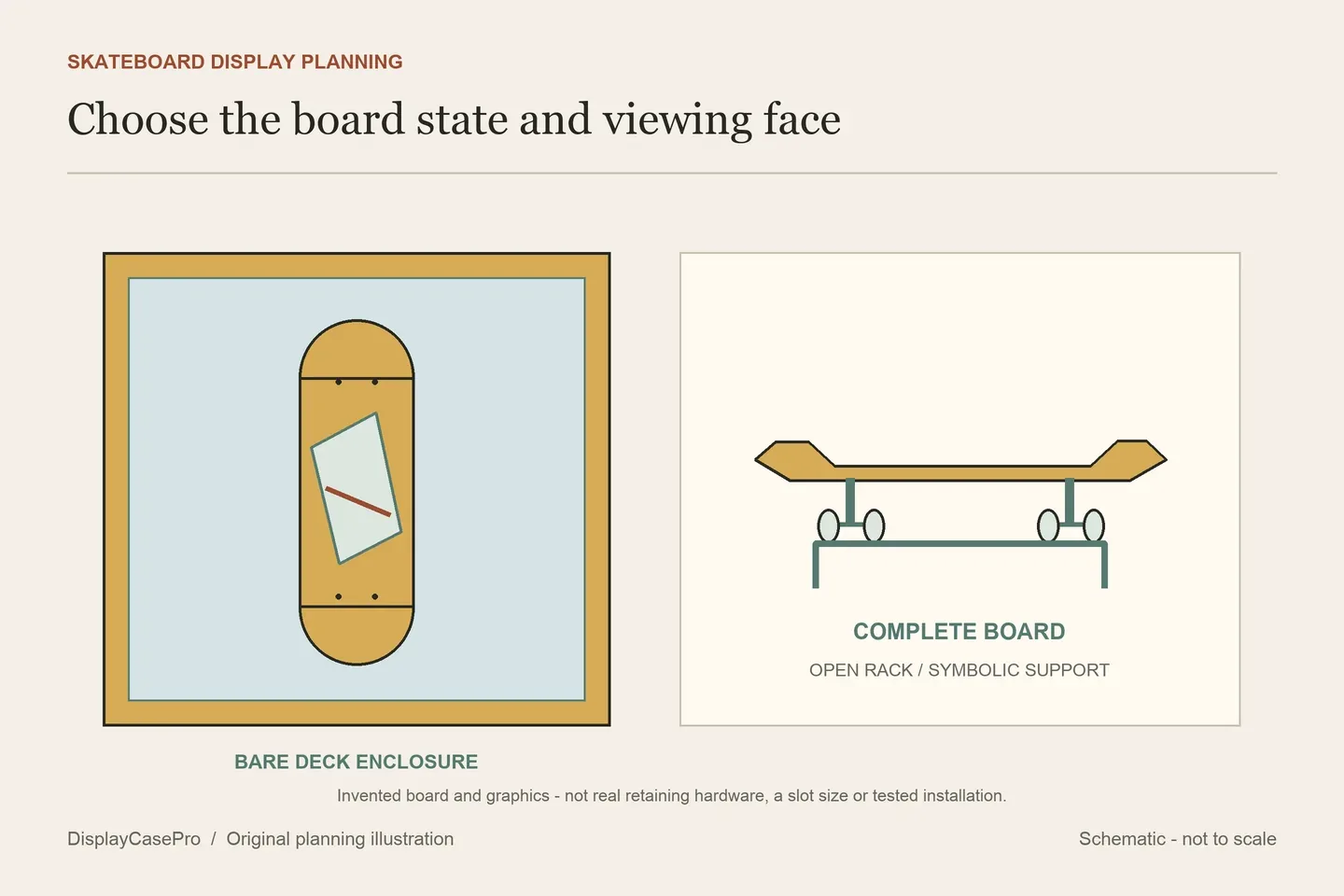
Choose a skateboard display case by deciding whether you are showing a bare deck or a complete board. A signed deck can be a shallow wall display; trucks, wheels and mounting hardware create a different depth and support task. The artwork face, the retaining method and how often you remove the board matter as much as its length.
A deck and a complete skateboard need different records
Start with the actual object. Record whether the trucks and wheels remain installed, which face contains the artwork or signature, and whether the display is horizontal or vertical. Include hardware, raised parts and anything attached to the deck. A product photograph of a bare board does not measure your complete setup.
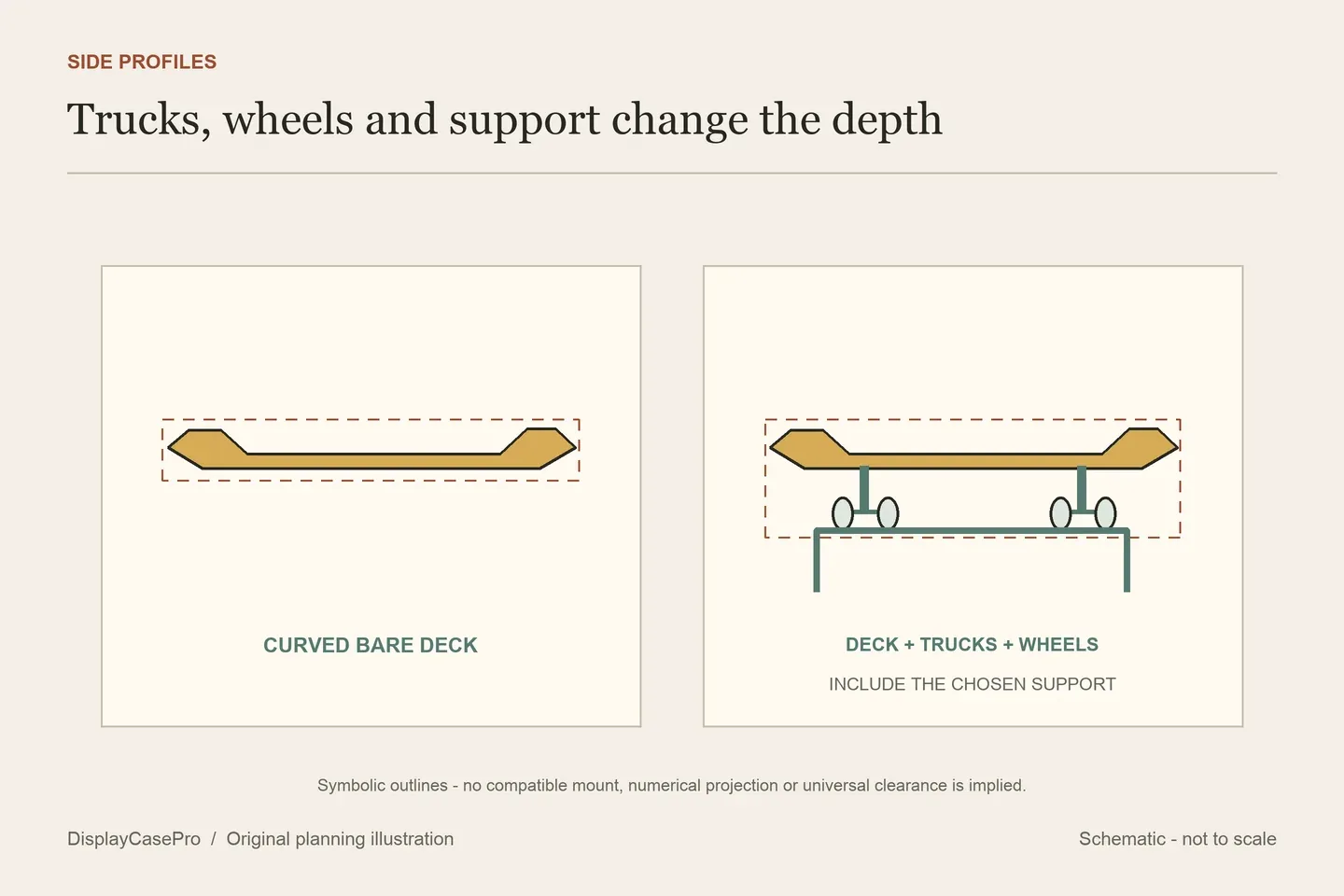
For a bare deck, record its full length, widest point and front-to-back profile in the intended presentation. The nose and tail can project away from the middle of the board. A length and width measurement alone does not describe that curved profile against a cabinet back.
For a complete board, record the combined outline of deck, trucks and wheels. Include the support's stand-off from the wall or background. A rack described as suitable for boards with trucks does not establish the depth of a closed case around that arrangement.
Choose whether you will display one board as an object or a group as a sequence. For several decks, record each one's length and width and the space needed for the graphics you want visible. Identical rack spacing does not prove that differently shaped boards will sit without interfering.
Choose an enclosure or a rack for a specific reason
| Object and use | Format to consider | Main question |
|---|---|---|
| A signed or illustrated bare deck | A shallow framed enclosure with a confirmed mount. | Which face is visible, and where does the retaining hardware contact it? |
| A complete board used regularly | An open rack designed for that board configuration. | How is the board retained and removed without relying on a clear cover? |
| Several boards or decks | A multi-position rack or separately sized cases. | Do outlines, wheels and captions fit the actual spacing? |
| An unusual shape or presentation | A documented custom frame or enclosure. | What exact cavity, mount and opening are included in the quoted design? |
Pro Board Racks' skateboard collection discusses open rack arrangements for skateboards and longboards. Its use of display language does not add a transparent closing front. Compare the physical format rather than assuming every search result labelled a case is an enclosure.
A bespoke example can suggest a layout without supplying a ready-made product specification. Exhibition Plinths' signed-skateboard presentation describes a custom frame with an MDF construction and glass front. It does not provide a standard cavity or establish fit for your board. Treat it as a project example, not a current universal case model.
A maximum deck length does not settle the depth
The source pages below were read on 17 October 2026. Published dimensions and claims belong to those exact products; no board or wall installation was tested for this guide.
| Product | Published information | What remains separate |
|---|---|---|
| sfDisplay 44-inch deck cabinet | Inside W44 × H10 × D3.25 inches; outside W45 × H11 × D4 inches. Horizontal and vertical presentation described. | The actual deck profile, supplied hook arrangement and complete-board depth. |
| SourceOne S1 SKATE TIER | 1–4-board options; listed width 6.75 inches and depth 7 inches. A 1.625-inch slot size is stated. | The slot axis and retaining arrangement, full board projection and spacing for the chosen option. |
| StoreYourBoard minimalist rack | Open aluminum rack with a maker-stated 30 lb capacity. The page uses both foam-rubber and felt wording for contact padding. | Confirm the current contact material and installation conditions; the number is not an independent wall-system test. |
The sfDisplay product is specifically presented as a deck cabinet. Its 44-inch figure is a length reference, not permission to ignore the listed 10-inch inside height or 3.25-inch inside depth. In vertical presentation, the long dimension turns with the cabinet; it does not create another 44-inch dimension across the short side.
Compare the complete mounted profile with the cavity. Do not treat a 3.25-inch inside depth as usable space entirely in front of the deck if the mount positions it away from the background. Request the intended mounting drawing and clear distance at the most projecting point.
The SourceOne listing gives different overall heights for its options: 7, 11.75, 17.75 and 23.5 inches for the one- through four-board versions. Those are rack dimensions. They are not the complete outline of the boards once loaded, and the 7-inch rack depth is not a guarantee about how far your wheels or deck will project.
Keep the 1.625-inch slot number with its unresolved axis rather than relabelling it as a universal deck-thickness limit. Ask how the chosen board sits in the slot and what prevents unwanted movement. The stated board count does not show that every mixture of longboards, complete boards and unusual shapes can share the rack.
Choose the viewing face before the retaining method
Identify the area that must remain unobstructed: a signature, central graphic, manufacturer's mark or a particular worn surface. Include a photograph in the inquiry so the supplier can explain where its hooks, brackets or supports sit relative to those features.
A mount intended for routine board storage may cover part of the artwork you want to show. Conversely, a visually discreet presentation still needs a documented retaining method. Do not assume an edge contact, screw hole, adhesive or friction hold is suitable merely because it is hidden from the front.
For signed or fragile artwork, establish acceptable contacts with the owner of the mounting design and, where appropriate, a suitable specialist. A seller's UV percentage or padded-arm description does not verify every ink, finish or adhesive. This guide does not prescribe a treatment or a universal preservation mount.
Leave room for the board and for its normal removal
For a framed enclosure, confirm the door direction and clear opening. Place adjacent frames and furniture outside the opening route. A board that fits behind a shut front may still be awkward to take off its hooks when the door or another object blocks the approach.
For an open rack, establish the manufacturer's removal sequence. Include the space to lift or angle the actual board, without guessing a clearance from an empty rack photograph. Check that handlebars, furniture or another board do not occupy that route.
Keep the wall mounting and the board retaining system as two separate checks. The sfDisplay listing gives the cabinet's unit weight as 13 lb; that is not its wall capacity or the combined loaded weight. Follow the exact installation instructions and establish suitable fixings for the actual wall. A rack's headline load figure cannot determine that on its own.
Use the deck, complete-board and mounting worksheet to record configuration, graphics, contact questions and opening route. The collection wall planning guide covers the wider wall composition. Keep unverified UV performance, stack strength and current stock out of the fit decision.
Common questions
Does a 44-inch case fit every board shorter than 44 inches?
No. Width, curved profile, trucks, wheels, mounting position and the clear opening still matter. Confirm the exact supported configuration.
Is a skateboard rack an enclosed display case?
An open rack holds the board without a surrounding closing front. Choose it for that function rather than expecting an enclosure's physical format.
Can a slot measurement tell me whether my complete board fits?
Only after the slot axis and retaining method are clear. A single slot figure does not describe the full loaded arrangement.
Comments
Share a display tip or ask a question.