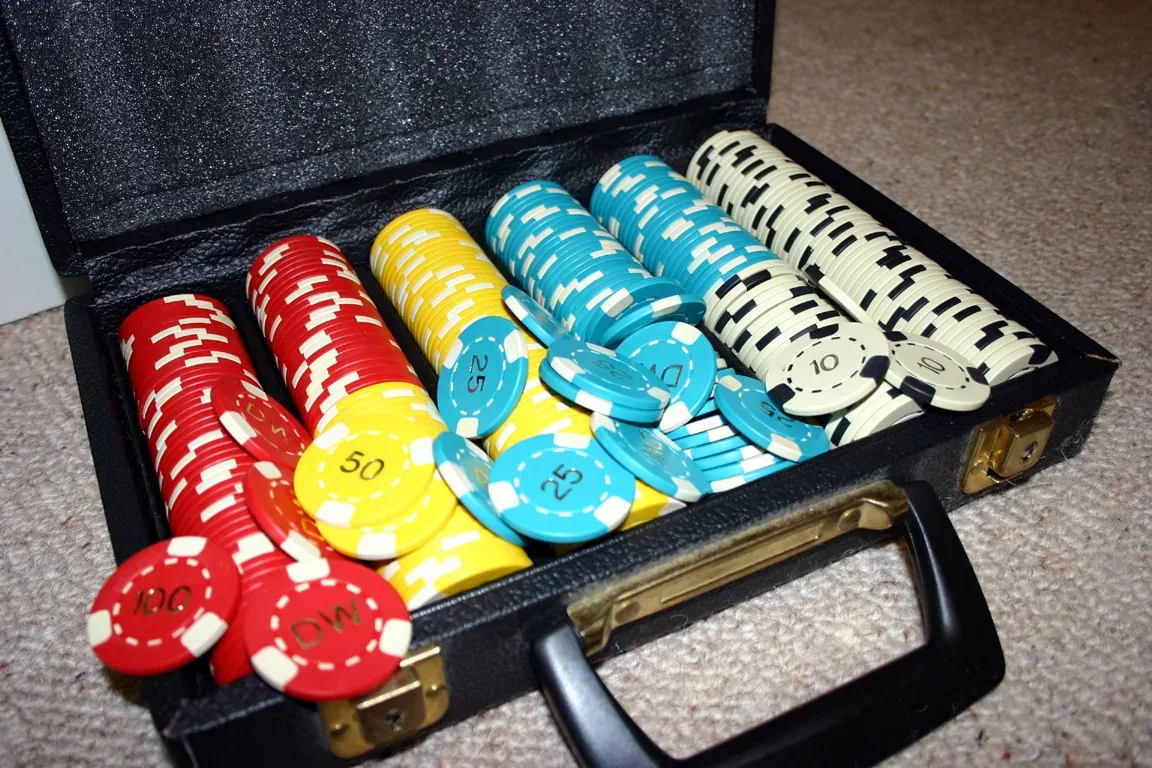
A collectible poker-chip display should make the chosen faces easy to read. A playing-chip case can instead hold dense stacks with most faces hidden. Decide which job you need before comparing cabinets, tilted stands, frame inserts or albums, and keep the actual chip or protective holder in the fit check.
Cover photograph: Psychofox’s Set of Poker Chips in Case, originally uploaded in 2005 and released by the author into the public domain worldwide. The full composition was proportionally resized and compressed. It illustrates stacked playing-chip storage, not a collector cabinet’s capacity or a transport test.

Start with individual pieces, not a suitcase count
List the casino, course, event or issue only as documented. Identify the face you want to see and retain a record of the reverse. Some collectors use poker-chip-shaped golf ball markers; those are flat collectible pieces, rather than the golf balls shown in a ball cabinet.
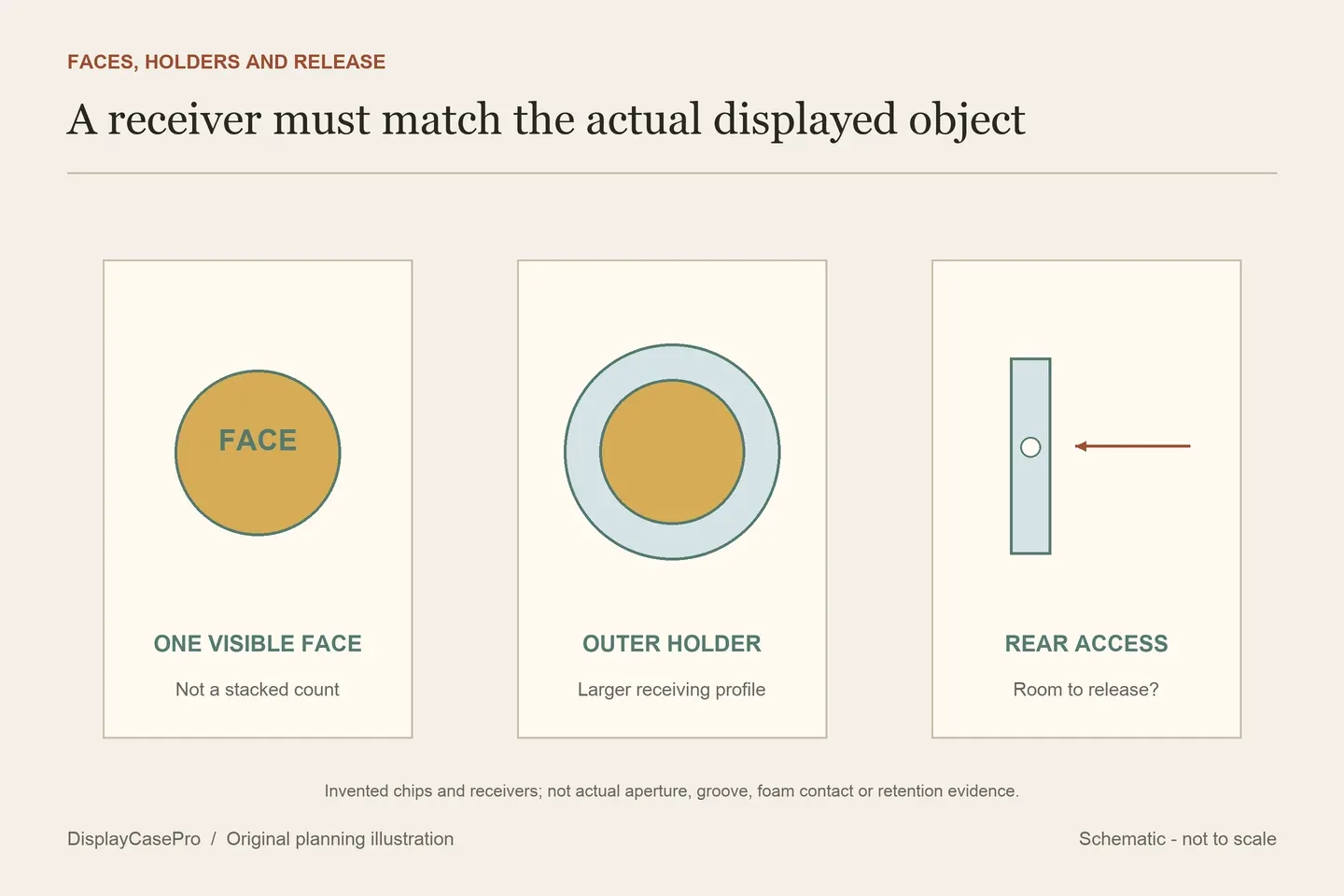
Record the actual outside diameter and full thickness. A chip in a capsule or other holder presents a different receiving profile from the bare chip. A slot or aperture intended for one format cannot be assumed to accept another merely because both descriptions mention the same nominal chip diameter.
A display with one position per face is useful for browsing a series. A case with rows of stacked playing chips answers a storage question. Neither arrangement is inherently better; choose the view that makes your particular collection useful.
Grooves, tilted receivers and foam inserts behave differently
| Source | What is offered | Receiving question |
|---|---|---|
| Great Golf Memories | Chip and golf-marker displays in several named capacities, plus separate cover accessories. | Exact chip format, confirmed count and whether the chosen display includes a front. |
| sfDisplay | Grooved cabinets, open row racks, fitted frames and 3D frames. | Selected product’s groove, row arrangement and protected-holder compatibility. |
| Spinettis | Capsules, flips, pages, easels, frame inserts and small cases. | Which layer is received: bare chip, capsule, insert or complete frame. |
| Casino Supply | Open ten-chip acrylic stand; overall H9.5 × W4.5 × D4 in. | Actual receiver diameter/thickness and access behind the stand. |
| SAFE | Albums, cases, drawers, acrylic displays and tiered easels. | Visible-face browsing versus enclosed storage, using the exact holder format. |
SAFE’s category text mentions standard 39 mm and 40 mm chips. Keep those references with its stated systems; they are not dimensions for every souvenir, oversized chip or capsule. General “archival,” fading-prevention or value-preservation language is not a substitute for a confirmed receiving specification or an independent material assessment.
A chip count needs a position map
The sfDisplay dc5165b describes thirteen rows of nine standard-sized chips, giving its nominal 117 positions. It lists outside H28 × W16 × D1.75 in, inside depth 1 in and shelf spacing 1.75 in. Those three measurements describe different boundaries.
A 1 in interior depth is not the groove width, and 1.75 in shelf spacing is not proof that every capsule can be inserted and removed. Confirm the receiving edge and complete protected profile for the actual row. The nominal map does not establish 117 mixed-size pieces, and the stated 9 lb unit weight is not a loaded wall rating.
Great Golf Memories’ 64 Poker Chip Display Cabinet requires clarification before using its count. The title says 64, while the description mentions eight shelves and up to sixteen standard chips or other coins up to 2 in high. It also gives outside H18 × W14 × D1.75 in. Do not invent “sixteen per shelf” or silently replace the title; request the selected product’s actual map.
For a mixed collection, assign each chip or holder to a confirmed position. Mark exceptions instead of forcing them into a standard row. A large caption, unusual edge or retained capsule may change the practical arrangement even where the nominal bare-chip count is clear.
A photo-frame insert size is not its chip-hole diameter
Spinettis’ one-piece chip inserts list twelve positions in an 8 × 10 in insert, twenty in 9 × 12 in, thirty-five in 12 × 16 in, sixty-three in 16 × 20 in and ninety-nine in 20 × 24 in. These are insert formats, not the individual receiving openings or the complete frame’s external footprint.
The product describes foam with an attached backer and excludes the displayed chips. Ask for aperture dimensions, accepted thickness, capsule compatibility and the frame depth required with that backer. A statement about holding chips in place does not independently establish harmless contact with every printed surface.
Keep insert, frame and glazing in one record. A nominal 8 × 10 in photo frame does not automatically provide adequate depth for a chip, foam and backer. The usable-depth guide explains why outside depth and receiving space should remain separate.
Leave access behind a rear-release stand
The Casino Supply stand describes tilted chip positions and a hole behind each position for pushing the chip out. That rear access matters at a shelf or desk: a stand placed tightly against a wall may be awkward to change. Its overall dimensions do not supply the receiving-hole diameter or confirm a capsule fit.
The same stand is open, rather than an enclosing case. Its base fixing holes and nominal ten-chip count are product features, not proof of a universal installation or transport restraint. Plan the exact location, support and retrieval routine without turning a “museum quality” title into a tested conservation claim.
Use the measurement guide for complete protected profiles. Download the chip-display worksheet to connect identity, face, holder, receiver, nominal map, actual position and unresolved fit questions. Keep reverse-side reference images clearly labelled if they accompany a one-face display.
Common questions
Can a golf poker-chip marker use a casino-chip display?
Compare the actual marker with the selected receiver. The category crossover establishes a possible format, not a universal diameter, thickness or capsule fit.
Does a playing-chip case display its entire collection?
It may store many stacked chips while showing only a small selection of faces. Count the faces you want readable separately from the total pieces stored.
Comments
Share a display tip or ask a question.