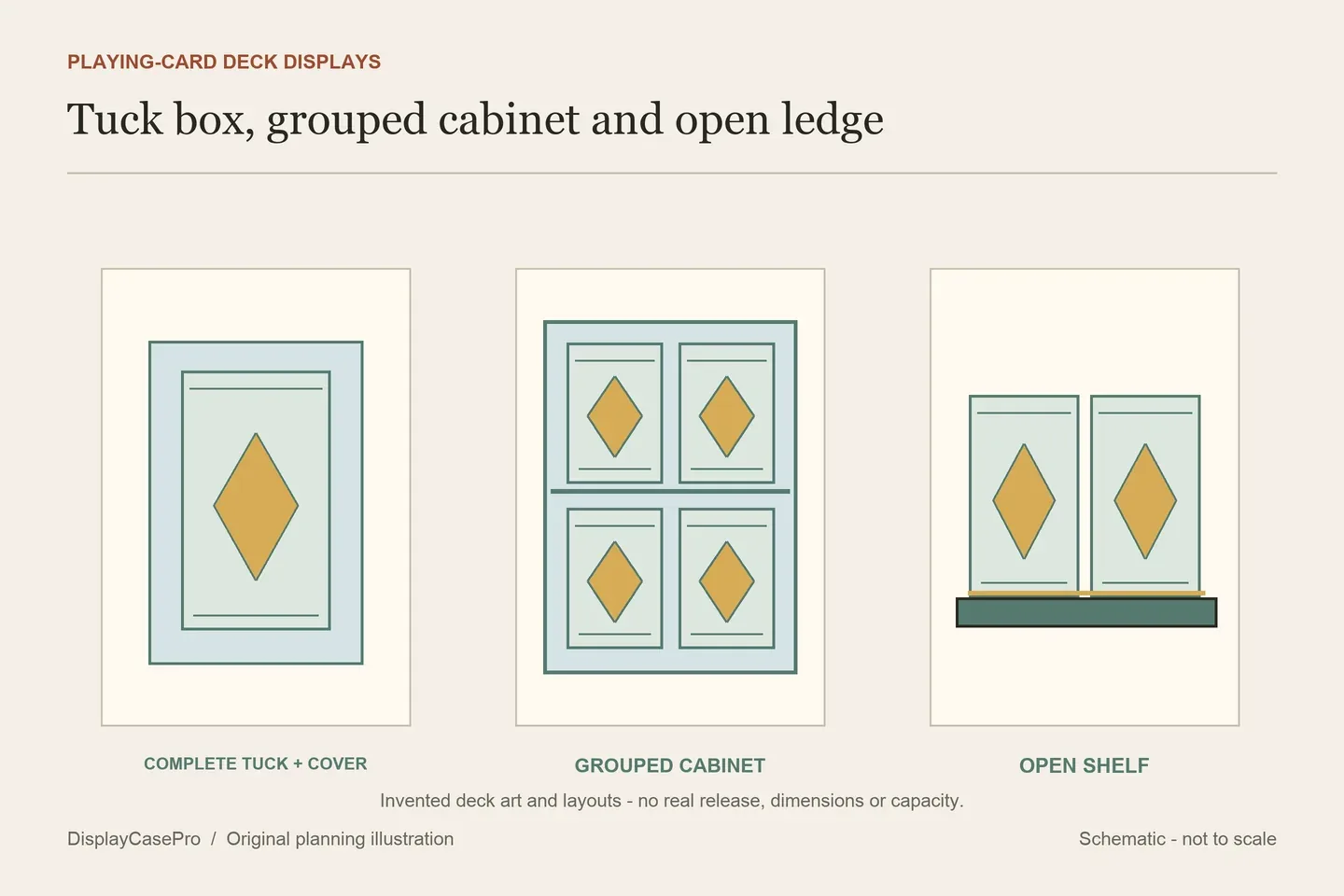
Choose a playing card display case for the complete deck and the packaging you intend to keep around it. A tuck box, a deck inside an additional protector and a special two-deck presentation box are different objects. Decide whether you want one featured release, a wall of boxed artwork or an open shelf for decks you still use.
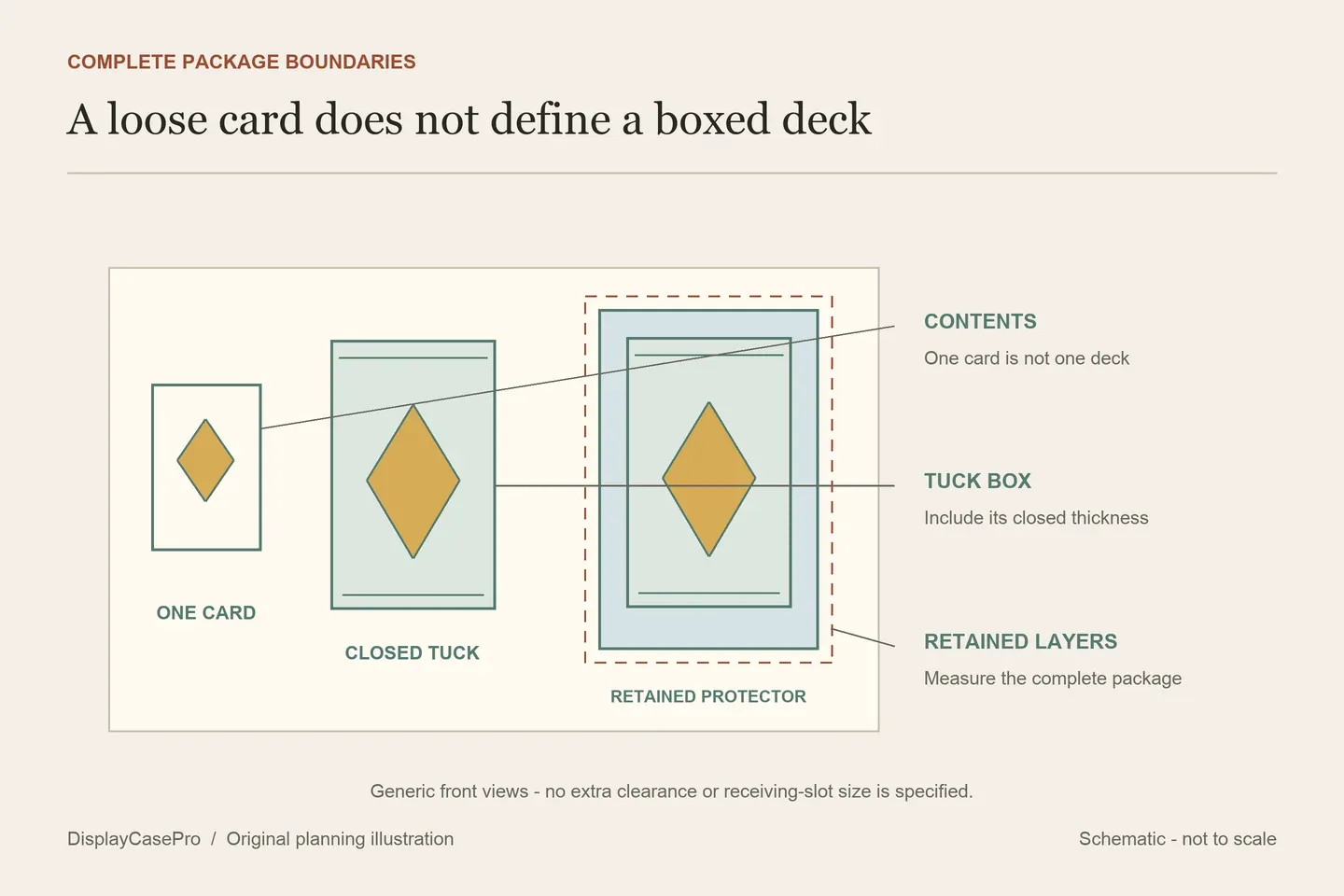
Start with the tuck box rather than one loose card
A tuck box is the carton around a deck. Its outside width, height and thickness determine the package entering an overcase or cabinet. The dimensions of an individual card do not include that carton, its folded flaps or an added protective sleeve.
Record the release, edition and packaging state first. A regular single deck, an unusually thick tuck, a double-deck slipcase and a larger presentation set should have separate entries. If the outer presentation box is the collectible you want to show, do not size its enclosure from one of the decks inside.
Keep any intended protector in the measurement. A transparent sleeve or rigid secondary box adds another boundary, even when the printed front still looks much the same. Record whether the new display will receive the original tuck directly or the already protected assembly.
Choose the face you want visible: front artwork, spine, back design or an opened package. A wall of fronts uses space differently from spine-out storage. If you intend an open carton or exposed deck, confirm that specific presentation and support; a product advertised for closed tuck boxes has not necessarily provided a way to retain loose cards.
Separate individual covers, grouped cabinets and open ledges
| Format | Useful purpose | Important distinction |
|---|---|---|
| Individual acrylic overcase | Feature one release or a defined small group. | Choose the exact one-, two- or multi-deck version and obtain its usable internal dimensions. |
| Wall cabinet | Present several tuck fronts behind a closing door. | Overall interior size does not provide the receiving space and removal route at every row. |
| Open wall shelf or rack | Browse or rotate a visible selection without opening a cabinet. | The shelf is a support, not an enclosing cover. Its height is not automatically the maximum deck height. |
| Closed brick or collection box | Keep a group together when continuous visibility is unnecessary. | Storage capacity and front-facing display capacity answer different questions. |
The 52Kards display and storage collection illustrates how broad this category can be. It includes deck sleeves, cases, racks, brick boxes, wallets, clips and a single-card frame. Choose the function before comparing counts; a clip for cards in use is not an enclosing display case around a tuck box.
For a mixed collection, one format need not do every job. A few featured decks can sit in individual covers while the remainder stay in identified storage. Keep a position record so an empty display slot is distinguishable from a missing deck.
Compare the number's definition as well as its value
The examples below use published maker descriptions. They are not measurements by DisplayCasePro, a ranking or a tested fit list. Keep the selected version and its dimension labels with the figures.
| Display | Published information | Question still to answer |
|---|---|---|
| Pennzoni 20-Deck Display Case | Outside W22 × H18 × D2 1/4 in; inside W20.5 × H16.25 × D1 1/2 in. Text gives an ideal deck height of 4.5 in and thickness no more than 1.5 in. | “Ideal” is not a stated maximum height. Ask for the actual row layout and usable bay openings for the packages you own. |
| theory11 Deck Display Shelf | Up to 12 decks; shelf W31 × H2 × D2.5 in. The page notes that its 2025 production batch may differ from earlier runs. | Confirm support and retention for the actual tuck width and thickness. The 2 in figure describes the shelf, not a universal deck limit. |
| TCC Crystal Playing Cards Display Case | One-, two-, three-, four- and six-deck versions, with magnetic disassembly described. | Obtain the complete interior of the selected version. The page's general side-gap wording does not supply all three receiving dimensions. |
Do not divide a cabinet's inside width by its advertised count to calculate a bay. The decks may occupy several rows or use a particular orientation, and shelves and retaining parts also take space. Request a diagram that identifies the actual positions behind the nominal capacity.
TCC describes its fit in relation to most USPCC-produced decks and mentions gaps of 1–2 mm along the long and wide sides. That is the maker's general wording, not an allowance to add to every special tuck, a thickness specification or proof that an existing protector fits.
For repeating wall shelves, retain the exact model and batch information. A new shelf carrying a familiar name may not visually match an older one. Confirm the actual receiving and mounting arrangement rather than assuming that matching finishes or photographs establish compatibility.
Read beyond a “deck display” product title
A specific listing shows why the description matters. Vanishing Inc.'s Carat XSC page uses “Single Deck Display” in its title, while the body describes a single poker-sized card in a paper insert between two 10.2 × 10.2 cm acrylic plates. Those plates do not establish space for a complete boxed deck.
Check what the product supports and what is included before ordering. A photograph of tuck artwork can be confused with a loose-card illustration, and a catalogue can place both products under the same storage category. Resolve that difference using the actual mounting description and accepted package.
Make the removal route fit the way you use the decks
For a cabinet, check the approach to each row as well as the closed fit. A projecting tuck, deep lip or neighbouring package can obstruct the hand movement needed to remove one deck. Keep an unusually wide or thick release in a position whose space is confirmed.
For an individual magnetic case, follow the exact maker's opening sequence. Confirm which panels separate and where the deck rests during opening. Do not use a carton flap as a handle to pull a tight package out of an enclosure.
Separate retrieval from opening the tuck. A deck can leave its display closed, then open on a suitable surface for use. Keep any display protector and the empty box associated with that release while the cards are elsewhere, and return the complete package to its recorded position.
Use the blank deck-display worksheet to record the edition, retained layers, selected case version and unresolved row limits. The collection measurement guide helps document the complete supported outline. For a wall group, arrange the finished outside footprints using the collection wall layout guide.
Common questions
Will a case for one poker deck fit every tuck box?
Confirm the exact carton and any retained protector against the chosen product's interior. A nominal deck format does not define every special edition's packaging or thickness.
Does a 20-deck cabinet hold 20 decks in rigid protectors?
Only an actual position-by-position fit check can establish that. Count complete protected packages and obtain the cabinet's receiving and opening dimensions rather than applying its bare-package count automatically.
Is an open display shelf a covered case?
No enclosing front follows from the shelf label. Choose an actual closing surround if enclosure is part of the requirement, and check its operation and usable space separately.
Comments
Share a display tip or ask a question.