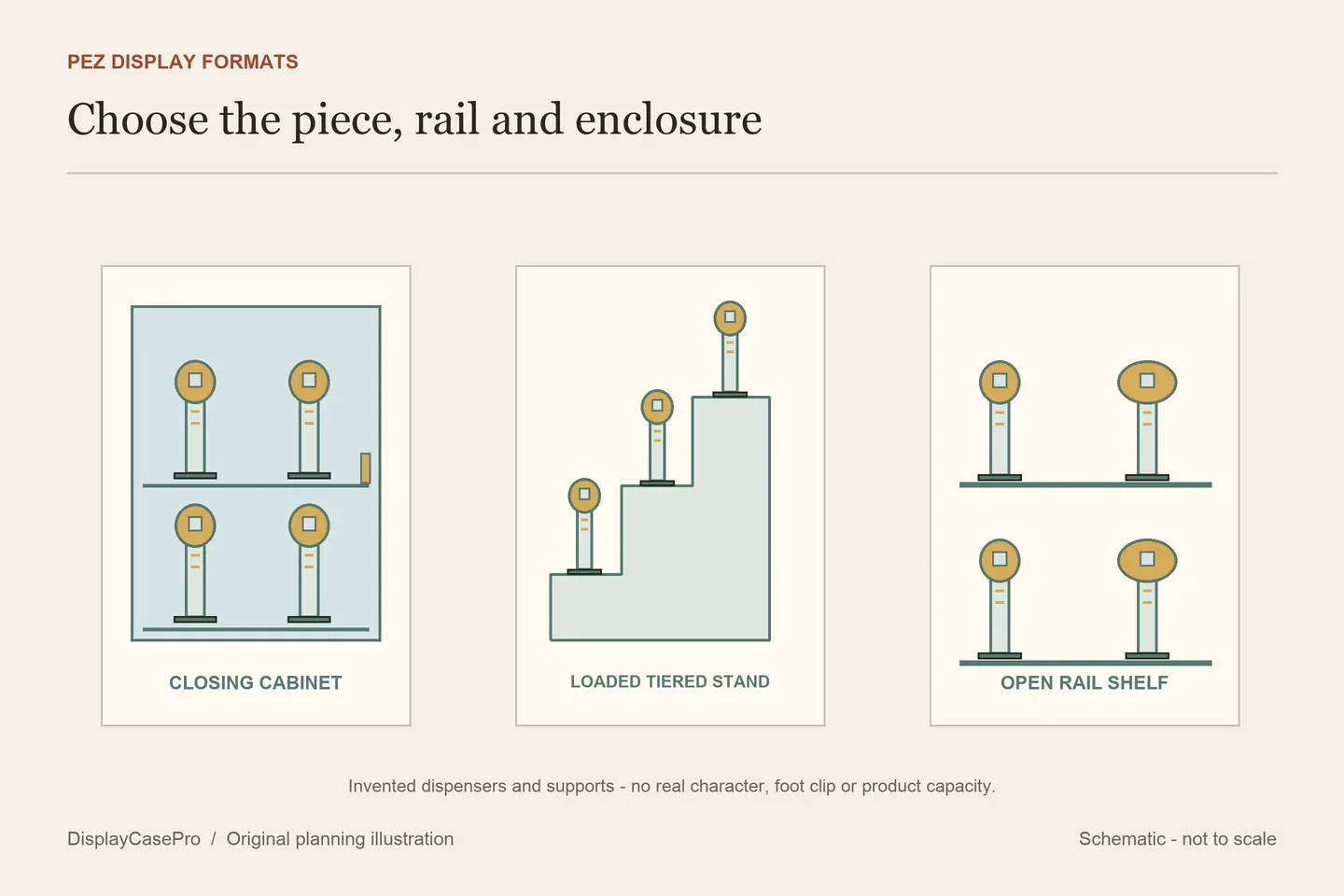
Choose a PEZ display case around the dispensers you actually own: their feet, head shapes, full stems and any retained packaging. A rail, tiered stand and cabinet with a closing door solve different parts of the display. Count useful positions after checking those details, rather than choosing the largest advertised capacity.
Sort feet, heads and packaging before counting rows
Make separate groups for loose dispensers with feet, those without feet, minis, wider heads, trucks and other unusually shaped pieces. Keep any identification uncertain until your collection record supports it. A character name alone does not describe the base that must enter a rail or the outline of the head above it.
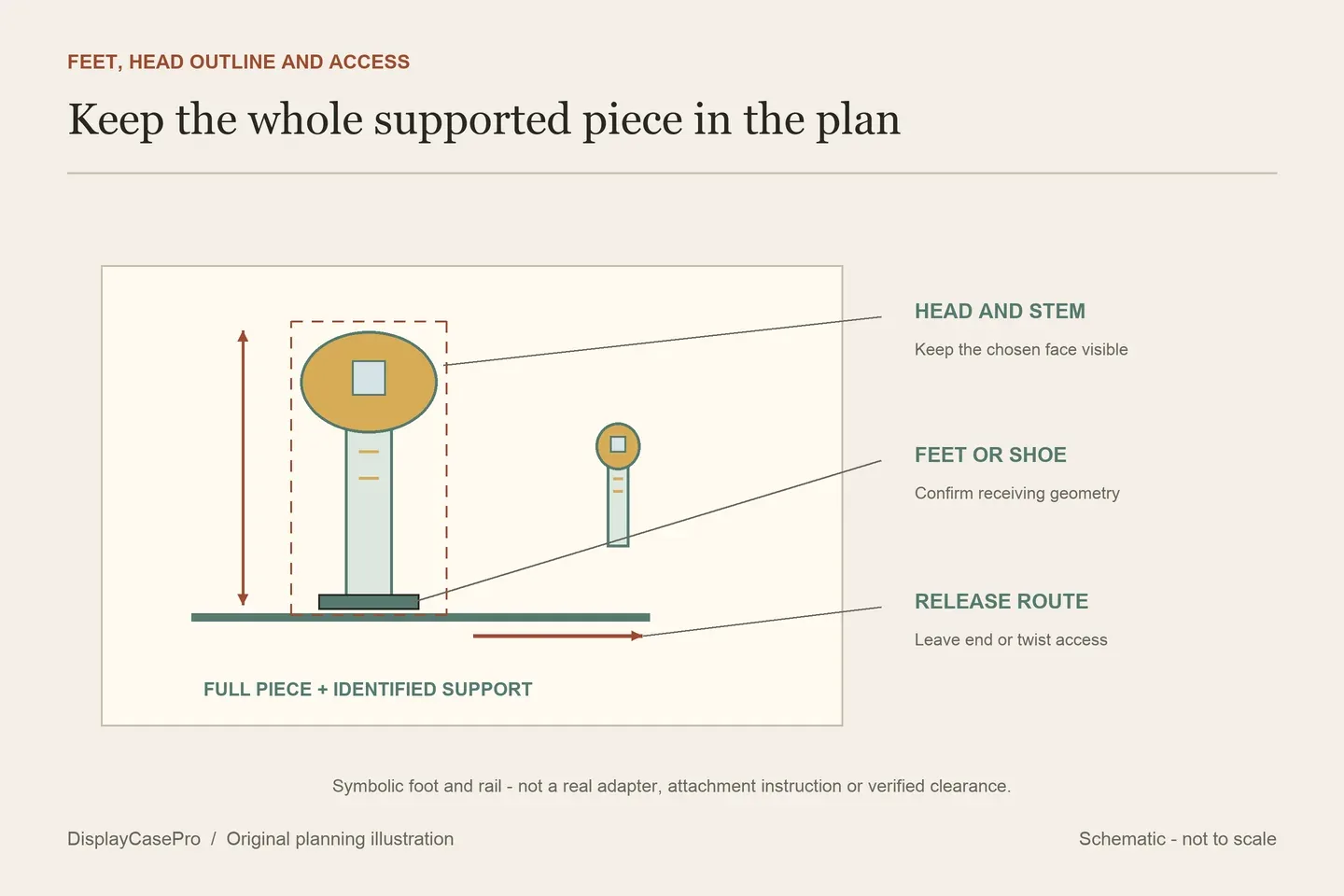
Record the complete height and widest profile in the intended position. Include a separately supplied shoe or support in that record. For a carded dispenser, measure the intact card and its projecting package instead; a rail intended for loose dispensers does not establish how a blister card should be presented.
Decide what needs to remain visible. A head-only sequence can be compact, but a printed stem may be part of the collecting interest. Give it a clear front view if you want to read its inscription. Keep a separate record image for a reverse or small mark that will face away from the room.
The PEZ Displays archive illustrates another distinction: its historical examples include loose-candy boxes, shipping displays and blister-card racks. These are different collecting objects and retail arrangements, rather than specifications for a modern loose-dispenser cabinet. The archive's photograph credits also do not give permission to reuse those images.
Choose the support and the enclosure separately
| Format | Useful arrangement | Question to resolve |
|---|---|---|
| Door-front cabinet | A settled collection with assigned rows behind a closing front. | Actual bay dimensions, supplied supports, head projection and door access. |
| Tiered grandstand | Several rows on a tabletop or inside a separately selected cabinet. | Height with dispensers on the top row, feet or shoe compatibility and rear-row visibility. |
| Open wall shelf with rails | A shallow front-facing sequence with accessible stems. | Rail fit, space to release each dispenser and the exact wall-mounting requirements. |
| Card or boxed presentation | An intact packaged piece displayed as a complete object. | Support for the whole package and its readable face, rather than loose-dispenser rail capacity. |
For an enclosure example, Pezzman's cabinet range names models for regular dispensers, trucks, minis and POP! PEZ. It describes hinged front doors with latches and clear Plexiglas backs as the default, with a wood back available on request. Check the actual model's arrangement rather than treating every named capacity as interchangeable.
Its Model B and Model G listings both give a 30 × 22.25-inch face size, while their third dimensions are 2.5 and 5 inches. The size lines do not identify clear interior dimensions. More depth and a larger nominal count still leave questions about the bays, supports and head shapes accommodated.
Check the receiving foot and the release route
The official PEZ 12-inch Econo Display Rail, item 951925, is described as approximately 12 inches long and holding approximately 1–9 dispensers. Its stated loading methods are a twist in or out, or sliding from either end. Dispensers are not included.
Those methods require different access. A rail end blocked by a cabinet side can make end-loading awkward; a neighboring broad head may occupy the room needed for a twist. Ask which method suits your actual dispenser and leave that route available in the proposed row. A footless piece needs its own confirmed support rather than an assumed fit in a rail designed around feet.
The rail has an adhesive underside. Establish its intended attachment to the chosen display surface and follow the product's instructions. That feature is not a reason to apply adhesive directly to a collectible, and the rail description does not verify every surface or every dispenser variant.
The Pez Collectors Store category describes grandstand shelves with toe clips for current dispenser feet or the toes of its own shoe accessory. Keep that named receiving system with the fit question. A separately chosen shoe changes the supported profile and does not become compatible solely because it is sold for PEZ.
A bare stand's height is not the loaded height
These published descriptions were read on 17 October 2026. They are examples of different sizing boundaries, not measured fit tests or a product ranking.
| Display | Published size and capacity | What still needs checking |
|---|---|---|
| Pez Collectors Store 14.75-inch five-tier grandstand | Approximately W14.75 × D7.5 × H8.5 in assembled; approximately 12 in from base to the top-row dispenser's head. Advertised for 60+ dispensers. | The height of your own top-row pieces, the widest heads and the actual receiving feet or shoes. |
| Display Geek / MK KUBBIES three-row PEZ shelf | Outside H18 × W22 × D2.75 in. The inside line says H5.75 × W22 × D2.75 in. Up to 16 per row, 48 total, depending on head size. | What the 5.75-inch inside-height line refers to, the actual rail arrangement and the profiles accepted in each row. |
The grandstand's approximate 12-inch loaded reference matters when selecting a separate cover. Its 8.5-inch assembled height describes the empty support, and the loaded reference is still not a guarantee for your tallest head. Include the complete stand and assigned dispensers in the enclosure check.
The KUBBIES description identifies corrugated cardboard, black rails and an open shelf arrangement. It does not specify a supplied closing front. Its stacking claim also requires attachment to the wall; it should not be turned into a promise about unsupported freestanding stacks. Resolve the inside-height definition with the supplier rather than silently treating it as a measured per-row clearance.
Give wide heads space without losing the stem story
Start a position map with the widest and tallest pieces. Reserve suitable bays for them, then fill the remaining positions with the smaller profiles. If several pieces share a character or theme, a documented sequence can remain readable across two rows rather than forcing every head into one crowded line.
For tiers, inspect the front view at the intended viewing position: can you see a rear piece's stem, or only its head? For a cabinet, check that a projecting head remains clear of the closed front. These are separate questions from whether the feet enter the support.
Keep a position reference with each collection record and leave room for retrieval. Use the blank PEZ profile and rail worksheet to record feet, shoes, head profiles and access. The collection measuring guide covers the complete occupied outline; the usable-space guide explains the room left above a finished base or backing.
Common questions
Will a rail hold dispensers without feet?
Confirm the actual receiving system and any intended shoe or adapter. The cited toe-clip and rail descriptions do not establish universal compatibility with footless dispensers.
Does “display case” always mean a closing cabinet?
Read the contents and opening description. The cited cardboard product is described as a shelf with rails, while the wood cabinet range expressly supplies hinged front doors.
Can a 60+ capacity be used for every head shape?
It is a maker's nominal arrangement. Count the positions your own heads, stems and supports can occupy while preserving the view and removal route.
Comments
Share a display tip or ask a question.