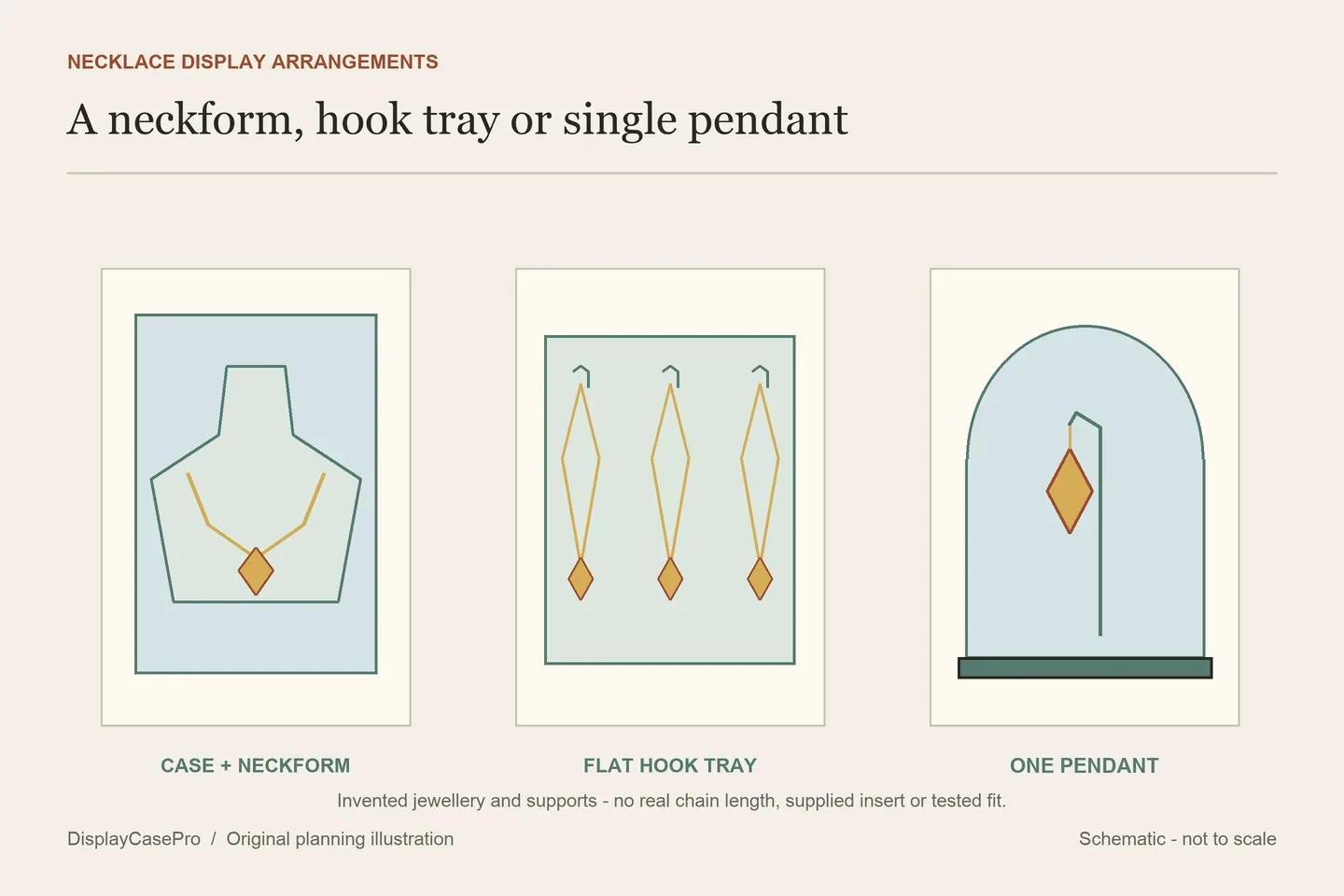
Choose a necklace display case around the arrangement inside it: a chain draped over a neckform, a necklace laid on a hooked tray, or one pendant suspended beneath a dome. The case, the support and the jewellery are separate parts. A product called a jewellery case does not automatically include a fitted necklace insert.
Measure the necklace in its intended position
Identify the chain, clasp, pendant and any attached parts that will remain together. Decide whether the complete necklace must be visible or whether the pendant is the main subject and the chain will be kept separately.
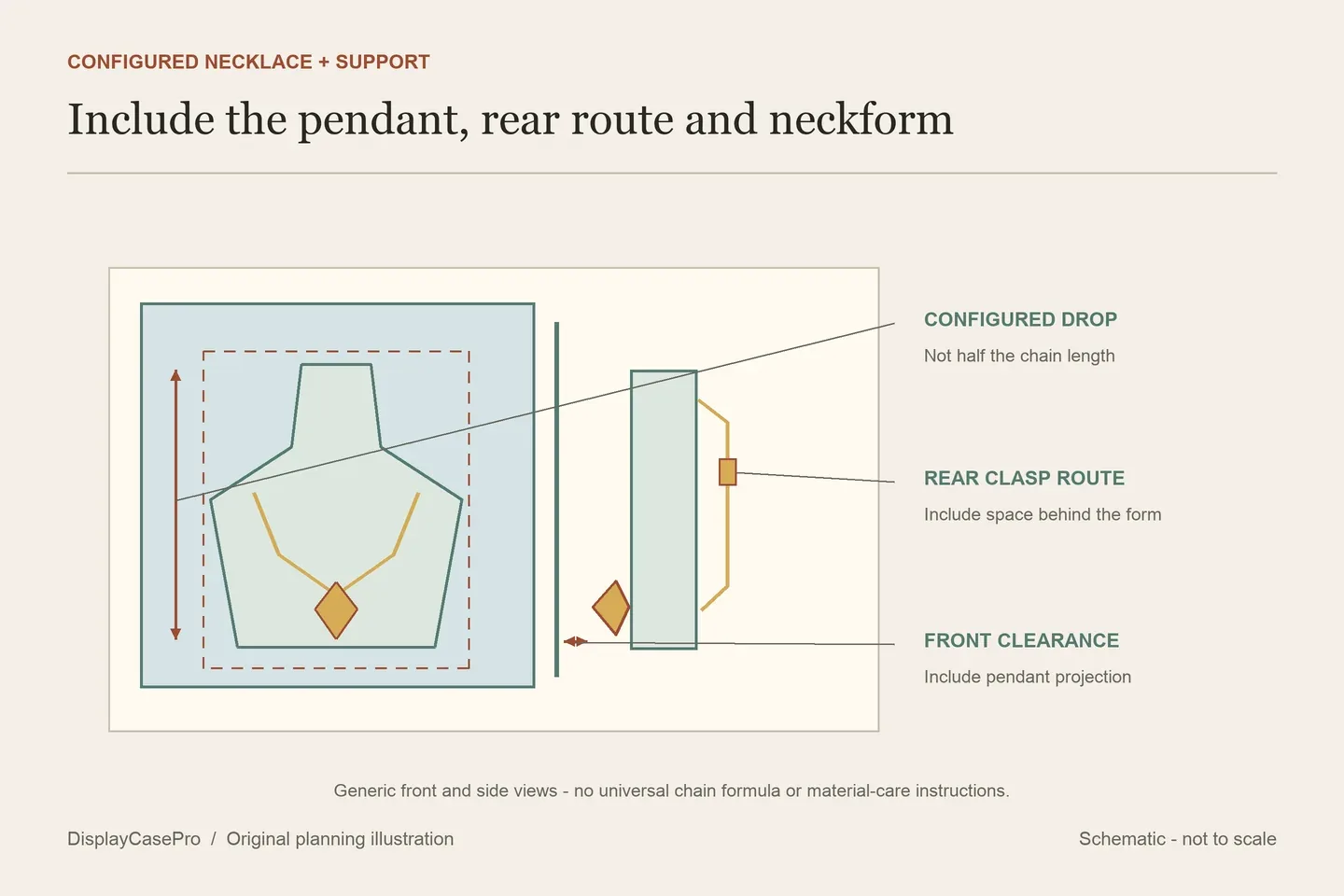
Place that arrangement on its intended support before recording the occupied height, width and projection. A neckform's shoulders and back can change where the clasp and chain sit. A flat tray creates a different route from a pendant hanging on a single hook.
Do not select the enclosure from chain length alone. The full length does not describe the drop on a particular neckform, the position of an extender or the projection of a deep pendant. Record the actual configured outline rather than applying a universal half-length formula.
Keep the rear route explicit. A chain or clasp behind a bust still occupies space and may need to be reached during removal. It should not become an unseen part pressed between the support and the case's back simply to make the front view fit.
Choose an enclosure and its intended support together
| Arrangement | What it presents | Space to confirm |
|---|---|---|
| Case around a neckform | A draped necklace and pendant in a front-facing view. | The full neckform footprint, configured drop, rear clasp and clear space above the support. |
| Flat case with a hook or insert tray | One or several chains laid out in assigned routes. | Exact tray fit, hook positions, pendant spacing and clearance to the closed cover. |
| Single-pendant dome | One pendant in a defined hanging position. | Hook-to-base and curved-roof space, plus the location of any retained chain. |
| Open stand or hook board | Accessible necklaces without an enclosing front. | Support suitability, neighbouring pieces and the route onto and off each position. |
A display category can contain all four. Michaels' display and packaging page includes open necklace supports, trays, cases and gift packaging, with both marketplace and direct retail items in the returned selection. A category label does not tell you what a particular enclosure includes.
Similarly, a jewellery case with compartments for rings or watches is not automatically a necklace system. Confirm the exact supplied insert or the option to buy the empty case, and choose the support before treating the remaining area as usable chain space.
Read the case size without inventing the interior
The following examples compare published descriptions. They are not hands-on fit tests or endorsements of security, preservation or material compatibility. Each missing dimension remains a question for the chosen product.
| Product | What is published | What to resolve |
|---|---|---|
| Ed's Box Acrylic Necklace Showcase, 1469 | 10 1/4 × 5 1/4 × 15 in H and a key lock. | The first two axes and inside/outside reference are not labelled. Confirm usable space, opening and whether the intended neckform is supplied. |
| Acme Acrylic Security Case, C1467 | W21 × D7 × H13 in, with a sliding back door and lock. | No clear internal dimensions are identified. Include the actual support and the approach behind the case for access. |
| JPI Glass-Top Wooden Case, GC4B | 8 1/4 × 7 1/4 × 1 3/4 in size; approximate compartment width 7 1/4 in. Latch and an option without insert. | One compartment width does not provide a complete clear cavity. The description names rings and bracelets; obtain the necklace insert configuration. |
| Memorials Walnut Small Standing Hook Case, PR-222088 | For one pendant, which is sold separately; approximate product size 3 in diameter × 4.5 in high. | Product height is not clear hook-to-base height or a full necklace's hanging drop. Confirm the intended pendant and chain arrangement. |
Keep similar-looking catalogue numbers separate. Ed's Box also lists different sliding-door cases among the related products on its 1469 page. Their measurements and opening descriptions should not be transferred to 1469 or assumed equivalent to Acme's C1467.
For the JPI case, an option without an insert is an order configuration, not a promise that any necklace tray fits. Its approximate single compartment width still leaves the other internal axis, usable height and closure clearance unanswered. A latch also should not be relabelled as a key lock.
A pendant dome serves a narrower task than a case around a full neckform. The Memorials category distinguishes a hook attached to the dome from one rising from its base, as well as open-hook displays. Establish which part moves during opening and where the pendant is supported; the cover's shape alone does not supply that procedure.
Check the tray's hook arrangement and the complete pendant
A tray can help separate chains when its layout suits the actual pieces. Ed's Box white 14-hook chain tray lists W10.87 × D15.62 × H1.87 in and a flap over the hook area for price tags. The header uses SKU F8-5, while the description uses F8-5-WH; confirm the exact white version when specifying it.
Those are tray dimensions, not a closing case's clear interior. Include the tray, configured chains and pendant projections when checking the assembled height. A 1.87 in tray height does not establish the free space over a pendant or clearance beneath a separate lid.
Fourteen hooks do not guarantee fourteen large pendants can sit without overlap. Map the full visible outlines and their retrieval routes. A broad pendant or an extender can change the neighbouring position even when the hooks themselves are evenly spaced.
Check where each clasp and remaining chain will rest. Follow the intended hook and tray instructions rather than tensioning a chain across an arbitrary gap. A flat insert's resting arrangement should not be turned upright unless its actual retention is specified for that use.
Check access to the clasp and the case opening
A rear-access retail case needs a usable approach behind it. Positioning its back against another object can defeat that access even when the closed case fits the furniture. A front opening or lift-off cover creates a different route, which should be checked for the selected enclosure.
For a neckform, confirm how the necklace leaves the support and where the clasp can be reached. For a tray, confirm whether the complete insert can be removed as directed or whether each piece is released in place. Have somewhere suitable to receive the jewellery and any lifted cover.
For a pendant-only display, record the associated chain's separate location. Keeping one small keepsake visible need not require crowding a whole necklace into the dome. Keep any identifying record with the correct piece without attaching a new adhesive label to the jewellery.
Choose finishes and contact materials with the actual jewellery maker's guidance where needed. “Velvet,” “leatherette” or a locked lid is not an anti-tarnish specification or a guarantee that every coating and gemstone suits the arrangement.
Use the blank necklace-display worksheet to keep the support, configured chain route, case and insert distinct. The collection measurement guide helps record the whole supported outline, and the usable-space guide explains why the exterior depth is not the room left in front of a mounted object.
Common questions
Does a jewellery case include a necklace insert?
Check the actual contents and variant. Some cases offer an empty configuration or inserts intended for rings and bracelets. The broad category name does not select the support.
Can chain length choose the height of a necklace case?
Record the necklace in its intended arrangement instead. A neckform, clasp, extender and projecting pendant change the occupied drop and depth.
Does a pendant dome hold the complete necklace?
Confirm that exact use. A product described for one pendant may not supply space or support for the whole chain; keep it separately with a linked location record when appropriate.
Comments
Share a display tip or ask a question.