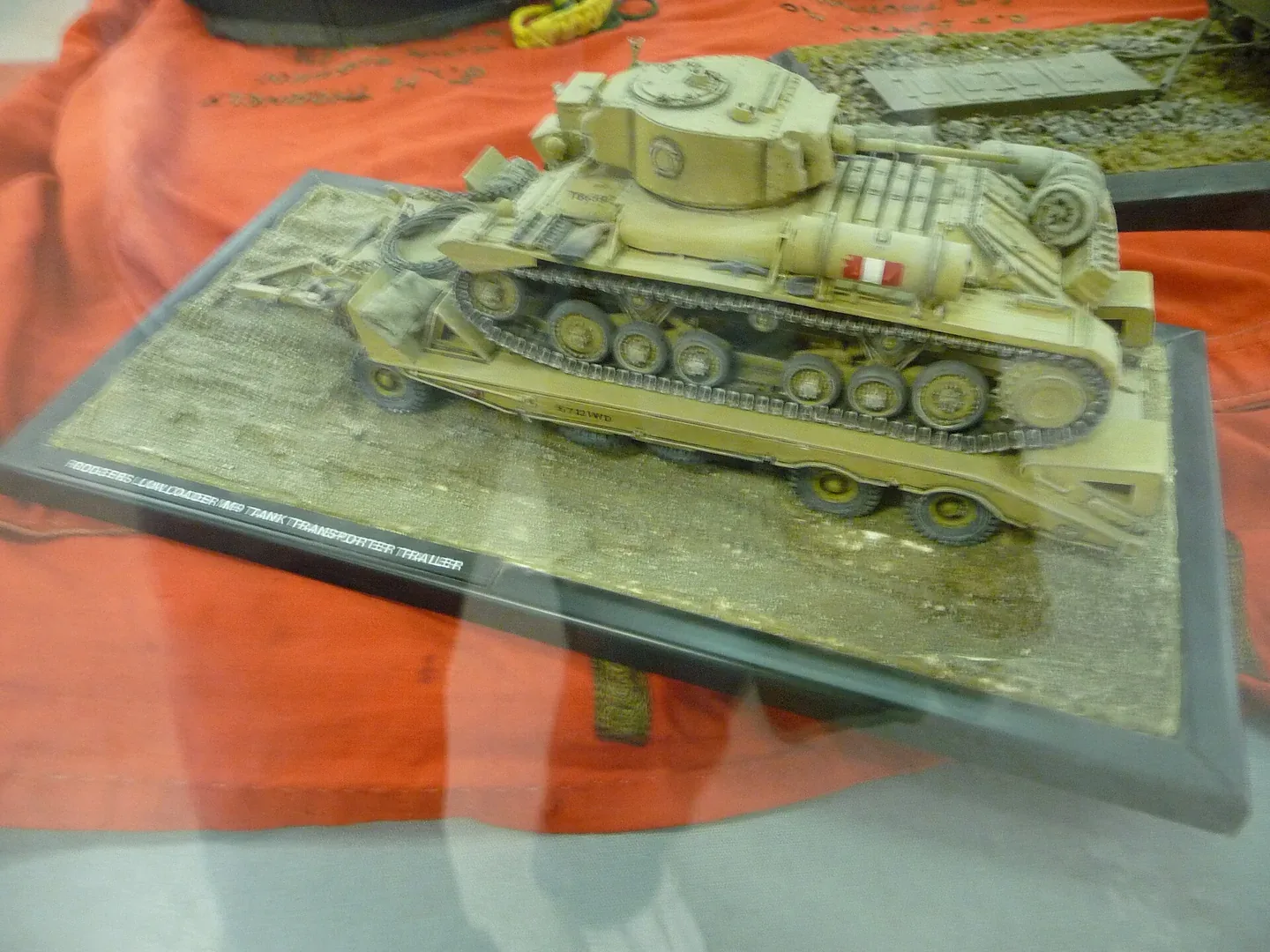
Choose a model tank display case around the complete static scene: turret direction, barrel elevation, antennae, stowage and the final base. A 1/35 label or hull length does not define that outline. Compare the finished scene with clearly labelled inside dimensions, then check the whole case and its opening at the intended location.
The hull is only one part of the display outline
Record the model maker, catalogue number and scale, followed by the state in which it will remain on display. Include the actual muzzle position, rear stowage, open hatches, machine gun, antennae and any accompanying figures. The longest or highest point may be a small fitting rather than the main vehicle body.
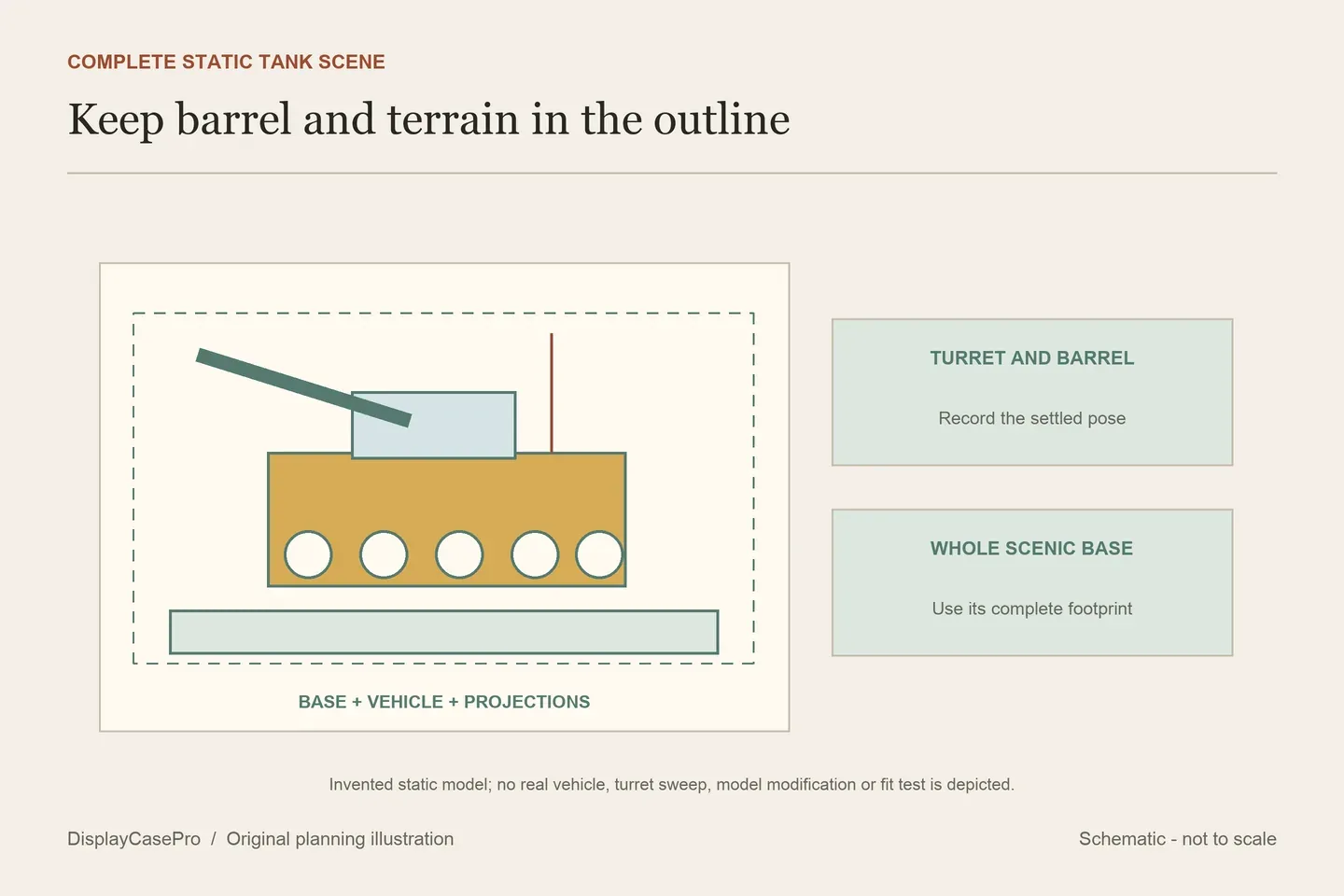
Choose a settled turret direction and barrel elevation before recording the outline. A barrel pointed diagonally can change both length and width; an elevated barrel can change height. Keep that actual configuration in a front, side and plan-view record instead of adding a universal allowance to the hull.
For a diorama, treat the finished scenic base as a separate complete object. Include terrain, walls, vegetation, figures, captions and any transporter or trailer in the scene. A cover that receives the tank alone may not accept the wider terrain or the highest part behind it.
A scenic base, a plinth and a case are separate components
| Display unit | Format to investigate | Record before ordering |
|---|---|---|
| One tank on its intended support | An individual cover and base. | Full vehicle projections, support, floor interface and cover opening. |
| Tank on a complete diorama | A cover around the finished scene. | Entire terrain footprint, highest detail and intended handling unit. |
| A row of separate vehicles | A cabinet with suitable bays or individual covers. | Each turret pose, label and retrieval route, rather than a nominal model count. |
| A scene on an elevated plinth | A specified plinth and separately confirmed enclosure. | The plinth's support conditions, top footprint and full case outside size. |
Hobbyist Haven's display category includes acrylic covers, scenic bases, stands and other supports. The word display does not make a wooden diorama base a surrounding enclosure. Check the actual supplied components before comparing packages.
shopPOPdisplays' model guide similarly spans individual boxes, cabinets, pedestals and risers. Its general assortment does not establish a tank-specific cavity or a rating for a particular heavy scene. Keep the whole finished display unit with the selected furniture's documented support requirements.
Keep inside dimensions, unlabelled sequences and scale apart
The following descriptions were read on 17 October 2026. Tamiya's page dates its product information to 1 October 2020 and says specifications may change; confirm the current item before ordering. No named tank or scenic base was physically fitted for this comparison.
| Product | Published size | Remaining question |
|---|---|---|
| Tamiya Display Case F, 73007 | Internal L350 × W158 × H131 mm; external L360 × W168 × H145 mm. | Compare the full static scene with the interior and confirm the base interface and cover operation. The maker's large 1/35 examples do not define every build. |
| IMEX IMX2511, black auto display case | The description gives 11¾ × 7¼ × 5¼ without units, axis labels or an inside/outside definition. | Obtain all missing labels and the clear receiving space. Do not silently treat the sequence as an interior measured in inches. |
| Hobbyist Haven Clear Acrylic Display Case | Many centimetre size options, including 30 × 15 × 15 cm; the returned text does not label axes or inside/outside. | Request a dimensioned drawing for the selected option, including the usable floor and the opening. Another size's photograph is not its specification. |
The Tamiya 350 mm inside length and 360 mm outside length refer to different boundaries. Keep the complete scenic base within the receiving plan, while using the outside dimensions for the shelf or plinth. Do not add terrain on top of an already planned vehicle arrangement without checking the finished height again.
IMEX's manufacturer page names IMX2511 as a 1/18 auto case. Hobbylinc's wider model-case category includes the same catalogue number under an auto/military description, alongside several other mixed-scale cases. These labels describe catalogue uses; neither resolves the missing units and cavity definition on the maker's current size line.
For Hobbyist Haven, retain the entire selected size sequence. A longer nominal option can still be lower or narrower than another option. Do not order by whichever number looks largest, and do not estimate the usable cavity by subtracting guessed acrylic thickness from an unlabelled dimension.
A settled pose and a moving turret need different space
This guide plans a static display state. If you later turn the turret or change the barrel elevation according to the model's instructions, recheck the complete outline before replacing the cover. The settled muzzle position and every position swept during rotation are different space questions.
Do not turn a turret merely to make a nearly suitable cover fit if the model's construction, attachments or instructions do not support that operation. Some completed displays fix their chosen composition; a photograph of another build does not establish how yours moves.
A nearby figure, hatch or antenna may remain clear of the barrel in one view and occupy its path in another. Include these details in the intended scene record. The case specification should follow the chosen display, rather than requiring fragile parts to be bent or removed without an appropriate model-specific plan.
Plan the track-side view and the route off the base
Choose the viewing direction that explains your build: track detail, weathering, turret markings or the relationship between vehicle and terrain. Keep a caption readable from that direction without placing it in front of the running gear. For several vehicles, compare complete plan-view outlines before deciding the row spacing.
A photograph can help discuss composition, but it cannot supply missing receiving dimensions. Better Display Cases' short tank-display post presents a customer's arrangement. Its reported fit belongs to that particular example; it does not prove your model, barrel state or base fits the same cover.
Ask how the selected surround opens and where it rests while the scene stays supported. A lift-off cover needs its intended route past the muzzle, antennae and highest terrain. A door or removable panel has a different approach. Obtain that routine for the exact case rather than transferring it from a similar product.
Establish which part is the intended handling unit. A decorative rim, barrel, aerial or scenery element is not automatically a handle. If the scene remains attached to a base, keep the maker's support and handling instructions with that record; an enclosure's empty dimensions do not establish loaded transport.
The tank scene and enclosure worksheet records turret direction, muzzle extent, terrain and unresolved size definitions. Use the general measuring guide for consistent units and the lighting guide for the final view through glazing.
Common questions
Does a 1/35 tank case fit every 1/35 model?
Scale does not specify the vehicle's physical size, turret pose or scenic base. Compare the actual complete scene with the selected case's usable space.
Should I measure the hull or the barrel?
Record the entire displayed outline, including the furthest muzzle and rear detail. Include the finished base and every projection above it.
Does the cover provide room to operate an RC tank?
The static display dimensions here do not establish an operating, charging or moving configuration. Resolve those tasks separately using the exact equipment's instructions.
Cover photograph: Model tank diorama by Simon Q, CC BY 2.0. Proportionally resized and converted to WebP. The tank, transporter and terrain illustrate a complete scene; reflective glazing does not identify or test a compared case.

Comments
Share a display tip or ask a question.