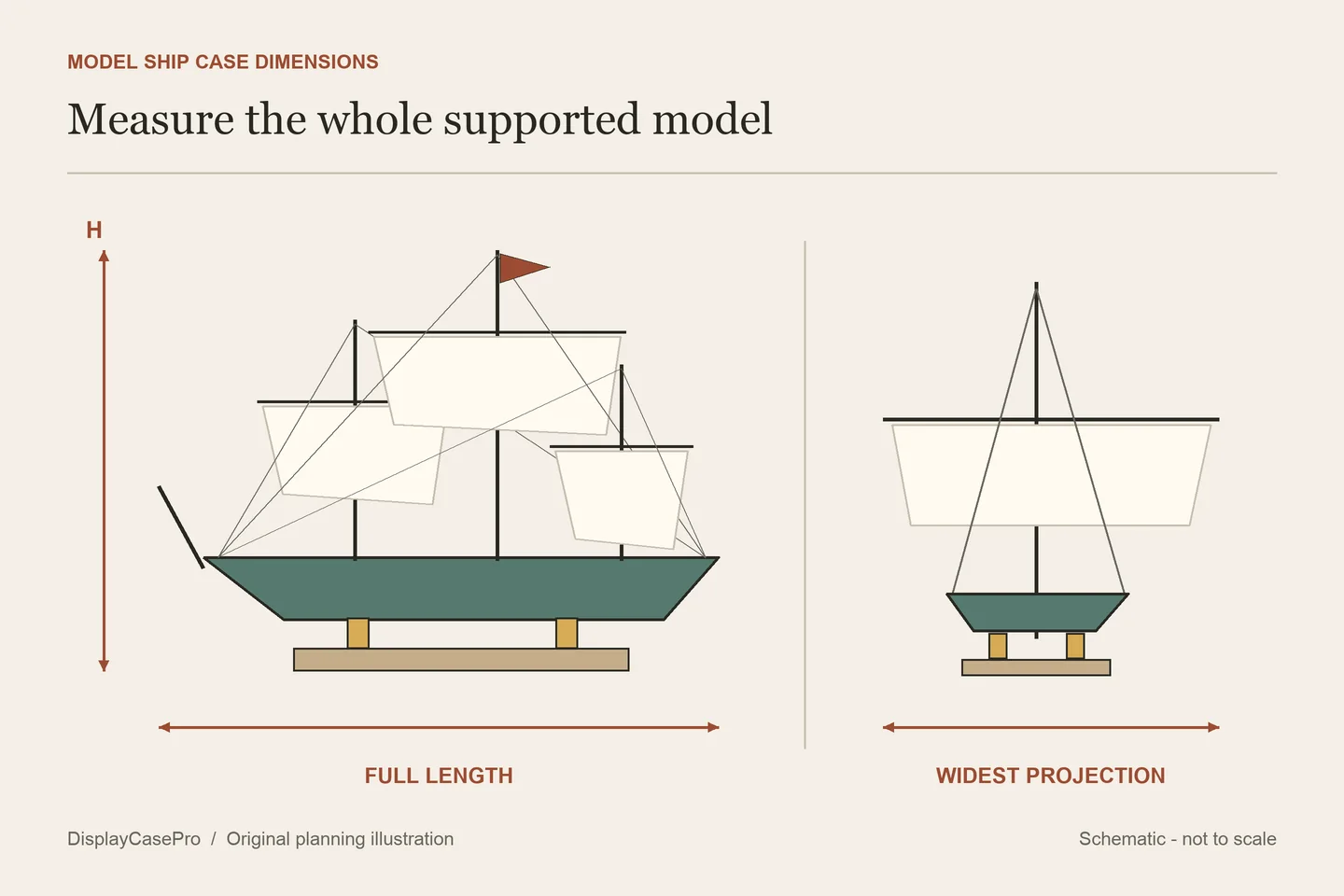
Specify a model ship display case from the complete supported model: the longest projection, widest yard or sail, and highest point above the final base. Compare that outline with the case’s usable inside dimensions. Keep the outside dimensions and opening space as separate checks for the room where it will stand.
Measure the completed ship on its final stand
A hull length is not the same as the model’s total display length. A scale and a ship name are not enough either: the particular model’s rigging, spars, base and display state determine its outline. Use the completed assembly, its maker’s dimensions or a suitable dimensioned record; do not reconstruct the answer from a product photograph.
| Measurement | Check the full outline | Record separately |
|---|---|---|
| Length | The most forward and rearward points in the intended display state, including a projecting bowsprit or stern detail. | Any base or label assembly extending beyond those points. |
| Width | The widest yard, sail, outrigger or other projection across the ship. | The complete stand’s footprint and the orientation within the case. |
| Height | The highest mast, flag or other detail above the bottom of the final supported assembly. | Cradle, pedestals, display base and any support added later. |
Keep the model in its intended display state. If a flag, sail or other detail has a choice of positions, record the chosen one using the model instructions. Do not bend a mast or tighten rigging to meet a case dimension. When direct measurement is unsuitable for a fragile model, resolve the outline with its maker or an appropriate model specialist.
The general collection measurement guide explains the complete-envelope approach. For a ship, add explicit fields for spars, rigging, stand and the intended viewing direction.
Read the dimension definition and axis order
Save each number with its label, axis order, units and exact model reference. Different sellers use W × H × D or L × D × H. “Common size” can mean something different from an overall footprint. The following examples reproduce the makers’ published definitions; they are not DisplayCasePro measurements.
A lift-off acrylic case: overall and inside differ
The observed default variant on the Displays2go case page, SKU AF29X11BKE, has a lift-off top and removable ring riser. Its specification panel uses W × H × D throughout:
| Listing label | Width | Height | Depth |
|---|---|---|---|
| Overall | 29.6 | 12.3 | 11.5 |
| Inside | 29.0 | 11.0 | 11.0 |
| Common Size | 29 | 11 | 11 |
For this SKU, common size matches the listed inside dimensions. That relationship is not a rule for other cases or variants. Match the supported ship to the usable inside space and confirm how the chosen riser or base arrangement affects it; use overall dimensions for the shelf or table footprint.
A legged case: maximum inside space is a different package
Everything Nautical’s extra-large ship case lists the following in L × D × H order:
| Listing label | Length | Depth | Height |
|---|---|---|---|
| Outside | 65 | 23 | 75 |
| Maximum inside | 61.25 | 18.25 | 55.75 |
The page explicitly says glass panels are not included. This is a legged case frame with a specified maximum interior, not 75 inches of clear model height or a completed glazed enclosure. Confirm the finished glazing, opening and usable arrangement before judging a particular ship’s fit.
A maker may quote interior dimensions throughout
BlueJacket’s case guide says its case dimensions are interior even where that word is not repeated. Its completed cases and kits also differ in contents: kits exclude glass. Keep these definitions with the quotation, and obtain the outside footprint if location space is constrained.
A blank “inside” field in another listing should remain a question. Do not estimate clear height by subtracting a guessed frame thickness, and do not use the dimensions from a similar-looking case as a substitute.
Choose allowance around the actual opening method
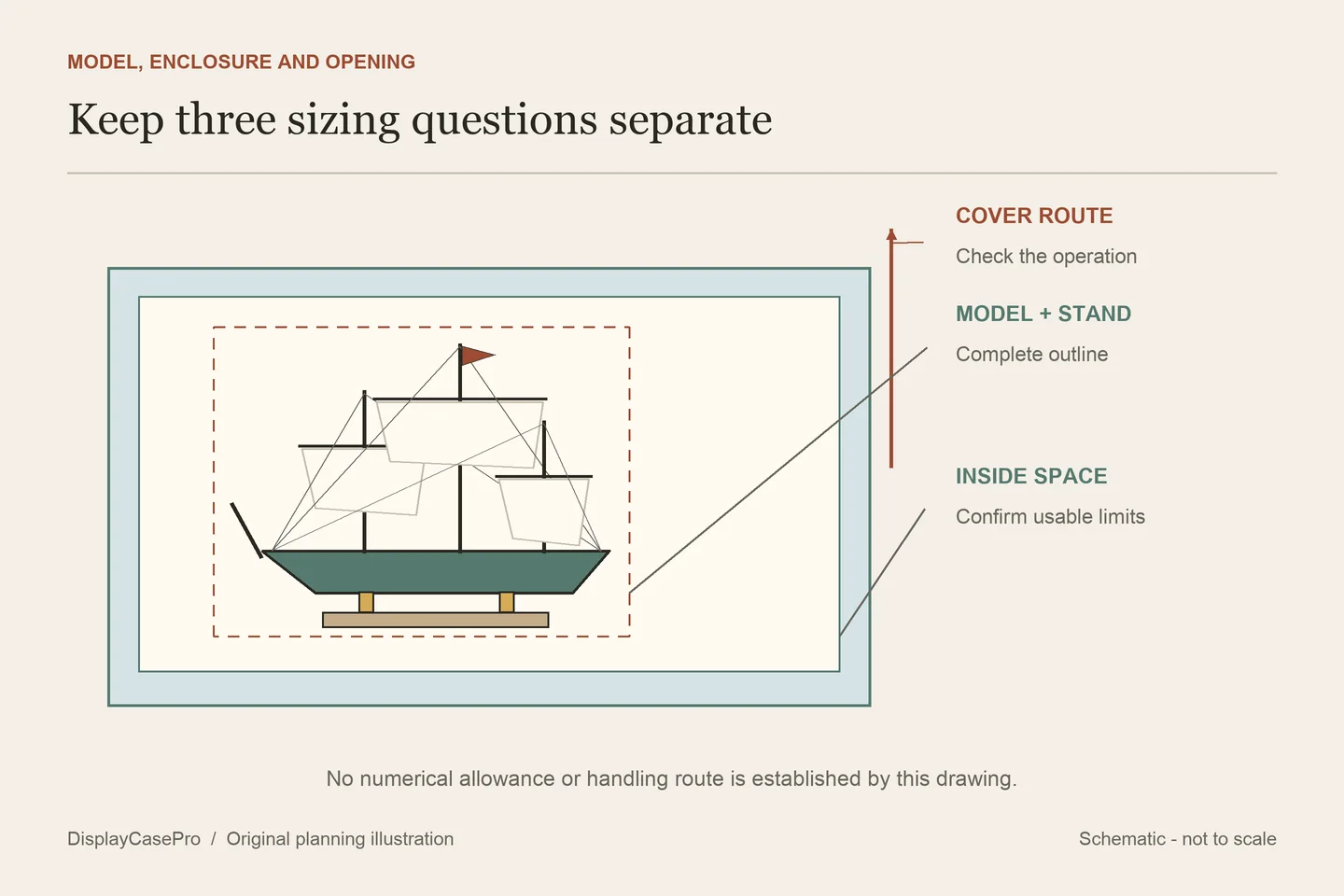
The complete supported outline is the minimum information for a case specification; it is not a finished case design. The maker must also account for the proposed mounting, opening and access arrangement. Ask which internal obstructions or frame members reduce the available path.
BlueJacket suggests adding 4 inches to length, 3 to width and 2 to height, including the pedestal or cradle, and explicitly describes that guidance as aesthetic and subjective. Treat it as that maker’s presentation starting point, not a universal clearance rule or permission to lift a cover past delicate rigging.
Describe the opening task as well as the dimensions. Does a complete top lift off? Does a door swing? Must framed panels be assembled or removed in a particular order? Where will the cover go while the model remains in place? Ask the case maker to confirm the intended operation for the selected design.
At the proposed location, check the empty cover’s movement and resting place using the maker’s instructions. For a tall case, include the space above and beside it. A case that fits under a shelf may still lack its intended opening space.
Check what the case order actually includes
A product called a ship display case might be a finished enclosure, a framed kit, a baseboard or a package requiring separately sourced glazing. Put the included components beside the dimensions before comparing quotations.
- Base and model support: identify the display base, cradle or pedestals retained from the model and any separate case base.
- Glazing: confirm whether panels are included, their specified material and who supplies the finished panels if excluded.
- Assembly state: distinguish a completed cover from loose components or a framed panel assembly.
- Usable opening: obtain the dimensions and intended access sequence for the finished configuration.
- Placement: record outside size, installation requirements and the route into the room.
Ask about the exact finished configuration. An enclosure’s empty weight is not a loaded-support rating, and a baseboard’s size does not establish the clear opening above it. Material or UV marketing also does not replace the dimensional checks.
Prepare a concise case order brief
Give the maker a labeled outline or dimensions for the supported ship, the units used, a description of the viewing orientation and the proposed location. Include the projecting details and final base. Ask the maker to return confirmed usable internal dimensions, overall dimensions, contents and opening method in the same written brief.
The blank model ship case worksheet keeps these fields separate. Preserve the seller’s original axis order, then map it explicitly to your intended orientation. If a needed dimension is absent, mark it for confirmation before choosing the case.
Once the size and access are resolved, plan the view and reflections with the display cabinet lighting guide. Keep lighting fittings and their space requirements in the final arrangement rather than adding them after the case is filled.
Common sizing questions
Can I order from the model’s scale?
Use the actual completed model and its final support. A scale does not specify this build’s sails, rigging, projecting details or stand.
Is maximum inside size the usable opening?
It describes the stated interior limit. Frame members, doors or the prescribed assembly route may define a different admission path. Ask for both where relevant.
Should I choose the closest listed size?
Choose only after the supported outline, clearances, contents and access method are resolved. A nominal size that nearly matches the hull is insufficient evidence of fit.
About this guide: Named product figures are attributed examples from the pages read. No particular model ship has been fitted, handled or tested in those cases for this article.
Comments
Share a display tip or ask a question.