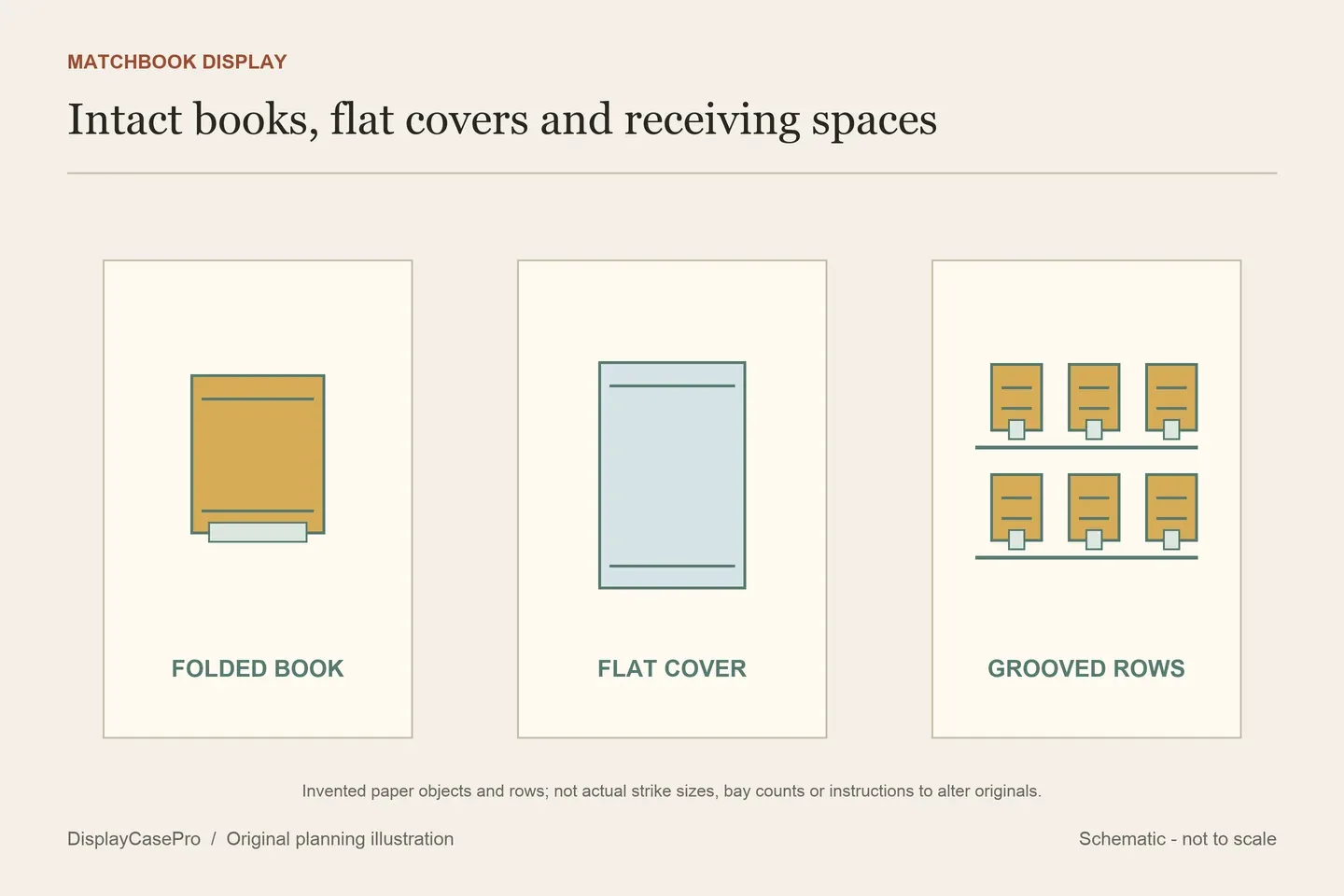
Choose a matchbook display case around what you are keeping intact: a complete folded matchbook, a separately collected flat matchcover or a matchbox. Compartment classes, grooved cabinet rows and album pockets serve different objects. A large nominal count does not resolve the thickness, visible face or receiving space of your collection.
A complete matchbook is different from its cover
Record each item in its present state. A folded book has a cover, fold, staple and potentially contents that affect its profile. A flat cover already collected separately presents another outline. A sliding matchbox is another construction again. Keep those descriptions with the item's documented identity rather than treating everything as a small paper rectangle.
Choose the view you want: the front advertisement, reverse information or an interior design already visible in its existing state. Give each piece an ID and keep a reference image where useful. A repeated cabinet pattern can hide a lower caption or part of a curved cover even when the item fits within the nominal row.
Do not remove matches, flatten a fold, detach a staple or cut a collected original solely to make a display product fit. This guide selects display formats; it does not prescribe preparation, treatment or storage of live or deteriorated matches. Resolve the actual object's condition and intended housing with an appropriate specialist before committing to contact materials or an enclosure.
Choose individually visible pieces or an accessible study collection
The Hobbymaster category includes matchcover pages and albums alongside compartmented matchbook cases. SAFE's category likewise mixes pages, album packages and displays. A page designed for a flat cover should not be assumed to accept the thickness of every intact book or box.
| Object and goal | Possible format | Confirm before choosing |
|---|---|---|
| Several intact books, fronts visible | Individual compartments. | Each bay's clear width, height and depth, plus support and viewing orientation. |
| A larger front-facing sequence | A grooved-shelf cabinet. | Actual book widths, shelf openings, groove/contact arrangement and door clearance. |
| Separately collected flat covers, both sides studied | Appropriate pockets or album pages. | Intact cover outline, pocket dimensions, materials and access without forced folding. |
| A wall composition with captions | An individually specified shadow box. | Support, lining, glazing separation and depth for the actual pieces. |
A House Digest ideas article carried by Yahoo ranges from bowls and clear boxes to framed layouts and permanent resin or glue projects. Those are different goals. A mixed pile gives glimpses of designs; it does not provide the individually readable sequence of a compartmented case. Permanent alteration is also a separate decision, not an automatic step for collected originals.
Strike classes and outside sizes do not give the bay dimensions
Hobbymaster labels one case 24-space 20-strike and another 18-space 30-strike. These are product-specific classes and position counts. Neither supplies a measurement of your particular folded book.
| Product | Published detail | Unresolved space |
|---|---|---|
| Hobbymaster 24-space 20-strike | Overall 14¾ × 8½ × 1¾ in. Individual velveteen compartments, plastic front and magnetic closure. | Axes are unlabelled in this size sequence; individual compartment cavities are not given. |
| Hobbymaster 18-space 30-strike | Approx. overall 14½ × 8 × 1 in. Description says 30-strike and smaller books and most matchboxes. | Actual bay and supported-item thickness; do not copy the other case's dimensions. |
| sfDisplay 117-matchbook cabinet | 13 rows of nine standard-sized books; outside H28 × W16 × D1.75 in; inside depth 1 in and shelf spacing 1.75 in. | Clear row width, groove dimensions, height definition and closed-door clearance for your pieces. |
| Custom Displays 6 × 9 × 2-inch example | Approx. inside face 4 × 7 in; its 2-inch range recommends items under ¾ in thick. | Usable depth above the selected lining and the actual support/contact arrangement. |
The Custom Displays range illustrates why a “2-inch” case name is not permission for a two-inch-thick object. Its approximate inside face and item-thickness recommendation describe different boundaries. Ask for the finished receiving space over the intended lining rather than treating the exterior thickness as a cavity.
Use an actual position map for a high-count cabinet
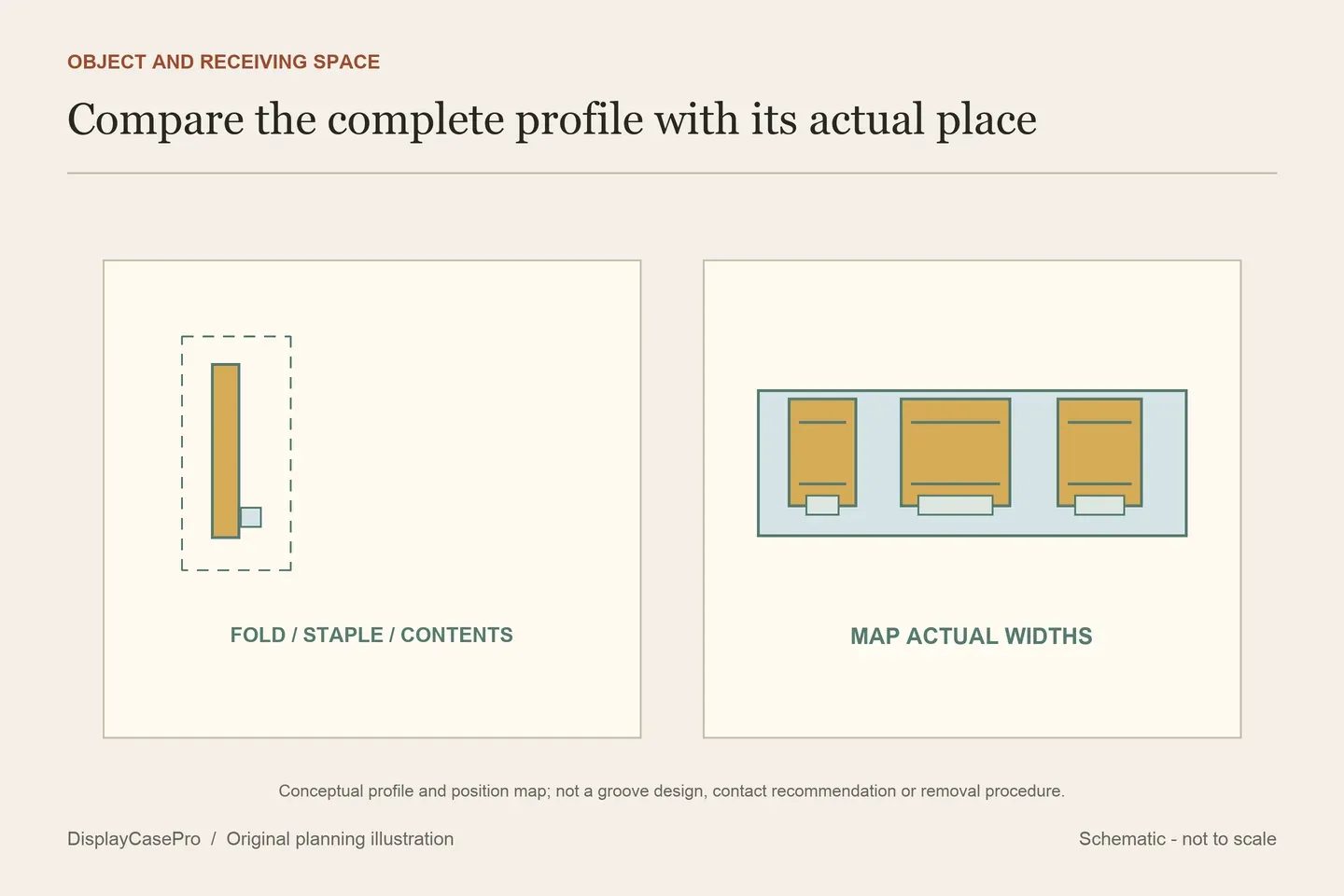
The sfDisplay cabinet states thirteen rows of nine standard-sized matchbooks. Treat 117 as that arrangement's nominal count. A wider book, unusual box or separately housed piece can require a different row allocation. The count does not establish one universal “standard” book profile.
Make labelled paper outlines from your documented sizes while the actual pieces remain appropriately housed. Mark the important front text and any supported projection. Arrange the outlines within confirmed row space, leaving the groove and door questions visible in the plan. Do not divide the cabinet's outside width by nine to invent a receiving width.
Check how a piece enters and leaves its position. Shelf spacing alone does not identify a groove's opening, the lift needed for release or the depth left behind the closed front. A row that looks full in a catalogue photograph may use different books from yours.
Keep the chosen view and opening routine together
A front-opening lid, a wall-hung case and a flat tabletop presentation need their own intended retention arrangement. A magnetic closure holds a lid closed; it does not by itself explain how each book stays in its compartment. Confirm the actual case instructions before changing its orientation.
Keep an accurate separate caption for a place, business or documented trip, and leave uncertain dates uncertain. If a reference copy serves the display better, identify it as a copy and keep its relationship to the original clear. General archival or UV language does not establish the suitability of every lining, pocket or exposure period.
Use the matchbook and matchcover worksheet to retain the intact state, strike class as documented, actual profile, visible text, receiving space and access question. The usable-depth guide explains the general difference between outside depth and space above a finished backing.
Common questions
Does a 30-strike label give the compartment width?
No clear cavity width is supplied by that label in the example above. Obtain the actual compartment dimensions and compare your complete item.
Should I flatten a book for a matchcover page?
Choose housing for the object's existing intact state. A page for separately collected flat covers is not an instruction to alter a complete matchbook.
Comments
Share a display tip or ask a question.