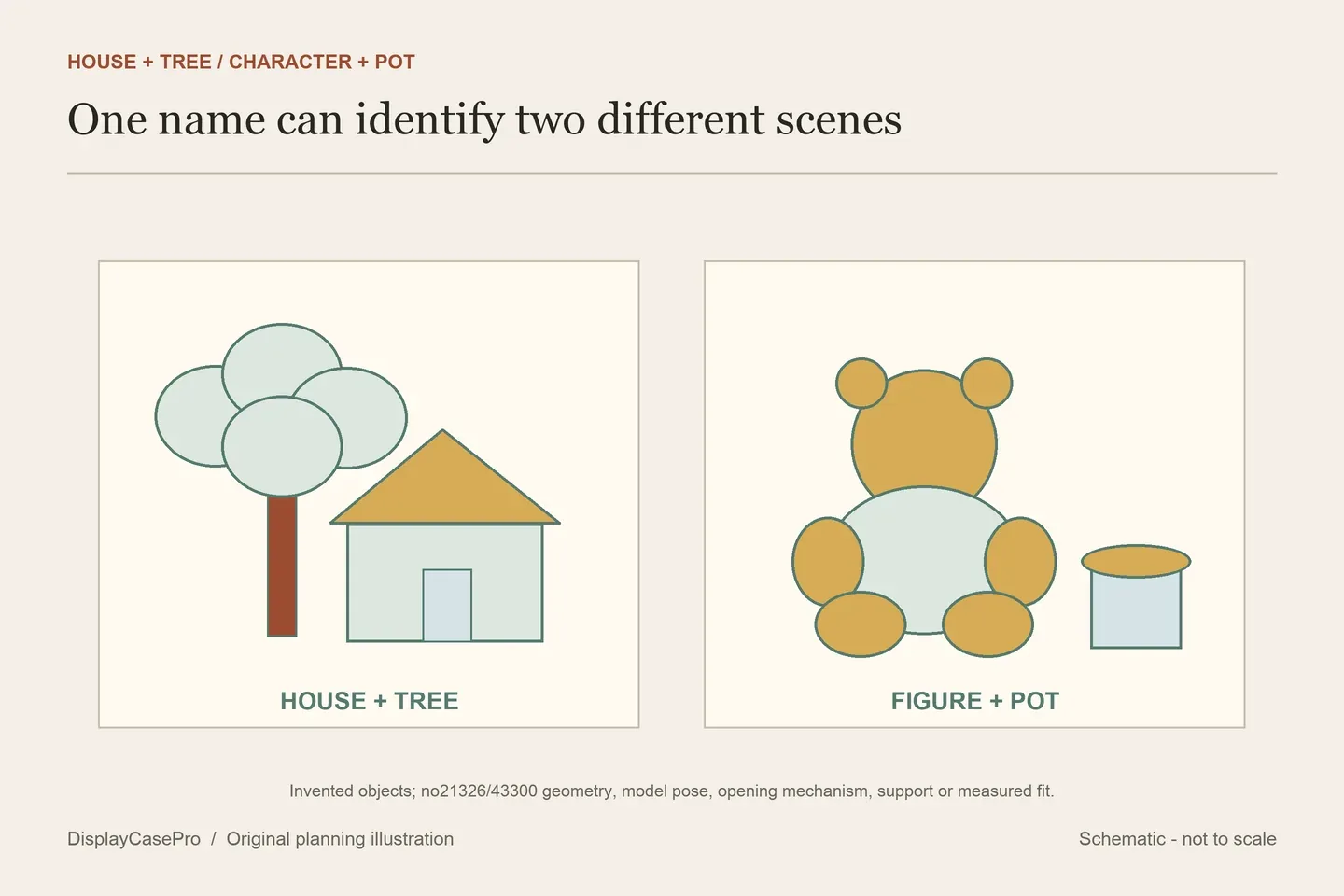
Choose a LEGO Winnie the Pooh display case by identifying the set first. Set 21326 is the house beneath a tree; 43300 is the large brick-built character with a honey pot. Their scenes, moving features and case specifications are different, even when a search result uses the same Winnie the Pooh name.
The house and the large character need different receiving plans
LEGO’s 21326 description identifies Pooh’s house beneath an oak tree, an opening back, five characters and accessories including a red balloon. Its prose size reference is over H24 × W18 × D22 cm. That is a model reference, not a measurement of every open-room and character arrangement.
The official 43300 description identifies a large Pooh with movable head, ears, arms and hands, plus a buildable honey pot. The pot opens to reveal two rooms and holds a Pooh minifigure and Eeyore character. LEGO gives the seated character’s height as over 23 cm; it does not provide the complete case envelope for every pose and pot position.
Keep those identities on the order, reference photograph and measurement record. A case expressly named for one should not be selected for the other simply because its headline contains the same character name.
Decide what remains visible before choosing a scenic rear
| Set and state | Keep in the outline | View or access to resolve |
|---|---|---|
| 21326 exterior scene | House, tree, bees, chosen character positions and balloon. | Front and side views, including the complete canopy. |
| 21326 rear already open | Actual opened house and any separately presented pieces. | Room visibility behind the selected rear treatment. |
| 43300 settled pose | Complete character pose, pot and retained small figures. | Head, ear and arm projections in that exact pose. |
| 43300 pot rooms presented | The actual pot opening and selected character arrangement. | Whether the finished view fits, and where handling takes place. |
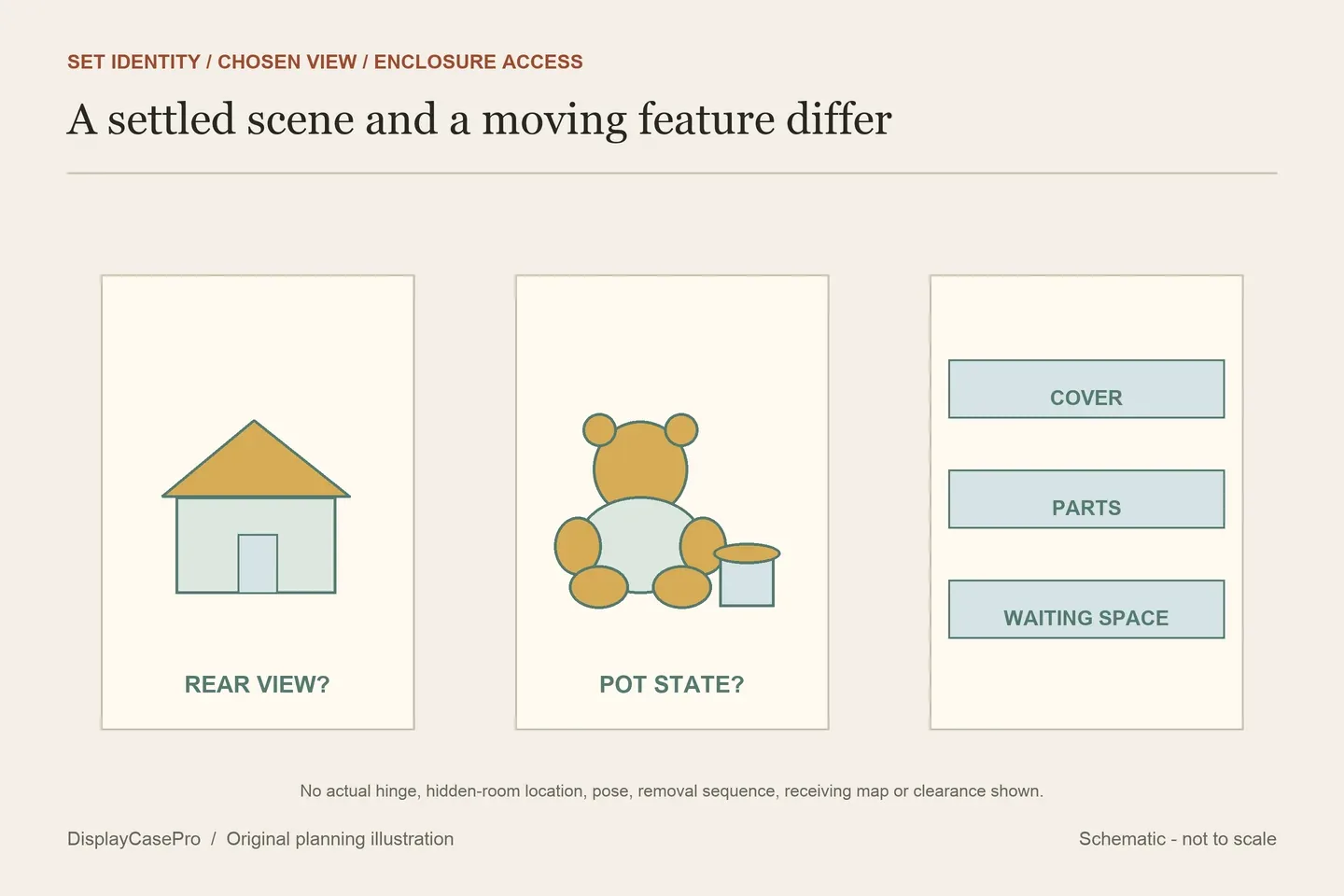
A backdrop can create a pleasing front-facing scene while blocking the view from behind. For 21326, choose whether the rooms or the exterior are your priority. For 43300, a character pose and an opened-pot view create another outline from a compact seated portrait.
Use the actual built arrangement rather than borrowing an open state from a different cottage set. Record the front, side and any important rear view without repeatedly moving small figures merely to fill an apparently empty floor.
Keep external, assembled and internal sizes separate
These five supplier descriptions were read on 18 October 2026. DisplayCasePro has not fitted either model or tested the cases’ dust, UV or long-term protection claims.
| Exact product | Published size | Boundary still to respect |
|---|---|---|
| Wicked Brick 21326 | External W29 × D29 × H30.3 cm. | Exterior; request the usable cavity and intended scene. |
| Brickcessories 21326 | Assembled 290 × 260 × 280 mm. | Axes and inside/outside unlabelled. |
| Flying Box 43300 | Case L8.75 × W8.75 × H10 in; base 9.25 × 9.25 in. | Case boundary unlabelled; larger base is separate. |
| iDisplayit 43300 | Inside L26 × W26 × H30 cm; outside L28 × W28 × H31 cm. | Labelled cavity, still requiring the intended pose and pot layout. |
| Brick In It 43300 | W28 × D28 × H26 cm. | Axes named; inside/outside unlabelled. |
For Brickcessories’ assembled tuple, obtain a labelled receiving drawing. The acrylic thicknesses and corner brackets do not provide enough information to calculate a clear cavity or decide the routine opening method.
For Brick In It’s 43300 case, do not subtract the character’s “over 23 cm” reference from the listed 26 cm height to claim three centimetres of working space. The case boundary, actual pose and opening task remain separate.
Likewise, a closed arrangement that fits a stated interior does not prove that arms or the pot can be moved through their whole intended action under the cover. Choose a settled presentation or an occasional access routine explicitly.
The larger base, print and locating features belong in the order
Flying Box’s 43300 description expressly uses a stud-free base and lists a separate 9.25-inch-square footprint. Keep that larger base in the furniture plan. “Tool-free assembly” does not, by itself, describe an access door or establish how the model is supported.
Wicked Brick’s 21326 product instead describes embedded set studs, a case plaque and magnetically joined base layers. Those magnets concern base construction, not a magnetic connection to the house. Ask for the intended positions when you want the back already open.
iDisplayit’s 43300 product names a 32 × 32-stud floor area and an optional printed background-and-floor scene. The area is not a complete placement map. Keep the chosen base and print variant with the actual character, pot and small-figure positions.
Reach the model after following the enclosure’s own routine
Wicked Brick describes lifting its 21326 surround off the base and returning it to grooves. Allow for the whole cover to pass the tree and retained balloon. Keep somewhere suitable for that cover before approaching the house’s back.
For 43300, iDisplayit describes a lid panel slotting on top and the clear case resting on its base. Use that product’s instructions; a flat-packed construction does not imply a hinged front. It also says the case is not designed for relocation with LEGO inside.
Keep the honey-pot opening identified by LEGO separate from promotional wording about hidden surprises. This guide supplies no instruction to open the character’s body or improvise another mechanism. Use the model’s own instructions for the feature you want to show.
Use the Pooh set, scene and access worksheet with the LEGO shelf case guide. Include removed pieces and the normal resting positions of both the cover and model components.
Common questions
Will a 21326 case receive 43300?
The sampled products identify different models. Confirm the exact set and complete intended scene instead of transferring compatibility from the shared name.
Does a 30 cm interior guarantee room to open the pot?
It describes a static receiving boundary. Confirm the actual opened arrangement and where the feature will be reached after opening the enclosure.
Comments
Share a display tip or ask a question.